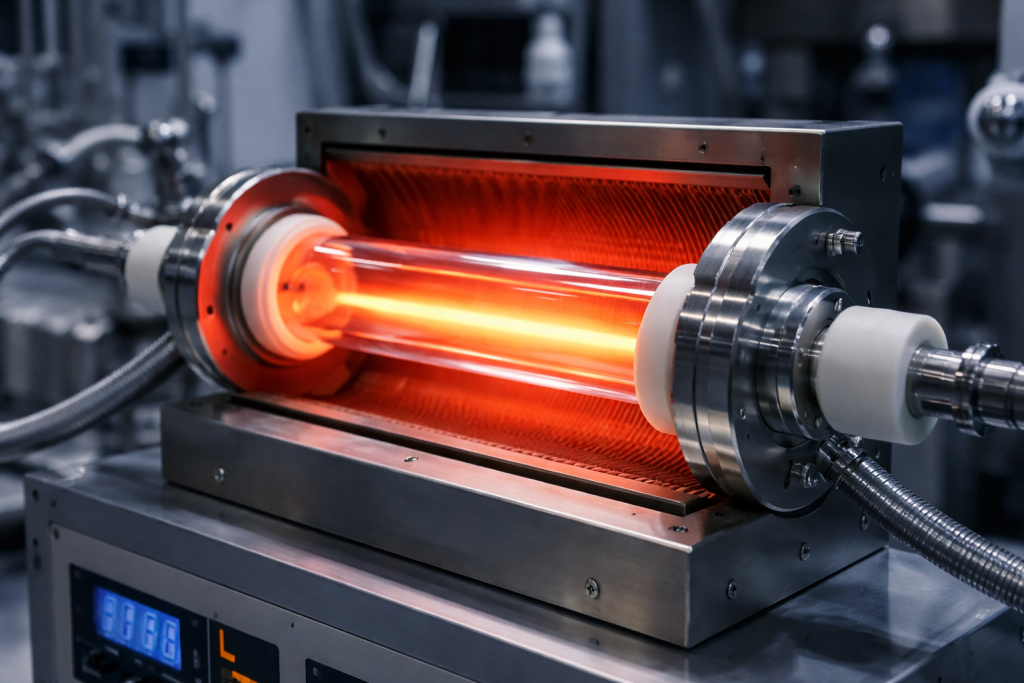
Many semiconductor quartz components are considerably more complex than simple tubes or plates.
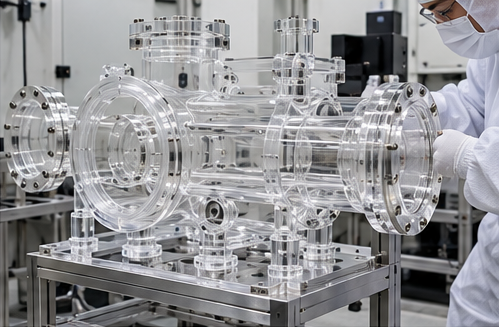
Process chambers, gas manifolds, bell jars and vacuum assemblies may contain multiple quartz sections joined by flame welding.
For these components, dimensional accuracy is important, but vacuum integrity can be even more critical.
A welded quartz component can look visually perfect while containing a microscopic leak or a high-stress region that fails only after repeated thermal cycles.
Why Complex Quartz Assemblies Are Welded
Large quartz systems often require side ports, gas inlets, flanges, viewing windows, branch tubes and pumping connections.
Manufacturing the entire geometry from a single quartz blank is often impractical.
Flame welding allows individual quartz sections to be fused together while maintaining a predominantly SiO₂ process environment.
A Clear Weld Is Not Automatically a Good Weld
Potential welding defects include trapped bubbles, incomplete fusion, local thinning, local thickening, distortion, inclusions and residual stress.
Some problems may remain invisible during normal room-temperature inspection.
Residual Stress Is a Hidden Reliability Risk
Quartz has a very low thermal-expansion coefficient.
However, welding creates strong local temperature gradients.
One area may approach the quartz softening range while nearby material remains significantly cooler.
If cooling is not controlled, residual stress can remain in the assembly.
Controlled annealing is therefore important for many heavily worked quartz components.
Stress Inspection
Polarized-light inspection can help reveal residual-stress patterns in transparent quartz.
It can be especially useful around:
- large side ports;
- thick-to-thin transitions;
- flange joints;
- multiple branch connections.
Why Vacuum Leak Testing Is Different
A vacuum system can be affected by very small leaks.
A weld may appear continuous under ordinary inspection while still allowing gas into the chamber.
Helium leak testing is commonly used because helium atoms are small and mass-spectrometer leak detectors can provide high sensitivity.
The required leak rate should be defined by the equipment specification.
Sealing Surfaces Need Dimensional Control
Quartz chambers may connect to metal equipment using O-rings, gaskets or custom clamps.
The sealing surface therefore requires appropriate flatness, finish and perpendicularity.
Excessive warpage can produce uneven gasket compression.
Thermal Cycling Can Reveal Weak Joints
Semiconductor equipment rarely remains at one temperature.
A quartz assembly may experience hundreds of heating and cooling cycles.
Residual stress, contamination or geometric stress concentration can gradually produce microcracks.
Qualification should therefore consider actual operating conditions rather than only room-temperature inspection.
Cleanliness Is Part of Vacuum Performance
Particles and residues inside a quartz vacuum assembly may affect pump-down, process contamination and wafer yield.
After final welding and machining, the component should undergo appropriate semiconductor-grade cleaning and packaging.
What Should Buyers Specify?
A custom welded quartz assembly RFQ should include:
- material grade;
- overall dimensions;
- wall thickness;
- weld locations;
- flange geometry;
- operating pressure;
- operating temperature;
- leak-rate requirement;
- cleaning requirement;
- packaging requirement.
Conclusion
A semiconductor welded quartz assembly should not be accepted simply because:
“The dimensions are correct and the weld looks clear.”
Reliable performance requires:
weld integrity + stress reduction + dimensional accuracy + leak testing + cleanliness.