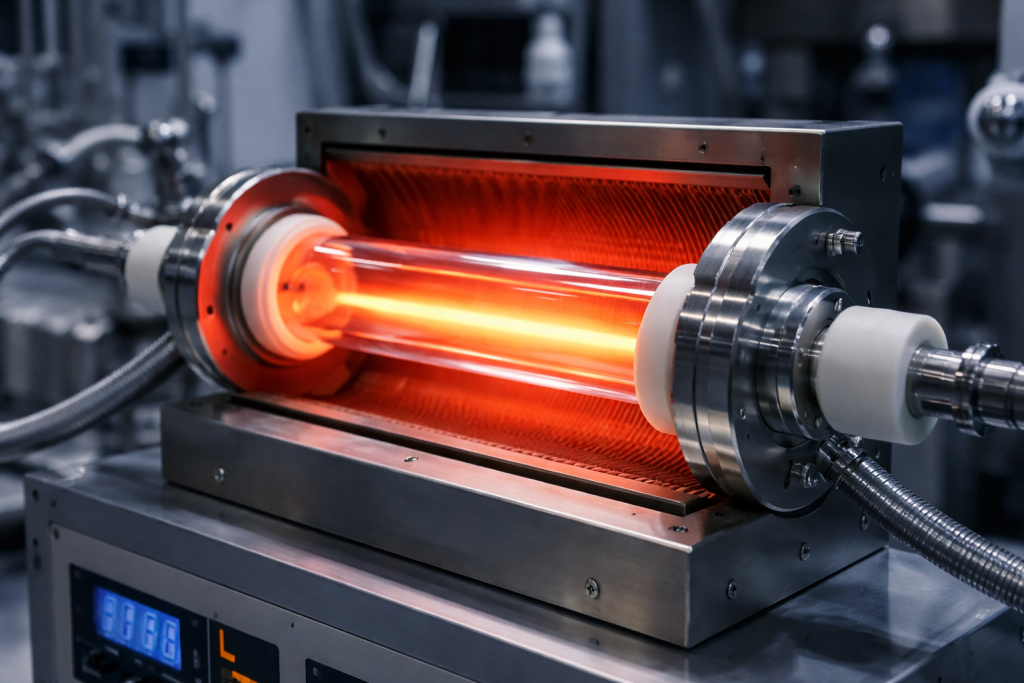
Quartz gas injectors are widely used inside semiconductor thermal and deposition equipment to introduce process gases into reaction chambers.
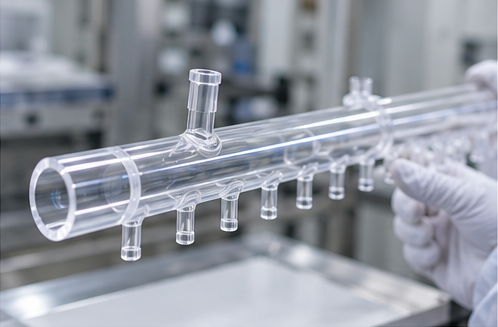
Compared with a simple quartz tube, an injector may contain multiple outlet holes, longitudinal slots, side branches, welded nozzles, closed ends and gas-distribution sections.
These features affect how gases enter the process region.
For LPCVD, oxidation, diffusion and related thermal processes, injector design can therefore contribute directly to process repeatability.
Why Quartz Is Suitable for Gas Delivery
High-purity quartz provides high-temperature capability, low thermal expansion, good thermal-shock resistance, electrical insulation and low contamination.
Quartz tubing can also be flame welded into relatively complex structures without introducing conventional metallic filler materials.
Hole Diameter Must Be Consistent
In a multi-hole injector, gas exits through a series of small openings.
If one hole is significantly larger than another, gas distribution may change.
Therefore, manufacturing inspection may need to control:
- hole diameter;
- hole spacing;
- angular position;
- hole orientation;
- distance from the tube end.
For injectors with many holes, accumulated dimensional variation can become important.
Hole Edge Condition Also Matters
A drilled quartz hole should not contain severe chipping.
Damaged edges can become particle sources and can also change local flow behavior.
For semiconductor injectors, hole quality should therefore be inspected visually in addition to nominal diameter measurement.
Injector Length and Straightness
Long injectors may extend deep into a furnace.
Overall straightness is therefore important.
If the injector bends, gas outlets may no longer point toward their intended locations.
Installation can also become more difficult.
Welded Branches Are Critical Areas
Complex injectors frequently contain welded side tubes, inlets or flanges.
Poor welding control can create bubbles, local thinning, distortion, inclusions or residual stress.
A weld that looks clear is not automatically mechanically ideal.
Why Annealing Matters
Localized flame processing produces strong temperature gradients.
Residual stress may remain after welding.
A component may pass room-temperature inspection but crack during later furnace cycling.
Controlled annealing can reduce residual stress after significant welding or forming operations.
Internal Surface Cleanliness
Gas flowing through the injector eventually reaches the wafer process environment.
Internal cleanliness is therefore critical.
Potential contamination sources include machining debris, dust, fingerprints, polishing residues and metal fixtures.
High-purity raw quartz cannot compensate for a contaminated finished injector.
ALD Makes Distribution Control More Important
Atomic layer deposition relies on repeated precursor and purge cycles.
Although the surface reaction is self-limiting, reactor performance still depends on effective precursor delivery.
Poor gas distribution may contribute to longer saturation time, precursor waste and local deposition variation.
Replacement Injectors Should Not Be Redesigned Casually
Some OEM injectors use unusual hole spacing or different hole diameters along their length.
This can be intentional.
The geometry may compensate for pressure loss along the tube.
Therefore, simplifying the hole pattern without process validation may change gas distribution.
What Information Should Be Included in the Drawing?
A good injector RFQ should include:
- overall length;
- tube OD and ID;
- material grade;
- inlet geometry;
- hole diameter;
- hole count;
- hole spacing;
- angular position;
- weld locations;
- flange dimensions;
- straightness;
- cleaning requirements.
Conclusion
A stable semiconductor quartz injector requires:
accurate hole geometry + controlled welding + low residual stress + internal cleanliness + dimensional consistency.
As deposition processes become more demanding, these fabrication details become increasingly important.