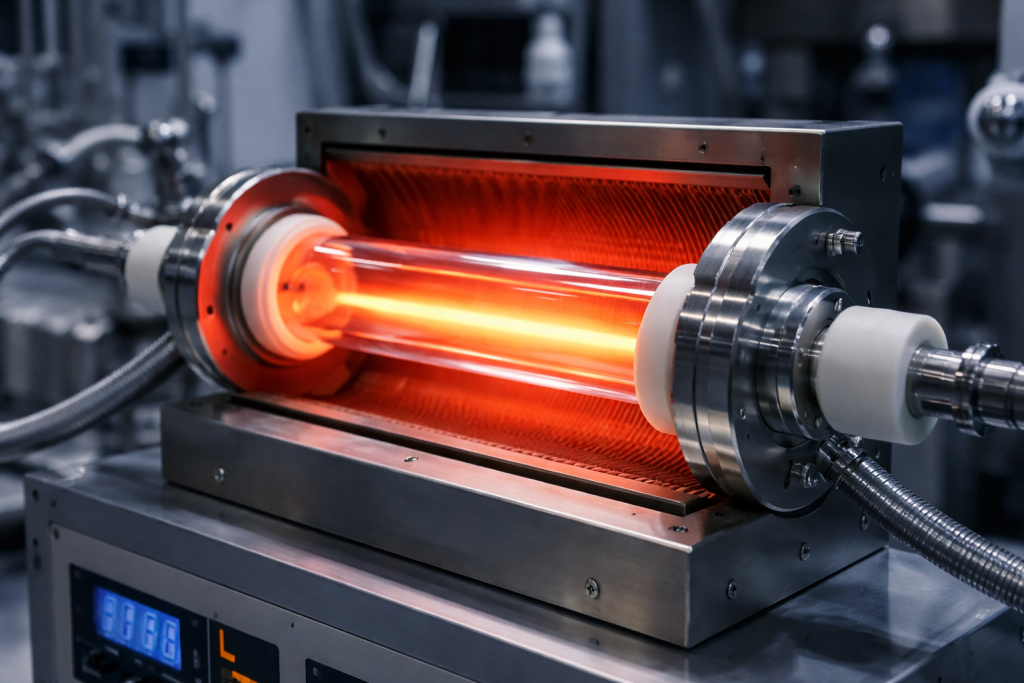
Engineers sourcing quartz windows, fused silica plates, optical discs or semiconductor optical components frequently encounter specifications such as:
JGS1
JGS2
JGS3
These designations are widely used in drawings, RFQs and supplier quotations, particularly in China and other Asian markets.
However, one of the most common purchasing mistakes is to assume:
JGS1 > JGS2 > JGS3
as if the numbers represented increasing or decreasing material quality.
They do not.
JGS1, JGS2 and JGS3 were traditionally classified primarily according to their spectral transmission characteristics:
- JGS1 — far-ultraviolet optical quartz glass
- JGS2 — ultraviolet optical quartz glass
- JGS3 — infrared optical quartz glass
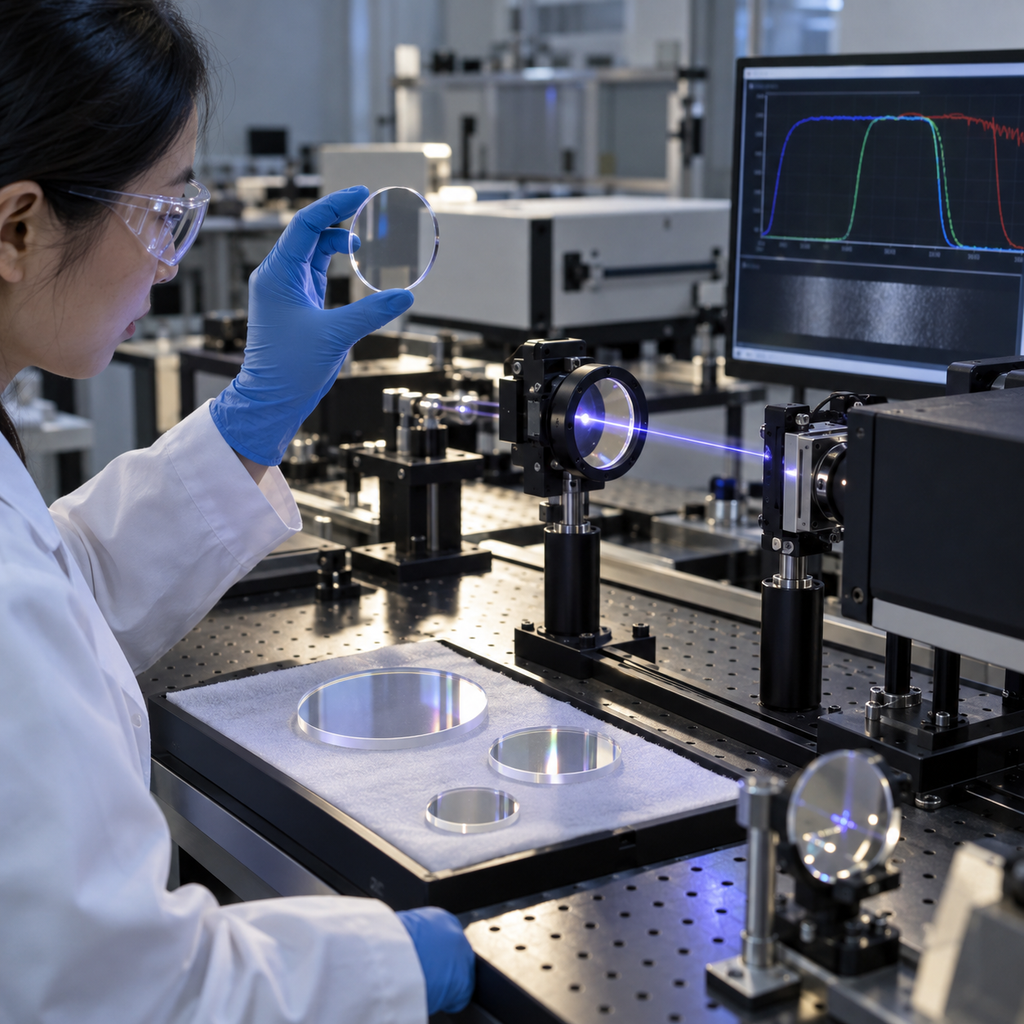
The traditional application wavelength ranges are approximately:
| Grade | Traditional Classification | Typical Spectral Range |
|---|---|---|
| JGS1 | Far-UV optical quartz glass | 185–2500 nm |
| JGS2 | UV optical quartz glass | 220–2500 nm |
| JGS3 | Infrared optical quartz glass | 260–3500 nm |
These wavelength classifications originate from the traditional JC 185—81 optical quartz glass system. The current Chinese industry standard JC/T 185—2013 uses different grade names—ZS, HS and KS—although JGS1/JGS2/JGS3 terminology remains very common commercially.
Therefore, engineers should treat JGS terminology as a material-selection shorthand, not as a complete modern procurement specification.
The correct material should be selected according to:
operating wavelength + OH content + impurity level + optical homogeneity + bubbles/inclusions + birefringence + surface quality + laser requirements + semiconductor cleanliness requirements
rather than by the JGS number alone.
1. What Is Fused Silica?
Fused silica is a non-crystalline form of silicon dioxide, SiO₂.
Unlike crystalline quartz, fused silica has an amorphous structure.
Typical advantages include:
- broad optical transmission;
- very low thermal expansion;
- excellent thermal shock resistance;
- high chemical stability;
- high electrical insulation;
- low optical birefringence;
- good UV performance in suitable grades.
High-purity fused silica is therefore used in:
- UV optical windows;
- laser optics;
- semiconductor lithography;
- wafer inspection;
- optical metrology;
- spectroscopy;
- semiconductor processing equipment;
- precision optical substrates;
- fused silica wafers.
But not all fused silica has the same optical performance.
The production process strongly influences:
- hydroxyl content;
- metallic impurities;
- bubbles;
- inclusions;
- striae;
- refractive-index uniformity.
That is why two components both described as “99.99% SiO₂” can perform very differently in an optical system.
2. JGS1: Far-Ultraviolet Optical Fused Silica
JGS1 is traditionally classified as far-ultraviolet optical quartz glass.
Its traditional spectral range extends down to approximately:
185 nm
making it the preferred JGS category when short-wavelength UV transmission is important.
Typical applications include:
- deep-UV optical windows;
- UV spectroscopy;
- UV light sources;
- excimer-laser optical components;
- UV inspection systems;
- semiconductor optical systems;
- UV lenses and prisms.
JGS1 material is commonly associated with high-purity synthetic fused silica manufacturing routes.
Synthetic fused silica minimizes many of the metallic impurities associated with natural quartz raw materials.
This is particularly valuable in deep UV because trace impurities and structural defects can produce absorption at short wavelengths.
Typical JGS1 Characteristics
JGS1 commonly offers:
- excellent deep-UV transmission;
- high chemical purity;
- low bubble/inclusion content in high-quality material;
- good refractive-index homogeneity;
- good visible transmission;
- excellent thermal stability.
However, UV performance does not automatically mean excellent IR performance.
This is where OH content becomes important.
3. JGS2: General UV and Visible Optical Quartz Glass
JGS2 is traditionally classified as ultraviolet optical quartz glass.
Its commonly quoted useful range begins at approximately:
220 nm
and extends through the visible and into the near-infrared.
JGS2 is frequently produced from high-quality natural quartz using melting and refining processes.
Because it does not always require the same synthetic production route as high-grade JGS1 material, JGS2 can often be a more economical solution for applications that do not require transmission below approximately 220 nm.
Typical applications include:
- UV-visible windows;
- optical flats;
- furnace observation windows;
- microscope components;
- laboratory optical components;
- UV lamp windows;
- optical plates;
- sight glasses;
- general industrial optics.
The important point is that JGS2 is not simply a lower-quality JGS1.
If an application operates at:
355 nm,
532 nm,
632.8 nm,
808 nm,
1064 nm,
for example, expensive deep-UV capability may provide little practical benefit.
In such cases, optical homogeneity, surface quality, coating performance and transmitted wavefront may be more important than selecting JGS1 solely because its grade number sounds more premium.
4. JGS3: Infrared Optical Quartz Glass
JGS3 is traditionally classified as infrared optical quartz glass.
Its commonly referenced spectral range extends approximately from:
260 nm to 3500 nm
with particular emphasis on improved infrared performance.
The major reason is generally lower hydroxyl content.
OH groups create strong absorption bands in fused silica, especially around the approximately 2.7 µm region.
Reducing OH therefore improves transmission in portions of the near- and mid-infrared.
JGS3-type low-OH material is therefore attractive for:
- infrared windows;
- IR spectroscopy;
- infrared sensing;
- laser systems;
- broadband UV-VIS-NIR/IR optical systems;
- thermal or process-monitoring optics.
Again:
JGS3 is not inferior to JGS1.
For an infrared application, JGS3 may be the technically correct material while JGS1 may actually perform worse because of OH absorption.
5. Why OH Content Matters
Hydroxyl groups—usually written as OH—are one of the most important variables in fused silica.
They become incorporated into the silica structure during manufacturing.
OH concentration can range from extremely low levels to hundreds or even over one thousand ppm depending on the production process.
This has major consequences for optical transmission.
High-OH Fused Silica
Higher-OH synthetic fused silica can provide excellent ultraviolet characteristics.
However, OH produces strong infrared absorption bands.
The most obvious occurs around:
2.7–2.8 µm
Additional OH-related absorption also appears at other near-IR wavelengths.
Low-OH Fused Silica
Very low-OH silica suppresses these absorption bands.
This makes it suitable for IR transmission and applications where optical absorption must be minimized.
Current commercial fused-silica data illustrate the magnitude of this difference.
For example, Corning lists approximately 800–1000 ppm OH for certain HPFS 7980 grades, while its IR-grade 7979 material is specified below 1 ppm OH. The company’s transmission curves show the high-OH material developing strong absorption around the 2.7–2.8 µm region while the low-OH material maintains much stronger transmission.
This demonstrates an important principle:
OH should be selected according to wavelength requirements—not minimized automatically.
6. Does High OH Mean Better UV Transmission?
Not by itself.
This is an important technical distinction.
Deep-UV transmission depends on a combination of:
- production route;
- raw-material purity;
- metallic contamination;
- structural defects;
- OH;
- hydrogen concentration;
- irradiation history.
High-purity synthetic fused silica is often optimized for UV performance, and many such materials also contain relatively high OH.
But it is incorrect to specify only:
OH = 1000 ppm
and assume that the material will automatically be suitable for a demanding 193 nm lithography application.
Modern semiconductor-grade UV fused silica may require control of:
- UV absorption;
- laser-induced compaction;
- laser-induced absorption;
- hydrogen concentration;
- refractive-index homogeneity;
- birefringence;
- striae;
- inclusions.
Corning, for example, separates fused-silica materials into specific Standard, KrF, ArF, IR and other grades rather than using OH concentration alone as the material definition.
7. JGS1 vs JGS2 vs JGS3 Transmission Comparison
A practical comparison can be summarized as follows:
| Property | JGS1 | JGS2 | JGS3 |
|---|---|---|---|
| Traditional designation | Far-UV | UV | Infrared |
| Approx. traditional range | 185–2500 nm | 220–2500 nm | 260–3500 nm |
| Deep-UV capability | Excellent | Moderate | Not primary purpose |
| Visible transmission | Excellent | Excellent | Excellent |
| Near-IR transmission | Good, depending on OH | Good | Good–excellent |
| ~2.7 µm OH absorption | Can be significant | Depends on OH | Reduced in low-OH material |
| Typical raw-material route | Often synthetic | Often natural quartz | Low-OH process |
| Typical priority | UV purity/transmission | Cost-performance balance | IR transmission |
| Typical applications | DUV, UV optics, semiconductor optics | General UV/VIS optics | IR optics, spectroscopy |
The traditional JC 185 system specified JGS1, JGS2 and JGS3 according to wavelength-dependent transmission requirements for 10 mm blanks rather than simply defining one universal purity level.
8. JGS1 vs JGS2 at 193 nm and 248 nm
These wavelengths are especially relevant to semiconductor optics.
193 nm
193 nm corresponds to ArF excimer-laser technology.
Standard JGS2 material should not automatically be selected for this region because its traditional classification begins at approximately 220 nm.
High-purity synthetic fused silica designed and qualified specifically for 193 nm is typically required.
For demanding semiconductor lithography, simply writing:
Material: JGS1
may still be insufficient.
The buyer should request actual transmission and laser-performance data at 193 nm.
248 nm
248 nm corresponds to KrF excimer-laser technology.
Both the traditional transmission range and commercial UV-fused-silica families offer more options here.
But for high-power or high-fluence exposure, UV resistance remains important.
Modern suppliers therefore often offer dedicated KrF-grade fused silica with controlled UV transmission and laser durability. Corning, for example, specifies dedicated 248 nm KrF material separately from standard fused silica.
9. JGS1 vs JGS2 at 355 nm
355 nm is widely used in:
- laser processing;
- UV marking;
- semiconductor inspection;
- fluorescence systems;
- UV imaging.
Both JGS1 and JGS2 may provide adequate bulk transmission at 355 nm.
The decision may therefore depend more on:
- optical homogeneity;
- laser damage threshold;
- absorption;
- surface finish;
- coating;
- cost.
Specifying JGS1 without reviewing these other parameters may not improve actual system performance.
10. What Is Optical Homogeneity?
Optical homogeneity describes how uniformly the refractive index is distributed throughout a material.
It can commonly be expressed as:
Δn
or refractive-index variation.
For a simple protective window, moderate homogeneity may be acceptable.
For:
- precision lenses;
- interferometers;
- beam expanders;
- lithography optics;
- large optical windows;
- laser beam delivery systems,
refractive-index variation can alter the optical wavefront.
This can lead to:
- wavefront distortion;
- focus shift;
- aberration;
- beam degradation.
Therefore, two fused-silica blanks with identical chemical composition and transmission curves may perform differently in precision optics because their optical homogeneity differs.
11. JGS Grade Does Not Completely Define Homogeneity
This is another frequent misunderstanding.
The traditional JGS classification did not simply say:
JGS1 has excellent homogeneity.
Instead, optical quartz glass was separately classified according to parameters including:
- spectral characteristics;
- optical homogeneity;
- birefringence;
- striae;
- granular inhomogeneity;
- bubbles;
- fluorescence.
In other words, JGS1/JGS2/JGS3 defines the spectral family, not every optical quality parameter.
For precision optical RFQs, therefore, specify homogeneity independently.
Examples may include:
Δn ≤ 5 × 10⁻⁶
or another limit based on the optical design.
Modern premium fused-silica manufacturers use the same approach. Corning, for example, offers separate homogeneity grades rather than assuming one value for every fused-silica product.
12. Why Striae Matter
Striae are localized refractive-index variations created during glass manufacturing.
They can become particularly important for:
- laser optics;
- imaging systems;
- large-aperture windows;
- precision interferometry.
A window may look perfectly transparent visually but still distort a wavefront because of internal striae.
Therefore, demanding optical components should specify:
- acceptable striae class;
- inspection direction;
- optical use axis.
This is especially important for thick fused-silica components.
13. Bubbles and Inclusions
Bubbles and inclusions can:
- scatter light;
- create local optical distortion;
- reduce laser-damage resistance;
- interfere with high-resolution imaging.
For a simple furnace sight glass, small inclusions may be acceptable.
For:
- UV laser optics;
- high-energy laser windows;
- semiconductor inspection optics,
they may not be acceptable.
Again, specifying only JGS1 does not fully define allowable bubbles or inclusions.
Modern fused silica materials therefore commonly specify inclusion classes separately.
14. Stress Birefringence
Fused silica is naturally isotropic in its amorphous state.
However, manufacturing and machining stresses can create birefringence.
This becomes important in:
- polarized laser systems;
- imaging systems;
- interferometry;
- lithography;
- polarization-sensitive spectroscopy.
A precision optical window may therefore require stress-birefringence specifications in addition to material grade.
High-end fused silica products can specify birefringence down to only a few nanometers per centimeter depending on grade.
15. JGS Material for Semiconductor Applications
The phrase “semiconductor application” covers several very different uses.
The correct fused silica specification depends on where the component is used.
Semiconductor Lithography Optics
For DUV lithography, high-purity synthetic fused silica may be used in:
- lenses;
- windows;
- optical plates;
- beam-delivery optics.
Important parameters include:
- transmission at 193 or 248 nm;
- laser resistance;
- refractive-index homogeneity;
- birefringence;
- striae;
- inclusions.
Corning specifically identifies high-purity fused silica for i-line, KrF 248 nm and ArF 193 nm semiconductor lithography applications.
For these applications, JGS1 alone should not be considered a sufficient specification.
16. Semiconductor Inspection and Metrology
Semiconductor equipment may use fused-silica windows for:
- wafer inspection;
- optical metrology;
- UV illumination;
- camera protection;
- laser alignment;
- chamber viewports.
The required material may depend on the inspection wavelength.
Examples:
193 nm / DUV inspection
Use high-purity UV-grade synthetic fused silica with certified transmission.
355 nm UV inspection
JGS1 or suitable JGS2 material may both be technically possible, depending on optical quality and laser power.
Visible inspection
Any suitable optical fused silica family may work; surface quality and flatness may dominate.
NIR or IR monitoring
Low-OH material may become more important.
17. Semiconductor Process Components Are Different
Not every quartz component used in semiconductor equipment should be specified as JGS1, JGS2 or JGS3.
Examples include:
- quartz furnace tubes;
- wafer boats;
- process rings;
- quartz flanges;
- injectors;
- liners;
- diffusion components.
For these products, critical parameters may instead include:
- SiO₂ purity;
- Na;
- K;
- Li;
- Al;
- Fe;
- Ca;
- B;
- particle generation;
- devitrification resistance;
- OH content;
- thermal stability;
- dimensional accuracy;
- cleaning and packaging.
A furnace tube does not become “semiconductor grade” simply because someone calls the raw material JGS1.
This distinction is important when issuing an RFQ.
For optical semiconductor components, use optical specifications.
For process-contact semiconductor quartz components, use chemical purity, contamination and process specifications.
18. JGS3 for Infrared Applications
JGS3 becomes particularly useful where transmission near the OH absorption region matters.
For example:
- IR spectroscopy;
- gas sensing;
- broadband optical monitoring;
- infrared laser systems.
Low-OH fused silica can greatly reduce absorption around approximately 2.7 µm.
Commercial fused silica data clearly illustrate this effect: Corning’s high-OH 7980 material shows pronounced OH absorption near this region, while its sub-1-ppm-OH IR grade maintains much stronger transmission.
However, fused silica itself eventually loses transmission deeper into the mid-IR.
Therefore, if the system operates at wavelengths such as:
5 µm, 8 µm, 10.6 µm
fused silica may no longer be the correct optical material regardless of whether it is labeled JGS3.
Alternative IR materials may be required.
19. Is JGS1 Better Than JGS2?
Not necessarily.
Consider three applications.
Application A — 193 nm UV Optical Window
JGS1 or, preferably, a certified high-purity synthetic DUV fused silica is appropriate.
JGS2 may not provide adequate short-wavelength performance.
Application B — 532 nm Observation Window
Both materials can transmit the wavelength.
Paying for deep-UV JGS1 may offer little benefit.
A properly specified JGS2 material may be sufficient.
Application C — 2.7–3.0 µm IR Window
High-OH UV fused silica may exhibit unacceptable absorption.
Low-OH JGS3-type material may be significantly better.
Therefore:
There is no universal “best JGS grade.”
There is only the most appropriate material for the required wavelength and optical specification.
20. Is JGS3 Better Than JGS1 for IR?
Generally, where OH absorption is the limiting factor, a low-OH IR-grade silica is the better choice.
But the buyer should not assume that every material sold as JGS3 automatically has identical OH concentration.
Ask the supplier to provide:
- measured OH;
- spectral transmission curve;
- material datasheet;
- transmission at the actual operating wavelength.
For critical applications, measured performance should always take priority over the material label.
21. JGS1 / JGS2 / JGS3 Are Not Exact International Equivalents
Customers sometimes ask:
Is JGS1 equal to Corning 7980?
or:
Is JGS3 the same as Heraeus Suprasil?
The safer engineering answer is:
not automatically.
Different manufacturers define materials using their own:
- manufacturing routes;
- purity specifications;
- OH levels;
- homogeneity grades;
- laser-resistance specifications;
- inclusion classes.
Corning, for example, offers 7980 Standard, KrF and ArF materials as well as low-OH 7979 IR grade and 8655 material, each with different performance specifications.
A general JGS category may help identify the intended wavelength family, but qualification should compare actual technical data.
Therefore an RFQ should not simply state:
JGS1 or equivalent
for a critical optical system.
Instead specify which parameters must be equivalent.
22. How to Choose JGS1, JGS2 or JGS3
A simple selection process is:
Step 1 — Define the Wavelength
What is the actual operating wavelength?
Examples:
193 nm
248 nm
355 nm
532 nm
1064 nm
1550 nm
2.7 µm
3.0 µm
This is the most important starting point.
Step 2 — Determine Whether UV or IR Performance Dominates
If transmission below approximately 220 nm is critical:
JGS1 / certified synthetic UV fused silica
should be evaluated.
For general UV-visible optics:
JGS2
may be sufficient.
For extended IR transmission where OH absorption matters:
low-OH JGS3-type fused silica
should be evaluated.
Step 3 — Define Optical Quality
Specify:
- homogeneity;
- bubbles/inclusions;
- birefringence;
- striae.
Step 4 — Define Surface Requirements
Specify:
- surface quality;
- flatness;
- parallelism;
- roughness;
- transmitted wavefront.
Step 5 — Define Coating
If required:
- AR coating;
- UV coating;
- broadband coating;
- high-power laser coating.
Step 6 — Specify the Application
Tell the manufacturer whether the component will be used for:
- lithography;
- laser processing;
- semiconductor inspection;
- spectroscopy;
- furnace observation;
- IR sensing.
This helps prevent material overspecification or incorrect substitution.
23. Recommended Selection by Application
| Application | Starting Material Choice | Parameters to Confirm |
|---|---|---|
| 193 nm optics | High-purity synthetic DUV fused silica / JGS1-type | 193 nm transmission, laser resistance, homogeneity |
| 248 nm optics | UV-grade fused silica | 248 nm transmission, UV durability |
| 355 nm optics | JGS1 or suitable JGS2 | LIDT, absorption, coating |
| Visible optical window | JGS2 often sufficient | Flatness, surface quality, homogeneity |
| 1064 nm laser | Application-dependent fused silica | Absorption, OH, LIDT |
| 1550 nm optics | Low-loss silica selected by actual data | OH absorption, coating |
| 2.7–3.0 µm IR | Low-OH / JGS3-type | OH, transmission curve |
| Semiconductor inspection | Wavelength dependent | Purity, homogeneity, surface quality |
| Semiconductor furnace parts | Semiconductor-grade quartz, not JGS alone | Trace metals, particles, OH, thermal stability |
24. Surface Quality Can Matter More Than JGS Grade
Consider two windows.
Window A
JGS1 material
Surface quality: 80/50
Poor flatness
Window B
JGS2 material
Surface quality: 10/5
λ/10 flatness
For a precision visible-light imaging system, Window B could perform much better despite using JGS2.
This illustrates why material selection and component fabrication must be considered separately.
Typical optical drawings may specify:
Surface Quality: 20/10
Flatness: λ/4 @ 632.8 nm
Parallelism: < 10 arc sec
Ra: < 1 nm
The appropriate values depend on the application.
25. Thickness Also Changes Transmission
Published transmission curves cannot be interpreted without considering sample thickness.
Absorption accumulates through the optical path.
A material with excellent transmission through a 1 mm sample can produce noticeably different results at:
10 mm,
50 mm,
100 mm.
The traditional JGS optical specification itself used 10 mm blanks for its wavelength-dependent transmittance criteria.
Therefore, when requesting a transmission requirement, specify:
T ≥ ___% at ___ nm through ___ mm thickness
This is much clearer than simply stating:
High transmission JGS1.
26. Internal vs External Transmission
Another specification issue is the difference between:
Internal Transmission
Transmission through the material after excluding surface reflection losses.
External Transmission
Actual measured transmission including Fresnel reflection at the two surfaces.
Uncoated fused silica surfaces reflect part of the incident light.
An AR coating can therefore significantly improve system transmission even if the bulk material remains unchanged.
When comparing supplier datasheets, check whether the quoted curve represents:
internal transmittance or external transmittance.
Otherwise, apparently different materials may simply be using different measurement definitions.
27. RFQ Guide for JGS Optical Quartz Components
For a faster and more accurate quotation, provide the following.
Material
- JGS1 / JGS2 / JGS3
- or required spectral performance
- synthetic / natural fused silica if specified
Optical Requirements
- operating wavelength
- minimum transmission
- OH requirement
- homogeneity
- birefringence
- bubbles/inclusions
Dimensions
- diameter
- length × width
- thickness
- dimensional tolerances
Surface
- SSP/DSP if wafer format
- optical polishing
- surface quality
- flatness
- parallelism
- roughness
Coating
- uncoated
- single-band AR
- broadband AR
- UV AR
- laser coating
Quantity
- prototype
- pilot run
- production quantity
Application
- semiconductor
- UV laser
- spectroscopy
- optical window
- IR sensor
- furnace viewport
Providing the operating wavelength is particularly important.
If an RFQ simply says:
Need JGS quartz window
there may not be enough information to select the correct material.
Example RFQ 1 — DUV Window
Material: Synthetic fused silica / JGS1-type
Diameter: Ø50 mm
Thickness: 5 mm
Working Wavelength: 193 nm
Transmission: Specify requirement at 193 nm
Surface Quality: 10/5
Flatness: λ/10
Parallelism: <10 arc sec
Coating: 193 nm AR
Quantity: 20 pcs
Application: Semiconductor UV optical system
Example RFQ 2 — General UV Window
Material: JGS2
Diameter: Ø100 mm
Thickness: 10 mm
Working Wavelength: 365 nm
Surface Quality: 20/10
Flatness: λ/4
Coating: Uncoated
Quantity: 50 pcs
Application: UV inspection system
Example RFQ 3 — IR Quartz Window
Material: Low-OH JGS3-type fused silica
Size: 80 × 80 mm
Thickness: 5 mm
Working Range: 2.0–3.0 µm
OH: Specify maximum requirement
Transmission: Customer-specified minimum
Surface Quality: 20/10
Coating: Broadband IR AR
Quantity: 30 pcs
In this case, the actual OH concentration and measured spectral curve are more meaningful than the JGS3 label alone.
Conclusion
The difference between JGS1, JGS2 and JGS3 is not simply material quality.
The three traditional grades were designed around different optical spectral regions:
JGS1 → far UV
JGS2 → general UV / visible
JGS3 → infrared
The key technical variables behind their performance include:
raw material → manufacturing process → impurities → OH → transmission → homogeneity → striae → birefringence → bubbles/inclusions
For general optical components, the traditional JGS designation can still be a useful starting point.
For demanding semiconductor, DUV, high-power laser or IR applications, however, JGS1/JGS2/JGS3 alone is not a sufficient material specification.
Engineers should specify actual operating wavelength, transmission, OH content, optical homogeneity, surface quality, laser requirements and component dimensions.
Fuyao Quartz can supply and fabricate custom fused-silica and optical-quartz components including:
- quartz windows;
- fused silica plates;
- fused silica wafers;
- optical discs;
- UV quartz components;
- IR quartz components;
- custom polished quartz parts.
Customers can provide the drawing, working wavelength, size, thickness, surface quality, flatness, coating requirement and quantity for material selection and quotation.
FAQ
Is JGS1 better than JGS2?
Not universally. JGS1 is generally preferred for deep-UV applications, while JGS2 can be a more economical and technically appropriate solution for many UV-visible applications.
Is JGS3 a lower-quality grade?
No. JGS3 is traditionally an infrared optical quartz-glass category. Its low-OH characteristics can make it preferable to high-OH UV material for certain infrared wavelengths.
What is the main difference between JGS1 and JGS3?
The main practical difference is spectral optimization. JGS1-type materials prioritize deep-UV performance, while JGS3-type low-OH materials prioritize IR transmission, particularly where OH absorption is important.
Does JGS1 always have a specific OH content?
No. JGS1 is not a universal OH specification. OH depends on the actual material and manufacturer. Critical applications should specify or request measured OH rather than relying solely on the grade name.
Which material is suitable for 193 nm semiconductor optics?
High-purity synthetic DUV fused silica specifically qualified for 193 nm should be used. A generic JGS1 designation may not be sufficient for demanding ArF lithography or high-fluence applications.
Which grade is best for semiconductor quartz components?
It depends on the component. Optical windows may require UV-grade fused silica, while furnace tubes, boats and process components are generally specified according to semiconductor purity, trace-metal contamination, OH, particle performance and thermal characteristics rather than JGS grade alone.
Is JGS terminology still used?
Yes. JGS1/JGS2/JGS3 remains common in commercial drawings and purchasing. However, the current JC/T 185—2013 optical-quartz standard uses ZS, HS and KS classifications, while JGS terminology comes from the older JC 185—1981 classification system.