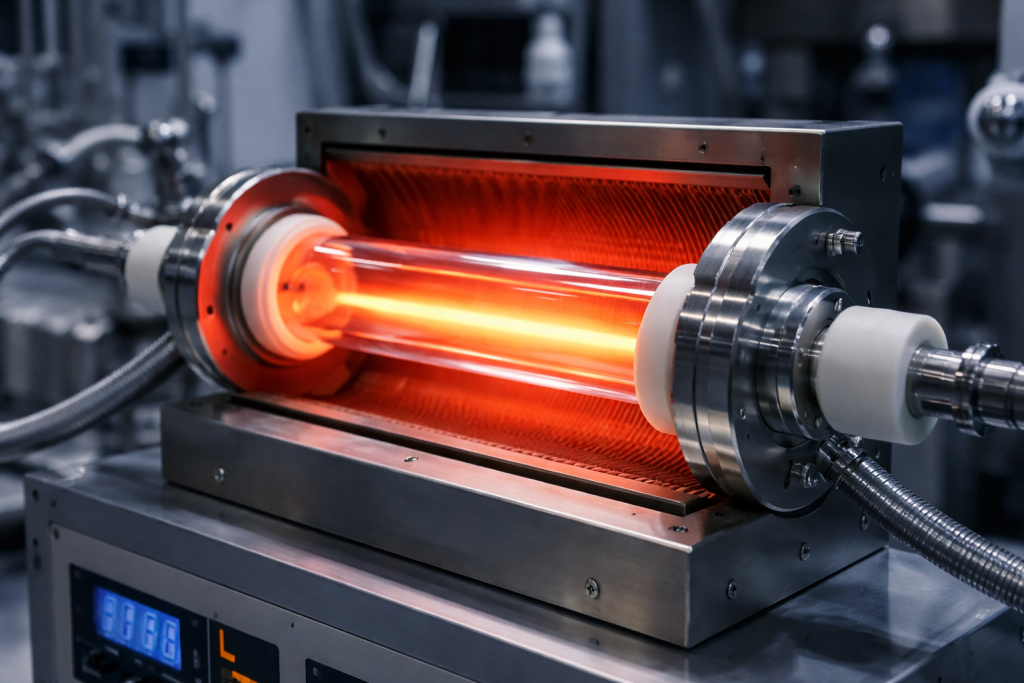
Fused silica optical components are widely used in laser material processing because they combine high optical transmission, low thermal expansion, high temperature stability and good resistance to many process environments.
However, selecting fused silica for a laser system is not simply a matter of choosing a transparent material. The component must be matched to the laser wavelength, beam conditions, surface quality, geometry, thermal load and required laser damage threshold.
A component that performs well with a low-power continuous-wave laser may not be suitable for a high-energy pulsed laser. The correct specification must therefore be developed around the complete laser process.
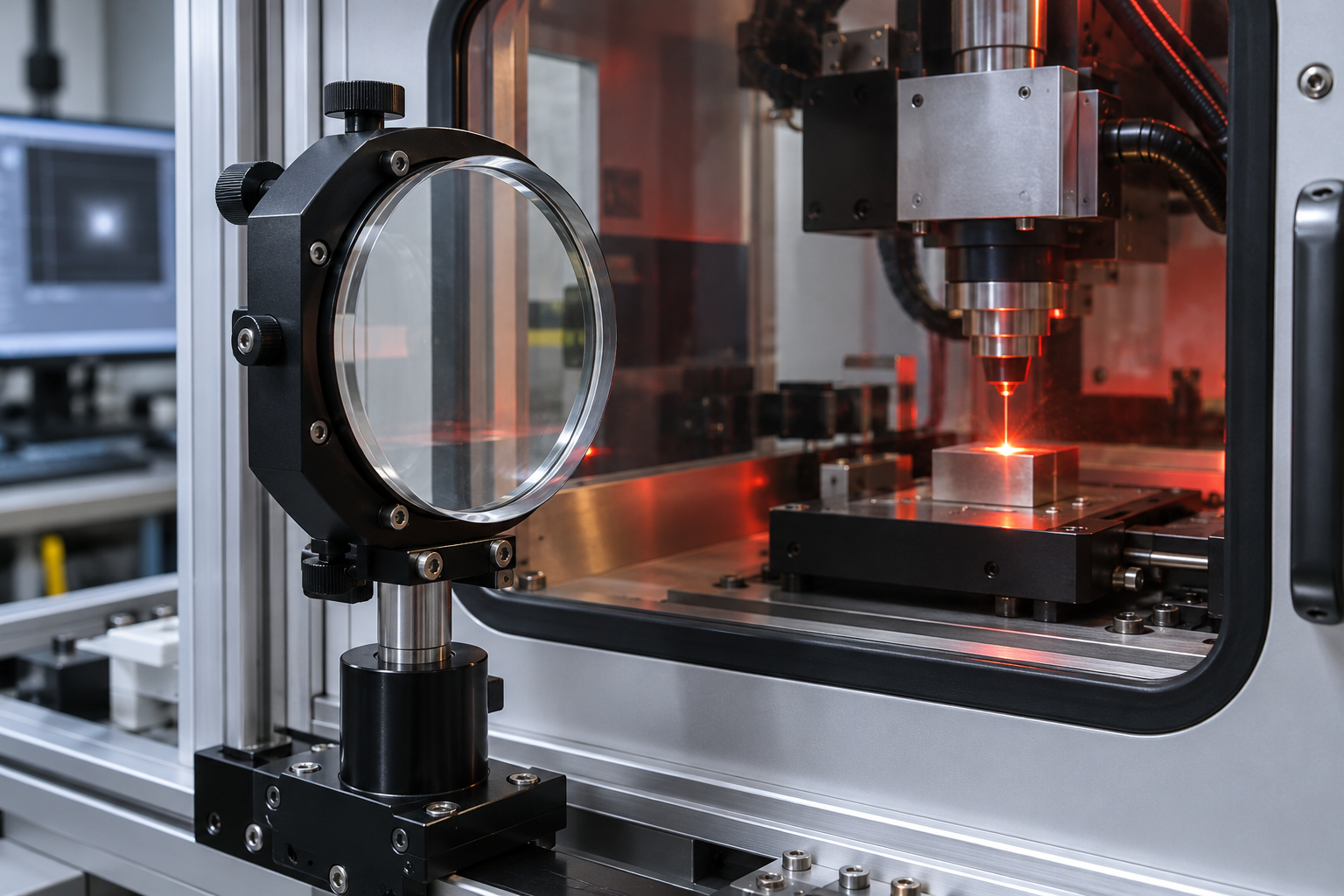
Why Fused Silica Is Used in Laser Processing
Fused silica and fused quartz are used in many optical and laser applications, including:
- Protective windows
- Beam-entry windows
- Laser processing windows
- Optical plates and discs
- Beam-delivery components
- Sensor windows
- UV and visible optical substrates
- Custom apertures and shaped components
- High-temperature optical fixtures
- Semiconductor and laboratory laser equipment
The material is suitable for demanding applications because it offers:
- Broad optical transmission in selected wavelength ranges
- Low thermal expansion
- Good thermal-shock resistance
- High softening temperature
- High electrical insulation
- Low contamination potential when properly processed
- Good dimensional stability
- Compatibility with precision optical finishing
The final performance still depends on the selected grade, thickness, surface quality, geometry and manufacturing process.
1. Define the Laser Wavelength First
The laser wavelength is one of the most important specifications for a fused silica optical component.
The supplier should know whether the component will be used with:
- Ultraviolet lasers
- Visible lasers
- Near-infrared lasers
- Fundamental laser wavelengths
- Harmonic wavelengths
- Broadband or tunable sources
- Continuous-wave lasers
- Pulsed lasers
- Ultrafast or femtosecond lasers
Different fused silica grades may provide different transmission, absorption and hydroxyl-content characteristics. A component designed for visible processing may not provide the same performance at deep-UV or infrared wavelengths.
The RFQ should identify:
- Operating wavelength
- Wavelength bandwidth
- Required transmission
- Maximum allowable absorption
- Angle of incidence
- Polarization condition
- Beam path or clear aperture
- Whether the component will be used in air, vacuum or a controlled atmosphere
For a broadband laser system, a transmission curve may be more useful than a single transmission value. The curve should cover the actual operating range and specify the sample thickness used for measurement.
2. Surface Quality Has a Direct Effect on Laser Performance
The optical surface is often the most sensitive part of a laser component.
Scratches, digs, pits, polishing residues, edge defects and microscopic contamination can create local field enhancement. Under high optical intensity, these areas may become initiation points for laser-induced damage.
Surface quality requirements may include:
- Scratch and dig classification
- Surface roughness
- Surface figure
- Flatness
- Parallelism
- Wedge
- Pits and inclusions
- Edge chips
- Clear-aperture condition
- Cleaning and handling requirements
Surface roughness alone does not fully describe optical quality. Two components may have similar roughness values but different surface figures, scratches or subsurface damage.
For beam-transmitting components, the customer should specify whether the requirement applies to:
- The entire front surface
- The clear aperture only
- The back surface
- The edge or bevel
- The area outside the optical aperture
The clear aperture should be defined on the drawing. It should also be clear whether marks outside the clear aperture are acceptable and what distance must be maintained from the usable beam area.
3. Laser Damage Threshold Is Not a Universal Material Number
Laser-induced damage threshold, commonly abbreviated as LIDT, describes the maximum laser radiation level that an optical component can withstand under defined test conditions.
LIDT depends on much more than the material name. Important variables include:
- Wavelength
- Continuous-wave or pulsed operation
- Pulse duration
- Pulse energy
- Repetition rate
- Beam diameter
- Energy density or fluence
- Peak power
- Number of pulses
- Polarization
- Angle of incidence
- Surface condition
- Cleaning condition
- Coating condition
- Test area and defect criteria
For this reason, a supplier should not provide a general LIDT value without stating the test conditions.
ISO 21254-2 describes 1-on-1 and S-on-1 test methods for determining the laser-induced damage threshold of optical laser components. The customer and supplier should agree on the relevant test method and reporting format before testing. ISO 21254-2:2011
A high LIDT requirement may also require tighter control of surface contamination, polishing damage, coating defects and handling procedures.
4. Continuous-Wave and Pulsed Lasers Require Different Evaluation
Laser components used with continuous-wave lasers are primarily evaluated for:
- Absorption
- Average power
- Thermal loading
- Temperature rise
- Thermal lensing
- Long-term dimensional stability
- Cooling conditions
Pulsed-laser components require additional information:
- Pulse energy
- Pulse duration
- Repetition frequency
- Peak power
- Beam profile
- Pulse-to-pulse stability
- Fluence at the component surface
- Number of pulses during service
Ultrafast lasers can be especially sensitive to surface and subsurface defects. A component that appears acceptable under visual inspection may not meet the requirements of a high-energy or high-repetition-rate application.
The supplier should review the laser operating conditions before recommending a material grade or surface finish.
5. Geometry and Clear Aperture Must Match the Optical Design
A fused silica optical component must be manufactured to the geometry required by the optical system.
The drawing should define:
- Overall length and width
- Diameter or non-round profile
- Thickness
- Thickness tolerance
- Clear aperture
- Flatness
- Parallelism
- Wedge
- Surface figure
- Chamfers
- Edge radius
- Holes, slots or mounting features
- Datum references
- Orientation marks
For a window or flat optical plate, parallelism and wedge can influence beam deviation and alignment. For a shaped component, dimensional tolerances and surface figure may be more important.
A supplier should review the design for:
- Minimum edge thickness
- Risk of chipping
- Stress concentration around holes
- Machining access
- Optical aperture limitations
- Mounting pressure
- Thermal expansion
- Cleaning access
The physical size of the component should not be confused with the usable optical aperture. The required beam area should remain clear after considering edge chamfers, mounting features and mechanical tolerances.
6. Thickness Influences Transmission and Thermal Behavior
Thickness affects both optical and thermal performance.
A thicker component may provide greater mechanical strength, but it can also result in:
- Increased absorption over the beam path
- Greater reflection losses
- More demanding polishing
- Higher weight
- Greater thermal load
- Increased sensitivity to wedge or parallelism errors
For high-power applications, the supplier may need to evaluate absorption and heat dissipation through the full thickness of the component.
For UV applications, the selected material grade and thickness should be reviewed together. For high-energy pulsed systems, the surface condition and bulk quality should be considered in addition to transmission.
7. Material Quality and Internal Defects
Internal material quality can affect optical performance and laser reliability.
Depending on the application, the customer may need to control:
- Bubbles
- Inclusions
- Striae
- Homogeneity
- Absorption bands
- Hydroxyl content
- Trace-metal contamination
- Internal stress
- Refractive-index variation
Optical laser components may require tighter internal quality than a general-purpose fused quartz plate.
The supplier should identify the inspection method and acceptance criteria for internal defects. A general visual statement such as “optically clear” is not sufficient for a precision laser component.
For critical applications, the buyer may request:
- Transmission curve
- Absorption data
- Homogeneity data
- Material certificate
- Lot traceability
- Certificate of Conformance
- Internal defect inspection
- Final inspection photographs
8. Coatings Should Be Considered Separately
Some laser systems require an anti-reflection coating or another functional coating. However, coating selection should be based on the actual wavelength and laser conditions.
The coating specification may need to include:
- Central wavelength
- Operating bandwidth
- Angle of incidence
- Polarization
- Reflection target
- Transmission target
- Continuous-wave or pulsed operation
- Laser damage threshold
- Environmental durability
- Cleaning limitations
The fused silica substrate and the coating should be evaluated as one optical assembly. A high-quality substrate cannot compensate for an unsuitable coating, and a suitable coating may still fail if the substrate surface contains contamination or subsurface damage.
For high-power or ultrafast laser systems, the customer should provide the complete laser profile before coating design begins.
9. Inspection Documents for Custom Optical Components
Inspection documentation should match the optical and mechanical requirements stated on the drawing.
A typical inspection package may include:
- Material certificate
- Certificate of Conformance
- Material lot information
- Dimensional inspection report
- Thickness measurement
- Flatness or surface-figure report
- Parallelism and wedge results
- Surface roughness data
- Scratch and dig inspection
- Clear-aperture inspection
- Transmission curve
- Internal defect inspection
- LIDT test report, when required
- Cleaning confirmation
- Pre-shipment photographs
- Packaging and traceability records
The report should identify the measurement instrument, test conditions and acceptance criteria.
For repeat orders, the supplier should keep the same drawing revision, material grade, inspection method and packaging process whenever possible.
10. How to Evaluate a Custom Fused Silica Supplier
A capable supplier should provide engineering support before production begins.
Ask the supplier whether it can:
- Recommend a suitable fused silica grade
- Review optical and mechanical drawings
- Manufacture round and non-round components
- Control thickness, flatness and parallelism
- Produce polished or precision-finished surfaces
- Machine holes, slots and custom profiles
- Inspect surface and internal defects
- Provide transmission and dimensional reports
- Support prototype and production quantities
- Maintain lot traceability
- Clean and package components for optical use
- Review special laser operating conditions
The supplier should also communicate limitations clearly. If a requested tolerance, LIDT value or surface quality requires additional testing, this should be identified in the quotation.
Custom Fused Silica Optical Component RFQ Checklist
To receive an accurate quotation, provide:
- Laser wavelength
- Wavelength bandwidth
- Continuous-wave or pulsed operation
- Pulse duration
- Pulse energy or average power
- Repetition rate
- Beam diameter
- Polarization
- Angle of incidence
- Required transmission
- Required LIDT
- Material grade
- Component dimensions
- Thickness and tolerance
- Clear aperture
- Surface quality
- Surface roughness
- Flatness, wedge and parallelism
- Edge and chamfer requirements
- Coating requirement, if applicable
- Operating environment
- Quantity
- Delivery schedule
- Required inspection documents
A drawing, 3D model, sample component or optical layout can help the supplier confirm feasibility more efficiently.
Frequently Asked Questions
Is fused silica suitable for every laser wavelength?
No. The correct grade and thickness depend on the wavelength, bandwidth, absorption requirement and operating environment.
Is laser damage threshold determined only by the material?
No. LIDT also depends on wavelength, pulse conditions, surface quality, contamination, coating and test method.
Is a polished surface always required?
Not for every component. The required finish depends on the optical path, beam intensity, clear aperture and application. High-power or precision beam-transmitting components generally require more controlled surfaces.
What is the difference between surface roughness and surface figure?
Surface roughness describes small-scale texture. Surface figure describes larger-scale deviation from the intended optical shape. Both may affect optical performance, but they measure different characteristics.
Can custom fused silica components include holes or mounting features?
Yes. Plates, windows and discs can be manufactured with holes, slots, chamfers and custom profiles when the geometry is suitable for machining and optical finishing.
Conclusion
Fused silica optical components for laser material processing must be specified according to the complete laser system.
The most important requirements include wavelength, transmission, surface quality, clear aperture, geometry, thermal conditions and laser damage threshold. For high-power or pulsed applications, the RFQ should also include pulse duration, pulse energy, repetition rate, beam diameter and angle of incidence.
A qualified supplier should be able to review the drawing, recommend suitable material and finishing conditions, provide inspection documents and support prototype or repeat production.
For custom fused silica windows, plates, discs and optical components, send your drawing, laser parameters, dimensions, quantity and special requirements for technical review and quotation.