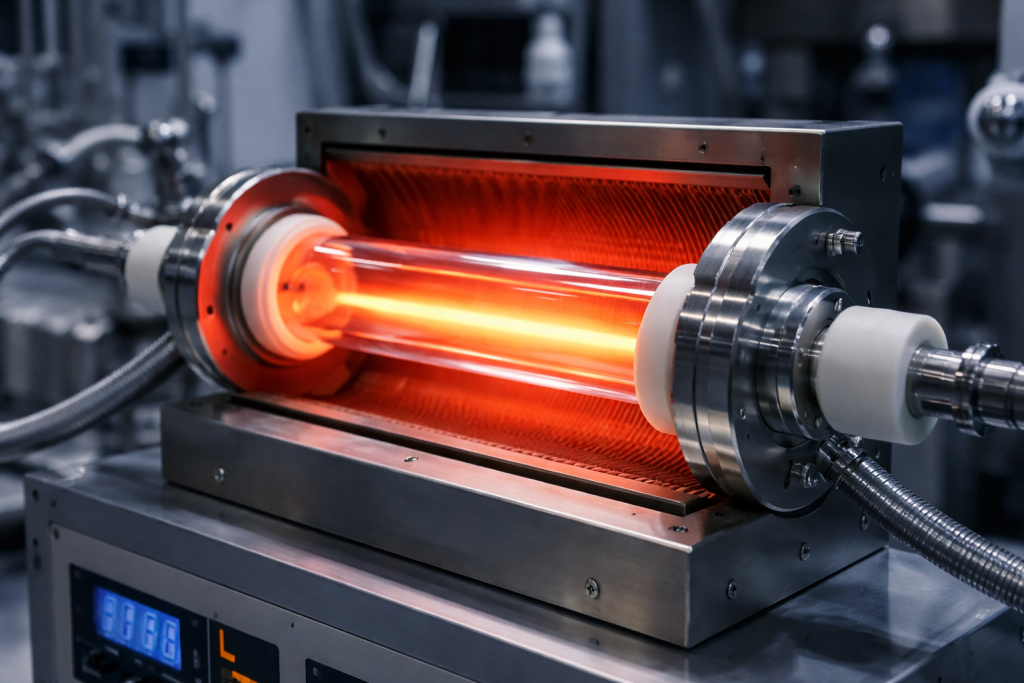
As semiconductor manufacturing continues to expand around 300 mm wafer platforms, quartz wafer boats remain one of the most important consumable components inside diffusion, oxidation, annealing and LPCVD furnaces.
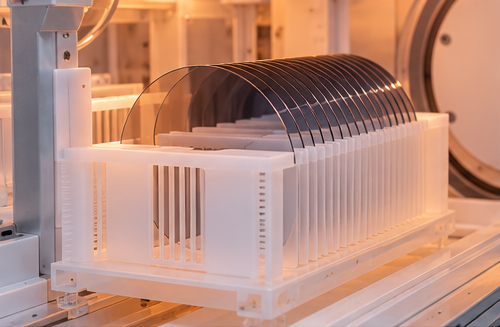
At first glance, a quartz wafer boat appears to be a relatively simple structure: several quartz rails containing a series of slots that support multiple wafers at a fixed pitch.
In practice, however, the geometry of every slot can affect wafer handling, thermal uniformity, particle generation and equipment compatibility.
A 300 mm wafer boat therefore needs to be treated as a precision process component rather than a generic quartz rack.
Why Quartz Is Used for Wafer Boats
Thermal semiconductor processes may operate at temperatures approaching or exceeding 1000°C.
The wafer boat must remain dimensionally stable while undergoing repeated heating and cooling cycles.
High-purity fused quartz is suitable because it provides low thermal expansion, strong thermal-shock resistance, low contamination and good chemical stability.
Quartz is therefore widely used for furnace tubes, injectors, liners and wafer boats.
Slot Pitch Is a Process Parameter
The pitch of a wafer boat is the center-to-center spacing between adjacent wafers.
Pitch directly affects how many wafers can be loaded into a furnace, but maximum capacity should not be the only design target.
If wafers are positioned too close together, gas flow between wafers may become more sensitive to furnace conditions.
If the pitch is unnecessarily large, furnace productivity decreases.
The correct slot pitch therefore depends on wafer diameter, thermal recipe, process chemistry, gas-flow design and equipment configuration.
For replacement quartz boats, the slot pitch should normally match the original equipment design.
Wafer Contact Geometry Matters
A wafer slot should support the wafer securely without creating excessive local stress.
The geometry of the contact area influences wafer insertion, wafer removal, edge contact and particle generation.
Sharp or damaged quartz contact points may increase the risk of wafer-edge chipping.
Excessive contact area, however, can create larger local thermal-contact zones.
The objective is therefore a stable and repeatable support geometry.
300mm Wafers Increase the Mechanical Challenge
A 300 mm silicon wafer spans a much larger distance than a 150 mm wafer.
The corresponding quartz boat is also larger.
This increases the importance of rail straightness, slot-position accuracy, overall parallelism and structural stiffness.
Small dimensional errors that might be acceptable in a laboratory carrier can become significant in a production furnace containing dozens of 300 mm wafers.
High-Temperature Sagging
Quartz offers excellent high-temperature performance, but it is not perfectly rigid under all conditions.
Long exposure to high temperature can gradually change the geometry of large quartz structures.
The degree of deformation depends on operating temperature, exposure time, support geometry, component span and quartz grade.
A wafer boat may remain visually intact while slowly developing slot misalignment or rail deformation.
Good structural design therefore tries to avoid unnecessarily long unsupported sections.
Devitrification Can Affect Service Life
Fused quartz is amorphous.
Under prolonged high-temperature exposure, particularly when contaminated by alkali or metallic species, local crystallization can occur.
This phenomenon is known as devitrification.
Devitrified regions may become cloudy, rough or white.
They can also behave differently under thermal cycling.
Contamination sources may include handling, dirty cleaning tanks, metal tools, furnace deposits and process residues.
Clean handling is therefore part of wafer-boat lifetime management.
Particle Control Starts at the Slot
Potential particle sources include chipped slot edges, grinding marks, residual machining debris, microcracks, devitrified regions and deposited films.
A wafer boat can remain dimensionally acceptable while becoming unsuitable because of deteriorating surface condition.
Maintenance should therefore include both dimensional and visual inspection.
Cleaning Without Creating New Damage
Used quartz boats are often chemically cleaned to remove process deposits.
Cleaning may extend service life, but careless handling can create new scratches or chips.
After cleaning, the boat should be inspected for damaged slots, cracks, residual deposits, cloudy regions and dimensional distortion.
What Should Be Specified in an RFQ?
A useful quartz wafer-boat drawing should include:
- wafer diameter;
- total capacity;
- slot pitch;
- slot width;
- rail spacing;
- overall dimensions;
- material grade;
- critical tolerances;
- cleaning requirement;
- acceptable chip limits.
For replacement parts, an original sample or detailed OEM drawing can be especially helpful.
Conclusion
A quartz wafer boat is not simply a holder for wafers.
It is part of the furnace process geometry.
For 300 mm thermal processing, reliable performance depends on:
material purity + slot geometry + dimensional stability + surface condition + clean handling.