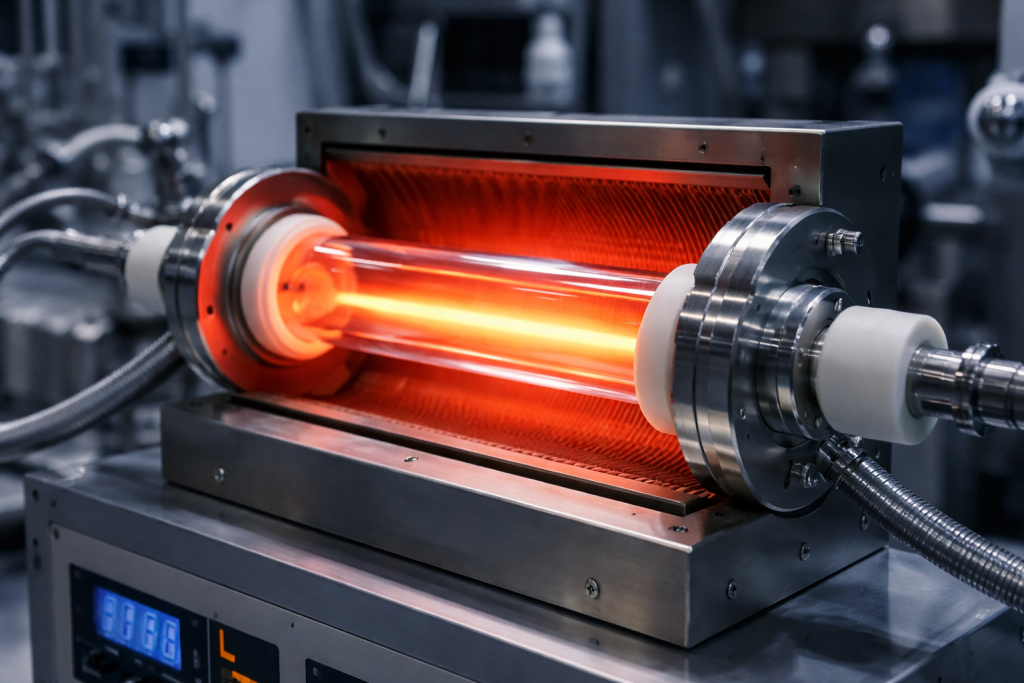
In semiconductor manufacturing, photovoltaic production, MEMS fabrication, compound semiconductor processing, and other advanced manufacturing industries, surface cleanliness directly affects device performance and process yield.
As device structures continue to shrink from the micrometer scale toward the nanometer scale, even extremely small amounts of contamination can become critical. Particles, metallic ions, organic residues, and process by-products may cause defects, electrical leakage, poor adhesion, reduced device reliability, or complete process failure.
For this reason, wet chemical cleaning remains one of the most important process steps in advanced manufacturing.
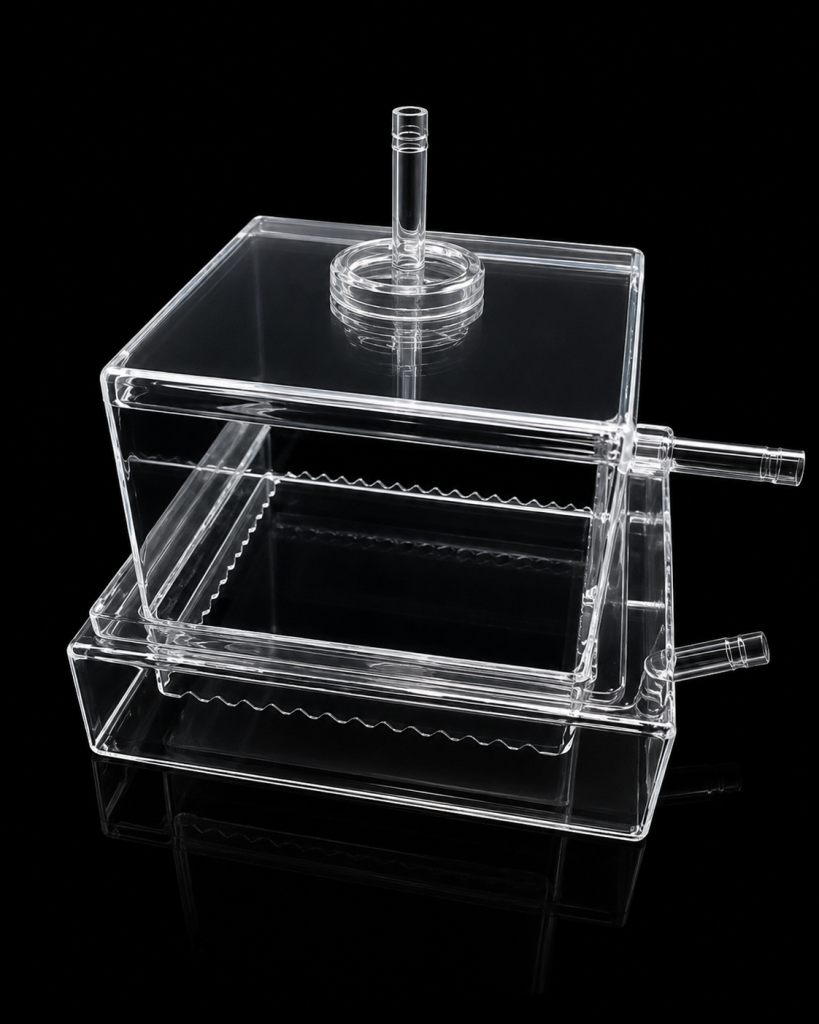
At the center of many wet processing systems is the quartz glass cleaning tank, also known as a quartz chemical bath, quartz wet process tank, or fused quartz cleaning vessel.
Made from high-purity fused quartz, these tanks provide a clean, chemically stable, and thermally reliable environment for precision cleaning and chemical processing.
Why Are Quartz Cleaning Tanks Important in Wet Processing?
A quartz cleaning tank is much more than a simple chemical container.
In high-purity manufacturing environments, it performs several important functions simultaneously:
- Chemical reaction vessel
- High-purity process liquid container
- Thermal management interface
- Contamination control barrier
- Wafer or substrate processing chamber
The performance of the tank can therefore directly influence process cleanliness, chemical stability, and ultimately product yield.
1. A Stable Reaction Vessel for Wet Chemical Processing
Many semiconductor and precision cleaning processes depend on carefully controlled chemical reactions.
Typical wet cleaning processes include:
- RCA cleaning
- SC-1 cleaning
- SC-2 cleaning
- SPM cleaning
- Acid cleaning
- Oxidation residue removal
- Metal contamination removal
- Organic contamination removal
- Wafer surface preparation
A properly designed quartz cleaning tank provides a stable environment in which process chemistry, temperature, immersion time, and substrate positioning can be controlled.
For example, RCA cleaning typically involves two important chemical stages.
SC-1 Cleaning
SC-1 generally uses a mixture based on:
NH₄OH + H₂O₂ + H₂O
It is commonly used to remove particles and certain organic contaminants from wafer surfaces.
SC-2 Cleaning
SC-2 commonly uses:
HCl + H₂O₂ + H₂O
This process is mainly used to remove metallic contamination and ionic impurities.
SPM Cleaning
Sulfuric peroxide mixture, often referred to as SPM or Piranha cleaning, typically consists of:
H₂SO₄ + H₂O₂
It is highly effective for removing organic residues.
Because many of these processes involve aggressive chemicals and elevated temperatures, the tank material must remain chemically stable while introducing as little contamination as possible.
High-purity fused quartz performs exceptionally well in many such environments.
2. A High-Purity Container for Aggressive Chemicals
Wet processing equipment frequently handles highly corrosive chemicals.
Depending on the process, these may include:
- Sulfuric acid — H₂SO₄
- Hydrochloric acid — HCl
- Nitric acid — HNO₃
- Hydrogen peroxide — H₂O₂
- Ammonium hydroxide — NH₄OH
- Aqua regia — HCl + HNO₃
- Various high-purity acidic cleaning solutions
At elevated temperatures, chemical compatibility becomes even more demanding.
Many metals can corrode and release metallic ions. Ordinary glass may contain sodium, potassium, calcium, boron, or other elements that can contaminate semiconductor wafers.
High-purity quartz offers a major advantage because its composition is predominantly SiO₂ with extremely low concentrations of metallic impurities.
This makes quartz particularly suitable for applications where contamination control is more important than simply containing the liquid.
Important Exception: Hydrofluoric Acid
One important material compatibility rule must be emphasized:
Quartz should not be used with hydrofluoric acid.
Hydrofluoric acid attacks silicon dioxide directly.
The basic reaction can be represented as:
SiO₂ + HF → fluorosilicate species
As a result, HF-containing solutions will gradually etch, thin, roughen, and eventually destroy a quartz tank.
Therefore, processes involving:
- HF
- Buffered oxide etch
- Dilute HF
- Fluoride-containing aggressive chemistry
normally require chemically compatible fluoropolymer materials such as:
- PFA
- PTFE
- PVDF, depending on process conditions
The tank material should always be selected according to the exact chemical recipe rather than temperature alone.
3. Quartz as a Thermal Management Interface
Many wet cleaning processes operate above room temperature because higher temperatures can accelerate chemical reactions and improve cleaning efficiency.
This introduces another challenge: thermal stress.
Fused quartz has an extremely low coefficient of thermal expansion, approximately:
5.5 × 10⁻⁷/K
This is significantly lower than that of many conventional glasses and engineering materials.
As a result, quartz provides excellent resistance to thermal shock.
This property allows properly designed quartz tanks to tolerate heating and cooling cycles more reliably than ordinary glass vessels.
For high-temperature wet processing, this means:
- Lower thermal stress
- Reduced risk of sudden cracking
- Better dimensional stability
- Stable process geometry
- More reliable repeated heating cycles
However, even fused quartz should not be treated as indestructible.
Large tanks, welded structures, sharp temperature gradients, mechanical stress, residual fabrication stress, and uneven heating can still lead to cracking.
For this reason, tank geometry and heating design are just as important as the material itself.
4. Quartz as a Contamination Control Barrier
Contamination control is one of the most important reasons quartz is widely used in semiconductor processing.
A cleaning tank must not become a source of contamination itself.
High-purity fused quartz can achieve extremely low concentrations of important metallic impurities such as:
- Sodium
- Potassium
- Iron
- Copper
- Calcium
- Aluminum
Depending on quartz grade and manufacturing process, selected impurities can be controlled to very low ppm or ppb levels.
This is especially important in semiconductor manufacturing because trace metallic contamination can influence:
- Gate oxide reliability
- Junction leakage
- Carrier lifetime
- Surface recombination
- Thin-film quality
- Device yield
Quartz also has a dense, relatively smooth surface that can be precision finished and carefully cleaned.
This helps reduce particle trapping and makes the material suitable for high-purity processing environments.
Why Is Fused Quartz Used Instead of Ordinary Glass?
The answer lies in the unique combination of purity, thermal stability, chemical resistance, and process compatibility offered by fused quartz.
1. Extremely High Purity
High-purity fused quartz primarily consists of SiO₂ and can reach purity levels exceeding:
99.99% SiO₂
Special semiconductor-grade quartz materials can provide even tighter impurity control.
Compared with common borosilicate or soda-lime glass, quartz contains significantly lower levels of alkali and metallic impurities.
This reduces the risk of introducing contaminants into:
- Silicon wafers
- Sapphire substrates
- SiC wafers
- GaAs wafers
- GaN substrates
- Optical components
- MEMS devices
For high-purity manufacturing, the chemical purity of the container itself is therefore an important part of process control.
2. Excellent Resistance to Many Acids
Fused quartz demonstrates excellent resistance to many acidic chemical environments.
It is commonly compatible with many concentrations and process conditions involving:
- Sulfuric acid
- Hydrochloric acid
- Nitric acid
- Hydrogen peroxide
- Acidic oxidizing mixtures
This makes quartz suitable for many cleaning, oxidation, stripping, and contamination-removal processes.
However, chemical resistance should never be generalized to all chemicals.
Quartz is vulnerable to:
- Hydrofluoric acid
- Fluoride-containing solutions
- Strong alkaline solutions
- Certain hot phosphate-containing environments
- Molten alkali compounds
Strong alkalis can also attack silica, particularly at elevated temperatures.
Therefore, the exact concentration, temperature, exposure time, and chemical composition should always be confirmed before specifying a quartz process tank.
3. Excellent Thermal Stability
The low thermal expansion coefficient of fused quartz gives it exceptional dimensional stability over a wide temperature range.
Compared with conventional glass, quartz experiences much less expansion during heating.
This is particularly useful for:
- Heated chemical baths
- Temperature-controlled cleaning
- Laboratory wet processing
- Semiconductor wet benches
- Repeated thermal cycling
Good thermal stability also helps maintain tank geometry during processing.
4. Clean and Smooth Surface
Quartz can be fabricated with smooth, dense surfaces that are easy to clean.
For high-purity applications, surface quality affects:
- Particle adhesion
- Chemical residue retention
- Cleaning efficiency
- Cross-contamination
- Process repeatability
A well-finished quartz surface minimizes unnecessary crevices and rough regions where contamination can accumulate.
Quartz vs. Other Cleaning Tank Materials
Different wet processes require different tank materials.
| Property | Fused Quartz | PFA/PTFE | PP | Stainless Steel |
|---|---|---|---|---|
| Purity | Excellent | Excellent | Good | Application-dependent |
| Transparency | Excellent | Limited / translucent | Limited | No |
| High-temperature stability | Excellent | Good | Limited | Good |
| Thermal shock resistance | Excellent | Excellent | Good | Good |
| Acid resistance | Excellent for many acids | Excellent | Good | Limited by chemistry |
| HF compatibility | No | Excellent | Application-dependent | Generally unsuitable |
| Strong alkali resistance | Limited | Excellent | Good | Application-dependent |
| Metallic contamination risk | Very low | Very low | Low | Higher for ultra-pure processes |
| Custom precision fabrication | Excellent | Good | Good | Excellent |
| Semiconductor wet processing | Excellent for compatible chemistry | Excellent | Selected processes | Specialized applications |
This comparison shows why no single tank material is suitable for every wet cleaning process.
Quartz is especially valuable where high purity, visibility, thermal stability, and resistance to non-fluoride acidic chemistry are required.
Major Applications of Quartz Glass Cleaning Tanks
Quartz wet process tanks are used from laboratory-scale research to advanced industrial manufacturing.
1. Semiconductor Manufacturing
One of the most important application areas is semiconductor wafer processing.
Quartz tanks can be used in compatible wet processes involving:
- Silicon wafer cleaning
- Pre-diffusion cleaning
- Pre-oxidation cleaning
- Organic residue removal
- Metal contamination removal
- Acid cleaning
- Surface preparation
These processes can influence important device characteristics such as:
- Surface cleanliness
- Gate oxide quality
- Junction leakage
- Film adhesion
- Defect density
- Electrical yield
For advanced semiconductor production, chemical purity and particle control are therefore critical.
2. Photovoltaic Manufacturing
Quartz processing vessels can also be used in selected wet processes for crystalline silicon solar cell manufacturing.
Applications may include:
- Wafer cleaning
- Surface preparation
- Contamination removal
- Laboratory texturing development
- Process chemistry evaluation
- High-purity chemical treatment
Material compatibility must be evaluated separately for each texturing or etching chemistry, particularly when alkaline or fluoride-containing solutions are involved.
3. MEMS and Microelectronics
MEMS fabrication involves extremely small mechanical structures that can be highly sensitive to particles and chemical residues.
Quartz tanks can provide a controlled wet processing environment for:
- Substrate cleaning
- Oxide-compatible cleaning
- Surface preparation
- Residue removal
- Research-scale wet etching processes where chemically compatible
The same advantages apply to microelectronic sensors and precision devices.
4. Compound Semiconductor Processing
Materials such as:
- GaAs
- GaN
- InP
- SiC
- Sapphire
often require specialized surface preparation before epitaxy, deposition, bonding, lithography, or device fabrication.
Custom quartz tanks can support compatible chemical cleaning processes while minimizing contamination from the processing vessel.
5. Optical and Photonic Components
High-purity quartz vessels are also suitable for precision cleaning of:
- Optical windows
- Laser components
- Sapphire optics
- Fused silica components
- Fiber optic components
- Precision glass substrates
For optical applications, particles and organic residues can strongly influence transmission, coating adhesion, and surface quality.
6. Laboratory and Analytical Applications
Quartz cleaning vessels are also widely used in laboratories requiring high chemical purity.
Typical applications include:
- Sample preparation
- Trace element analysis
- High-purity reagent handling
- Material research
- High-temperature chemical processing
- Semiconductor R&D
- University laboratories
Because quartz is transparent, researchers can visually monitor the chemical process and sample condition during treatment.
Custom Quartz Cleaning Tank Design
One of the major advantages of fused quartz is its fabrication flexibility.
A quartz cleaning tank does not need to be limited to a simple rectangular container.
Depending on the equipment design, custom features can include:
- Rectangular or cylindrical tank geometry
- Custom length, width, and depth
- Quartz covers
- Overflow structures
- Drain ports
- Inlet and outlet connections
- Quartz tubing connections
- Internal wafer carrier supports
- Weir structures
- Double-wall designs
- Custom quartz welding
- Heating-compatible structures
- Sensor ports
- Thermocouple interfaces
- Liquid level interfaces
For semiconductor wet benches, dimensional accuracy and connection position are often especially important because the tank must integrate with:
- Wafer carriers
- Robotic handling systems
- Chemical supply lines
- Exhaust systems
- Temperature controllers
- Recirculation systems
Custom fabrication therefore plays an important role in quartz tank performance.
Key Specifications When Ordering a Quartz Cleaning Tank
When requesting a custom quartz wet process tank, providing complete technical information can significantly reduce design and quotation time.
Recommended information includes:
Tank dimensions
Specify:
Length × Width × Height
and indicate whether these are internal or external dimensions.
Wall thickness
Wall thickness affects:
- Mechanical strength
- Tank weight
- Thermal behavior
- Fabrication difficulty
- Cost
Larger tanks normally require greater wall thickness or additional structural design.
Quartz material grade
Specify whether the application requires:
- Standard fused quartz
- High-purity fused quartz
- Semiconductor-grade quartz
For contamination-sensitive applications, impurity requirements should also be provided.
Operating temperature
Provide both:
- Normal process temperature
- Maximum temperature
This helps determine appropriate material thickness and fabrication design.
Chemical composition
Specify every chemical that will contact the quartz, including:
- Chemical name
- Concentration
- Temperature
- Exposure duration
This is essential for confirming compatibility.
Connection design
Indicate whether the tank requires:
- Drain outlet
- Overflow port
- Quartz tube
- Flange
- Ground joint
- Feedthrough
- Sensor interface
- Custom fitting
Application
Tell the manufacturer whether the tank is used for:
- Semiconductor wafers
- Solar wafers
- Sapphire
- SiC
- Laboratory samples
- Optical components
- High-purity chemical processing
Application information helps determine the appropriate manufacturing and cleaning requirements.
How to Improve the Service Life of a Quartz Cleaning Tank
Although fused quartz provides excellent thermal and chemical performance, correct operation remains essential.
Recommended practices include:
- Verify chemical compatibility before use.
- Never use quartz tanks for HF-containing processes.
- Avoid strong alkaline solutions unless compatibility has been specifically evaluated.
- Avoid severe local heating.
- Heat large tanks uniformly whenever possible.
- Prevent mechanical impact on tank corners and welded areas.
- Do not place heavy components directly onto unsupported quartz surfaces.
- Avoid sudden temperature gradients across large welded structures.
- Clean the tank using contamination-compatible procedures.
- Inspect welded joints and corners periodically.
A quartz tank normally fails because of a combination of chemical attack, thermal stress, mechanical stress, or improper handling, rather than because of temperature alone.
How to Choose the Right Material for a Wet Process Tank
The correct tank material should be selected according to four main parameters:
Chemical composition + process temperature + contamination requirements + mechanical design
Quartz is particularly suitable when the process requires:
- Extremely high purity
- Very low metallic contamination
- Good resistance to many acids
- Excellent thermal stability
- High-temperature capability
- Transparent process observation
- Smooth and clean surfaces
- Flexible custom fabrication
For HF-based or strongly alkaline processes, fluoropolymer or other compatible materials may be more appropriate.
Selecting the correct tank material from the beginning can improve process stability, reduce contamination, extend equipment service life, and reduce the risk of costly wafer loss.
Conclusion
In advanced manufacturing, a cleaning tank is not simply a container for chemicals. It is part of the process environment that directly influences contamination control, chemical stability, thermal uniformity, and product quality.
High-purity quartz glass cleaning tanks combine low metallic contamination, excellent thermal stability, good resistance to many aggressive acids, a smooth surface, transparency, and flexible custom fabrication.
These properties make them particularly valuable for semiconductor, photovoltaic, MEMS, compound semiconductor, optical, and laboratory wet processing applications.
For processes involving RCA cleaning, SPM cleaning, high-purity acid treatment, or contamination-sensitive surface preparation, a properly designed quartz tank can provide a clean and stable processing environment.
However, material compatibility remains critical. HF and fluoride-containing solutions attack quartz and require alternative tank materials such as PFA or PTFE.
When specifying a custom quartz cleaning tank, the most important information includes:
tank dimensions, wall thickness, quartz purity, process chemicals, chemical concentration, operating temperature, connection design, and application.
A tank designed around the actual process conditions will provide significantly better reliability than a generic laboratory vessel.
Frequently Asked Questions
Can quartz tanks be used for RCA cleaning?
Yes. High-purity fused quartz is suitable for many RCA cleaning processes, including compatible SC-1 and SC-2 chemistries, provided that temperature, concentration, and equipment design are appropriate.
Can a quartz cleaning tank hold hydrofluoric acid?
No. HF attacks silicon dioxide and will etch the quartz tank. PFA or PTFE is normally preferred for HF and fluoride-containing wet processes.
Can quartz tanks be used with sulfuric acid?
Quartz generally has excellent compatibility with sulfuric acid and is frequently used for compatible high-purity sulfuric acid and sulfuric-peroxide processes. Actual temperature and process conditions should still be evaluated.
Why use quartz instead of ordinary glass?
Quartz provides higher purity, much lower alkali contamination, better thermal stability, better thermal shock resistance, and superior suitability for contamination-sensitive semiconductor processes.
Can quartz cleaning tanks be custom manufactured?
Yes. Quartz tanks can be customized according to tank dimensions, wall thickness, overflow design, drain position, quartz connections, covers, wafer carrier interfaces, sensor ports, and wet bench integration requirements.
What information is required for a custom quartz tank quotation?
The most useful information includes tank dimensions, wall thickness, quartz grade, operating temperature, chemical type and concentration, connection requirements, drawings, quantity, and intended application.