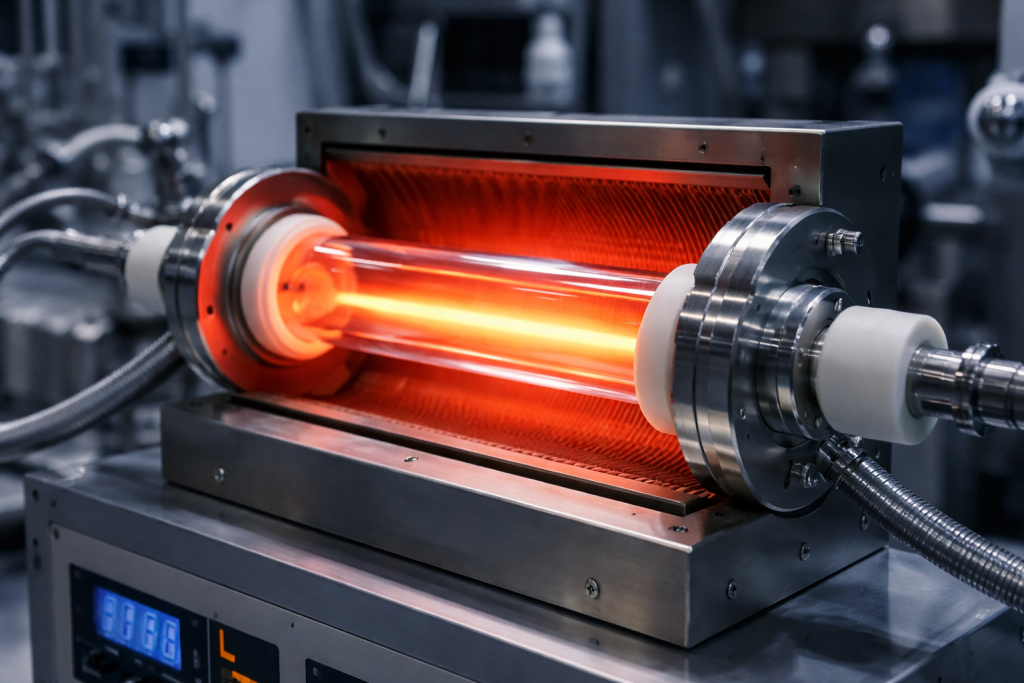
Thermocouples are among the most widely used contact temperature sensors in laboratory tube furnaces, muffle furnaces, vacuum furnaces, heat-treatment systems, semiconductor processing equipment, and industrial thermal systems.
However, the thermocouple wire itself is only part of the measurement system.
The thermocouple protection tube is the first barrier between the sensing element and the furnace environment. It protects the thermocouple from oxidation, corrosive gases, metal vapors, sample volatilization, mechanical impact, and direct contact with process materials.
In many cases, unstable temperature readings, calibration drift, shortened thermocouple life, or premature thermocouple failure are not caused by the sensor itself. The real problem is an incorrect protection tube material.
Among the most common options are:
- Fused quartz protection tubes
- High-purity alumina / corundum protection tubes
- Metal alloy protection tubes
Each material has very different temperature limits, thermal shock behavior, chemical compatibility, and mechanical properties.
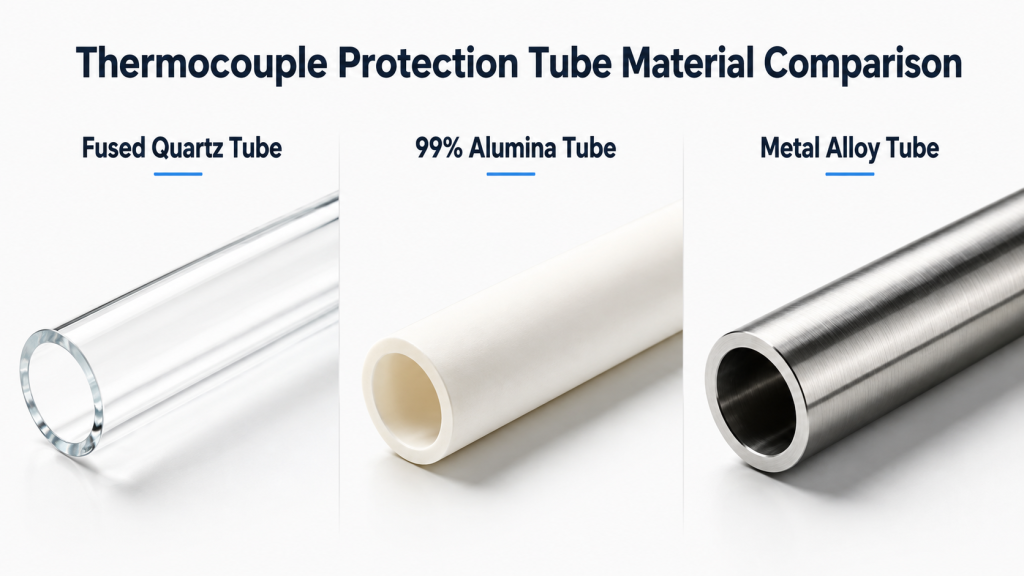
This guide compares quartz, 99% alumina, stainless steel, and nickel-alloy thermocouple protection tubes and explains how to select the appropriate material for B, S, W-Re, K, E, J, and T type thermocouples.
1. Why Does the Thermocouple Protection Tube Matter?
A thermocouple generates a voltage according to the temperature difference between two dissimilar conductors. To maintain accurate measurements, the thermocouple junction and wires must remain chemically and mechanically stable.
Without adequate protection, several problems can occur.
Thermocouple contamination
Metal vapors, sulfur compounds, alkali elements, carbonaceous gases, silicon-containing compounds, and other contaminants may react with thermocouple wires.
This is especially serious for platinum-rhodium thermocouples, where even relatively small amounts of contamination can change the thermoelectric characteristics of the wire.
Oxidation
Some thermocouple materials perform well in air, while others require vacuum, inert gas, or reducing atmospheres.
For example, tungsten-rhenium thermocouples rapidly oxidize when exposed to air at elevated temperatures.
Mechanical damage
Thin thermocouple wires can easily be damaged by vibration, furnace loading, sample movement, or accidental contact.
A protection tube provides mechanical isolation.
Chemical attack
Samples heated inside furnaces may release:
- Alkali metal vapors
- Sulfur-containing gases
- Metallic vapors
- Reducing gases
- Halogen-containing compounds
- Carbonaceous species
The protection tube must resist these substances before they reach the thermocouple.
For this reason, protection tube selection should always consider:
temperature + atmosphere + chemical environment + thermocouple type + mechanical conditions.
2. Fused Quartz Thermocouple Protection Tubes
Fused quartz is a high-purity amorphous silicon dioxide material consisting primarily of SiO₂.
Quartz thermocouple protection tubes are commonly manufactured as hollow tubes with one closed end, allowing the thermocouple and ceramic insulation components to be inserted from the open side.
They are widely used in laboratory furnaces because of their excellent thermal shock resistance and relatively low cost.
Main Advantages of Quartz Protection Tubes
Excellent thermal shock resistance
One of the most important advantages of fused quartz is its extremely low thermal expansion coefficient.
This gives quartz excellent resistance to rapid heating and cooling compared with many ceramic materials.
For laboratory furnaces that are frequently heated and cooled, this can significantly reduce the risk of thermal-shock cracking.
Transparent and easy to inspect
Quartz is transparent or translucent depending on material grade and wall thickness.
Users can visually inspect:
- Thermocouple position
- Ceramic insulation tubes
- Wire condition
- Internal contamination
- Condensed process materials
This is particularly convenient in research laboratories.
Good chemical stability in many oxidizing environments
High-purity fused quartz performs well in clean air and many oxidizing furnace environments.
Easy to fabricate
Quartz can be manufactured into:
- Closed-end protection tubes
- Open-ended tubes
- Flanged tubes
- Bent tubes
- Custom-diameter tubes
- Vacuum-compatible assemblies
Compared with advanced ceramics, custom fabrication can also be relatively economical.
Temperature Limit of Quartz Protection Tubes
For many furnace applications, fused quartz is most suitable for continuous service at approximately:
≤1000–1100°C
The exact allowable temperature depends on:
- Quartz purity
- Wall thickness
- Mechanical load
- Furnace atmosphere
- Heating duration
- Contamination level
- Surface condition
At prolonged elevated temperatures, particularly around or above 1100°C, fused quartz can gradually undergo devitrification.
The originally amorphous silica begins forming crystalline phases.
This can cause the tube to:
- Become cloudy or white
- Lose transparency
- Become more brittle
- Develop surface cracks
- Lose thermal shock resistance
- Eventually fracture
Therefore, quartz should not normally be selected simply because its softening temperature is high. The practical long-term operating temperature is more important than the theoretical material softening point.
When Quartz Should Be Used Carefully
Alkali-containing environments
Quartz has poor resistance to strong alkalis and alkali metal compounds.
Lithium, sodium, potassium, and related vapors can aggressively attack silica at high temperatures.
If samples release significant alkali vapor, alumina is usually a more suitable protection material.
Strong reducing or hydrogen-containing atmospheres
Quartz can behave differently in reducing environments than in clean oxidizing atmospheres.
Hydrogen and reducing species may promote reactions, gas penetration, surface degradation, or contamination depending on temperature and process conditions.
For sustained high-temperature reducing environments, high-purity ceramic protection is generally preferred.
Platinum-rhodium thermocouples
For precious-metal thermocouples such as B and S types, high-purity alumina is normally preferred over quartz.
At elevated temperatures, contamination from silica-containing materials, impurities, process vapors, or furnace components may negatively affect platinum-based thermocouples.
Because B and S thermocouples are expensive and are often used for precision high-temperature measurement, protection system purity becomes especially important.
3. 99% High-Purity Alumina / Corundum Protection Tubes
High-purity alumina protection tubes are normally manufactured from approximately 99% or higher Al₂O₃ ceramic.
They are commonly white or ivory in appearance and are opaque.
For high-temperature furnaces, precious-metal thermocouples, and chemically demanding environments, alumina is one of the most widely used ceramic protection materials.
Main Advantages of Alumina Protection Tubes
Higher operating temperature
Depending on purity, density, manufacturing process, and mechanical loading, high-purity alumina protection tubes can commonly be used at approximately:
1500–1600°C in long-term furnace applications
Some high-purity alumina grades may tolerate even higher temperatures under controlled conditions.
This gives alumina a significant advantage over fused quartz when furnace temperatures exceed approximately 1100°C.
Excellent high-temperature structural stability
Unlike fused quartz, alumina does not suffer from the same silica devitrification mechanism.
Its ceramic crystal structure remains stable at high temperatures when operated within the appropriate temperature range.
Strong chemical resistance
High-purity alumina has good resistance to many:
- Oxidizing atmospheres
- Inert gases
- Vacuum conditions
- Mild reducing environments
- Metallic vapors
- Alkali-containing environments
Chemical compatibility must still be evaluated for aggressive molten salts, strong reducing conditions, or specialized process chemistries.
Suitable for precious-metal thermocouples
High-purity alumina is widely used with:
- Type B thermocouples
- Type S thermocouples
- Type R thermocouples
- Other platinum-based sensors
The high purity of the ceramic helps reduce contamination risks at elevated temperatures.
Limitations of Alumina Protection Tubes
Lower thermal shock resistance than quartz
This is one of the most important practical differences.
Alumina has a significantly higher thermal expansion coefficient than fused quartz.
Rapid temperature changes may therefore produce thermal stress and cracking.
Avoid:
- Inserting a cold alumina tube directly into an extremely hot furnace
- Removing a red-hot alumina tube into cold air
- Extremely fast furnace ramp rates
- Direct cold-gas impingement on hot ceramic tubes
Controlled heating and cooling can greatly increase service life.
Opaque material
Because alumina is not transparent, thermocouple wires cannot be visually inspected without removing the sensor assembly.
Higher manufacturing cost
High-purity ceramic raw materials, forming, sintering, grinding, and finishing generally make alumina protection tubes more expensive than standard quartz tubes.
However, in high-temperature or corrosive environments, the longer thermocouple lifetime may justify the additional cost.
4. Metal Thermocouple Protection Tubes
Metal protection tubes are widely used in industrial environments where mechanical strength is more important than extreme temperature capability.
Common materials include:
- 304 stainless steel
- 316 / 316L stainless steel
- Inconel 600
- Inconel 601
- Other nickel-based heat-resistant alloys
Compared with quartz and alumina, metal tubes are much less fragile.
Advantages of Metal Protection Tubes
Excellent mechanical strength
Metal tubes provide excellent resistance to:
- Impact
- Vibration
- Handling damage
- Mechanical loading
- Installation stress
This makes them particularly useful in industrial equipment.
Easy mechanical integration
Metal tubes can be manufactured with:
- Threads
- Compression fittings
- Welded flanges
- Vacuum fittings
- Process connections
- Mounting bosses
This makes them ideal for industrial reactors, tanks, pipes, furnaces, and pressure systems.
Good performance at low and medium temperatures
Stainless steel protection tubes are economical and effective for many applications below approximately 700–800°C.
Nickel-based alloys can operate at higher temperatures.
5. Stainless Steel vs. Inconel Protection Tubes
The term “metal protection tube” covers materials with very different temperature capabilities.
316 Stainless Steel
316 stainless steel offers:
- Good general corrosion resistance
- Good mechanical strength
- Easy machining and welding
- Relatively low cost
For prolonged high-temperature service, however, oxidation and scale formation become increasingly important.
In practical thermocouple protection applications, 316 stainless steel is normally selected for low- to medium-temperature environments rather than extreme furnace temperatures.
Inconel 600 / 601
Nickel-based Inconel alloys provide significantly better oxidation resistance at elevated temperatures.
Depending on atmosphere and application design, certain Inconel grades can operate around or above 1000°C.
However, actual service life depends strongly on:
- Furnace atmosphere
- Sulfur exposure
- Carbon activity
- Thermal cycling
- Wall thickness
- Mechanical stress
- Metal vapor contamination
Therefore, a nickel-alloy tube should not automatically be considered equivalent to an alumina ceramic tube simply because both have high published temperature ratings.
For long-term high-temperature furnace measurement above approximately 1000–1100°C, high-purity ceramics are often preferred when mechanical impact is not the dominant concern.
6. Quartz vs. Alumina vs. Metal Protection Tubes
| Property | Fused Quartz | 99% Alumina | Stainless Steel / Inconel |
|---|---|---|---|
| Typical long-term temperature | ≤1000–1100°C | Approx. 1500–1600°C | Alloy-dependent |
| Thermal shock resistance | Excellent | Moderate to low | Good |
| Mechanical impact resistance | Low | Low to moderate | Excellent |
| Transparency | Yes | No | No |
| Oxidizing atmosphere | Excellent | Excellent | Good to excellent |
| High-temperature reducing atmosphere | Limited | Better | Alloy-dependent |
| Alkali vapor resistance | Poor | Better | Application-dependent |
| Precious-metal thermocouples | Generally not preferred | Excellent choice | Usually avoided at high temperature |
| Custom machining | Easy | More difficult | Excellent |
| Thread / flange integration | Possible | Limited | Excellent |
| Relative cost | Low | Medium to high | Medium to high |
| Typical application | Laboratory furnace | High-temperature furnace | Industrial process equipment |
No single protection tube material is ideal for every application.
7. Protection Tube Selection by Thermocouple Type
Type B Thermocouples
Type B thermocouples use platinum-rhodium alloys and are designed for very high-temperature measurement.
Because the wire is expensive and sensitive to contamination, material purity is extremely important.
Recommended
High-purity alumina protection tube
High-purity alumina tubes and alumina insulators are widely used to isolate platinum-rhodium wires from furnace contaminants.
Avoid when possible
Standard metal protection tubes at high temperatures should normally be avoided because metallic contamination may affect the precious-metal wires.
Quartz is also generally not the first choice for long-term high-temperature B-type thermocouple protection.
For precision measurements, a high-purity ceramic protection system is preferred.
8. Type S Thermocouples
Type S thermocouples are another platinum-rhodium thermocouple commonly used in high-temperature furnaces.
Their requirements are similar to Type B thermocouples.
Recommended
99% or higher purity alumina
For demanding applications, even higher-purity alumina may be specified.
The inner insulating components should also have appropriate purity to minimize contamination.
9. Tungsten-Rhenium Thermocouples
Tungsten-rhenium thermocouples are commonly used for extremely high-temperature measurements.
They must generally operate in:
- Vacuum
- Inert gas
- Controlled reducing atmospheres
They should not be exposed directly to high-temperature air because tungsten oxidizes rapidly.
Protection tube selection
High-purity alumina can be suitable when:
- Operating temperature remains within the ceramic’s safe range
- The atmosphere is chemically compatible
- The application does not exceed the practical temperature capability of alumina
However, W-Re thermocouples may operate at temperatures well beyond the service limit of ordinary alumina tubes.
For ultra-high-temperature applications, specialized ceramics or refractory-metal protection systems may therefore be required.
This is an important example where none of quartz, conventional alumina, or standard metal tubes may be suitable for the entire thermocouple temperature range.
10. Type K Thermocouples
Type K thermocouples are among the most widely used thermocouples in laboratory and industrial furnaces.
They provide a good balance between:
- Cost
- Temperature range
- Oxidation resistance
- Availability
- Measurement stability
Protection tube selection should primarily depend on operating atmosphere and temperature.
Condition 1: Clean oxidizing atmosphere below approximately 1000–1100°C
Quartz protection tube
Quartz is often an economical solution for laboratory tube furnaces when:
- The atmosphere is air
- No significant alkali vapor is present
- No aggressive reducing gas is present
- Rapid heating and cooling are common
Condition 2: Above approximately 1100°C
Alumina protection tube
Alumina is usually preferred because prolonged exposure at these temperatures may accelerate quartz devitrification.
Condition 3: Hydrogen, reducing atmosphere, or alkali-containing vapor
High-purity alumina is normally preferred.
Condition 4: Lower temperature with mechanical vibration
Metal alloy protection tube
A stainless steel or nickel-alloy protection tube may provide significantly better mechanical reliability.
11. Type E Thermocouples
Type E thermocouples use nickel-chromium and constantan conductors.
They provide a relatively high thermoelectric output and are commonly used for low- and intermediate-temperature measurement.
For clean oxidizing furnace applications:
Quartz can be used at suitable temperatures.
For environments containing aggressive vapors or reducing gases:
Alumina may provide better chemical protection.
For industrial applications where mechanical strength is important:
Metal protection tubes are often preferred.
12. Type J Thermocouples
Type J thermocouples use iron and constantan.
Because the iron conductor is susceptible to oxidation, Type J thermocouples are generally used at lower temperatures than Type K thermocouples.
For relatively clean furnace environments, quartz can provide adequate protection.
For industrial processes involving vibration or physical impact, stainless steel protection tubes are often more practical.
Where corrosive vapors or chemically aggressive furnace atmospheres are present, alumina may provide additional isolation.
13. Type T Thermocouples
Type T thermocouples use copper and constantan and are mainly used for relatively low-temperature measurement.
Because the required operating temperature is much lower, extremely high-temperature ceramic protection is rarely necessary.
Recommended
Metal protection tubes
Advantages include:
- Excellent mechanical protection
- Easy installation
- Compact design
- Thread and flange compatibility
- Good durability
Quartz or alumina can also be used, but their high-temperature properties are normally unnecessary for Type T applications.
14. Quick Thermocouple Protection Tube Selection Table
| Thermocouple | Typical Protection Tube | Main Reason |
| Type B | High-purity alumina | High temperature and contamination control |
| Type S | High-purity alumina | Protect platinum-rhodium wire |
| Type R | High-purity alumina | Precious-metal thermocouple protection |
| W-Re | Alumina or specialized refractory material | Vacuum / inert high-temperature operation |
| Type K | Quartz / alumina / metal | Depends strongly on temperature and atmosphere |
| Type E | Quartz / alumina / metal | Moderate-temperature applications |
| Type J | Quartz / metal / alumina | Generally lower-temperature operation |
| Type T | Metal | Low temperature and mechanical protection |
This table should be treated as an initial selection guide rather than an absolute rule.
Actual material selection must consider the complete furnace environment.
15. Five Questions to Ask Before Selecting a Protection Tube
Before ordering a thermocouple protection tube, answer the following questions.
1. What is the maximum continuous operating temperature?
Do not select materials based only on the furnace’s temporary peak temperature.
Continuous operating temperature is usually more important.
For example:
- 800°C → quartz, alumina, or metal may all be possible
- 1050°C → quartz may still be suitable under appropriate conditions
- 1200°C → alumina is normally preferred
- 1500°C → high-purity alumina is typically required
1600°C → specialized materials may be necessary
2. What is the furnace atmosphere?
Identify whether the process uses:
- Air
- Oxygen
- Nitrogen
- Argon
- Vacuum
- Hydrogen
- Forming gas
- Carbon-containing gases
- Other reducing atmospheres
Atmosphere can completely change material compatibility.
3. What does the sample release at high temperature?
This question is frequently overlooked.
Samples may release:
- Sodium
- Potassium
- Lithium
- Zinc
- Lead
- Sulfur
- Silicon compounds
- Metal vapor
- Organic decomposition products
These substances can attack the protection tube or contaminate the thermocouple.
4. How fast does the furnace heat and cool?
For rapid thermal cycling:
Quartz has a major advantage.
For slow heating at very high temperatures:
Alumina may provide much longer service life.
5. Is mechanical strength important?
If the thermocouple is installed in:
- Moving equipment
- High-vibration machinery
- Pipelines
- Industrial reactors
- Pressure vessels
a metal protection tube may be more practical than fragile ceramic or quartz components.
16. Protection Tube Diameter and Wall Thickness Also Matter
Material is not the only specification affecting performance.
Protection tube geometry influences measurement response and lifetime.
Smaller diameter
Advantages:
- Faster thermal response
- Lower thermal mass
Disadvantages:
- Lower mechanical strength
- More susceptible to breakage
Larger diameter
Advantages:
- Better mechanical strength
- Longer potential service life
Disadvantages:
- Slower temperature response
- Greater thermal lag
The correct diameter should balance response speed with mechanical reliability.
17. Closed-End Thickness and Temperature Response
Most furnace thermocouple protection tubes have one closed end.
The thermocouple measuring junction should be positioned close to this end to minimize response delay.
However, the junction should not be forced mechanically against the wall.
Excessive tip thickness can increase:
- Thermal lag
- Response time
- Measurement delay
For applications requiring rapid temperature tracking, the protection tube tip geometry should therefore be carefully designed.
18. Installation Tips for Alumina Protection Tubes
Because alumina is more sensitive to thermal shock than quartz, proper installation significantly affects service life.
Recommended practices include:
- Avoid inserting room-temperature ceramic directly into an extremely hot furnace.
- Avoid removing red-hot alumina tubes directly into cold airflow.
- Use controlled furnace ramp rates where possible.
- Avoid excessive cantilever length.
- Support long tubes mechanically.
- Prevent excessive flange clamping force.
- Allow for thermal expansion.
- Do not force the ceramic tube into misaligned mounting holes.
Many ceramic protection tube failures occur because of mechanical installation stress rather than insufficient material temperature resistance.
19. When Should a Thermocouple Protection Tube Be Replaced?
Protection tubes should be inspected periodically.
Replace quartz tubes when you observe:
- Severe clouding
- Devitrification
- Surface cracking
- Chemical corrosion
- Local wall thinning
- Deposits that cannot be removed
- Visible deformation
Replace alumina tubes when you observe:
- Longitudinal cracks
- Tip cracking
- Severe surface corrosion
- Excessive bending
- Mechanical damage
Replace metal tubes when you observe:
- Oxide scale
- Wall thinning
- Pitting
- Deformation
- Cracking
- Weld damage
- Corrosion penetration
A damaged protection tube should not be treated as a cosmetic issue.
Once the barrier fails, furnace contaminants can reach the thermocouple directly and permanently alter its calibration.
20. Which Thermocouple Protection Tube Should You Choose?
There is no universal “best” thermocouple protection tube.
The correct choice depends on the application.
Choose fused quartz when:
- Temperature is generally below approximately 1000–1100°C
- The atmosphere is clean and oxidizing
- Thermal cycling is frequent
- Visual inspection is useful
- Cost is important
Choose high-purity alumina when:
- Temperature exceeds approximately 1100°C
- Platinum-rhodium thermocouples are used
- High-temperature chemical stability is required
- Alkali or metallic vapor contamination is possible
- Furnace temperatures may reach 1400–1600°C
Choose stainless steel or nickel alloy when:
- Mechanical strength is critical
- Vibration or impact is present
- Threaded or flanged installation is required
- Operating temperature is within the alloy’s safe range
- Industrial installation durability is more important than extreme-temperature capability
Conclusion
A thermocouple protection tube may appear to be a simple furnace accessory, but it plays a major role in the reliability of the entire temperature measurement system.
Incorrect protection tube selection can result in:
- Thermocouple contamination
- Calibration drift
- Unstable temperature readings
- Premature sensor failure
- Furnace downtime
- Incorrect experimental data
For relatively clean laboratory furnaces below approximately 1000–1100°C, fused quartz offers excellent thermal shock resistance and good cost performance.
For high-temperature furnaces, aggressive environments, and platinum-rhodium thermocouples, high-purity alumina is generally the preferred solution.
For lower-temperature industrial systems where vibration, impact resistance, pressure sealing, and mechanical installation are important, stainless steel or nickel-alloy protection tubes provide significant advantages.
The most reliable selection therefore starts with five parameters:
maximum temperature, furnace atmosphere, process chemistry, thermocouple type, and mechanical conditions.
Matching these factors with the correct protection tube material can significantly improve temperature measurement stability and extend thermocouple service life.
Frequently Asked Questions
1. Is quartz or alumina better for thermocouple protection tubes?
Neither material is universally better.
Quartz offers superior thermal shock resistance and is suitable for many laboratory furnace applications below approximately 1000–1100°C.
Alumina offers significantly better high-temperature capability and is generally preferred for temperatures above approximately 1100°C and for precious-metal thermocouples.
2. Can quartz protection tubes be used at 1200°C?
Quartz may tolerate short-term exposure depending on grade and conditions, but prolonged operation near or above this temperature increases the risk of devitrification and loss of mechanical strength.
For continuous 1200°C service, high-purity alumina is normally a safer choice.
3. What protection tube is recommended for Type S thermocouples?
High-purity alumina protection tubes and alumina insulating components are commonly recommended for Type S platinum-rhodium thermocouples because they provide good high-temperature stability and help minimize contamination.
4. What protection tube should be used for a Type K thermocouple?
For clean air applications below approximately 1000–1100°C, quartz is often suitable.
For higher temperatures or chemically aggressive atmospheres, alumina is generally preferred.
For lower-temperature industrial applications requiring high mechanical strength, stainless steel or nickel-alloy protection tubes may be used.
5. Why do alumina thermocouple protection tubes crack?
The most common causes include thermal shock, excessive heating or cooling rates, mechanical stress, improper mounting, excessive unsupported length, and accidental impact.
Controlled temperature changes and correct mechanical support can significantly improve service life.
6. Can Inconel protection tubes operate above 1000°C?
Certain Inconel grades can operate around or above 1000°C in suitable atmospheres. However, actual service life depends strongly on alloy grade, atmosphere, sulfur content, oxidation conditions, wall thickness, and thermal cycling.
For long-term extreme-temperature furnace measurement, ceramic protection tubes may still provide better chemical stability.
7. What information is needed when ordering a custom thermocouple protection tube?
Typical specifications include:
- Material
- Outer diameter
- Inner diameter
- Wall thickness
- Total length
- Closed-end or open-end design
- Maximum operating temperature
- Furnace atmosphere
- Thermocouple type
- Required flange or connection
- Quantity
Providing the actual application conditions helps the manufacturer recommend a more reliable protection tube design.