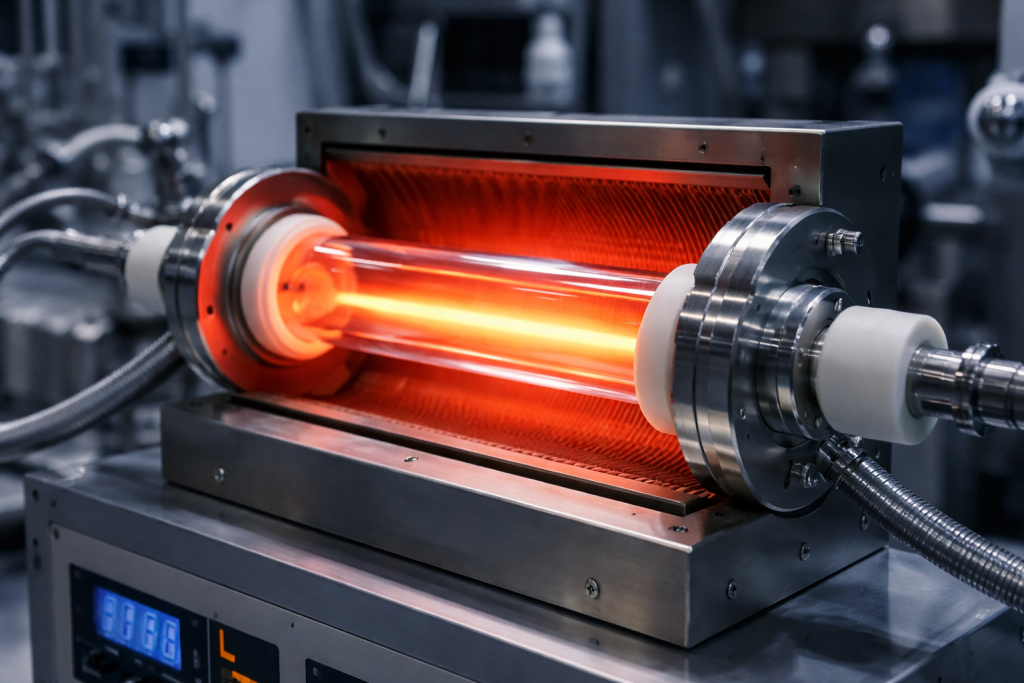
Quartz components are widely used in semiconductor manufacturing equipment because of their high thermal stability, chemical resistance, low contamination potential, and excellent performance in high-temperature and plasma-related processes.
From diffusion furnaces and oxidation systems to deposition, etching, cleaning, and wafer-handling equipment, semiconductor-grade quartz parts must meet much stricter requirements than ordinary industrial glass components.
For equipment manufacturers and semiconductor fabs, selecting a quartz supplier is therefore not simply a matter of machining a component to the correct dimensions. Material purity, welding quality, dimensional tolerance, surface condition, cleaning, and particle control can all directly affect process stability and wafer yield.
This guide explains the key considerations in quartz parts manufacturing for advanced semiconductor equipment.
Why Quartz Is Used in Semiconductor Equipment
High-purity fused quartz consists primarily of silicon dioxide and offers a combination of properties that are particularly suitable for semiconductor processing.
Important advantages include:
- High resistance to elevated temperatures
- Low thermal expansion
- Good thermal shock resistance
- Excellent chemical stability
- Low metallic contamination
- High purity
- Good optical transmission in selected wavelengths
- Ability to fabricate complex custom geometries
- Compatibility with many semiconductor cleaning processes
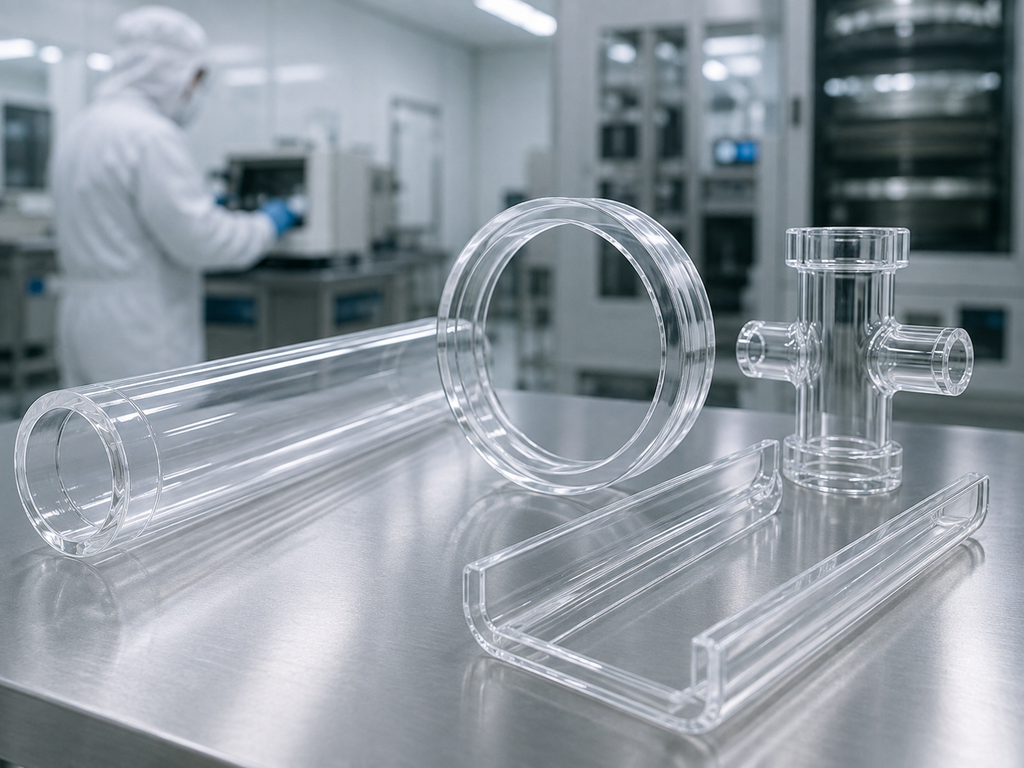
Typical semiconductor quartz components include:
- Quartz furnace tubes
- Diffusion tubes
- Process chambers
- Quartz wafer boats
- Wafer carriers
- Pedestals
- Quartz rings
- Flanges
- Sleeves
- Bell jars
- Injector tubes
- Gas distribution components
- Quartz windows
- Susceptor support components
- Custom welded assemblies
The required specifications depend strongly on the process in which the component will be used.
1. Material Purity Is the Foundation of Semiconductor-Grade Quartz Parts
The first consideration in quartz component fabrication is the purity of the raw material.
Semiconductor processes are highly sensitive to contamination. Even trace amounts of alkali metals, transition metals, or other impurities may influence electrical properties, film quality, defect density, or device reliability.
Common metallic impurities of concern include:
- Aluminum
- Iron
- Sodium
- Potassium
- Lithium
- Calcium
- Magnesium
- Titanium
For critical semiconductor applications, high-purity fused quartz is normally selected rather than general industrial-grade quartz glass.
The required purity should be specified according to the actual process.
For example, a quartz component used in a semiconductor diffusion furnace may require substantially tighter contamination control than a quartz observation window used outside the critical process zone.
When sourcing custom quartz parts, buyers should confirm:
- Raw quartz material grade
- SiO₂ purity
- Metallic impurity limits
- OH content where relevant
- Material traceability
- Lot consistency
- Cleaning method
- Packaging environment
Raw material certification can be particularly important for components installed close to wafers.
2. Quartz Welding Is Critical for Complex Components
Many semiconductor quartz parts cannot be manufactured from a single piece of material.
Large process tubes, flanges, gas injectors, chambers, and complex assemblies often require quartz welding.
Quartz welding normally uses localized high-temperature heating to soften and fuse quartz sections together without introducing conventional filler materials.
Although the process may appear simple, semiconductor-grade quartz welding requires significant process control.
Poor welding can lead to:
- Local wall-thickness variation
- Internal stress
- Distortion
- Bubbles
- Inclusions
- Surface irregularities
- Weak joints
- Cracking during thermal cycling
The welding zone must therefore be carefully controlled.
Stress Around Welded Areas
One of the most important concerns is residual thermal stress.
Quartz has a low coefficient of thermal expansion, but rapid or uneven heating during fabrication can still create localized stress.
If residual stress is excessive, the component may survive final inspection but crack after repeated heating and cooling inside semiconductor equipment.
Proper annealing after welding can reduce residual stress and improve service reliability.
Weld Geometry
Weld geometry also affects mechanical strength and flow behavior.
For gas-handling components, irregular weld beads or internal protrusions may disturb gas flow or create areas where particles accumulate.
For furnace tubes or chambers, dimensional distortion near the joint may also affect installation accuracy.
A high-quality quartz welding process should therefore consider both mechanical integrity and the internal geometry of the finished part.
3. Dimensional Tolerance Becomes More Important as Equipment Precision Increases
Modern semiconductor equipment requires increasingly precise component positioning.
Quartz parts may interface with:
- Metal chambers
- Ceramic components
- Wafer handling systems
- O-rings
- Vacuum seals
- Heating elements
- Gas delivery systems
- Alignment structures
As a result, dimensional tolerance is a critical manufacturing parameter.
Typical specifications may include:
- Outer diameter
- Inner diameter
- Wall thickness
- Overall length
- Flatness
- Parallelism
- Concentricity
- Roundness
- Perpendicularity
- Hole diameter
- Slot width
- Groove dimensions
- Flange thickness
Not every quartz component requires extremely tight tolerances.
The correct tolerance should be determined according to function.
Over-specifying tolerances can significantly increase machining cost without improving equipment performance.
For example, a mating sealing surface may require tight flatness, while a non-functional external surface may allow considerably larger dimensional variation.
4. CNC Machining of Quartz Components
Complex semiconductor quartz parts may require CNC grinding, drilling, milling, slotting, or polishing.
Quartz is hard and brittle, making machining fundamentally different from machining metals or polymers.
Improper machining conditions can cause:
- Edge chipping
- Microcracks
- Subsurface damage
- Fracture
- Poor dimensional accuracy
- Excessive surface roughness
Diamond tools are commonly used for quartz machining.
Tool condition, feed rate, spindle speed, cooling, fixturing, and machining sequence all influence the quality of the final component.
For thin-wall quartz components, mechanical stress during machining must be particularly well controlled.
5. Surface Finish and Microcrack Control
Surface condition has both mechanical and contamination implications.
A rough or damaged quartz surface can contain microscopic cracks that may grow under thermal or mechanical stress.
Surface defects can also provide sites where process residues and particles accumulate.
Depending on the application, quartz components may receive:
- Ground surfaces
- Fine-ground surfaces
- Mechanically polished surfaces
- Fire-polished surfaces
- Optical-polished surfaces
The correct finishing process depends on the component.
A semiconductor process chamber does not necessarily require optical polishing, while a quartz optical window may require extremely low surface roughness and strict scratch-dig specifications.
The objective should be to achieve the surface quality required for the application without unnecessary processing.
6. Particle Control Is a Major Semiconductor Manufacturing Requirement
Particles are one of the most important contamination concerns in semiconductor fabrication.
Particles generated from quartz components can settle on wafers and contribute to defects during lithography, deposition, etching, or thermal processing.
Particle generation may result from:
- Rough machined surfaces
- Chipped edges
- Poor welding
- Microcracks
- Residual machining debris
- Improper cleaning
- Handling damage
- Chemical attack during service
- Repeated thermal cycling
Because of this, particle control must begin during manufacturing rather than only during final cleaning.
Edge Quality
Sharp or damaged quartz edges are especially susceptible to chipping.
Depending on the design, controlled chamfers or rounded edges may help improve handling durability.
However, edge geometry must not interfere with the functional dimensions of the component.
Manufacturing Environment
The production environment is also important.
After machining and welding, semiconductor quartz components should be protected from:
- Dust
- Metal particles
- Oil
- Fingerprints
- Packaging contamination
Clean handling procedures become particularly important during final manufacturing stages.
7. Cleaning Semiconductor Quartz Components
Cleaning removes machining residues, particles, metallic contamination, and surface contaminants before the component is packaged.
The exact cleaning process varies depending on material grade, contamination level, customer requirements, and component geometry.
A typical process may include several stages such as:
- Initial particle removal
- Detergent or chemical cleaning
- High-purity water rinsing
- Acid cleaning where appropriate
- Final DI water rinsing
- Controlled drying
- Clean inspection
- Clean packaging
For semiconductor-grade components, contamination can easily be reintroduced after cleaning.
Therefore, final inspection, handling, and packaging should be integrated with the cleaning process.
8. Thermal Stability and Annealing
Quartz components used in diffusion, oxidation, annealing, and deposition equipment may experience repeated heating and cooling cycles.
Residual stress from machining or welding can reduce component life.
Annealing is therefore an important step for many welded or heavily processed quartz components.
A suitable annealing process can:
- Reduce residual stress
- Improve thermal cycling reliability
- Reduce crack risk
- Stabilize component geometry
For large quartz chambers and furnace tubes, uniform heating and controlled cooling are particularly important.
9. Inspection of Custom Quartz Parts
Dimensional inspection alone is not sufficient for semiconductor quartz components.
Depending on the application, inspection may include:
- Visual inspection
- Dimensional measurement
- Wall-thickness inspection
- Flatness measurement
- Concentricity measurement
- Surface defect inspection
- Weld inspection
- Stress inspection
- Particle inspection
- Cleanliness inspection
Critical components may also require documentation associated with raw material and manufacturing records.
A clear drawing is therefore essential when ordering custom quartz parts.
10. What Information Should Be Included in a Quartz Component Drawing?
Providing complete specifications can significantly reduce communication time between the customer and quartz manufacturer.
A typical RFQ should include:
Component Information
- Part name
- Drawing number
- Application
- Equipment type if available
Material
- Fused quartz grade
- Required purity
- OH requirement if applicable
Dimensions
- Diameter
- Length
- Thickness
- Hole dimensions
- Groove dimensions
- Slot dimensions
Tolerances
Specify tolerances only where necessary.
Critical dimensions should be clearly identified.
Surface Requirements
Examples include:
- Ground
- Fine ground
- Fire polished
- Mechanically polished
- Optical polished
Edge Requirements
Specify:
- Chamfer
- Radius
- Sharp edge restrictions
- Chip limits
Cleaning Requirements
Specify whether semiconductor-grade cleaning is required.
Quantity
Prototype quantities and production quantities should both be provided where possible.
11. Quartz Components for Different Semiconductor Processes
Quartz component requirements vary significantly by process.
Diffusion and Oxidation
Typical parts include:
- Furnace tubes
- Wafer boats
- Gas injectors
- Process tubes
Key requirements include:
- High temperature resistance
- Low contamination
- Dimensional stability
- Thermal cycling resistance
CVD and Deposition
Quartz may be used for:
- Chambers
- Liners
- Bell jars
- Gas distribution components
- Support structures
Particle control and chemical resistance become especially important.
Wafer Cleaning
Quartz tanks, carriers, and fixtures may be used in aggressive chemical environments.
Chemical purity and surface cleanliness are critical.
Plasma Processing
Quartz components used near plasma environments can experience surface erosion.
Material purity, surface finish, and component design influence particle generation and service life.
12. Prototype Manufacturing vs Production Manufacturing
Semiconductor equipment development often begins with small quantities of custom quartz parts.
Prototype production is useful for verifying:
- Fit
- Assembly
- Gas flow
- Thermal behavior
- Mechanical interference
- Sealing
- Equipment compatibility
Once the design is verified, the manufacturing process can be standardized for repeat production.
For production quantities, consistency becomes as important as absolute precision.
Customers should evaluate whether a supplier can maintain:
- Material consistency
- Welding consistency
- Dimensional repeatability
- Cleaning consistency
- Packaging consistency
from one production batch to another.
How to Select a Semiconductor Quartz Parts Manufacturer
When evaluating a quartz component supplier, price should not be the only consideration.
Important capabilities include:
- Access to high-purity quartz materials
- Precision quartz machining
- Quartz welding
- Large-diameter fabrication
- Complex custom fabrication
- Stress-relief annealing
- Precision inspection
- Semiconductor-grade cleaning
- Clean packaging
- Prototype manufacturing
- Batch production
A supplier that controls more manufacturing stages internally can generally provide better process traceability and dimensional consistency.
Frequently Asked Questions
What quartz purity is required for semiconductor equipment?
There is no single purity specification suitable for every application. Quartz components located close to wafers or exposed directly to semiconductor processes generally require higher purity and tighter contamination control than external structural components.
Can quartz components be manufactured according to custom drawings?
Yes. Quartz tubes, chambers, flanges, rings, wafer boats, injectors, windows, and other components can be manufactured according to customer drawings. Dimensions, tolerances, surface requirements, welding areas, and cleaning specifications should be clearly identified.
Why are welded quartz components annealed?
Quartz welding creates localized thermal gradients that can leave residual stress in the component. Annealing helps reduce this stress and lowers the risk of cracking during transportation, installation, or repeated thermal cycling.
What causes particles from quartz components?
Particles may originate from chipped edges, rough surfaces, microcracks, poor welding, machining residues, chemical erosion, or thermal cycling. Proper machining, finishing, cleaning, handling, and component design are essential for particle control.
Is tighter dimensional tolerance always better?
No. Extremely tight tolerances increase manufacturing difficulty and cost. Tolerances should be based on the functional requirements of the component, especially sealing, alignment, assembly, and wafer positioning surfaces.
Conclusion
Quartz parts manufacturing for advanced semiconductor equipment requires much more than cutting and shaping fused silica.
High-purity raw materials, controlled quartz welding, precision machining, dimensional inspection, stress management, surface finishing, cleaning, and particle control all contribute to the performance and reliability of the finished component.
As semiconductor equipment becomes more precise and contamination requirements become increasingly strict, the quality of quartz components can directly influence process stability, maintenance intervals, and wafer yield.
For custom semiconductor quartz parts, providing a detailed drawing together with material, tolerance, surface, cleaning, and application requirements is the most effective way to achieve reliable and repeatable manufacturing results.