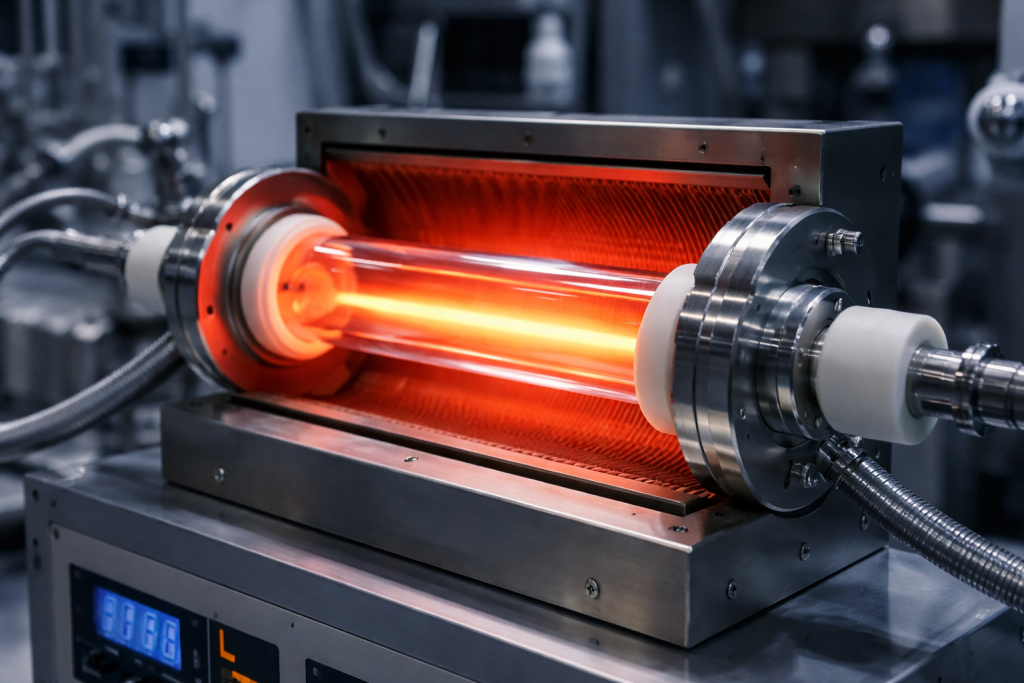
High-purity quartz diffusion tubes are critical process components in semiconductor thermal equipment. They are commonly used in oxidation, diffusion, annealing, LPCVD, heat treatment, and other furnace processes where wafers must be exposed to controlled gases at elevated temperatures.
Although a quartz diffusion tube may appear to be a relatively simple cylindrical component, its performance depends on much more than its outside diameter and length. Parameters such as tube diameter, wall thickness, dimensional tolerance, quartz purity, OH content, surface condition, thermal stability, cleaning method, flange geometry, and packaging can directly affect equipment compatibility, contamination control, process uniformity, and service life.
This guide explains the most important specifications engineers and purchasing teams should consider when sourcing high-purity quartz diffusion tubes for semiconductor furnaces.
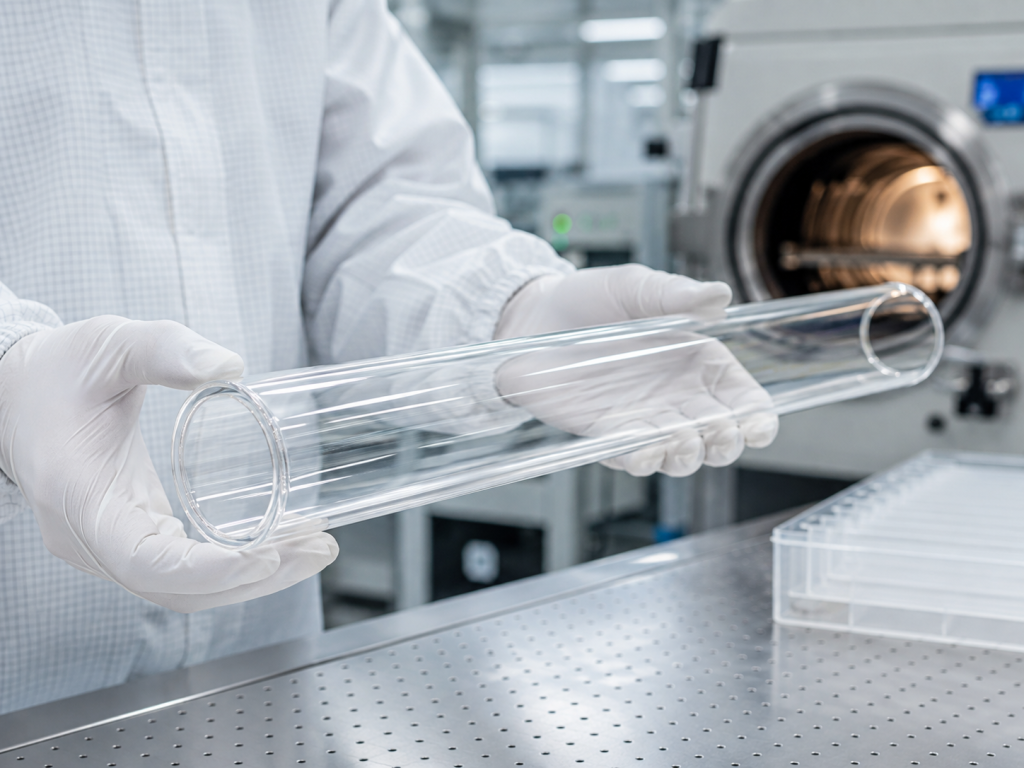
What Is a Quartz Diffusion Tube?
A quartz diffusion tube is a high-temperature process tube installed inside a semiconductor furnace.
During processing, wafers are loaded into the tube using quartz boats or carriers and exposed to controlled process gases while the furnace maintains the required temperature profile.
Typical processes include:
- Thermal oxidation
- Dopant diffusion
- Annealing
- LPCVD
- Dry oxidation
- Wet oxidation
- High-temperature heat treatment
- Research furnace processing
Quartz is particularly suitable for these applications because it provides a combination of:
- High temperature resistance
- Very low thermal expansion
- High chemical resistance
- Excellent electrical insulation
- High material purity
- Good resistance to many process gases
For semiconductor applications, however, ordinary industrial quartz tubing may not provide sufficient purity or dimensional control. High-purity fused quartz is generally required.
1. Quartz Diffusion Tube Diameter
Diameter is one of the first specifications that must be confirmed.
A diffusion tube normally has both:
Outer Diameter — OD
and
Inner Diameter — ID
The relationship between OD, ID, and wall thickness determines the mechanical strength and internal process space of the tube.
The required diameter depends mainly on:
- Wafer diameter
- Quartz boat dimensions
- Furnace chamber design
- Gas flow requirements
- Heater geometry
- Required process clearance
Quartz furnace tubes may be designed for wafer sizes such as:
- Small research wafers
- 2-inch wafers
- 3-inch wafers
- 4-inch wafers
- 6-inch wafers
- 8-inch wafers
- Custom semiconductor substrates
The tube diameter should never be selected based only on wafer diameter.
The wafer boat, loading mechanism, process gas distribution, and thermal clearance must also be considered.
OD vs ID: Which Dimension Is More Important?
Both dimensions are important, but their functional significance can differ.
Outside Diameter
OD affects compatibility with:
- Furnace heating zones
- Support structures
- Sealing assemblies
- Tube holders
- Insulation components
- Equipment frames
If the OD is too large or too small, the diffusion tube may not fit the furnace correctly.
Inside Diameter
ID determines the usable internal process space.
It affects:
- Wafer boat clearance
- Gas flow
- Loading and unloading
- Process volume
- Distance between wafers and the tube wall
For replacement tubes, the safest approach is usually to provide the original tube drawing or accurately measured OD and ID.
2. Diameter Tolerance
Quartz is a brittle material, and large furnace tubes are typically formed and thermally processed rather than machined in the same way as metal pipes.
Therefore, realistic diameter tolerances should be defined.
The required tolerance depends on:
- Tube diameter
- Tube length
- Wall thickness
- Furnace design
- Sealing method
- Flange geometry
Critical interfaces may need tighter dimensional control than non-functional sections.
For example, the sealing end or flange area may require tighter tolerances than the center process section.
When preparing an RFQ, buyers should distinguish between:
critical fitting dimensions
and
general tube dimensions.
This can reduce unnecessary manufacturing cost.
3. Wall Thickness
Wall thickness is another critical diffusion tube parameter.
It influences:
- Mechanical strength
- Tube rigidity
- Thermal behavior
- Furnace loading
- Vacuum performance
- Resistance to deformation
- Service life
A wall that is too thin may increase the risk of:
- Sagging
- Distortion
- Cracking
- Handling damage
A wall that is unnecessarily thick may increase:
- Material consumption
- Tube weight
- Thermal mass
- Cost
The optimal wall thickness therefore depends on tube diameter, length, operating temperature, furnace support design, and process pressure.
4. Wall Thickness Uniformity
Nominal wall thickness alone does not fully describe tube quality.
Wall thickness should remain reasonably uniform around the circumference and along the critical process area.
Large variation may result in:
- Uneven mechanical stress
- Localized heating differences
- Dimensional instability
- Reduced service life
For precision semiconductor furnace components, manufacturers may inspect several positions along the tube rather than measuring only one point.
Where wall thickness uniformity is particularly important, the drawing should state the inspection requirement.
5. Tube Length
Diffusion tubes can range from relatively short laboratory components to long furnace tubes used in production equipment.
Length affects both manufacturing difficulty and thermal behavior.
Long quartz tubes require careful control of:
- Straightness
- Diameter
- Wall thickness
- End geometry
- Support position
As tube length increases, maintaining precise geometry becomes more challenging.
Long tubes can also become more sensitive to:
- Handling stress
- Gravity-induced deformation
- High-temperature sagging
For replacement parts, buyers should provide the complete overall length rather than only the heated-zone length.
6. Straightness
Straightness is especially important for long semiconductor furnace tubes.
Poor straightness may create problems with:
- Furnace installation
- Heater clearance
- Boat loading
- Process alignment
- Sealing
The required straightness should depend on the equipment design.
If the furnace has very limited clearance between the quartz tube and heater assembly, straightness may become a critical specification.
For long diffusion tubes, straightness should therefore be evaluated together with diameter and wall thickness.
7. High-Purity Quartz Material
Material purity is one of the most important differences between semiconductor quartz components and general industrial quartz products.
Quartz used in semiconductor furnaces should minimize the introduction of unwanted contaminants into the process environment.
Potential metallic impurities can include elements such as:
- Sodium
- Potassium
- Iron
- Aluminum
- Calcium
- Lithium
- Titanium
The acceptable impurity concentration depends on the semiconductor process and quartz grade.
For contamination-sensitive processes, buyers should specify:
high-purity semiconductor-grade fused quartz
rather than simply requesting “quartz glass.”
8. Why Quartz Purity Matters
During high-temperature semiconductor processing, the furnace environment must remain highly controlled.
Contamination originating from furnace components may affect:
- Wafer surface cleanliness
- Dopant control
- Gate oxide quality
- Thin-film properties
- Device yield
- Process repeatability
For this reason, quartz material selection should be considered together with the cleaning and packaging process.
A high-purity raw material can still become contaminated if machining, welding, cleaning, handling, or packaging are poorly controlled.
9. What Is OH Content in Quartz?
OH content refers to the concentration of hydroxyl groups within fused quartz or fused silica.
Different quartz manufacturing processes can produce materials with different OH levels.
OH content can influence characteristics such as:
- Infrared transmission
- High-temperature behavior
- Viscosity
- Optical absorption
- Certain thermal properties
There is no single OH level that is automatically best for every quartz diffusion tube application.
The appropriate material should be selected according to the furnace temperature, process chemistry, semiconductor requirements, and original equipment specification.
10. Low-OH vs Higher-OH Quartz
Quartz materials are often discussed in terms of lower or higher OH content.
The manufacturing route of the quartz has a strong influence on this property.
Lower-OH Quartz
Lower-OH grades may be preferred for certain high-temperature or infrared-related applications.
Depending on the material and process, lower hydroxyl concentration may help meet specific thermal or optical performance requirements.
Higher-OH Fused Silica
Some synthetic fused silica materials may contain higher OH levels while providing extremely high chemical purity and excellent ultraviolet optical performance.
Such materials can be valuable for optical components but are not automatically the best choice for every furnace tube.
Therefore, engineers should avoid specifying a quartz tube based only on the lowest possible OH number.
The complete application should be considered.
11. OH Content Should Match the Existing Furnace Specification
For replacement diffusion tubes, the safest approach is often to match the material specification used by the original furnace design.
Changing the quartz grade without evaluation may alter:
- Thermal behavior
- Service life
- Optical properties
- Process contamination characteristics
If the existing specification is unknown, buyers should provide information about:
- Maximum operating temperature
- Process atmosphere
- Furnace type
- Wafer material
- Semiconductor process
The quartz supplier can then help determine an appropriate material grade.
12. Thermal Stability
One reason fused quartz is widely used in diffusion furnaces is its very low coefficient of thermal expansion.
This allows quartz components to withstand substantial temperature changes better than many conventional glass materials.
However, low thermal expansion does not mean quartz is immune to thermal damage.
Failure may still occur because of:
- Rapid temperature changes
- Localized heating
- Surface contamination
- Existing microcracks
- Mechanical stress
- Devitrification
- Improper support
The furnace operating procedure should therefore remain within the recommended thermal conditions.
13. High-Temperature Sagging
Large quartz diffusion tubes may gradually deform when used for long periods at elevated temperature.
This phenomenon may be influenced by:
- Operating temperature
- Tube diameter
- Wall thickness
- Quartz viscosity
- Tube length
- Support spacing
- Service duration
Sagging may eventually affect:
- Wafer boat clearance
- Tube installation
- Gas flow
- Process uniformity
When designing a long diffusion tube, mechanical support and wall thickness should therefore be considered together.
14. Devitrification
Fused quartz is normally amorphous.
Under certain high-temperature conditions, especially when contamination is present, portions of the surface may begin to crystallize.
This process is known as devitrification.
Possible symptoms include:
- Cloudy areas
- White crystalline regions
- Rough surfaces
- Reduced mechanical reliability
Contaminants can accelerate devitrification.
For this reason, furnace quartz components should be kept clean and should not be touched directly with bare hands.
15. Process Gas Compatibility
Quartz diffusion tubes may be exposed to many different process gases.
Depending on the furnace process, these may include gases used for:
- Oxidation
- Diffusion
- Annealing
- Deposition
- Purging
Before purchasing a replacement tube, buyers should inform the supplier about unusual or aggressive process chemistry.
Quartz offers excellent chemical resistance in many environments, but chemical compatibility should not be assumed for every process condition.
Temperature, gas concentration, and exposure time all matter.
16. Tube End Geometry
A semiconductor diffusion tube rarely consists only of a straight cylinder.
Tube ends may include features such as:
- Flared ends
- Ground joints
- Quartz flanges
- Lips
- Reduced sections
- Enlarged sections
- Sealing surfaces
These features must match the original furnace assembly.
Critical dimensions may include:
- Flange outside diameter
- Flange thickness
- Sealing surface
- Joint diameter
- Joint angle
- End length
- Concentricity
For replacement tubes, photographs alone are usually insufficient.
A technical drawing or original sample is preferable.
17. Side Ports and Gas Connections
Quartz diffusion tubes may contain side arms or ports for:
- Gas inlet
- Gas outlet
- Exhaust
- Pressure measurement
- Temperature measurement
- Process monitoring
Port specifications should include:
- Tube diameter
- Wall thickness
- Position
- Angle
- Length
- Joint type
The welded area around the port is particularly important because it experiences both thermal and mechanical stress.
Smooth transitions and good welding quality can help reduce stress concentration.
18. Quartz Welding Quality
Large semiconductor diffusion tubes often require quartz welding to connect:
- Flanges
- Side ports
- Injectors
- Joint sections
- Exhaust connections
Welding quality can influence:
- Mechanical strength
- Leak performance
- Thermal reliability
- Dimensional accuracy
Poorly controlled welding may create:
- Localized distortion
- Residual stress
- Uneven wall thickness
- Weak transition areas
For precision furnace tubes, weld zones should be carefully formed and inspected.
19. Surface Condition
The internal surface of a diffusion tube directly faces the semiconductor process environment.
Surface condition can therefore affect:
- Particle behavior
- Contamination
- Cleaning effectiveness
- Process stability
The required surface finish depends on the furnace process.
A semiconductor-grade tube should be manufactured and handled in a way that minimizes:
- Grinding residue
- Surface contamination
- Loose particles
- Metallic contamination
Special attention should be paid to welded and machined areas.
20. Cleaning High-Purity Quartz Diffusion Tubes
Cleaning is one of the most important stages before a diffusion tube enters a semiconductor furnace.
During manufacturing, contamination can be introduced through:
- Cutting
- Grinding
- Welding
- Handling
- Measurement
- Storage
The cleaning process should remove residues without damaging or contaminating the quartz surface.
Depending on the required cleanliness level, cleaning may involve several controlled stages using suitable chemicals, high-purity water, and clean handling.
21. Why Ordinary Cleaning May Be Insufficient
A quartz component can look perfectly clean to the naked eye while still carrying microscopic contaminants.
Possible contaminants include:
- Fine particles
- Metallic ions
- Organic residues
- Dust
- Fingerprints
In semiconductor processes, these contaminants may become important even when they cannot be seen visually.
Therefore, semiconductor furnace components should not be evaluated only by appearance.
Cleaning specifications should correspond to the intended process.
22. Semiconductor-Grade Cleaning
When semiconductor-grade cleaning is required, the supplier should use appropriate contamination-control procedures.
The exact process depends on the application and customer specification.
Important considerations include:
- Controlled cleaning chemicals
- High-purity rinse water
- Clean containers
- Contamination-controlled handling
- Appropriate drying
- Clean packaging
After final cleaning, unnecessary handling should be avoided.
23. Handling After Cleaning
Even an excellent cleaning process can be compromised by poor handling afterward.
Clean quartz should generally be handled using suitable:
- Clean gloves
- Clean tools
- Clean packaging materials
Direct contact with bare hands should be avoided.
Fingerprints can introduce contamination that may become more problematic during high-temperature use.
24. Packaging Requirements
A large quartz diffusion tube is both fragile and contamination-sensitive.
Packaging therefore has two purposes:
mechanical protection
and
cleanliness protection.
A suitable packaging system should help prevent:
- Impact
- Vibration
- Tube movement
- Surface contamination
- Dust exposure
Large tubes may require customized supports so that mechanical loads are distributed over safe areas.
Critical quartz ports and flanges should receive additional protection.
25. Visual Inspection
Before shipment, quartz diffusion tubes should normally undergo visual inspection.
Typical inspection items may include:
- Cracks
- Chips
- Scratches
- Welding defects
- Contamination
- Abnormal deformation
- Surface defects
Visual inspection is especially important around:
- Flanges
- Weld joints
- Side ports
- Tube ends
Any inspection criteria required by the customer should be clearly stated before production.
26. Dimensional Inspection
Important dimensions should be verified according to the drawing.
Inspection may include:
- OD
- ID
- Overall length
- Wall thickness
- Flange dimensions
- Port position
- Port angle
- Straightness
Critical dimensions should be identified separately.
This prevents unnecessary tight control on non-critical dimensions while ensuring compatibility at important interfaces.
27. Leak Testing
Diffusion tubes containing welded ports, joints, or sealing structures may require leak testing.
Leak requirements depend on:
- Furnace design
- Atmospheric or reduced-pressure operation
- Process sensitivity
- Sealing method
For applications where leak integrity is critical, the RFQ should clearly specify the required test method or allowable leak rate.
Leak testing requirements should be agreed upon before production rather than added after manufacturing.
28. Quartz Diffusion Tube Specification Checklist
A complete RFQ should include the following information whenever possible:
| Parameter | Information to Provide |
|---|---|
| Material | High-purity fused quartz grade |
| Application | Oxidation, diffusion, LPCVD, annealing, etc. |
| Wafer size | 4″, 6″, 8″ or custom |
| OD | Required outside diameter |
| ID | Required inside diameter |
| Wall thickness | Nominal value and tolerance |
| Length | Overall tube length |
| Straightness | Requirement if critical |
| OH content | Required grade or limit if applicable |
| Purity | Semiconductor-grade requirement |
| End structure | Flange, joint, open end, etc. |
| Ports | Diameter, position, angle and quantity |
| Surface | Process-side surface requirement |
| Cleaning | Standard or semiconductor-grade |
| Leak test | Required if applicable |
| Packaging | Clean and protective packaging |
| Quantity | Prototype and production quantity |
| Drawing | PDF/DWG/STEP or original sample |
29. Example RFQ
A useful inquiry may be structured as follows:
Product: High-Purity Quartz Diffusion Tube
Application: Semiconductor oxidation furnace
Wafer Size: 200 mm
Material: Semiconductor-grade fused quartz
Outside Diameter: According to attached drawing
Inside Diameter: According to attached drawing
Wall Thickness: According to drawing
Overall Length: According to drawing
OH Requirement: Please confirm suitable grade
Ports: Two gas ports, dimensions per drawing
Tube End: Quartz flange
Cleaning: Semiconductor-grade cleaning
Inspection: Dimensional and visual inspection
Packaging: Clean protective packaging
Quantity: 2 pcs for qualification, production quantity to follow
This provides significantly more useful information than simply asking:
“Please quote a quartz furnace tube.”
30. Common Specification Mistakes
Several problems repeatedly appear in quartz diffusion tube RFQs.
Providing Only OD and Length
This is usually insufficient.
ID, wall thickness, port geometry, flange structure, and application may also be critical.
Ignoring OH Content and Quartz Grade
Not every transparent quartz material has identical chemical and thermal properties.
Specifying Extremely Tight Tolerances Everywhere
Large quartz tubes are not machined like precision metal components.
Tolerances should focus on functional interfaces.
Ignoring Cleaning
For semiconductor applications, cleanliness may be as important as dimensional accuracy.
Using Photographs Without Drawings
Photographs are useful for identifying the general component but cannot accurately define critical geometry.
31. Replacement Quartz Diffusion Tubes
When replacing an existing furnace tube, buyers should ideally provide:
- Original equipment model
- Existing quartz tube drawing
- Original part number
- Process type
- Wafer diameter
- Operating temperature
- Photographs
- Old tube sample if available
If no drawing exists, a quartz manufacturer may reproduce the component based on a physical sample.
However, critical dimensions and functional interfaces should still be confirmed before production.
32. Prototype Qualification Before Volume Production
For customized semiconductor furnace tubes, it is often advisable to qualify a small number of components before placing a larger production order.
Qualification may evaluate:
- Equipment fit
- Wafer boat clearance
- Port alignment
- Sealing
- Leak performance
- Thermal cycling
- Process cleanliness
- Service life
After successful qualification, the approved dimensions and inspection requirements can be used as the production standard.
Conclusion
A high-purity quartz diffusion tube should not be specified only by diameter and length.
For reliable semiconductor furnace operation, engineers should consider the complete relationship between:
diameter, ID, wall thickness, tube length, straightness, quartz purity, OH content, surface condition, flange geometry, port configuration, cleaning, inspection, and packaging.
Among these parameters, diameter and wall thickness determine mechanical compatibility and strength, while material purity and OH content help define the quartz material characteristics.
Cleaning and contamination control are equally important because even a dimensionally perfect tube can create process problems if the internal surface is contaminated.
For custom or replacement semiconductor quartz diffusion tubes, the most effective sourcing approach is to provide a detailed technical drawing together with operating conditions and cleanliness requirements.
This allows the quartz manufacturer to evaluate manufacturability, recommend an appropriate material grade, control critical dimensions, and develop a suitable cleaning and inspection process.
Frequently Asked Questions
What material should be used for semiconductor diffusion tubes?
High-purity fused quartz is commonly used because of its high-temperature capability, low thermal expansion, chemical resistance, electrical insulation, and low contamination potential.
Is quartz diffusion tube OD the same as wafer size?
No. The tube must be substantially larger than the wafer because it also needs to accommodate the quartz boat, loading clearance, and process gas flow.
Why is wall thickness important?
Wall thickness affects mechanical strength, rigidity, thermal mass, deformation resistance, and service life. The appropriate thickness depends on tube diameter, length, operating temperature, and furnace design.
What is OH content in quartz?
OH content refers to hydroxyl groups present within fused quartz or fused silica. It varies with the material manufacturing process and can influence optical and high-temperature properties.
Is lower OH always better for a diffusion tube?
No. The correct quartz grade depends on the furnace process, temperature, contamination requirements, and original equipment specification. OH content should be considered together with overall material purity and application requirements.
Why does a semiconductor quartz tube need special cleaning?
Machining, welding, handling, and storage can introduce particles, metallic contamination, and organic residues. Semiconductor-grade cleaning helps reduce the risk of transferring these contaminants into the wafer process.
What information should be sent when requesting a custom diffusion tube?
Provide the OD, ID, wall thickness, overall length, quartz grade, end structure, port dimensions, cleaning requirement, process conditions, quantity, and preferably a complete technical drawing.