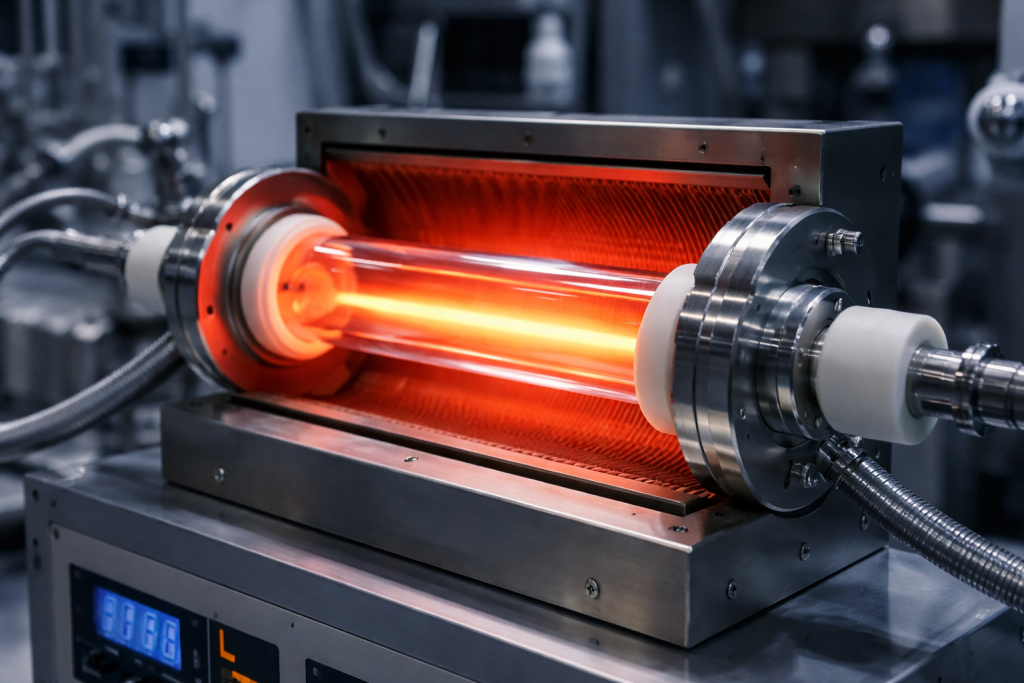
High-purity quartz components are widely used in semiconductor diffusion, oxidation, annealing, LPCVD and other high-temperature wafer processing systems.
Typical quartz furnace components include process tubes, wafer boats, carriers, injectors, liners, flanges, gas distribution tubes, support rods and custom welded assemblies.
In these applications, quartz is not selected only because it can withstand high temperatures. The purity of the material, manufacturing environment, cleaning process and condition of the finished component can all influence contamination risk.
For semiconductor equipment engineers and purchasing teams, specifying “high-purity quartz” is therefore not enough. A reliable procurement specification should consider both the purity of the raw quartz material and the contamination introduced during fabrication, cleaning, handling and service.
This guide explains the main contamination sources associated with semiconductor quartz components and how to select suitable quartz materials for furnace applications.
Why High-Purity Quartz Is Used in Semiconductor Furnaces
Semiconductor thermal processes often expose wafers to elevated temperatures for extended periods.
Quartz glass offers several useful characteristics for these environments:
- High temperature capability
- Low thermal expansion
- Good thermal shock resistance
- High chemical resistance
- High purity potential
- Good dimensional stability
- Compatibility with many semiconductor process gases
- Ability to manufacture large and complex components
Quartz can also be formed into long tubes, welded assemblies, wafer boats and complicated gas delivery structures.
However, the fact that a component is made from quartz does not automatically make it suitable for semiconductor processing.
Material purity and contamination control are critical.
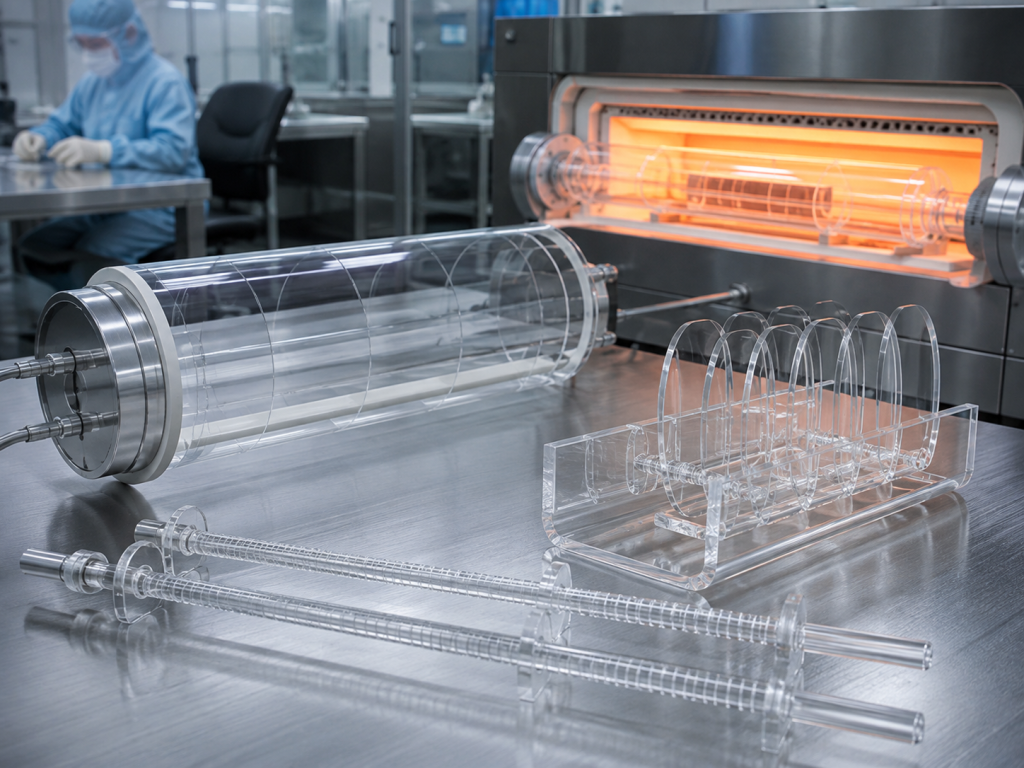
Quartz Material Purity vs Finished-Part Cleanliness
One of the most important distinctions when specifying semiconductor quartz is the difference between:
Material purity
and
component cleanliness.
Material purity refers primarily to impurities contained within the quartz glass itself.
Component cleanliness refers to contamination present on the finished surface after machining, flame working, grinding, welding, cleaning, inspection, packaging and transportation.
A quartz tube can be manufactured from very high-purity material but still arrive contaminated if it is processed or packaged incorrectly.
Likewise, a very clean component cannot fully compensate for unsuitable raw material if the application requires extremely low impurity levels.
For critical semiconductor furnace components, both factors must be controlled.
1. Metallic Impurities in Quartz
Metallic impurities are an important consideration when selecting quartz for semiconductor processing.
Potential elements of concern may include:
- Aluminum
- Iron
- Sodium
- Potassium
- Lithium
- Calcium
- Magnesium
- Titanium
- Copper
The exact elements that matter most depend on the semiconductor process and device requirements.
Some impurities originate from the original quartz raw material, while others can be introduced during component fabrication.
For this reason, buyers should not rely only on a general description such as:
“99.99% pure quartz.”
For demanding applications, it is more useful to request an actual material specification or impurity analysis showing relevant trace elements.
2. Alkali Contamination
Alkali elements such as sodium, potassium and lithium can be particularly important in semiconductor processing environments.
Potential sources include:
- Raw quartz material
- Handling contamination
- Cleaning chemicals
- Process residues
- Inappropriate storage
- Contaminated fixtures
For semiconductor furnace applications, the acceptable impurity level should be determined according to the process sensitivity.
High-purity quartz grades intended specifically for semiconductor manufacturing are generally preferable to ordinary industrial quartz glass for wafer-facing or process-critical components.
3. Aluminum and Other Structural Impurities
Aluminum is commonly considered when evaluating natural quartz-derived materials because it can occur within the original quartz structure.
Other trace elements may also remain depending on raw material quality and purification processes.
The presence of an impurity does not automatically make a quartz grade unusable.
The important question is:
Does the impurity profile meet the contamination requirements of the intended process?
For some furnace components, commercially available high-purity fused quartz may be sufficient.
For more contamination-sensitive processes, a higher-purity or specially produced fused silica grade may be required.
Material selection should therefore be application-specific rather than based only on a generic purity percentage.
4. OH Content
Quartz glass may also contain hydroxyl groups, commonly referred to as OH content.
OH is different from metallic contamination but can influence certain physical and optical properties of fused quartz. Heraeus notes that, in addition to metallic impurities, fused quartz and fused silica contain water in the form of OH groups and that OH content influences material properties.
For semiconductor furnace components, OH content may be one of several material parameters considered when selecting a quartz grade.
Different manufacturing routes can produce quartz glass with different OH levels.
The appropriate material depends on factors such as:
- Furnace temperature
- Process atmosphere
- Thermal history
- Component geometry
- Required service life
- Process sensitivity
A low-OH material should not automatically be assumed to be superior in every application.
The complete material specification should be considered.
5. Contamination Introduced During Grinding and Machining
Even when high-purity quartz raw material is used, fabrication can introduce contamination.
Quartz components may require:
- Cutting
- Grinding
- Drilling
- Edge finishing
- Surface machining
- Flange preparation
- Slot machining
Possible contamination sources during these steps include:
- Grinding tools
- Abrasives
- Machine fixtures
- Cutting fluids
- Operator handling
- Workshop dust
- Metal contact surfaces
For semiconductor components, the manufacturing process should minimize unnecessary contact with contamination sources.
After machining, suitable cleaning is required before the component moves to final processing and packaging.
6. Flame Working and Quartz Welding
Many semiconductor furnace components cannot be manufactured from a single quartz tube.
Quartz welding or flame working may be required to manufacture:
- Side ports
- Injectors
- Flanges
- Branch tubes
- End structures
- Gas distribution assemblies
- Complex furnace tubes
The quality of the welding process affects more than dimensional accuracy.
The manufacturing environment and tooling around the welding process should also be controlled to reduce contamination.
After welding, the component may require further cleaning and inspection.
For complex quartz assemblies, buyers should ask whether the manufacturer has experience with semiconductor-grade quartz fabrication rather than only general laboratory glassware.
7. Surface Contamination from Handling
Human handling is another potential contamination source.
Examples include:
- Fingerprints
- Skin oils
- Dust
- Fibers
- Glove residues
- Packaging debris
This is why final semiconductor quartz components should normally be handled under controlled conditions after cleaning.
For critical surfaces, direct contact should be minimized.
The cleanliness requirement should be maintained not only during production but also during final inspection, packing and shipping.
8. Cleaning Chemical Residues
Cleaning itself can become a contamination source if the process is not properly controlled.
Possible issues include:
- Insufficient rinsing
- Chemical residues
- Contaminated rinse water
- Dirty cleaning tanks
- Cross-contamination between parts
- Particles introduced during drying
A semiconductor-grade cleaning process should therefore control:
- Cleaning chemistry
- Water quality
- Rinse sequence
- Drying environment
- Handling after cleaning
The required cleaning method should depend on the intended semiconductor process and the customer’s internal specifications.
9. Packaging Contamination
A quartz component can be properly cleaned and still become contaminated during packaging.
Common risks include:
- Packaging fibers
- Dust
- Foam particles
- Direct contact with dirty cardboard
- Inappropriate plastic materials
- Uncontrolled warehouse storage
For semiconductor quartz components, packaging should protect against both:
mechanical damage
and
contamination.
Large furnace tubes require particular care because their size makes them difficult to clean again after delivery.
Double-bagging or other controlled packaging methods may be appropriate when required by the customer.
10. Contamination During Furnace Service
Not all contamination originates from the quartz supplier.
Once installed, quartz components are exposed to the process environment.
Deposits may gradually form from:
- Process gases
- Reaction by-products
- Dopant materials
- Thin-film deposition
- Furnace residues
- Wafer handling
- Cleaning cycles
Over time, these deposits may affect particle performance or contamination control.
Quartz furnace components should therefore be evaluated according to both material condition and process history.
A component may eventually require cleaning, refurbishment or replacement even if the quartz itself remains mechanically intact.
Choosing Quartz Material for Semiconductor Furnace Components
Different furnace components may have different material requirements.
Furnace Process Tubes
Large process tubes normally require:
- High-purity quartz material
- Stable wall thickness
- Good straightness
- Controlled dimensions
- Low contamination
- Good thermal performance
Large-diameter fused quartz tubing is specifically used in semiconductor wafer processing furnaces, including equipment serving 300 mm wafer manufacturing.
For these tubes, buyers should evaluate both the base material and the manufacturer’s ability to fabricate large components without introducing unacceptable contamination.
Quartz Wafer Boats
Wafer boats directly support semiconductor wafers and therefore deserve particular attention.
Important factors include:
- Material purity
- Slot geometry
- Surface condition
- Particle generation
- Dimensional stability
- Cleaning condition
For wafer-contact components, the surface finish and manufacturing cleanliness can be as important as the nominal purity of the material.
Quartz Injectors
Quartz gas injectors often contain:
- Small holes
- Long internal passages
- Welded branches
- Complex gas distribution structures
Because these areas may be difficult to clean after manufacturing, contamination control during fabrication is particularly important.
Hole geometry and internal cleanliness should be included in the inspection specification when they are process-critical.
Quartz Flanges
Quartz flanges may be located outside or near the hottest process region, but contamination control can still matter.
Important requirements may include:
- Flatness
- Concentricity
- Sealing surface condition
- Hole position
- Weld quality
- Cleanliness
For flanges welded onto process tubes, both the flange material and the welded transition should be considered.
Quartz Support Rods and Pins
Support rods, paddles, pins and fixtures may look relatively simple, but they are frequently positioned close to wafers.
Material purity, surface condition and handling cleanliness should therefore be selected according to their proximity to the process zone.
Natural Fused Quartz vs Synthetic Fused Silica
Both natural quartz-derived fused quartz and synthetic fused silica can be used in high-purity applications, but they are produced using different raw-material routes.
The correct choice depends on the application.
Natural fused quartz can provide excellent thermal properties and is widely used in semiconductor furnace hardware.
Synthetic fused silica can offer very tightly controlled purity characteristics for particularly sensitive applications.
However, buyers should avoid making the selection based only on the words:
natural
or
synthetic.
The more useful comparison includes:
- Trace metallic impurities
- OH content
- Thermal properties
- Bubble and inclusion requirements
- Manufacturing method
- Component geometry
- Process temperature
- Cost
- Availability
For many furnace applications, a proven semiconductor-grade fused quartz material is more important than selecting material based purely on manufacturing category.
High-Purity Quartz Material Selection Checklist
Before ordering semiconductor furnace quartz components, the following information should be reviewed.
| Item | What to Confirm |
|---|---|
| Quartz grade | Semiconductor-grade or specified material |
| Material source | Natural fused quartz or synthetic fused silica |
| Metallic impurities | Relevant elemental limits or analysis |
| OH content | If important to the process |
| Bubble/inclusion level | According to component requirements |
| Maximum temperature | Based on actual process conditions |
| Thermal cycling | Heating and cooling frequency |
| Surface finish | Ground, polished, fire-polished or as specified |
| Cleaning | Semiconductor-compatible cleaning requirement |
| Packaging | Clean packaging and contamination protection |
| Traceability | Material lot or production identification |
| Inspection | Dimensional and visual inspection requirements |
Do Not Specify Purity Alone
A common RFQ might state:
Material: High-Purity Quartz
Purity: 99.99%
This is often not enough for semiconductor equipment.
A better specification might include:
Material: Semiconductor-grade fused quartz
Application: Diffusion furnace process tube
Operating temperature: [customer value]
Wafer size: 200 mm / 300 mm
Critical impurities: Customer-specified elemental requirements
OH requirement: If applicable
Cleaning: Semiconductor-compatible final cleaning
Packaging: Clean protective packaging
Inspection: Dimensional report + visual inspection
Traceability: Material lot information required
This allows the quartz manufacturer to understand the actual process requirements rather than quoting a generic industrial quartz material.
Questions to Ask a Quartz Component Supplier
When qualifying a supplier for semiconductor furnace parts, buyers may ask:
What quartz material grades do you use?
The supplier should be able to identify the material rather than simply stating “high-purity quartz.”
Can you provide material certification?
Depending on the project, this may include material grade, lot information or impurity data.
How are quartz components cleaned after machining and welding?
The answer should match the cleanliness level required for the application.
How are finished parts handled after cleaning?
Final handling conditions are important because contamination can be reintroduced easily.
Can you manufacture large furnace tubes and complex welded assemblies?
Large semiconductor furnace components require different capabilities from ordinary small quartz laboratory products.
Can you provide inspection reports?
For custom components, dimensional reports can reduce incoming inspection problems.
How are parts packaged?
Packaging should protect both component geometry and cleanliness.
Material Selection Should Follow Process Risk
There is no single quartz purity specification that is correct for every semiconductor furnace.
A practical material selection strategy is to classify the component according to process risk.
Higher-Risk Components
Examples:
- Process tubes
- Wafer boats
- Injectors
- Wafer-contact supports
- Components directly exposed to critical process gases
These normally justify stricter material and cleanliness requirements.
Moderate-Risk Components
Examples:
- Outer quartz shields
- Support structures
- Secondary liners
Requirements may still be strict but can differ from wafer-contact components.
Lower-Risk Components
Quartz parts located outside the active process zone may not require the same purity level as components directly surrounding wafers.
Matching the specification to the real contamination risk helps avoid both under-specification and unnecessary cost.
Conclusion
High-purity quartz is essential to many semiconductor furnace systems, but the phrase “high purity” should never be treated as a complete specification.
Contamination may originate from:
- Raw quartz material
- Metallic impurities
- Machining
- Grinding
- Quartz welding
- Human handling
- Cleaning chemicals
- Packaging
- Furnace process residues
For this reason, successful material selection requires consideration of both the quartz material and the complete manufacturing process.
For semiconductor furnace tubes, wafer boats, injectors, flanges and other custom quartz components, buyers should define the application, operating temperature, critical impurity requirements, cleanliness level, inspection criteria and packaging requirements before production.
A qualified quartz supplier should be able to combine suitable semiconductor-grade material with controlled fabrication, cleaning, inspection and packaging.
This approach reduces contamination risk and provides a more reliable basis for long-term semiconductor furnace operation.
FAQ
1. What does high-purity quartz mean for semiconductor applications?
High-purity quartz generally refers to fused quartz or fused silica with tightly controlled impurities suitable for contamination-sensitive processing. For semiconductor applications, buyers should review actual impurity specifications instead of relying only on a general purity percentage.
2. Is synthetic fused silica always better than natural fused quartz?
No. The correct material depends on impurity requirements, OH content, temperature, component geometry and process conditions. Semiconductor-grade natural fused quartz is widely used in furnace applications, while synthetic fused silica may be selected for applications requiring particular purity characteristics.
3. Which quartz components are commonly used in semiconductor furnaces?
Common components include process tubes, wafer boats, injectors, liners, flanges, support rods, paddles, gas tubes and custom welded quartz assemblies.
4. Can quartz become contaminated during manufacturing?
Yes. Grinding tools, machining fixtures, handling, welding, cleaning and packaging can all introduce contamination if they are not properly controlled.
5. Should semiconductor quartz components include material certificates?
For critical applications, material identification, lot traceability or impurity information can be valuable. The exact documentation should be specified during the RFQ stage.
6. Is material purity more important than surface cleanliness?
Both are important. Material purity concerns impurities inside the quartz glass, while cleanliness concerns contamination on the finished component surface. A high-purity material can still become contaminated during fabrication or handling.
7. What information should I send when requesting a semiconductor quartz component?
Provide the drawing, quartz grade requirements, operating temperature, process environment, critical impurity limits, cleaning requirement, dimensional tolerances, inspection requirements, quantity and packaging requirements.