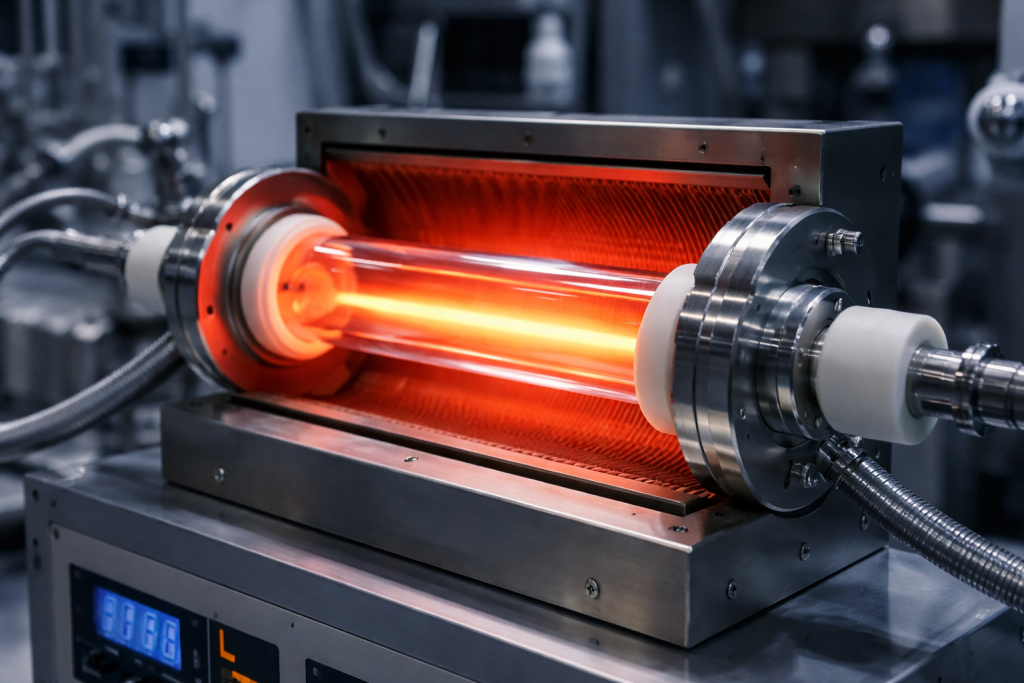
Selecting the correct wall thickness for a fused quartz tube is not simply a matter of choosing the strongest available option. Tube diameter, operating temperature, pressure differential, unsupported length, mounting configuration, and fabrication quality all influence whether a quartz component will perform reliably.
A tube that is too thin may crack, deform, or collapse under vacuum. A tube that is unnecessarily thick may increase cost, reduce usable internal space, extend heating time, and introduce additional thermal stress.
For semiconductor furnaces, vacuum processing systems, laboratory reactors, and high-temperature industrial equipment, selecting the appropriate quartz tube wall thickness requires understanding how these variables interact.
This guide explains the key considerations involved in specifying fused quartz tubes for demanding applications.
Why Quartz Tube Wall Thickness Matters
Fused quartz offers several advantages for high-temperature and contamination-sensitive processes:
- High thermal stability.
- Low thermal expansion.
- Excellent chemical purity.
- Good resistance to thermal shock under suitable conditions.
- Optical transparency.
- Compatibility with many semiconductor manufacturing environments.
However, fused quartz remains a brittle material. Its mechanical performance depends heavily on surface condition, geometric consistency, operating temperature, and the presence of localized stress.
Wall thickness directly affects:
- Resistance to pressure differences.
- Structural stiffness.
- Thermal response.
- Long-term dimensional stability.
- Resistance to handling damage.
- Weight and support requirements.
- Available internal process space.
- Manufacturing cost.
A suitable design balances these factors rather than relying on wall thickness alone.
Understanding Outer Diameter, Inner Diameter and Wall Thickness
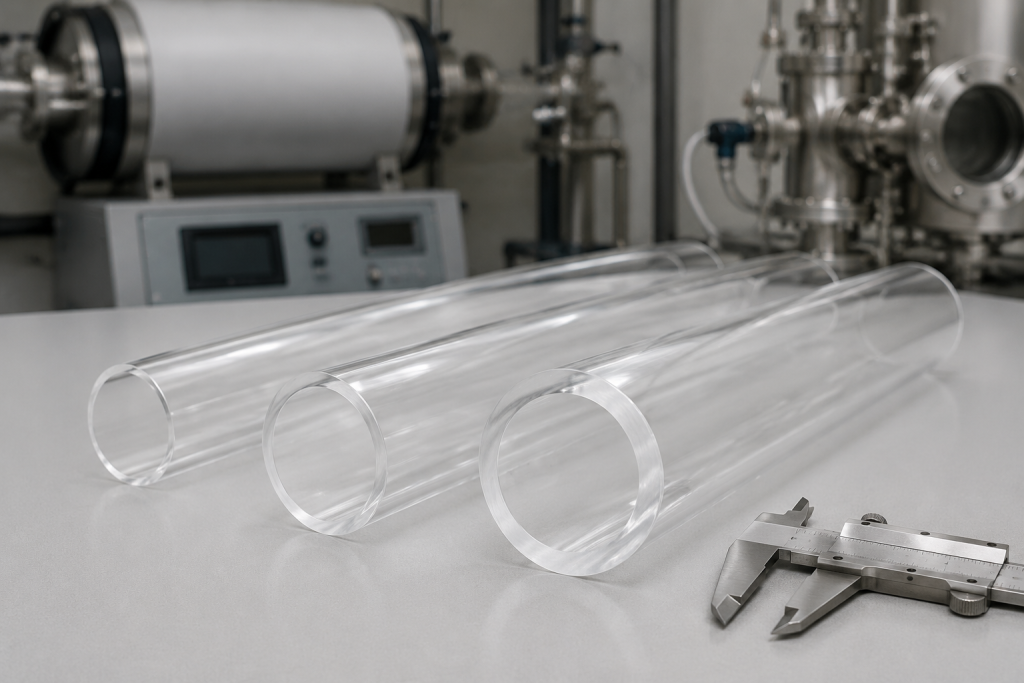
Three dimensions define the basic geometry of a quartz tube:
- Outer diameter, or OD.
- Inner diameter, or ID.
- Wall thickness.
The relationship is:
Wall thickness = (Outer diameter − Inner diameter) ÷ 2
For example, a quartz tube with an outer diameter of 50 mm and an inner diameter of 44 mm has a nominal wall thickness of 3 mm.
| Outer diameter | Inner diameter | Nominal wall thickness |
|---|---|---|
| 30 mm | 26 mm | 2 mm |
| 50 mm | 44 mm | 3 mm |
| 80 mm | 72 mm | 4 mm |
| 100 mm | 90 mm | 5 mm |
These examples illustrate dimensional relationships only. They should not be interpreted as approved dimensions for a particular vacuum, pressure, or temperature condition.
For custom manufacturing, buyers should specify whether the outer diameter or inner diameter is the critical dimension. Maintaining both within tight tolerances can affect material selection, production methods, and cost.
How Tube Diameter Affects Wall Thickness
As tube diameter increases, the tube generally becomes more sensitive to deformation under external pressure and mechanical loading.
A small-diameter tube can often maintain adequate stiffness with a relatively thin wall. A larger tube operating under similar conditions may require a thicker wall, improved support, a shorter unsupported span, or a combination of these measures.
Diameter matters because larger cylindrical structures are generally more susceptible to:
- Ovalization.
- Vacuum-related instability.
- Bending under their own weight.
- Stress concentration at supports.
- Distortion at elevated temperatures.
For this reason, wall thickness should never be selected independently of diameter.
A 3 mm wall may be suitable for one small quartz tube but insufficient for a larger tube exposed to the same operating environment.
Diameter-to-Thickness Ratio
The relationship between tube diameter and wall thickness is often considered through the diameter-to-thickness ratio.
A higher ratio means a relatively thinner wall compared with the tube diameter. A lower ratio indicates a thicker and generally stiffer structure.
For example:
- A 40 mm tube with a 2 mm wall has a diameter-to-thickness ratio of 20.
- An 80 mm tube with a 2 mm wall has a ratio of 40.
- An 80 mm tube with a 4 mm wall again has a ratio of 20.
Although this comparison helps explain relative geometry, it cannot replace engineering analysis. Actual performance also depends on tube length, manufacturing tolerances, surface defects, temperature, and pressure conditions.
Vacuum Load and External Pressure
Vacuum is one of the most important considerations when specifying a quartz process tube.
When a tube is evacuated internally while the surrounding environment remains at atmospheric pressure, the outside atmosphere presses inward on the tube wall.
At sea level, the maximum differential associated with an ideal internal vacuum is approximately:
101.3 kPa, or approximately 1 atmosphere.
This may appear modest compared with the pressure ratings associated with metal equipment, but it can still create a substantial structural load on a large, thin-walled quartz tube.
Why Larger Tubes Are More Sensitive
A large-diameter quartz tube presents a greater unsupported cylindrical surface to external pressure.
If the wall is insufficiently stiff, the tube may deform or fail through a combination of:
- Local instability.
- Ovalization.
- Buckling-like behavior.
- Crack initiation at surface defects.
- Failure near welded joints or support points.
Unlike ductile metal components, quartz does not provide a reliable visible yielding stage before fracture. A component can fail suddenly if local stress exceeds the material’s practical strength.
Vacuum Does Not Affect Every Tube Equally
The acceptable wall thickness for vacuum service depends on:
- Tube diameter.
- Tube length.
- Maximum pressure differential.
- Operating temperature.
- End support conditions.
- Fabrication tolerances.
- Welded branches or side ports.
- Surface quality.
- Existing chips or scratches.
- Thermal cycling frequency.
A tube used under partial vacuum at room temperature may need a different design from a tube used under near-full vacuum at elevated temperature.
Design decisions should be validated for the actual assembly rather than based on nominal dimensions alone.
Unsupported Length and Tube Sagging
Tube length is often overlooked when specifying wall thickness.
A long quartz tube can bend under its own weight, especially when installed horizontally. Additional loads from attached fittings, internal components, or uneven support can increase bending stress.
At elevated temperatures, long-term deformation may become more significant.
Common risk factors include:
- Excessive distance between support points.
- Heavy flanges attached near unsupported ends.
- Internal wafer boats or process fixtures.
- Concentrated mechanical loading.
- Repeated heating and cooling.
- Uneven temperature distribution.
A thicker wall can improve stiffness, but additional wall thickness also increases the tube’s own weight.
Therefore, the best solution may involve:
- Improved support spacing.
- Better support geometry.
- Reduced unsupported length.
- A revised mounting arrangement.
- Controlled load distribution.
- A moderate wall-thickness increase.
Support materials should also be compatible with the operating temperature and contamination requirements of the process.
Operating Temperature and Mechanical Stability
Fused quartz is widely used in high-temperature applications, but its mechanical behavior changes as temperature rises.
Even when a tube remains below its softening temperature, prolonged exposure to elevated temperature can reduce its resistance to deformation, particularly under mechanical load.
This is especially relevant for:
- Semiconductor diffusion furnaces.
- Oxidation systems.
- Chemical vapor deposition equipment.
- High-temperature laboratory reactors.
- Thermal treatment chambers.
- Process gas delivery systems.
High Temperature Increases Design Complexity
A quartz tube that is mechanically stable at room temperature may behave differently when operating at elevated temperature.
Potential issues include:
- Increased sagging.
- Higher sensitivity to support loads.
- Stress near welded features.
- Distortion of sealing surfaces.
- Gradual dimensional changes.
- Accelerated damage from contamination.
Maximum usable temperature depends on the quartz material grade, hydroxyl content, process atmosphere, load, exposure time, and equipment configuration.
A single universal operating-temperature limit should not be assumed for all fused quartz tubes.
Long-Term Exposure Matters
Short-duration thermal exposure and continuous high-temperature operation are not equivalent.
A tube that tolerates a brief thermal cycle may not provide adequate dimensional stability during prolonged operation under vacuum or mechanical load.
When requesting a quotation, provide:
- Normal operating temperature.
- Maximum operating temperature.
- Duration at maximum temperature.
- Heating and cooling rates.
- Number of thermal cycles.
- Expected service life.
- Process atmosphere.
These details allow the supplier to assess whether standard tubing is appropriate or whether a custom design is required.
Thermal Shock and Temperature Gradients
Fused quartz has a low coefficient of thermal expansion, which contributes to its reputation for thermal shock resistance.
However, low expansion does not eliminate all thermal stress.
Problems can arise when:
- One end of the tube remains cool while another section is heated.
- Cold process gas contacts a hot internal surface.
- A hot tube touches a cold metal fixture.
- Heating occurs unevenly across the tube diameter.
- Thick sections cool differently from thin sections.
- Welded joints create abrupt changes in geometry.
Thicker Walls Are Not Automatically Better
Increasing wall thickness can improve structural stiffness, but it also changes how heat moves through the component.
A thicker wall may experience a greater temperature difference between its inner and outer surfaces during rapid heating or cooling.
This can contribute to:
- Thermal stress.
- Local cracking.
- Delayed temperature stabilization.
- Longer process cycle times.
For applications involving rapid thermal changes, the optimum wall thickness must balance mechanical strength with thermal response.
Surface Quality and Practical Strength
The theoretical strength of fused quartz is not the same as the practical strength of a manufactured and handled tube.
Scratches, chips, grinding damage, and surface contamination can significantly reduce resistance to fracture.
Important inspection areas include:
- Tube ends.
- Cut edges.
- Ground sealing surfaces.
- Welded side ports.
- Flange transitions.
- Support contact areas.
- Internal surfaces near tooling marks.
A thicker tube with poor edge finishing may perform worse than a properly fabricated tube with a thinner wall.
For demanding applications, specify:
- Acceptable edge condition.
- Surface defect limits.
- Polished or fire-finished ends.
- Weld quality.
- Dimensional tolerances.
- Cleaning requirements.
- Packaging methods.
Avoiding surface damage during installation is equally important.
Wall Thickness Uniformity and Concentricity
Nominal wall thickness alone does not describe the entire cross-section.
A quartz tube can meet an average thickness requirement while still having a locally thin section caused by poor concentricity or dimensional variation.
This matters because failure typically begins at the weakest location.
Relevant specifications include:
- Minimum wall thickness.
- Maximum wall thickness variation.
- Outer diameter tolerance.
- Inner diameter tolerance.
- Roundness.
- Concentricity.
- Straightness.
For vacuum or high-temperature applications, the minimum actual wall thickness can be more important than the nominal average.
For example, a tube specified as 4 mm nominal wall thickness may not provide the expected performance if one section measures substantially below the minimum required value.
When possible, define both nominal and minimum acceptable wall thickness in procurement documents.
Welded Joints, Side Ports and Flanges
Custom quartz tubes frequently include additional features such as:
- Welded side branches.
- Gas inlet ports.
- Exhaust connections.
- Ground joints.
- Quartz flanges.
- Closed ends.
- Thermocouple access points.
These features can change the stress distribution and introduce local variations in wall thickness.
A straight tube that performs well under vacuum may require additional evaluation after side ports or flanges are added.
Common Stress Concentration Areas
Potential problem areas include:
- Sharp transitions between thick and thin sections.
- Poorly blended welds.
- Welded branches positioned near support points.
- Heavy flanges attached to thin tubing.
- Localized overheating during fabrication.
- Misalignment between connected sections.
Where possible, fabricated transitions should be smooth and designed to avoid abrupt geometric changes.
Post-fabrication inspection should include the welded regions rather than relying only on measurements of the original tube.
Material Purity and Application Requirements
For semiconductor processes, mechanical performance is only one part of material selection.
A quartz process tube may also need to meet requirements related to:
- Metallic impurity concentration.
- Alkali contamination.
- Hydroxyl content.
- Particle generation.
- Surface cleanliness.
- Resistance to devitrification.
- Process gas compatibility.
Contamination can also influence long-term mechanical behavior. Certain residues or deposits may promote surface degradation and increase the risk of devitrification at elevated temperatures.
A thicker tube does not compensate for unsuitable material purity or poor cleaning.
For critical applications, wall-thickness requirements should be considered together with the selected quartz grade and cleanliness standard.
Understanding Safety Margin
A safety margin accounts for uncertainty between nominal design conditions and actual operating conditions.
For quartz tubes, relevant uncertainties can include:
- Dimensional tolerances.
- Surface scratches.
- Pressure fluctuations.
- Temperature variation.
- Installation misalignment.
- Support movement.
- Repeated thermal cycling.
- Material variability.
- Long-term degradation.
- Accidental handling damage.
Because fused quartz is brittle, safety margins should be established through appropriate engineering evaluation and application-specific testing.
Why a Single Safety Factor Is Not Enough
A generic safety factor cannot automatically account for every failure mode.
Different mechanisms may require separate consideration:
- External-pressure instability.
- Tensile fracture from bending.
- Thermal stress.
- Local stress at welded joints.
- Handling damage.
- Long-term deformation.
- Seal or flange loading.
For applications involving vacuum, hazardous gases, high temperatures, or personnel exposure, the entire equipment design should include suitable protective measures and qualified engineering review.
Common Wall Thickness Selection Mistakes
Choosing Based Only on Tube Diameter
Diameter is important, but it does not account for temperature, length, vacuum level, or installation conditions.
Two tubes with the same diameter can require different wall thicknesses when used in different systems.
Assuming a Thicker Tube Is Always Safer
Excessive wall thickness may:
- Increase component weight.
- Increase support loads.
- Reduce internal process space.
- Increase thermal gradients.
- Extend heating and cooling times.
- Raise production cost.
The correct wall thickness is the one that satisfies the operating requirements without creating unnecessary secondary problems.
Ignoring Tube Length
A long horizontal tube can fail because of bending or sagging even when its wall thickness appears adequate for pressure alone.
Support spacing should always be considered.
Ignoring Surface Defects
A minor scratch or edge chip can become a crack initiation point under vacuum or thermal cycling.
Careful inspection and protective handling are essential.
Using Room-Temperature Assumptions for High-Temperature Service
Mechanical behavior under high-temperature conditions can differ significantly from room-temperature performance.
Design validation should reflect actual operating conditions.
Overlooking Welded Features
Ports, flanges, and joints can create local stress concentrations that are not present in a simple straight tube.
Custom fabrication details must be included in the assessment.
Information to Include in a Quartz Tube RFQ
To receive a meaningful recommendation and quotation, provide the following information:
| Specification | Recommended information |
|---|---|
| Tube material | Fused quartz grade, purity requirements, or approved equivalent |
| Outer diameter | Nominal dimension and tolerance |
| Inner diameter | Required clear opening and tolerance |
| Wall thickness | Nominal thickness and minimum acceptable thickness |
| Overall length | Total length and unsupported span |
| Operating temperature | Normal temperature, maximum temperature, and exposure duration |
| Pressure conditions | Internal pressure, external pressure, and maximum differential |
| Vacuum requirements | Operating vacuum level and frequency of vacuum cycling |
| Orientation | Horizontal, vertical, or custom mounting |
| Support arrangement | Support locations, contact materials, and attached loads |
| Fabricated features | Flanges, side ports, closed ends, joints, or welded branches |
| Surface finish | Cut ends, ground ends, fire polishing, or optical polishing |
| Cleanliness | Semiconductor cleaning, particle control, or custom packaging |
| Operating environment | Process gases, chemicals, contamination sensitivity, and thermal cycling |
| Quantity | Prototype quantity, production quantity, and replacement schedule |
A complete RFQ allows the manufacturer to evaluate whether an existing standard tube can be used or whether custom fabrication is more appropriate.
When Custom Quartz Tube Design Is Recommended
Custom engineering should be considered when the application includes:
- Large tube diameters.
- Near-full internal vacuum.
- High operating temperatures.
- Long unsupported horizontal spans.
- Welded side ports or heavy flanges.
- Semiconductor contamination requirements.
- Rapid heating or cooling.
- Repeated thermal cycling.
- Tight dimensional tolerances.
- High-value materials or sensitive internal components.
In these situations, selecting a standard wall thickness without considering the complete system can increase the risk of premature failure or unexpected downtime.
Conclusion
Selecting the correct quartz tube wall thickness requires more than comparing standard tube sizes.
Outer diameter, inner diameter, vacuum load, unsupported length, operating temperature, surface quality, welded features, and safety margin all influence the performance of a fused quartz tube.
A thinner tube may improve thermal response and reduce cost, while a thicker tube may provide greater structural stiffness. Neither approach is universally correct. The best design depends on the actual operating environment and the complete equipment configuration.
For semiconductor furnaces, vacuum systems, and high-temperature industrial processes, a well-specified custom quartz tube can improve reliability, reduce breakage, and support more consistent long-term operation.