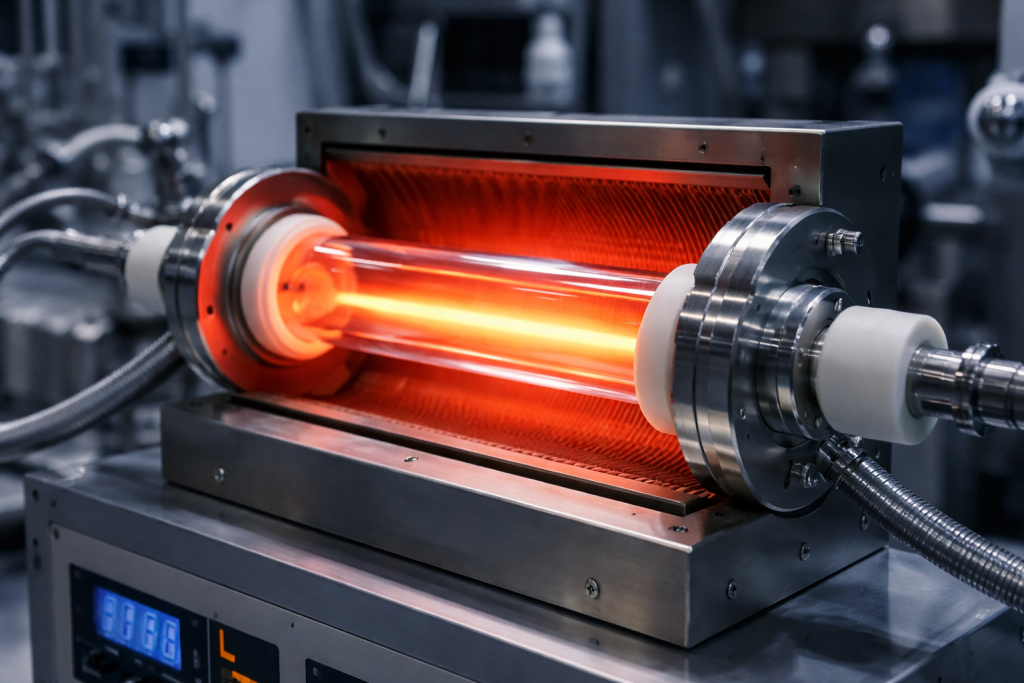
Thermocouple protection tubes are widely used in furnaces, kilns, heat-treatment systems and industrial thermal equipment to protect temperature sensors from direct exposure to process gases, particles, molten materials and mechanical damage.
Among non-metallic protection tube materials, three of the most common choices are:
- Fused quartz
- High-purity alumina
- Silicon carbide
Although all three materials can be used to protect thermocouples, their performance differs significantly in terms of temperature capability, thermal shock resistance, chemical stability, mechanical strength and response speed.
The correct material should therefore be selected according to the actual furnace environment rather than temperature alone.
1. What Should Be Considered When Selecting a Thermocouple Protection Tube?
A protection tube is not simply a barrier around the thermocouple.
Its material and geometry can influence:
- Sensor response time
- Thermocouple service life
- Measurement stability
- Contamination risk
- Mechanical reliability
- Resistance to process gases
- Maintenance frequency
Before choosing a material, engineers should consider:
- Maximum operating temperature
- Continuous or intermittent use
- Heating and cooling rate
- Furnace atmosphere
- Chemical exposure
- Abrasive particles
- Mechanical impact
- Required response speed
- Thermocouple type
- Purity requirements
These conditions determine whether fused quartz, alumina or silicon carbide is the more appropriate solution.
2. Fused Quartz Thermocouple Protection Tubes
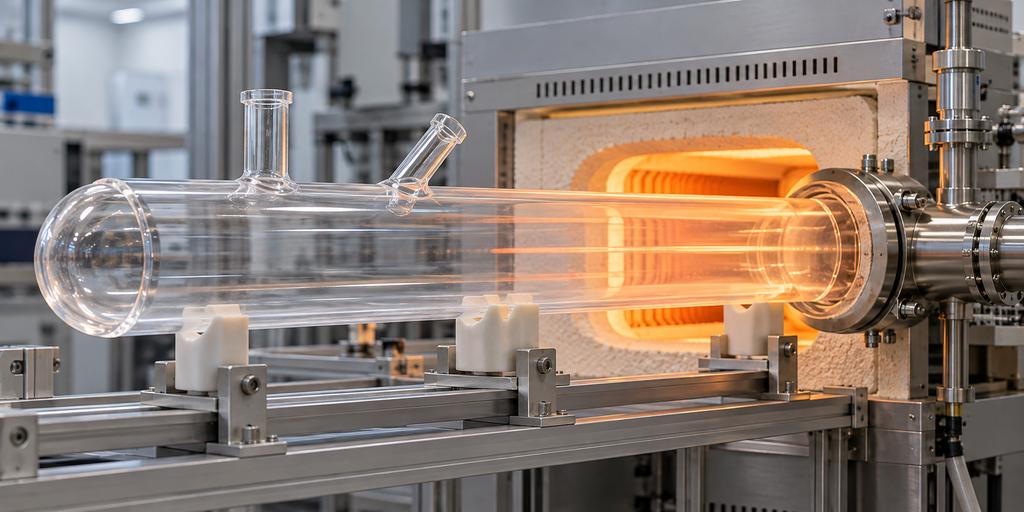
Fused quartz is commonly used in laboratory furnaces, semiconductor equipment and clean thermal-processing systems.
Its most important advantage is its extremely low coefficient of thermal expansion.
This gives fused quartz excellent resistance to rapid heating and cooling.
Main Advantages of Fused Quartz
Fused quartz offers:
- Excellent thermal shock resistance
- Very low thermal expansion
- High chemical purity
- Good resistance to many acids
- Transparent construction
- Easy visual inspection
- Good dimensional accuracy
- Relatively flexible custom fabrication
For applications with frequent thermal cycling, quartz can be especially useful because it experiences less thermal stress than many ceramics.
Typical Applications
Fused quartz protection tubes are commonly used in:
- Laboratory furnaces
- Semiconductor furnaces
- Tube furnaces
- Research equipment
- Controlled-atmosphere systems
- Optical and thermal testing equipment
Limitations of Fused Quartz
Quartz is not suitable for every high-temperature environment.
Its limitations include:
- Lower mechanical strength than dense ceramics
- Sensitivity to impact
- Limited resistance to alkali-rich environments
- Possible devitrification at elevated temperatures
- Reduced dimensional stability during prolonged high-temperature service
Therefore, fused quartz is best suited to relatively clean environments where thermal shock resistance and purity are more important than mechanical strength.
3. Alumina Thermocouple Protection Tubes
High-purity alumina is one of the most commonly used ceramic materials for high-temperature thermocouple protection.
Compared with fused quartz, alumina can generally operate at higher sustained temperatures and provides better mechanical stability.
High-purity grades such as 99.5% or 99.7% Al₂O₃ are commonly used for demanding furnace applications.
Main Advantages of Alumina
Alumina provides:
- High operating temperature capability
- Good mechanical strength
- Excellent electrical insulation
- Good wear resistance
- Good chemical stability
- High-temperature dimensional stability
It is especially suitable for thermocouples using platinum or platinum-rhodium wires.
Typical Applications
Alumina tubes are often used in:
- High-temperature laboratory furnaces
- Ceramic sintering furnaces
- Heat-treatment equipment
- Research furnaces
- Type R, S and B thermocouple assemblies
- High-temperature process monitoring
Thermal Shock Limitation
One of the main differences between alumina and fused quartz is thermal shock resistance.
Alumina expands more during heating than quartz.
Rapid heating or cooling can therefore create greater thermal stress.
For example, directly inserting a cold alumina tube into a very hot furnace may increase the risk of cracking.
For this reason, alumina protection tubes usually require more controlled heating and cooling conditions.
4. Silicon Carbide Thermocouple Protection Tubes
Silicon carbide is commonly selected for more severe industrial environments.
It offers a combination of:
- High-temperature resistance
- Excellent thermal conductivity
- Good thermal shock resistance
- High mechanical strength
- Strong abrasion resistance
- Good corrosion resistance
Compared with fused quartz and alumina, SiC is particularly useful when the thermocouple tube is exposed to harsh operating conditions.
Typical Applications
SiC protection tubes may be used in:
- Heat-treatment furnaces
- Industrial kilns
- Incinerators
- Petrochemical systems
- Chemical-processing equipment
- Metal-processing furnaces
- High-temperature gas monitoring systems
5. Not All Silicon Carbide Tubes Are the Same
Silicon carbide protection tubes can be produced using different material systems.
Common types include:
- Sintered silicon carbide
- Reaction-bonded silicon carbide
- Nitride-bonded silicon carbide
- Siliconized silicon carbide
These materials can have different:
- Maximum service temperatures
- Porosity
- Thermal conductivity
- Mechanical strength
- Corrosion resistance
Therefore, purchasing specifications should not simply state:
“SiC protection tube.”
The specific SiC grade should be confirmed according to the actual furnace environment.
6. Thermal Shock Resistance
Thermal shock performance is one of the most important differences between these materials.
Fused Quartz
Fused quartz has extremely low thermal expansion.
This makes it highly resistant to rapid heating and cooling.
It is especially suitable for applications involving:
- Frequent furnace cycling
- Rapid temperature changes
- Laboratory testing
- Batch processing
Alumina
Alumina performs well at steady high temperature but is generally more sensitive to sudden temperature changes.
Gradual heating and cooling are recommended.
Silicon Carbide
SiC combines relatively low thermal expansion with high thermal conductivity.
Heat can move through the material quickly, reducing internal temperature gradients.
This gives many SiC grades excellent thermal shock resistance.
In severe thermal cycling environments, SiC can therefore offer an important advantage over alumina.
7. Thermal Conductivity and Sensor Response
Protection tube material can also affect thermocouple response time.
Heat must pass through the protection tube before reaching the thermocouple junction.
Silicon carbide has relatively high thermal conductivity.
This allows heat to move through the tube wall quickly.
As a result, SiC protection tubes can provide faster thermal response in some applications.
Fused quartz has relatively low thermal conductivity.
Alumina generally falls between quartz and SiC.
However, actual response time also depends on:
- Tube wall thickness
- Outer diameter
- Inner diameter
- Thermocouple position
- Furnace atmosphere
- Gas velocity
Reducing wall thickness may improve response speed, but it can also reduce mechanical strength.
8. Mechanical Strength and Abrasion Resistance
Mechanical conditions are another important selection factor.
Fused Quartz
Quartz is relatively brittle.
It can be damaged by:
- Impact
- Improper installation
- Tool contact
- Strong vibration
Alumina
Alumina offers higher hardness and mechanical strength than quartz.
However, it remains a brittle ceramic.
Silicon Carbide
SiC usually provides the strongest resistance to:
- Abrasion
- Erosion
- Mechanical wear
- Furnace debris
- High gas velocity
For industrial furnaces containing abrasive particles, SiC may therefore provide longer service life.
9. Chemical Resistance
Temperature alone should never determine material selection.
The furnace atmosphere is equally important.
Fused Quartz
Quartz generally performs well in:
- Clean oxidizing atmospheres
- Many acidic environments
- Semiconductor-type furnace systems
It is less suitable for:
- Alkali-rich gases
- Strong alkaline materials
- Heavy contamination environments
Alkali contamination can also accelerate quartz devitrification.
Alumina
High-purity alumina provides good chemical stability in many furnace atmospheres.
It is widely used in:
- Oxidizing environments
- Inert atmospheres
- High-temperature ceramic processing
Silicon Carbide
SiC can provide strong resistance to:
- Corrosive gases
- Abrasive particles
- Harsh industrial atmospheres
However, chemical resistance varies by SiC grade.
Process gas composition should always be confirmed before selecting the material.
10. Fused Quartz vs Alumina vs Silicon Carbide
| Property | Fused Quartz | High-Purity Alumina | Silicon Carbide |
|---|---|---|---|
| Thermal Shock Resistance | Excellent | Moderate | Excellent |
| Sustained High Temperature | Moderate | Excellent | Excellent |
| Mechanical Strength | Moderate | Good | Very Good |
| Abrasion Resistance | Low | Good | Excellent |
| Thermal Conductivity | Low | Medium | High |
| Transparency | Yes | No | No |
| Electrical Insulation | Excellent | Excellent | Depends on Grade |
| Chemical Purity | Excellent | Excellent | Depends on Grade |
| Resistance to Mechanical Abuse | Moderate | Good | Excellent |
| Custom Fabrication | Relatively Easy | Moderate | More Difficult |
This table should be used as a general comparison only.
Actual performance depends on material grade, geometry and process conditions.
11. When Should You Choose Fused Quartz?
Fused quartz is often the best choice when:
- Rapid heating and cooling occur
- High purity is required
- The process environment is clean
- Mechanical impact is limited
- Visual inspection is useful
- Custom shapes are required
Typical applications include semiconductor, laboratory and research furnaces.
12. When Should You Choose Alumina?
Alumina may be more suitable when:
- Operating temperature is higher
- Long-term thermal stability is required
- Electrical insulation is important
- Noble-metal thermocouples are used
- Thermal cycling is relatively controlled
Alumina is commonly selected for stable, high-temperature furnace environments.
13. When Should You Choose Silicon Carbide?
Silicon carbide becomes attractive when several difficult conditions occur together.
SiC may be preferred when:
- Thermal shock is severe
- Mechanical strength is important
- Abrasive particles are present
- Fast thermal response is required
- Corrosive process gases are present
- Long tubes require better rigidity
- Operating conditions are harsh
This makes SiC especially useful in industrial furnaces where quartz or alumina may experience shorter service life.
14. Combined Protection Tube Designs
In some high-temperature applications, using two materials together can provide better performance.
One common configuration is:
Outer SiC protection tube + inner alumina tube
The outer SiC tube provides:
- Mechanical protection
- Thermal shock resistance
- Abrasion resistance
The inner alumina tube provides:
- Electrical insulation
- Thermocouple separation
- High-temperature stability
This combination can be particularly useful for platinum-based thermocouples used in harsh furnace environments.
15. What Information Should Be Included in an RFQ?
When ordering custom thermocouple protection tubes, buyers should provide as much operating information as possible.
Important specifications include:
- Material
- Material grade
- Outer diameter
- Inner diameter
- Wall thickness
- Total length
- Closed-end or open-end design
- End shape
- Maximum operating temperature
- Continuous or intermittent use
- Furnace atmosphere
- Process gases
- Heating and cooling rate
- Thermocouple type
- Installation method
For custom quartz protection tubes, additional requirements may include:
- High-purity fused quartz grade
- Straightness
- Surface finish
- Dimensional tolerance
- Flange configuration
- Gas-tight structure
- Custom welded components
A complete specification helps manufacturers recommend the correct tube rather than simply selecting the lowest-cost material.
Conclusion
Fused quartz, alumina and silicon carbide thermocouple protection tubes are designed for different operating conditions.
Fused quartz is especially suitable for clean applications requiring excellent thermal shock resistance and high purity.
High-purity alumina is better suited to sustained high-temperature operation and thermocouple systems requiring electrical insulation.
Silicon carbide is particularly valuable when high temperature is combined with abrasion, corrosion, mechanical stress or severe thermal cycling.
There is therefore no universal best material.
The correct selection should be based on:
Operating temperature + thermal cycling + furnace atmosphere + chemical exposure + mechanical conditions + thermocouple type
For custom protection tubes, OD, ID, wall thickness, length, end geometry and mounting structure should also be defined before production.