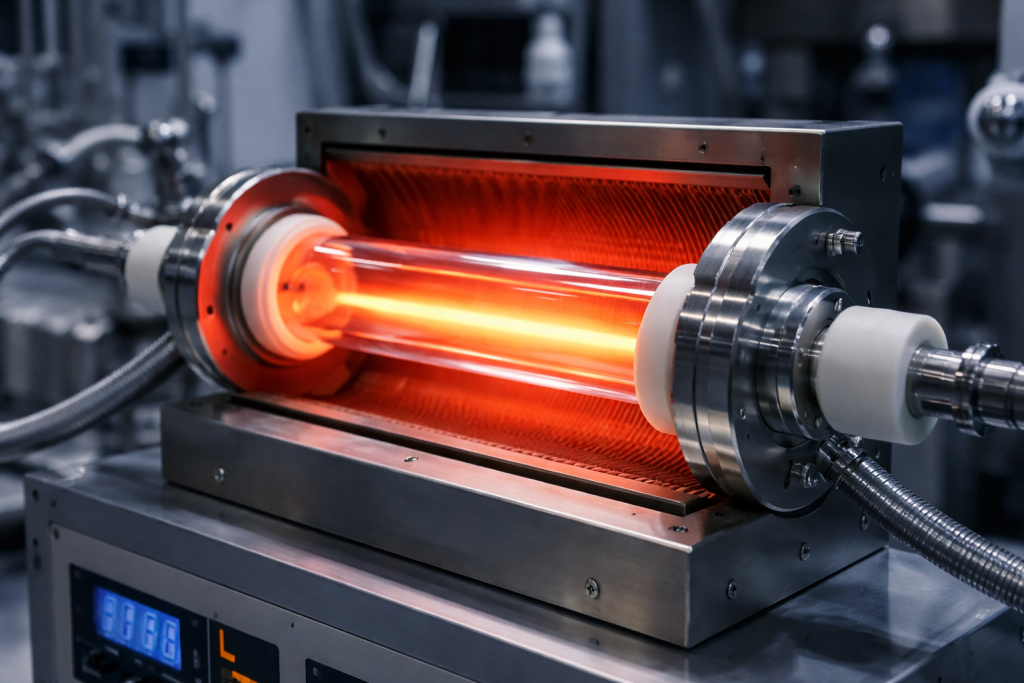
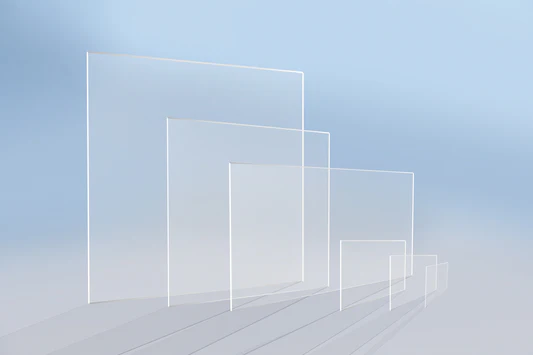
Quartz reaction tubes are widely used in tube furnaces, CVD systems, annealing equipment, oxidation processes, research reactors and controlled-atmosphere thermal systems.
Their popularity comes from the combination of high purity, low thermal expansion, good chemical resistance and excellent thermal-shock performance.
However, a custom quartz reaction tube is rarely just a simple straight tube.
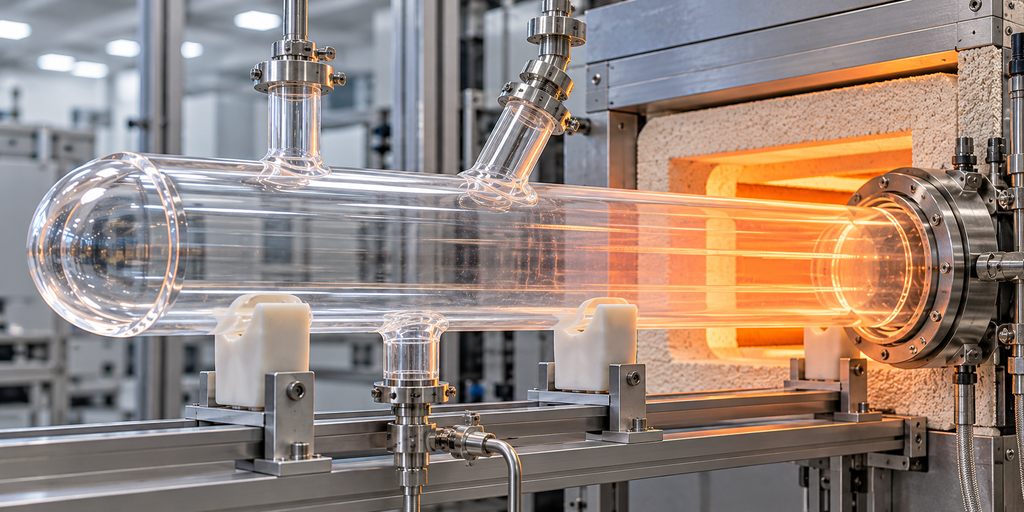
Many applications require:
- Closed ends
- Gas inlet and exhaust ports
- Side branches
- Flanges
- Reduced or expanded sections
- Custom wall thickness
- Vacuum connections
- Thermocouple ports
Once these features are added, the design must consider not only dimensions, but also thermal stress, gas flow, high-temperature deformation and manufacturability.
This article explains the main engineering points that should be reviewed before ordering a custom quartz reaction tube.
1. Why Fused Quartz Is Used for High-Temperature Reaction Tubes
One of the most important advantages of fused quartz is its extremely low coefficient of thermal expansion.
This allows quartz to tolerate rapid heating and cooling much better than many conventional glass materials.
Other useful characteristics include:
- High silica purity
- Low thermal expansion
- Good thermal-shock resistance
- High electrical resistivity
- Good resistance to many acids
- Optical transparency
- Relatively easy glassworking and welding
These properties make quartz particularly useful when the reaction tube itself must remain clean and stable during thermal processing.
Typical applications include:
- Semiconductor thermal processing
- Tube furnace experiments
- Gas-phase reactions
- CVD and LPCVD systems
- Oxidation and diffusion processes
- Material annealing
- Laboratory synthesis
- Controlled-atmosphere heating
2. Closed-End Quartz Reaction Tubes
Many reaction systems require one end of the tube to be permanently sealed.
Common closed-end shapes include:
- Rounded end
- Domed end
- Hemispherical end
- Flat end
- Tapered end
The end shape affects both mechanical strength and thermal stress.
Rounded and Domed Ends
Rounded ends are commonly used because they provide a smoother transition from the cylindrical wall to the sealed end.
This helps distribute stress more evenly.
They are especially useful when:
- The closed end is inside the hot zone
- Rapid thermal cycling is expected
- Process gas reaches the sealed end directly
- The tube is relatively large in diameter
Flat Ends
Flat ends may be required when:
- Equipment space is limited
- Samples must be positioned close to the end
- Optical access is needed
- The tube must fit a specific chamber geometry
However, the transition between the side wall and flat end should not be unnecessarily sharp.
Abrupt geometry changes can create localized thermal stress.
3. Closed-End Thickness Matters
The sealed end should not be designed independently from the main tube wall.
If the end is too thin, it may have insufficient mechanical strength.
If it is much thicker than the tube wall, it may heat and cool at a different rate.
This difference can create local thermal gradients.
Important parameters include:
- Tube OD
- Tube ID
- Wall thickness
- Closed-end thickness
- End radius
- Operating temperature
- Heating rate
- Internal pressure or vacuum
For custom manufacturing, it is usually better to specify the desired end geometry rather than only asking the manufacturer to “seal one end.”
4. Gas Port Design
Many quartz reaction tubes require welded gas ports.
Typical designs include:
- Vertical side ports
- Angled ports
- Tangential gas inlets
- Axial gas inlets
- Exhaust ports
- Thermocouple ports
- Sampling ports
Port position can affect both gas flow and tube durability.
A welded branch changes the local geometry and often creates a region with different wall thickness.
Therefore, gas ports should be positioned carefully.
5. Avoid Placing Ports in Severe Thermal Gradient Zones
One common design mistake is placing a welded gas port directly at the transition between the furnace hot zone and cold zone.
This area may already experience a strong temperature gradient.
Adding a welded joint can increase thermal stress.
When possible, ports should be kept away from:
- Hot-zone boundaries
- Tube support locations
- Mechanical clamps
- Highly stressed flange areas
- Regions exposed to direct flame or heaters
This does not mean a port can never be located near these areas, but the geometry and thermal conditions should be reviewed carefully.
6. Gas Flow Direction Can Affect Process Uniformity
Gas port direction is not only a mechanical issue.
It can also affect process uniformity.
Axial Gas Entry
Gas enters along the main axis of the reaction tube.
This arrangement is commonly used when relatively uniform longitudinal gas flow is required.
Side Gas Entry
A side inlet is simple and convenient for many laboratory systems.
However, it can create localized high-velocity flow near the inlet.
Angled or Tangential Entry
Angled ports can be used to influence gas circulation or reduce direct gas impingement on the sample.
For sensitive applications, the following should be considered together:
- Inlet position
- Outlet position
- Port angle
- Gas velocity
- Sample location
- Furnace hot zone
- Tube diameter
A supplier should therefore receive the complete port layout rather than only a list of port diameters.
7. Wall Thickness Is Not Simply “Thicker Is Better”
Wall thickness affects:
- Mechanical strength
- Tube weight
- Thermal response
- High-temperature sagging
- Resistance to pressure differential
- Manufacturing difficulty
- Cost
Increasing wall thickness may improve stiffness, but it also increases thermal mass.
A thicker tube will usually heat and cool more slowly.
For applications involving rapid thermal cycling, an unnecessarily thick wall can create larger temperature differences through the tube section.
The correct wall thickness should balance mechanical stability and thermal performance.
8. Large-Diameter Tubes Need More Attention to Sagging
At elevated temperatures, fused quartz gradually loses stiffness.
Large horizontal tubes can slowly deform under their own weight.
This is commonly referred to as sagging.
The risk depends on:
- Tube diameter
- Wall thickness
- Heated length
- Unsupported span
- Process temperature
- Time at temperature
- Quartz grade
- Tube orientation
For large-diameter reaction tubes, support design should therefore be considered at the same time as the tube itself.
A tube that performs well at room temperature may still deform slowly after repeated high-temperature cycles.
9. Thermal Shock Is Excellent, but Not Unlimited
Quartz has excellent thermal-shock resistance because of its very low thermal expansion.
However, even quartz can crack when severe local temperature differences develop.
Typical causes include:
- Cold process gas entering a hot tube
- Water contacting hot quartz
- Rapid insertion into a hot furnace
- Uneven furnace heating
- Thick welded sections next to thin walls
- Direct flame impingement
- Local contamination
- Sudden cooling after high-temperature operation
Therefore, material selection alone cannot prevent thermal-shock failure.
Geometry and operating procedures are equally important.
10. Cold Gas Injection Is an Important Design Consideration
Cold gas entering a hot quartz tube can rapidly cool a small local area.
The surrounding quartz may remain much hotter.
This localized temperature difference creates thermal stress.
The effect becomes more significant when:
- Gas flow rate is high
- Inlet diameter is small
- Gas temperature is low
- The inlet is located directly in the hot zone
- The tube cycles frequently
Possible design improvements include:
- Moving the inlet farther from the hottest region
- Preheating the gas
- Reducing sudden flow changes
- Increasing inlet radius
- Using a smoother branch transition
11. Welded Areas Require Careful Fabrication
Quartz gas ports, branches and flanges are commonly fabricated using high-temperature glassworking techniques.
The joint area must be carefully controlled.
Poor fabrication can create:
- Uneven wall thickness
- Local thin spots
- Distortion
- Residual stress
- Misaligned ports
- Internal restrictions
- Weak transition areas
A good welded joint should have:
- Smooth geometry
- Good alignment
- Consistent wall transition
- No visible cracking
- No excessive bubbles or inclusions
- Minimal distortion
For complex reaction tubes, dimensional inspection after fabrication is particularly important.
12. Horizontal Support Design
Long reaction tubes are often installed horizontally.
The support positions can significantly affect service life.
If the unsupported length is excessive, the tube may gradually bend during repeated high-temperature operation.
Support design should consider:
- Tube diameter
- Wall thickness
- Overall length
- Heated length
- Furnace hot zone
- Flange weight
- Attached piping
- Vacuum components
Supports should hold the tube securely without creating excessive mechanical constraint.
13. Vacuum and Pressure Must Be Specified
Quartz reaction tubes are frequently used under:
- Vacuum
- Slight positive pressure
- Flowing gas near atmospheric pressure
These operating conditions are not interchangeable from a mechanical-design perspective.
The ability of a quartz tube to tolerate pressure differential depends on:
- Diameter
- Wall thickness
- Length
- Temperature
- Surface condition
- Joint design
- End geometry
Large-diameter tubes are especially sensitive.
If a tube will operate under vacuum or pressure, this should always be included in the RFQ.
14. Purity Requirements
Not every quartz reaction tube requires semiconductor-grade material.
For ordinary laboratory heating, standard high-quality fused quartz may be sufficient.
However, semiconductor, electronics and advanced-material processes may require stricter control of:
- Na
- K
- Li
- Al
- Fe
- OH content
- Surface cleanliness
- Metallic contamination
- Particle contamination
The material grade should therefore be selected according to the actual process rather than simply choosing the highest grade available.
15. Typical Custom Reaction Tube Configurations
Closed-End Reaction Tube
One end open and one end sealed.
Suitable for laboratory reactions, sample heating and controlled-atmosphere experiments.
Open-Ended Furnace Tube
Both ends remain open.
Common in continuous gas-flow tube furnaces.
Side-Port Reaction Tube
Includes one or more welded gas inlets or exhaust ports.
Multi-Port Reaction Tube
Can include separate connections for:
- Process gas
- Exhaust
- Thermocouple
- Vacuum
- Pressure measurement
- Sampling
Flanged Quartz Tube
Used when the reaction tube must connect to:
- Vacuum hardware
- Stainless-steel piping
- Process chambers
- Gas manifolds
Complex Custom Reactor
May combine:
- Large-diameter body
- Reduced ends
- Closed end
- Multiple branches
- Quartz flanges
- Ground joints
- Internal quartz structures
16. What Should Be Shown on the Drawing?
A useful engineering drawing should include:
- Outer diameter
- Inner diameter
- Wall thickness
- Overall length
- Closed-end geometry
- End thickness
- Port diameter
- Port wall thickness
- Port length
- Port position
- Port angle
- Flange dimensions
- Joint geometry
- Required tolerances
For complex parts, a STEP file can also help the manufacturer understand the complete geometry.
17. What Should Be Included in the RFQ?
For custom quartz reaction tubes, provide:
- Quartz material grade
- OD
- ID
- Wall thickness
- Length
- End configuration
- Number of ports
- Port sizes
- Port positions
- Port angles
- Flange requirements
- Maximum operating temperature
- Heating rate
- Cooling rate
- Process gas
- Vacuum level or pressure
- Required quantity
If possible, also provide:
- 2D drawing
- STEP file
- Existing sample
- Equipment photo
The more complete the operating information, the easier it is to evaluate manufacturability before production.
18. Common Design Mistakes
Mistake 1: Choosing the Thinnest Wall Only to Reduce Cost
This may reduce mechanical margin and increase distortion risk.
Mistake 2: Making Every Section Very Thick
Excessive thickness adds weight and may worsen thermal gradients.
Mistake 3: Placing a Port at the Hottest Transition Zone
The welded area may experience unnecessary thermal stress.
Mistake 4: Using Sharp Geometry Changes
Smooth transitions are generally preferable for repeated thermal cycling.
Mistake 5: Ignoring Support Positions
Long horizontal tubes can deform at high temperature.
Mistake 6: Not Specifying Vacuum or Pressure
A tube designed for atmospheric operation may not be suitable for pressure differential.
Mistake 7: Specifying Only Dimensions but Not Operating Conditions
Temperature, gas chemistry and thermal cycling can materially affect the recommended design.
Conclusion
A quartz reaction tube should not be designed only by specifying diameter, length and wall thickness.
For high-temperature applications, the most important factors are:
closed-end geometry + gas-port design + wall thickness + welded joints + thermal gradients + support conditions
Fused quartz provides excellent thermal-shock performance, but localized cooling, poor joint geometry or excessive mechanical loading can still lead to cracking or deformation.
Wall thickness also needs to be optimized rather than maximized.
A thicker tube can improve mechanical stability, but excessive thickness increases weight and changes thermal response.
For custom quartz reaction tubes, providing both the mechanical drawing and actual operating conditions allows the manufacturer to evaluate the design more accurately before fabrication.