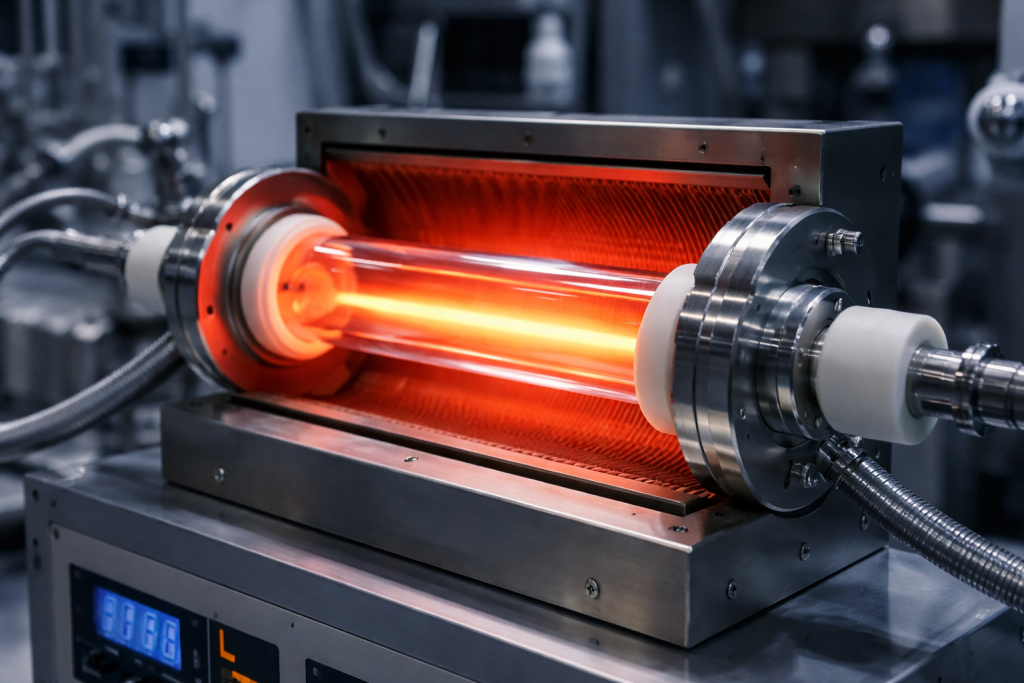
The global semiconductor industry is entering another major manufacturing expansion cycle.
According to the latest SEMI 300mm Fab Outlook released in October 2026, worldwide front-end equipment spending for 300mm semiconductor fabs is projected to reach a record US$149 billion in 2026, representing approximately 31% year-over-year growth. SEMI expects investment to continue expanding at double-digit rates through 2029, when annual spending could reach approximately US$227 billion.
Behind these figures is more than a short-term equipment purchasing cycle. Artificial intelligence, high-performance computing, advanced logic, HBM memory and regional semiconductor manufacturing programs are driving construction of new fabs and expansion of existing production lines.
For semiconductor material and component suppliers, this expansion is also increasing attention on the process materials that operate inside wafer fabrication equipment.
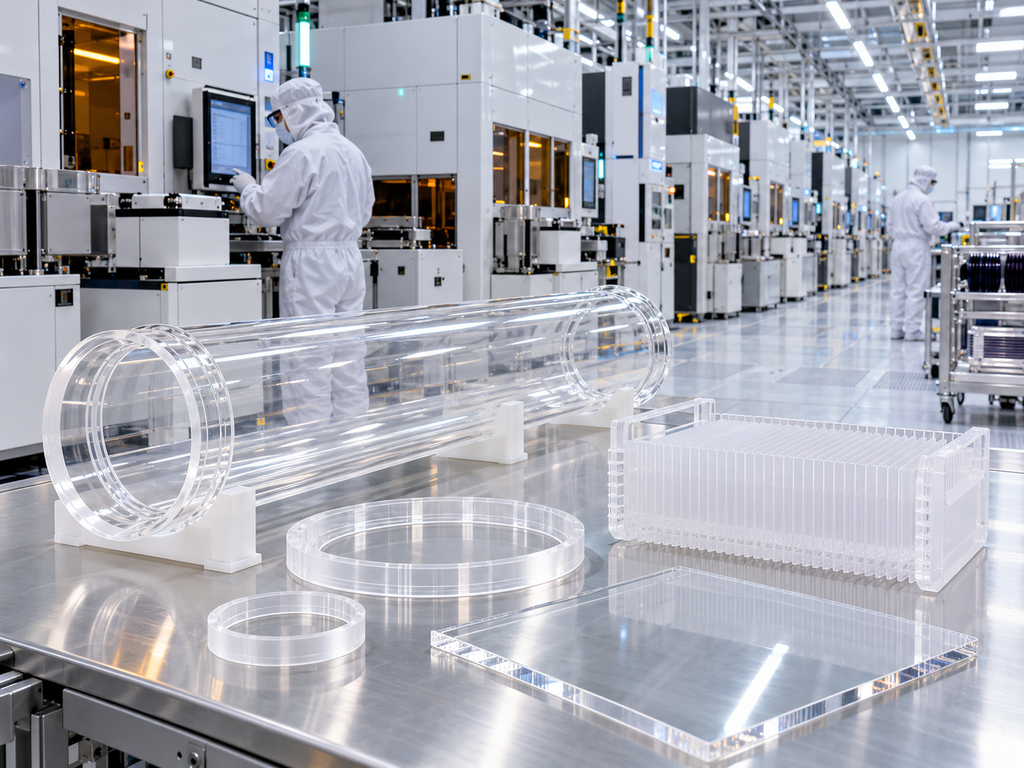
One of these critical material groups is high-purity fused quartz.
Quartz tubes, wafer boats, process tubes, rings, plates, windows and other custom quartz components are widely used in semiconductor thermal processing and other high-temperature or chemically demanding environments. As 300mm manufacturing capacity expands, requirements for quartz component purity, dimensional control, thermal stability and contamination management are becoming increasingly important.
300mm Fab Investment Has Accelerated Sharply in 2026
The latest SEMI forecast represents a significant upward shift in semiconductor manufacturing investment.
SEMI now projects:
- US$149 billion in global 300mm front-end fab equipment spending in 2026
- Approximately 31% year-over-year growth
- Around 16% additional growth in 2027
- Approximately 12% growth in 2028
- Approximately 18% growth in 2029
- Spending reaching about US$227 billion by 2029
Total installed 300mm manufacturing capacity is also expected to increase by approximately 7% in 2026, followed by annual growth of around 8% between 2027 and 2029.
The expansion is no longer limited to a small number of leading-edge fabs.
SEMI expects 20 new 300mm fabs or production lines to begin construction worldwide in 2026, excluding pure R&D facilities, followed by another 18 in 2027. Thirteen new 300mm fabs or lines are projected to begin operations or ship first silicon during 2026.
For semiconductor equipment supply chains, this means increasing demand not only for major capital equipment but also for the precision components and consumable parts required to operate and maintain that equipment.
AI and Advanced Memory Are Major Investment Drivers
Artificial intelligence remains one of the strongest forces behind the current semiconductor investment cycle.
Training and inference systems require enormous amounts of computing power, which in turn increases demand for advanced logic processors, GPUs, accelerators and high-bandwidth memory.
Memory investment is especially notable.
SEMI projected earlier in 2026 that global 300mm fab equipment spending in the memory sector would exceed US$50 billion for the first time, reaching approximately US$52 billion. DRAM equipment investment alone was expected to reach about US$37 billion, supported by demand for HBM and DDR5 products.
The broader semiconductor equipment market is already reflecting this acceleration. Global semiconductor equipment billings reached approximately US$40.53 billion in the second quarter of 2026, up 23% year over year and 11% sequentially, according to SEMI.
Higher semiconductor production capacity does not translate one-to-one into quartz component demand. However, more fabs, additional process tools and higher wafer throughput generally expand the installed base of equipment that requires high-purity process components, replacement parts and maintenance materials.
Why High-Purity Quartz Remains Important in Semiconductor Processing
Fused quartz has a combination of properties that make it suitable for many semiconductor processing environments.
These include:
- High temperature resistance
- Low thermal expansion
- Good thermal shock resistance
- High chemical stability
- High optical transmission across selected UV, visible and infrared wavelengths
- High achievable material purity
- Precision machining and forming capability
In semiconductor thermal processing, contamination control is especially important.
A process component may appear mechanically simple, but impurities introduced by material selection, machining, cleaning, packaging or handling can affect semiconductor processes.
For this reason, semiconductor-grade quartz components are typically evaluated differently from general industrial quartz glass.
Depending on the application, customers may specify requirements covering material grade, OH content, metallic impurities, surface quality, dimensional tolerance, cleaning method and packaging.
Quartz Diffusion Tubes and Process Tubes
One of the most established semiconductor applications for fused quartz is the quartz diffusion furnace tube.
These tubes are used in thermal processes such as:
- Oxidation
- Diffusion
- Annealing
- LPCVD-related processes
- High-temperature research processes
As semiconductor fabs migrate toward higher productivity and increasingly controlled thermal environments, process-tube geometry becomes increasingly important.
Typical specifications may include:
Outer Diameter and Inner Diameter
OD and ID determine compatibility with furnace systems and internal wafer-handling components.
Wall Thickness
Uniform wall thickness can affect mechanical strength, thermal behavior and overall dimensional consistency.
Tube Length
Large furnace tubes may require tight control of straightness and geometry over substantial lengths.
Open-End or Closed-End Geometry
Tube-end structure can be customized according to furnace and gas-flow design.
Flanges and Connections
Quartz tubes may incorporate welded flanges, ports, joints or other custom structures.
For replacement components, dimensional matching with existing equipment can be especially important.
Quartz Wafer Boats and Carriers
Quartz boats and carriers are used to hold silicon wafers during thermal processing.
For 300mm manufacturing, the dimensional requirements of wafer-handling components become increasingly demanding because even relatively small geometric deviations can influence wafer positioning and process consistency.
Important considerations include:
- Wafer slot spacing
- Slot width
- Boat straightness
- Overall dimensions
- Surface condition
- Thermal stability
- Particle control
- Cleaning and packaging
Quartz boats may be fabricated for specific furnace systems rather than being treated as universal components.
Consequently, technical drawings, equipment information or physical samples are often used when developing customized replacement parts.
Custom Quartz Components Are Becoming More Important
Modern semiconductor equipment uses far more quartz products than simple straight tubes.
Depending on the equipment and process environment, custom fused quartz components can include:
- Quartz tubes
- Quartz plates
- Quartz discs
- Quartz rings
- Quartz flanges
- Quartz windows
- Quartz rods
- Quartz wafer boats
- Quartz carriers
- Quartz liners
- Quartz sleeves
- Precision-drilled quartz parts
- Welded quartz assemblies
- Special-shaped quartz components
This makes precision quartz fabrication increasingly important.
Customers are often looking not simply for raw quartz material, but for finished components manufactured according to drawings.
Important manufacturing capabilities can include:
Precision Cutting
Quartz blanks must first be prepared with controlled dimensions and minimal edge damage.
Grinding and Machining
Grinding, drilling and CNC machining can be used to produce holes, slots, grooves and complex geometries.
Surface Finishing
Depending on the application, surfaces may be ground, mechanically polished or flame finished.
Quartz Welding
Complex process assemblies may require precision joining of tubes, ports, flanges and other quartz structures.
Cleaning
For semiconductor applications, cleaning after machining is especially important because particles and residual contaminants must be controlled before final packaging.
Purity Is Only One Part of Semiconductor Quartz Quality
High purity is essential, but purity alone does not define a semiconductor-grade quartz component.
A component manufactured from excellent raw material can still cause problems if machining accuracy, surface condition or cleaning is inadequate.
Semiconductor equipment manufacturers and fabs therefore increasingly evaluate quartz components through multiple parameters.
Material Grade
Natural fused quartz and synthetic fused silica can offer different impurity levels, OH characteristics and optical properties.
The correct material depends on the specific process.
Dimensional Tolerance
OD, ID, thickness, flatness, perpendicularity and hole position may all affect equipment compatibility.
Surface Quality
Machining marks, chips, scratches and subsurface damage should be controlled according to application requirements.
Thermal Stability
Components used repeatedly at elevated temperatures need stable geometry and reliable thermal performance.
Contamination Control
Cleaning, handling and packaging procedures can be as important as the original quartz material.
Expansion Is Becoming Global
The current 300mm investment cycle is geographically broad.
North America, Asia and other semiconductor manufacturing regions are all developing additional capacity.
SEMI projects equipment investment in the Americas alone to increase from approximately US$18.1 billion in 2026 to US$40.6 billion in 2029.
This geographic diversification also changes semiconductor supply-chain requirements.
Equipment manufacturers and fabs increasingly need component suppliers capable of supporting:
- Custom drawings
- Small prototype quantities
- Replacement parts
- Production batches
- Consistent material specifications
- International shipment
- Documentation and inspection
For quartz manufacturers, the opportunity therefore extends beyond simply supplying higher volumes.
The more important opportunity is supplying increasingly specialized components with repeatable quality.
From Standard Quartz Products to Precision Semiconductor Components
The current semiconductor investment cycle is likely to favor suppliers that can move beyond commodity quartz products.
A semiconductor equipment customer may require a custom tube with a specific ID, OD and wall thickness.
Another may require a quartz plate with precision holes and controlled flatness.
A third may need an existing furnace component reproduced from a drawing or physical sample.
This makes the ability to support custom quartz fabrication increasingly valuable.
At Fuyao Quartz, quartz components can be manufactured according to customer drawings and application requirements, including quartz tubes, plates, windows, flanges, rings and other custom-fabricated parts for semiconductor and industrial equipment.
Specifications can be discussed based on parameters such as:
- Material grade
- Dimensions
- Tolerance
- Surface finish
- Hole geometry
- Welding structure
- Thermal-processing environment
- Quantity
- Cleaning and packaging requirements
Outlook: More Fabs Mean Higher Requirements for the Quartz Supply Chain
The projected US$149 billion in 300mm fab equipment spending in 2026 illustrates the scale of the current semiconductor capacity expansion.
More importantly, SEMI expects this investment cycle to continue through the end of the decade, with 300mm equipment spending potentially reaching US$227 billion in 2029.
AI, advanced logic, HBM, next-generation memory and regional semiconductor manufacturing programs are creating demand for new fabs and new equipment.
For the high-purity quartz industry, this trend creates opportunities—but also raises technical expectations.
Future semiconductor quartz components will increasingly need to combine:
High material purity + precise machining + stable dimensions + controlled surfaces + clean processing + reliable batch consistency.
For fabs and semiconductor equipment manufacturers sourcing quartz components, selecting the correct material and defining the required dimensions, tolerances and surface conditions early in the design process can help reduce qualification time and improve component compatibility.
As 300mm semiconductor manufacturing continues to expand worldwide, high-purity fused quartz is expected to remain an important supporting material within the semiconductor equipment supply chain.