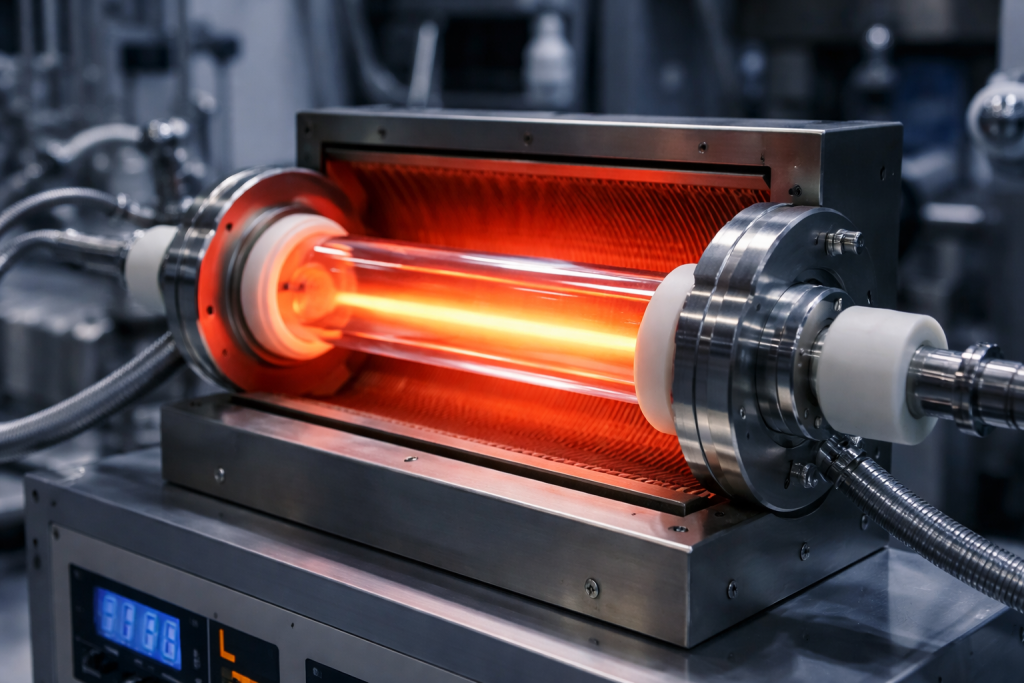
Fused silica reaction tubes are widely used in advanced chemical processing due to their exceptional thermal stability, chemical inertness, and optical transparency. These properties make them indispensable in environments involving high temperatures, corrosive media, and stringent purity requirements. This article provides a scientific overview of the material advantages of fused silica and key engineering considerations in designing reaction tubes for industrial and laboratory applications.
1. Introduction
In modern chemical processing, reaction vessels must withstand aggressive environments while maintaining structural integrity and process purity. Conventional materials such as metals or standard borosilicate glass often face limitations in extreme conditions.
Fused silica, produced by melting high-purity silica, offers a unique combination of thermal, chemical, and optical properties. As a result, fused silica reaction tubes are widely employed in applications such as:
- High-temperature gas-phase reactions
- Semiconductor-related chemical processing
- Corrosive acid handling (e.g., HCl, HNO₃ vapor systems)
- Analytical and laboratory-scale synthesis
2. Material Advantages of Fused Silica
2.1 Exceptional Thermal Stability
Fused silica exhibits a very low coefficient of thermal expansion (~0.5 × 10⁻⁶ /K), which provides excellent resistance to thermal shock. Reaction tubes can endure rapid heating and cooling cycles without cracking, making them suitable for furnace-based processes exceeding 1000°C.
Key benefits:
- Minimal dimensional change under temperature gradients
- Reduced risk of fracture during thermal cycling
- Stable performance in continuous high-temperature operation
2.2 Superior Chemical Inertness
Fused silica is highly resistant to most acids (except hydrofluoric acid and hot phosphoric acid), ensuring minimal contamination of reaction media.
Implications for chemical processing:
- Ideal for high-purity reactions
- Reduced risk of unwanted side reactions
- Long service life in corrosive environments
2.3 High Purity and Low Contamination
With impurity levels often below ppm, fused silica minimizes ion leaching and particulate contamination. This is particularly critical in:
- Fine chemical synthesis
- Semiconductor precursor processing
- Optical and electronic material preparation
2.4 Optical Transparency
Fused silica transmits a wide range of wavelengths (UV to IR), enabling:
- In-situ optical monitoring
- Laser-assisted reactions
- Spectroscopic analysis during processing
2.5 Mechanical Strength and Structural Integrity
Although brittle compared to metals, fused silica offers sufficient mechanical strength when properly designed. Its performance can be optimized through geometry and wall thickness control.
3. Design Considerations for Reaction Tubes
3.1 Dimensional Design and Wall Thickness
The tube diameter and wall thickness must be carefully selected based on:
- Internal pressure conditions
- Thermal gradients
- Mechanical loads
Design insight:
Thicker walls improve strength but reduce thermal responsiveness, requiring a balance between durability and heat transfer efficiency.
3.2 Thermal Management
Uniform heating is critical to avoid stress concentration. Design strategies include:
- Gradual temperature ramping
- Use of controlled furnace zones
- Avoidance of sharp temperature gradients
3.3 Chemical Compatibility Assessment
While fused silica resists most chemicals, it is vulnerable to:
- Hydrofluoric acid (HF)
- Strong alkalis at high temperatures
Proper evaluation of process chemistry is essential before material selection.
3.4 Surface Quality and Finishing
Surface defects can act as stress concentrators. High-quality polishing and finishing improve:
- Mechanical reliability
- Contamination control
- Flow dynamics within the tube
3.5 Connection and Sealing Design
Joining fused silica tubes with other system components requires careful engineering:
- Use of graded seals or compatible materials
- Minimization of thermal expansion mismatch
- Consideration of vacuum or pressure sealing requirements
4. Applications in Chemical Processing
4
Fused silica reaction tubes are integral to a range of advanced processes:
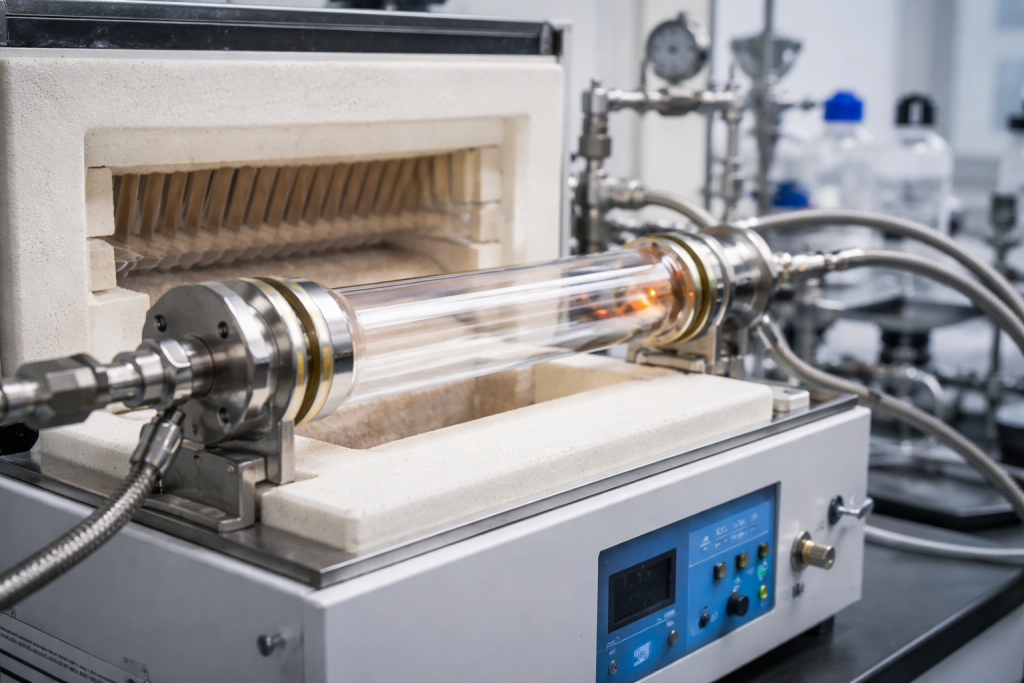
- Tube furnaces for thermal decomposition and oxidation
- CVD (Chemical Vapor Deposition) systems
- Gas purification and transport systems
- Analytical instrumentation such as spectroscopy cells
Their ability to maintain purity and withstand extreme environments makes them a preferred material in both research and industrial settings.
5. Limitations and Engineering Trade-offs
Despite its advantages, fused silica has certain limitations:
- Brittleness compared to metals
- Sensitivity to mechanical impact
- Limited resistance to HF and strong alkalis
Engineering solutions often involve hybrid system designs or protective coatings to mitigate these drawbacks.
6. Conclusion
Fused silica reaction tubes represent a critical enabling technology in modern chemical processing, offering unmatched thermal stability, chemical resistance, and purity. However, optimal performance depends not only on material selection but also on careful engineering design, including thermal management, structural considerations, and compatibility assessment.
As chemical processes continue to evolve toward higher precision and harsher environments, fused silica will remain a cornerstone material—particularly in applications where purity and stability are non-negotiable.