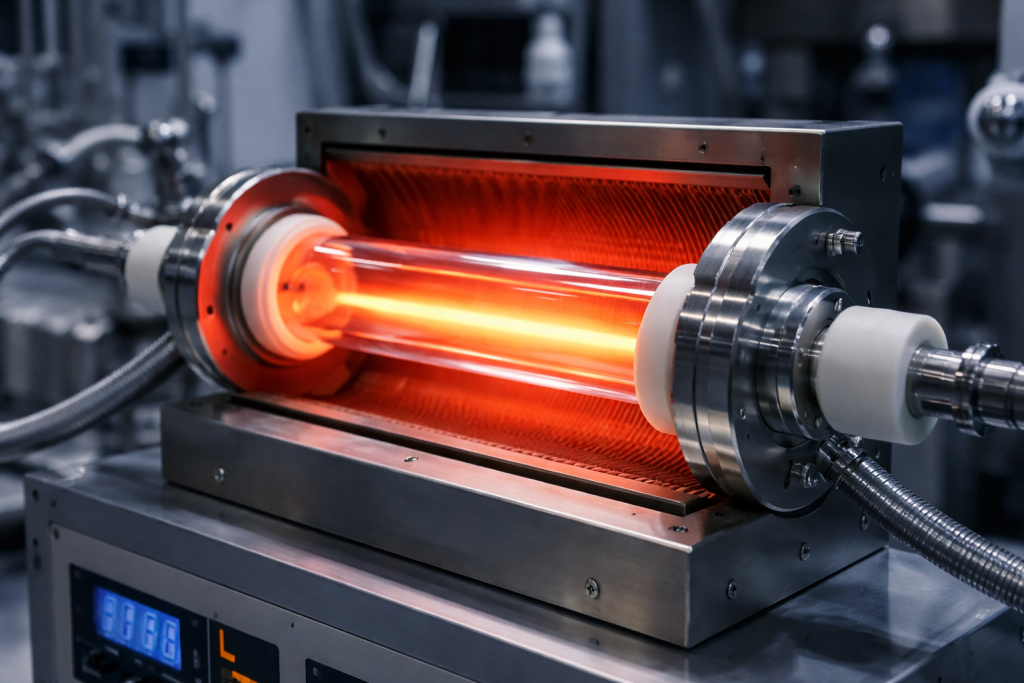
Quartz furnace tubes are critical consumable components in semiconductor thermal processing equipment. They are widely used in diffusion, oxidation, annealing, LPCVD and other high-temperature processes because fused quartz combines high chemical purity, low thermal expansion and good resistance to thermal shock.
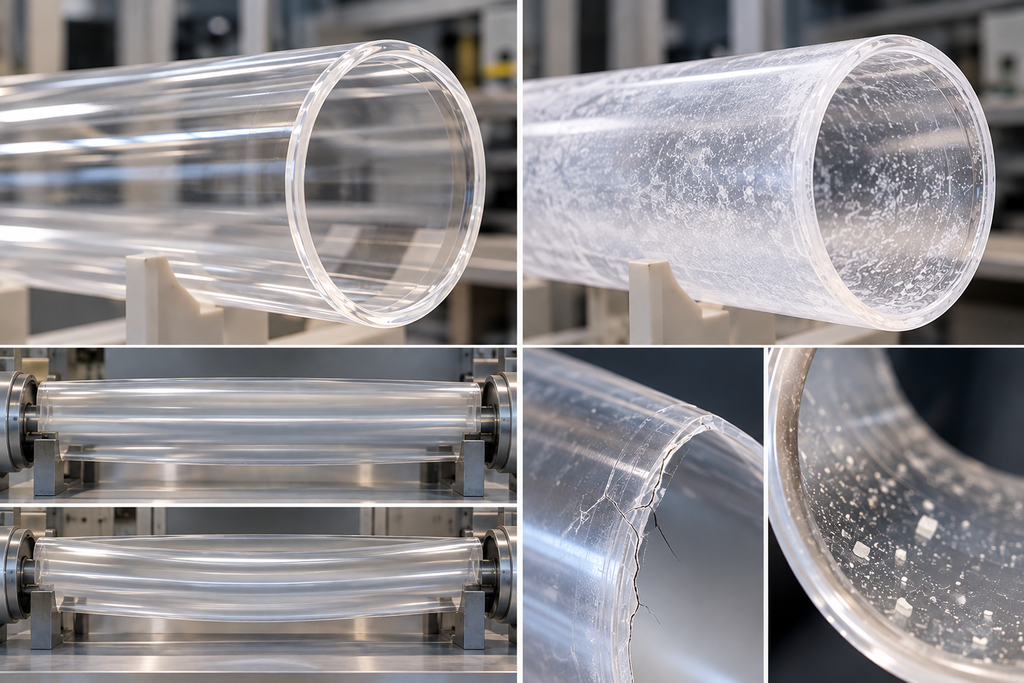
However, a quartz process tube does not remain unchanged throughout its service life.
Repeated high-temperature cycles, process chemistry, cleaning, contamination and mechanical handling can gradually alter the tube surface, geometry and mechanical condition. Eventually, these changes may affect process stability, particle performance or equipment reliability.
For semiconductor fabs and equipment maintenance teams, the important question is therefore not simply:
“How many months can a quartz furnace tube be used?”
A better question is:
“What physical and process indicators show that the quartz tube should be replaced?”
There is no universal replacement interval. The correct decision should be based on the actual condition of the tube and the requirements of the semiconductor process.
1. Why Quartz Furnace Tubes Degrade
High-purity fused quartz is particularly suitable for semiconductor furnace applications because of its chemical purity and thermal properties. Commercial semiconductor-grade quartz tubing is available with tightly controlled geometry, low bubble and inclusion levels and very low concentrations of metallic impurities.
During actual furnace operation, however, quartz tubes are repeatedly exposed to:
- High process temperatures
- Heating and cooling cycles
- Process gases
- Dopant-containing environments
- Chemical cleaning
- Surface contamination
- Mechanical loading
- Wafer boat insertion and removal
- Maintenance and handling
These factors can gradually cause several different degradation mechanisms.
The most important indicators are:
- Devitrification
- Sagging or dimensional deformation
- Cracks and edge damage
- Surface roughening and particle generation
- Chemical contamination
- Changes around joints, ports and welded areas
Each should be evaluated separately.
2. Devitrification: One of the Most Visible Warning Signs
Fused quartz has an amorphous glass structure.
At elevated temperatures and under certain conditions, parts of this amorphous structure can transform into crystalline silica. This phenomenon is known as devitrification.
Contamination can accelerate the process. Alkali elements such as sodium and potassium are particularly important because they can disrupt the silica network and act as nucleation sources for crystallization.
What Does Devitrification Look Like?
Common visual indications may include:
- White or cloudy areas
- Localized opaque patches
- Roughened surfaces
- Crystalline-looking regions
- Loss of transparency
- Surface changes concentrated around contaminated areas
A small visual change does not automatically mean that the tube must immediately be discarded.
The location, depth and growth rate of the devitrified area are more important.
Devitrification becomes more concerning when it:
- Continues expanding between maintenance cycles
- Appears on critical process surfaces
- Produces significant surface roughness
- Occurs near stressed or welded areas
- Is accompanied by microcracking
- Creates potential particle contamination
An Important Exception
Engineers should also distinguish uncontrolled devitrification from intentionally stabilized quartz materials.
Some specialized high-temperature quartz grades intentionally form a controlled cristobalite layer on the outside of the furnace tube to improve resistance to deformation.
For example, Heraeus describes a stabilized quartz grade in which a thin cristobalite shell is deliberately formed at elevated temperature to increase mechanical stability.
Therefore:
Crystallization alone should not be used as the only replacement criterion without first confirming the quartz material grade and furnace tube design.
3. Sagging: When the Tube No Longer Holds Its Geometry
Quartz softens gradually at very high temperatures.
When a large-diameter tube operates at elevated temperatures for extended periods, gravity and mechanical loading can slowly change its geometry.
This is commonly called sagging.
High-temperature quartz grades are specifically developed to reduce this effect, which demonstrates how important dimensional stability is in furnace applications.
Why Sagging Matters
Even if the tube has no visible crack, deformation may create process problems.
Possible effects include:
- Reduced clearance for quartz wafer boats
- Changes in wafer-to-wall spacing
- Misalignment with loading systems
- Uneven gas flow
- Changes in temperature distribution
- Increased mechanical interference during boat loading
- Sealing problems at furnace interfaces
For large-diameter semiconductor tubes, small dimensional changes can become significant because the equipment is designed around controlled clearances.
What Should Be Checked?
Maintenance teams can periodically inspect:
- Tube straightness
- Outer diameter
- Inner diameter
- Roundness
- Local deformation
- Centerline sag
- Position of ports and joints
- Clearance between the tube and wafer boat
If deformation begins interfering with equipment alignment or established process geometry, replacement should be considered even if the tube remains mechanically intact.
4. Cracks: A Stronger Replacement Signal
Cracking is generally more serious than discoloration or mild surface haze.
Quartz can tolerate rapid temperature changes relatively well because of its low coefficient of thermal expansion. However, it is still a brittle material.
Cracks can develop because of:
- Mechanical impact
- Improper installation
- Contact with furnace hardware
- Poor handling during cleaning
- Localized thermal gradients
- Existing scratches or chips
- Stress around welded structures
- Repeated service cycles
Areas That Deserve Particular Attention
Inspect carefully around:
- Tube ends
- Flanges
- Ground interfaces
- Gas ports
- Injector connections
- Welded joints
- Support positions
- Boat loading zones
A crack that continues to propagate can eventually cause catastrophic tube failure.
For semiconductor process equipment, even a relatively small crack may also make cleaning more difficult or create particle traps.
When Should a Cracked Tube Be Replaced?
Replacement should normally be strongly considered when a crack:
- Extends through the wall
- Continues growing
- Appears in a mechanically loaded area
- Is located near a sealing surface
- Is associated with a significant chip
- Produces loose material
- Creates uncertainty about mechanical integrity
Crack evaluation should always be conservative for high-temperature process chambers.
5. Particle Generation Can Be More Important Than Visible Damage
A quartz tube may still look mechanically usable while causing process contamination.
This is particularly important in semiconductor manufacturing.
As the tube ages, surfaces may become:
- Rougher
- Devitrified
- Chemically attacked
- Contaminated
- Difficult to clean
- More susceptible to particle retention
Deposited process films may also build up on the inner surface.
During thermal cycling or cleaning, these deposits can crack, peel or release particles.
The furnace tube therefore needs to be evaluated not only as a structural component but also as part of the contamination-control system.
Warning Signs Include
- Increasing particle counts
- Repeated particle excursions after cleaning
- Visible deposits that cannot be fully removed
- Flaking films
- Roughened internal surfaces
- Unusual contamination patterns
- Yield deterioration associated with the furnace
If particle performance cannot be restored after an approved cleaning cycle, replacing the quartz tube may be more economical than continuing repeated cleaning.
6. Contamination May Determine Tube Life Before Mechanical Failure
Semiconductor-grade quartz materials are selected partly because of their extremely low contamination levels.
Modern quartz grades can contain extremely low concentrations of metals, while synthetic fused silica can reduce many trace elements even further.
During service, however, contamination can be introduced from:
- Process chemistry
- Handling
- Cleaning chemicals
- Maintenance tools
- Furnace components
- Environmental exposure
- Improper storage
Alkali contamination is particularly undesirable because sodium and potassium can also promote quartz devitrification at elevated temperature.
This means contamination can create two problems simultaneously:
Process contamination + accelerated quartz degradation
For sensitive semiconductor processes, the acceptable service life may therefore be determined by contamination performance long before the quartz tube reaches its mechanical limit.
7. Do Not Use a Fixed Number of Furnace Cycles as the Only Rule
A common purchasing or maintenance question is:
“How many cycles can a quartz furnace tube last?”
There is no reliable universal number.
Tube life depends on variables including:
- Maximum operating temperature
- Time at temperature
- Furnace diameter
- Quartz material grade
- Wall thickness
- Process chemistry
- Dopant exposure
- Cleaning method
- Cleaning frequency
- Tube support design
- Thermal cycling profile
- Furnace atmosphere
- Contamination level
A tube running one thermal process may behave very differently from an identical tube installed in another process.
For this reason, semiconductor fabs usually benefit from building their own replacement criteria based on process history and inspection data.
8. Practical Furnace Tube Inspection Checklist
During preventive maintenance, the following points can be recorded.
Visual Condition
Check for:
- Cloudiness
- White crystallized areas
- Discoloration
- Surface haze
- Deposits
- Chips
- Scratches
- Cracks
Dimensional Condition
Check:
- Straightness
- Roundness
- OD
- ID
- Wall condition
- Local sagging
- Position of welded ports
- Flange alignment
Surface Condition
Evaluate:
- Roughness changes
- Deposits
- Flaking
- Cleaning residue
- Signs of chemical attack
Process Performance
Review:
- Particle trends
- Contamination data
- Yield changes
- Furnace uniformity
- Repeat maintenance frequency
Mechanical Condition
Inspect:
- Tube ends
- Flanges
- Welds
- Gas ports
- Supports
- Loading areas
The replacement decision should combine these observations rather than relying on one factor alone.
9. Replace, Clean or Continue Using?
A simple decision framework can be useful.
| Condition | Possible Action |
|---|---|
| Light removable surface deposits | Clean and reinspect |
| Minor surface haze with stable geometry | Monitor |
| Localized early devitrification | Inspect and monitor trend |
| Increasing devitrification and roughness | Consider replacement |
| Persistent particle problems after cleaning | Consider replacement |
| Significant sagging | Replace |
| Boat clearance affected | Replace |
| Growing crack | Replace |
| Through-wall crack | Replace |
| Major flange or weld damage | Replace |
| Repeated contamination excursion | Investigate and consider replacement |
The actual acceptance criteria should always be established according to the furnace design and semiconductor process requirements.
10. What to Specify When Ordering a Replacement Quartz Furnace Tube
Replacing a furnace tube is also an opportunity to review whether the original specification is still appropriate.
For custom semiconductor quartz furnace tubes, the RFQ should ideally include:
- Quartz material grade
- Outer diameter
- Inner diameter
- Wall thickness
- Overall length
- Straightness requirement
- Roundness requirement
- End configuration
- Flange geometry
- Gas inlet/outlet ports
- Welded connections
- Surface requirements
- Cleaning requirements
- Packaging requirements
- Drawing or STEP file
- Maximum service temperature
- Semiconductor process application
For demanding applications, trace-element limits, OH content, bubble/inclusion requirements and inspection documentation may also need to be defined.
Conclusion
Quartz furnace tubes should not be replaced simply because they have reached a predetermined age.
Their condition should be evaluated according to devitrification, dimensional deformation, cracks, particle performance, contamination and process stability.
In many semiconductor applications, the tube may need replacement before mechanical failure occurs because process cleanliness and dimensional consistency are more important than whether the tube can physically continue operating.
Conversely, minor visual changes do not always mean immediate failure, particularly when specialized stabilized quartz materials are being used.
A structured inspection program helps fabs and equipment operators determine the right replacement point while reducing unnecessary tube changes and avoiding the much higher cost of particle excursions, contamination or unexpected furnace downtime.
For custom semiconductor quartz furnace tubes, replacement tubes can be manufactured according to customer drawings and requirements for diameter, wall thickness, length, flanges, gas ports, welded structures and high-purity quartz material selection.