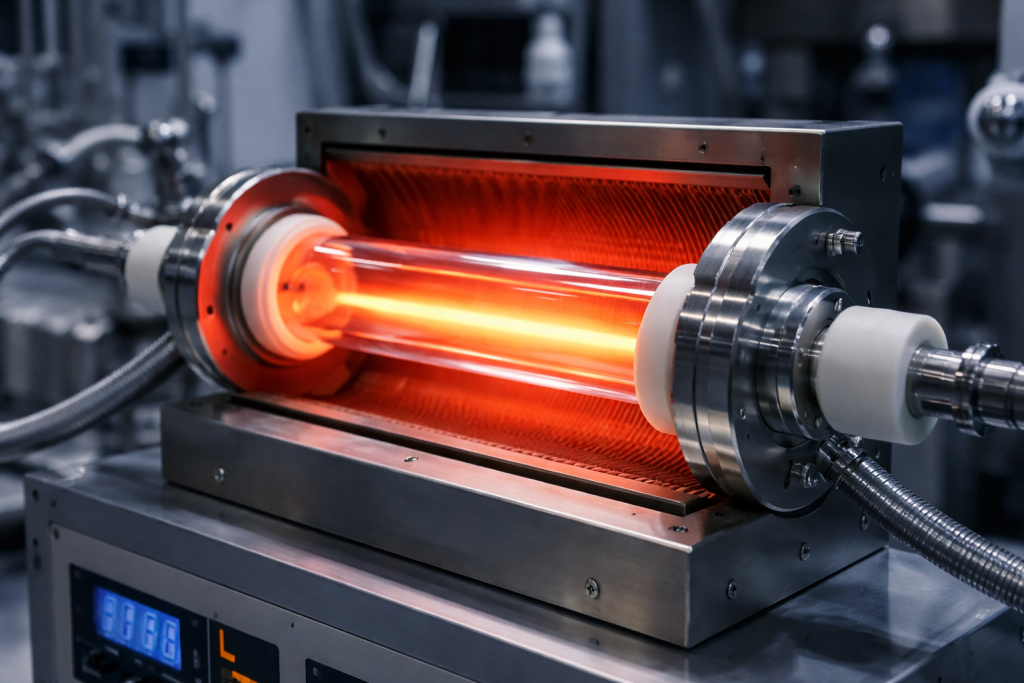
Fused quartz windows are widely used in UV systems, semiconductor processing equipment, optical instruments, vacuum chambers and high-temperature applications because they combine excellent optical transmission with low thermal expansion, high chemical resistance and good dimensional stability.
However, a quartz window should not be selected only by diameter and thickness.
For demanding industrial applications, buyers also need to consider:
- Material grade
- UV or IR transmission
- Purity
- Surface quality
- Flatness
- Parallelism
- Edge condition
- Coating requirements
- Operating temperature
- Custom machining requirements
The correct combination depends heavily on the actual application.
In semiconductor equipment, quartz windows may also serve as chamber windows, RF transmission windows or process observation windows. Current SEMICON 2026 suppliers continue to list high-purity quartz windows and custom-machined quartz components for etching, deposition, diffusion and other front-end semiconductor equipment.
1. Why Is Fused Quartz Used for Optical Windows?
Fused quartz and fused silica offer several properties that make them suitable for demanding optical and semiconductor systems.
Typical advantages include:
- Broad optical transmission
- Excellent UV performance
- Low thermal expansion
- High thermal stability
- Strong chemical resistance
- Good electrical insulation
- High-purity material options
- Low contamination potential
Quartz glass has a very low coefficient of thermal expansion, typically around 5 × 10⁻⁷/K over common temperature ranges, which helps reduce dimensional change during thermal cycling.
This is particularly useful for systems where the window is exposed to:
- High temperatures
- Rapid temperature changes
- Plasma
- Vacuum environments
- UV radiation
- Reactive process gases
2. Fused Quartz vs Fused Silica: Are They the Same?
The terms are sometimes used interchangeably, but the material origin and production method may differ.
Fused Quartz
Fused quartz is generally produced by melting high-purity natural quartz.
It is widely used for:
- Semiconductor furnace components
- Quartz tubes
- Process windows
- Laboratory equipment
- High-temperature viewing windows
Synthetic Fused Silica
Synthetic fused silica is produced from chemical precursors and can achieve extremely low metallic impurity and inclusion levels.
It is often selected for:
- Deep UV systems
- High-end optical systems
- Semiconductor plasma applications
- Sensitive deposition processes
- Laser and photonics systems
Synthetic semiconductor-grade fused silica can also be manufactured with exceptionally low metallic contamination and very low bubble or inclusion levels.
Therefore, the correct material should be selected according to the optical wavelength, purity requirements and process environment rather than simply specifying “quartz glass.”
3. UV Transmission Is One of the Main Reasons to Use Fused Quartz
One of the most important advantages of fused quartz is its wide transmission range.
Depending on the grade and OH content, fused quartz can transmit from the ultraviolet region through visible wavelengths and into the near infrared.
Some undoped fused quartz materials offer transmission beginning around 170 nm and extending into the infrared range, although actual performance depends strongly on material grade, thickness, impurities and OH concentration.
This makes quartz windows suitable for:
- UV curing equipment
- UV cleaning
- UV ozone systems
- Excimer systems
- UV inspection instruments
- Photolithography-related systems
- Optical spectroscopy
- Semiconductor processing
For short-wavelength UV applications, material grade becomes especially important.
4. UV-Grade Fused Silica Windows
When the application uses deep UV or VUV wavelengths, a standard fused quartz window may not be sufficient.
Buyers should evaluate:
- UV transmission cutoff
- OH concentration
- Metallic impurities
- Bubble and inclusion level
- Solarization resistance
- Thickness
High-energy UV exposure can gradually create optical defects in quartz glass, reducing transmission. This effect is commonly called solarization. Synthetic fused silica and specially engineered grades may offer improved resistance under prolonged high-energy UV exposure.
For this reason, the operating wavelength should always be included in the RFQ.
For example:
Operating wavelength: 193 nm
is much more useful than simply specifying:
Material: Quartz
5. Semiconductor Quartz Windows Require More Than Optical Transmission
Quartz windows used in semiconductor equipment may have very different requirements from ordinary optical windows.
Applications can include:
- Plasma etching
- CVD
- PVD
- ALD
- Diffusion
- RTP
- Epitaxy
- Process chambers
- RF transmission
- Optical monitoring
- Wafer cleaning equipment
For plasma and deposition processes, purity is especially important because contaminants from the component may enter the process environment.
High-purity synthetic fused silica grades are available specifically for sensitive semiconductor applications, including plasma etch and deposition, where low metallic contamination and freedom from bubbles or inclusions can be critical.
Current semiconductor suppliers also describe chamber windows as components requiring strict material purity, low defect levels and tight contamination control.
6. Material Purity Should Be Specified for Semiconductor Applications
For general industrial windows, standard fused quartz may be sufficient.
For semiconductor systems, buyers may need to control trace metals including:
- Al
- Fe
- Na
- K
- Li
- Ca
- Mg
- Cu
- Ti
- Cr
High-purity synthetic fused silica grades can achieve trace metal concentrations far below conventional electrically fused quartz.
For highly sensitive applications, buyers should request:
- Material grade
- Material certificate
- Impurity data
- OH content
- Bubble specification
- Inclusion specification
- Traceability
Do not assume all transparent quartz sheets provide the same semiconductor performance.
7. Surface Quality: Scratch-Dig
For optical windows, surface quality is commonly specified using a scratch-dig value.
Examples include:
- 80-50
- 60-40
- 40-20
- 20-10
- 10-5
A lower number generally indicates a higher-quality optical surface.
As an industry reference, optical window manufacturing can range from approximately 80-50 for commercial-grade windows to 40-20 for precision windows and 10-5 for high-precision applications.
The required level depends on the application.
60-40 or 40-20
Often suitable for:
- General optical systems
- Industrial viewing
- UV equipment
- Process monitoring
20-10 or better
May be required for:
- Laser systems
- Imaging systems
- High-precision optical instruments
- Sensitive semiconductor optical paths
Using unnecessarily tight surface specifications can significantly increase manufacturing cost.
8. Surface Roughness
Scratch-dig and surface roughness are not the same specification.
Surface roughness describes microscopic surface texture.
Depending on the application, buyers may specify Ra values such as:
- Ra ≤ 1 nm
- Ra ≤ 0.5 nm
- Ra ≤ 0.2 nm
High-precision semiconductor or bonding applications may require especially low roughness.
The required value should be confirmed according to:
- Optical scattering
- Sealing requirements
- Bonding requirements
- Particle control
- Plasma exposure
9. Flatness
Flatness is particularly important for optical and semiconductor windows.
It may be specified as:
- λ
- λ/2
- λ/4
- λ/10
- λ/20
where λ normally refers to a defined inspection wavelength.
Commercial optical windows may tolerate several wavelengths of flatness, while precision optical windows can require λ/10 or tighter.
Flatness becomes more difficult to control as:
- Diameter increases
- Thickness decreases
- Aspect ratio increases
- Material is removed asymmetrically
Therefore, large thin quartz windows should always be reviewed for manufacturability before specifying extremely tight flatness.
10. Parallelism
Parallelism controls the angle between the two major polished surfaces.
It is especially important when the window is used in:
- Imaging systems
- Lasers
- Optical measurement
- Beam transmission
- Interferometry
Poor parallelism may introduce:
- Beam deviation
- Optical distortion
- Measurement error
Typical requirements can range from several arcminutes for industrial applications to arcseconds for precision optical systems. High-precision optical window manufacturing can reach parallelism in the arcsecond range.
11. Clear Aperture
The clear aperture defines the usable optical area of the window.
For example:
Clear aperture: ≥90% of diameter
means that surface imperfections or edge-related features outside this area may be acceptable according to the drawing.
Clear aperture should be specified when the window is used for:
- Imaging
- Laser transmission
- Spectroscopy
- UV illumination
- Semiconductor optical monitoring
Without this specification, suppliers may apply the same surface requirement across the entire component, unnecessarily increasing cost.
12. Edge Quality Is Often Overlooked
Quartz is strong under compression but brittle.
Poor edge finishing can create microcracks that later cause fracture during:
- Thermal cycling
- Assembly
- Vacuum loading
- Mechanical clamping
- Cleaning
Common edge treatments include:
- Ground edge
- Chamfer
- Bevel
- Radius edge
- Polished edge
For precision windows, buyers should define both:
edge geometry + edge finish
rather than only providing diameter and thickness.
13. Quartz Window Shapes Can Be Customized
Quartz windows do not need to be simple round discs.
Custom fabrication can include:
- Round windows
- Square windows
- Rectangular windows
- Oval windows
- Ring-shaped windows
- Stepped windows
- Flanged windows
- Grooved windows
- Windows with holes
- Windows with slots
- Complex CNC-machined profiles
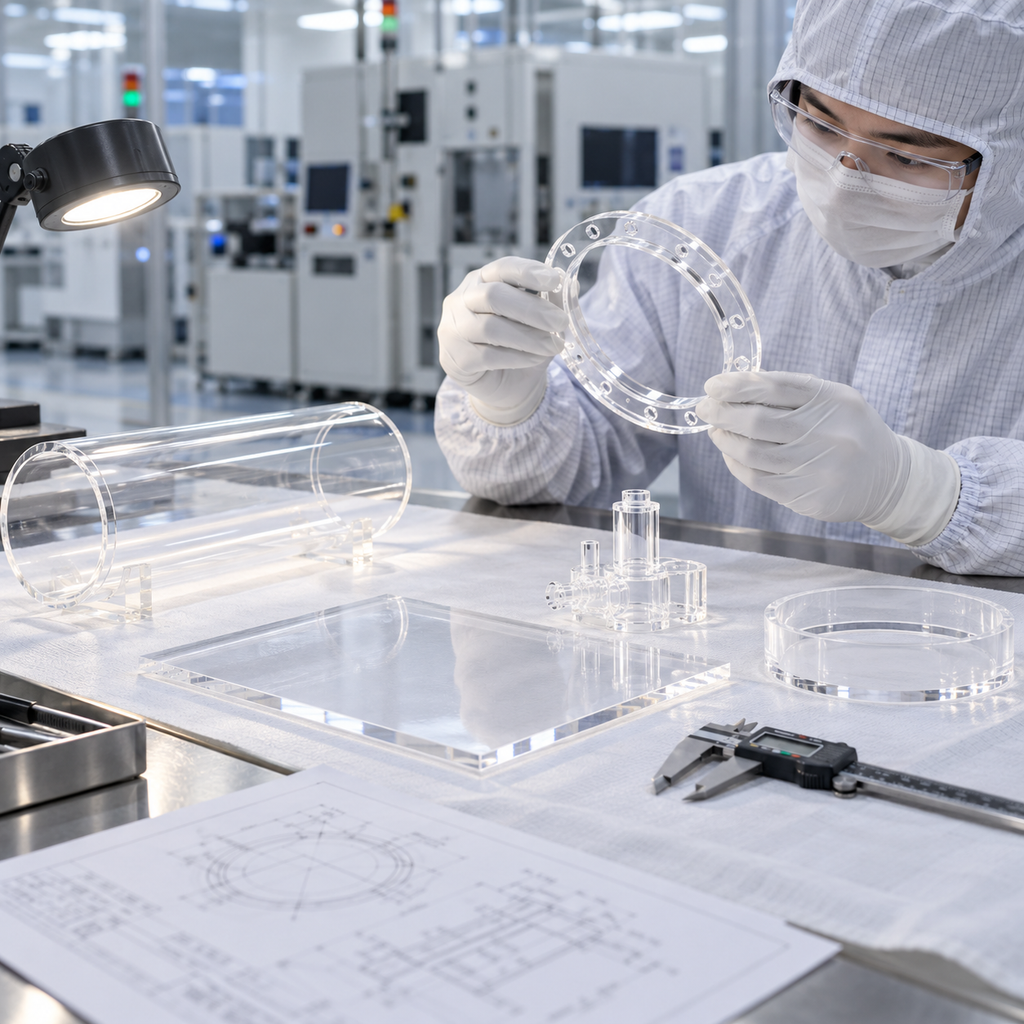
Advanced quartz fabrication for semiconductor applications can combine polishing, cutting, grinding, drilling, grooving, internal machining, threading and quartz welding.
This is useful when replacing proprietary equipment components or developing new systems.
14. Quartz Window Thickness Selection
Thickness affects:
- Mechanical strength
- Optical path
- Weight
- Flatness
- Thermal response
- Vacuum pressure resistance
Typical custom quartz windows may range from thin optical plates to thick chamber components.
A window used in vacuum or pressure service should not be selected based only on optical requirements.
The buyer should also provide:
- Window diameter
- Unsupported diameter
- Pressure differential
- Operating temperature
- Mounting method
- Safety factor
These parameters allow proper mechanical evaluation.
15. Anti-Reflection Coatings
Uncoated fused silica has Fresnel reflection at each air-glass interface.
For applications requiring higher optical throughput, anti-reflection coatings may be applied.
Available coating systems can include:
- UV AR coating
- Visible AR coating
- NIR AR coating
- Broadband AR coating
- Laser V-coating
Optical suppliers commonly offer coatings covering UV, visible and infrared wavelength ranges.
When requesting coated windows, provide:
- Operating wavelength
- Angle of incidence
- Required transmission
- Environmental conditions
- Laser power, if applicable
16. Uncoated Windows Are Often Preferred in Semiconductor Process Chambers
Coatings are not always desirable.
Inside semiconductor process equipment, coatings may face:
- Plasma attack
- Chemical exposure
- Particle generation
- High temperatures
Therefore, many chamber windows use polished high-purity quartz without optical coatings.
The correct approach depends on whether the window functions primarily as:
- An optical component
- A structural chamber component
- An RF transmission window
- A process observation window
17. Custom Fused Quartz Fabrication
A capable fused quartz window supplier should provide more than material cutting.
Typical manufacturing processes include:
- CNC machining
- Precision grinding
- Lapping
- Double-side polishing
- Optical polishing
- Hole drilling
- Slot machining
- Step machining
- Edge beveling
- Quartz welding
- Cleaning
- Inspection
Current semiconductor quartz suppliers increasingly emphasize integrated grinding, polishing, precision machining, welding and cleaning capabilities rather than simply raw material supply.
This is particularly important for custom replacement parts.
18. Cleaning and Packaging for Semiconductor Use
After machining and polishing, the window may still contain:
- Grinding particles
- Polishing residue
- Handling contamination
- Metal contamination
- Organic residue
For semiconductor applications, cleaning and packaging should therefore be included in the manufacturing process.
Depending on customer requirements, this may include:
- Ultrasonic cleaning
- Chemical cleaning
- DI water rinsing
- Controlled drying
- Cleanroom handling
- Double-bag packaging
- Clean protective film
- Particle-controlled packaging
Semiconductor quartz manufacturers increasingly use controlled cleanroom environments for high-purity quartz processing and packaging.
19. Typical Applications
UV Systems
Fused quartz windows can be used in:
- UV curing
- UV sterilization
- UV ozone cleaning
- Excimer equipment
- UV inspection
- Spectroscopy
Semiconductor Equipment
Typical applications include:
- Etch chamber windows
- CVD chamber windows
- Plasma windows
- RF windows
- Observation ports
- Cleaning systems
- RTP systems
- Deposition systems
SEMICON exhibitor listings continue to classify fused quartz glass windows and quartzware as important materials and components for semiconductor process equipment.
Optical Systems
Applications include:
- Laser systems
- Imaging
- Spectroscopy
- Scientific instrumentation
- Optical sensors
- Light sources
20. What Should Be Included in a Quartz Window RFQ?
For faster quotation, buyers should provide the following information:
Product: Fused Quartz Window / Fused Silica Window
Shape: Round / Square / Rectangular / Custom
Diameter or Dimensions: e.g. Ø100 mm
Thickness: e.g. 3 mm
Material Grade: Natural Fused Quartz / Synthetic Fused Silica / Specific Grade
Transmission Range: e.g. 200–400 nm
Surface Quality: e.g. 20-10 Scratch-Dig
Surface Roughness: e.g. Ra ≤0.5 nm
Flatness: e.g. λ/4
Parallelism: e.g. ≤1 arcmin
Clear Aperture: e.g. ≥90%
Edge: Chamfer / Bevel / Radius
Coating: Uncoated / UV AR / VIS AR / Custom
Cleaning: Standard / Semiconductor Cleaning
Quantity: Prototype + Production Quantity
Application: UV / Semiconductor / Optical / Vacuum / Other
A drawing is strongly recommended for custom parts.
21. Example Specification
A typical custom RFQ might read:
Product: Fused Silica Window
Diameter: 100.00 ±0.10 mm
Thickness: 3.00 ±0.05 mm
Material: UV-grade synthetic fused silica
Surface: Double-side polished
Surface Quality: 20-10 Scratch-Dig
Surface Roughness: Ra ≤0.5 nm
Flatness: λ/4 @ 632.8 nm
Parallelism: ≤1 arcmin
Clear Aperture: ≥90%
Edge: 0.3 mm × 45° chamfer
Coating: Uncoated
Quantity: 10 prototype pieces
Application: UV optical system
This provides significantly more useful information than simply requesting:
“Please quote a quartz glass window.”
Conclusion
Fused quartz windows are used across UV, semiconductor and optical systems, but the required specification can vary dramatically between applications.
For a general viewing window, standard fused quartz with moderate surface quality may be sufficient.
For deep-UV systems, UV transmission and solarization resistance may become the dominant considerations.
For semiconductor equipment, material purity, bubble and inclusion control, particle cleanliness and custom machining capability can be more important than optical appearance alone.
For precision optical systems, surface quality, flatness, parallelism and coating performance become critical.
The most effective sourcing approach is therefore to define:
material grade → wavelength → purity → dimensions → surface quality → flatness → parallelism → edge condition → cleaning → coating → application
before requesting a quotation.
A qualified custom quartz manufacturer should be able to support the entire process from material selection and prototype machining through precision polishing, inspection, cleaning and batch production.