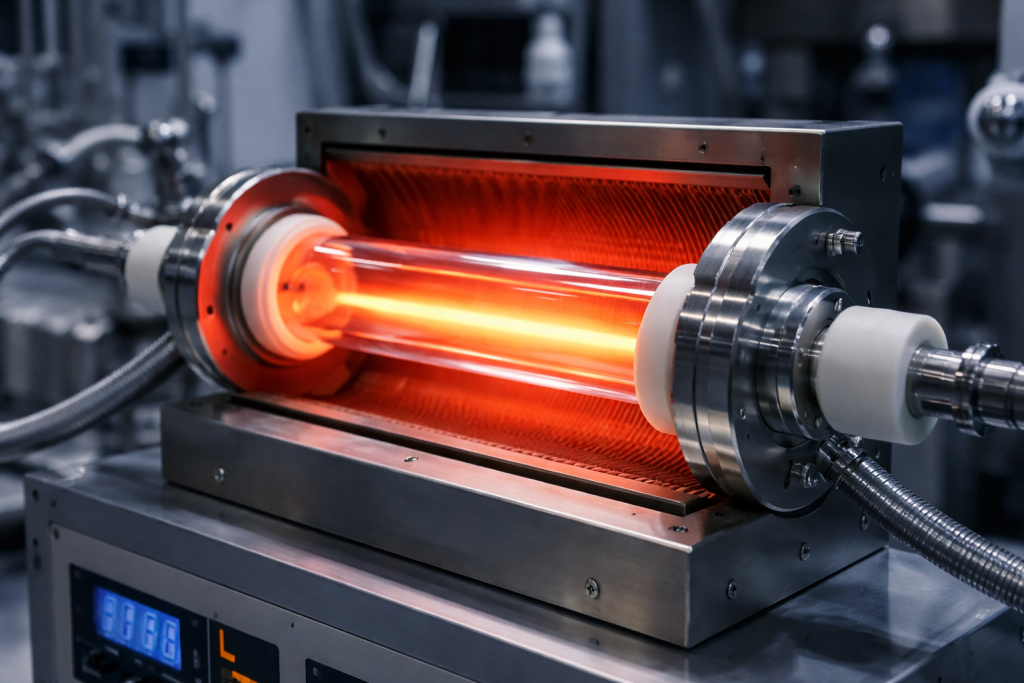
Quartz glass is widely used in semiconductor manufacturing equipment because of its high thermal resistance, chemical stability, low contamination potential and excellent optical properties. Typical applications include quartz tubes, wafer boats, rings, plates, windows, flanges, chambers, carriers and other custom quartz components used in diffusion, oxidation, etching, deposition and cleaning processes.
However, choosing a quartz glass supplier for semiconductor equipment involves much more than comparing price.
For semiconductor applications, buyers should evaluate material purity, machining capability, welding quality, dimensional control, cleaning, inspection and traceability before approving a supplier.
Current semiconductor industry activity also continues to emphasize high-purity quartzware, precision machining and contamination control for advanced wafer-processing equipment. SEMICON Taiwan 2026 suppliers, for example, are prominently showcasing high-purity quartz rings, tubes, windows and custom-machined components for semiconductor manufacturing.
1. Start with Quartz Material Purity
Material purity is one of the most important considerations when selecting semiconductor quartz components.
Even very small concentrations of metallic impurities can become a contamination source during high-temperature or plasma processes.
Typical impurities that buyers may need to control include:
- Al
- Fe
- Na
- K
- Li
- Ca
- Mg
- Cu
- Ti
For demanding semiconductor applications, synthetic fused silica or specially processed high-purity fused quartz may be required.
Some high-purity synthetic fused silica grades are designed specifically for semiconductor applications and can achieve extremely low metallic impurity levels. Material selection should therefore depend on the actual process rather than simply specifying “quartz glass.”
When requesting a quotation, buyers should ask the supplier for:
- Quartz material grade
- Manufacturing method
- Typical impurity data
- OH content
- Maximum operating temperature
- Thermal properties
- Optical transmission, if required
- Certificate of Analysis or material certificate
Natural Fused Quartz vs Synthetic Fused Silica
These materials should not automatically be considered interchangeable.
Natural fused quartz is generally produced from high-purity quartz raw material, while synthetic fused silica is produced from chemical precursors.
Synthetic fused silica can provide extremely low metallic contamination and high optical purity, making it attractive for sensitive semiconductor, UV and optical applications.
However, its OH content can differ significantly depending on the production process. OH concentration affects viscosity, infrared transmission and thermal behavior, so it should be considered according to the operating environment.
2. Check the Supplier’s Quartz Fabrication Capabilities
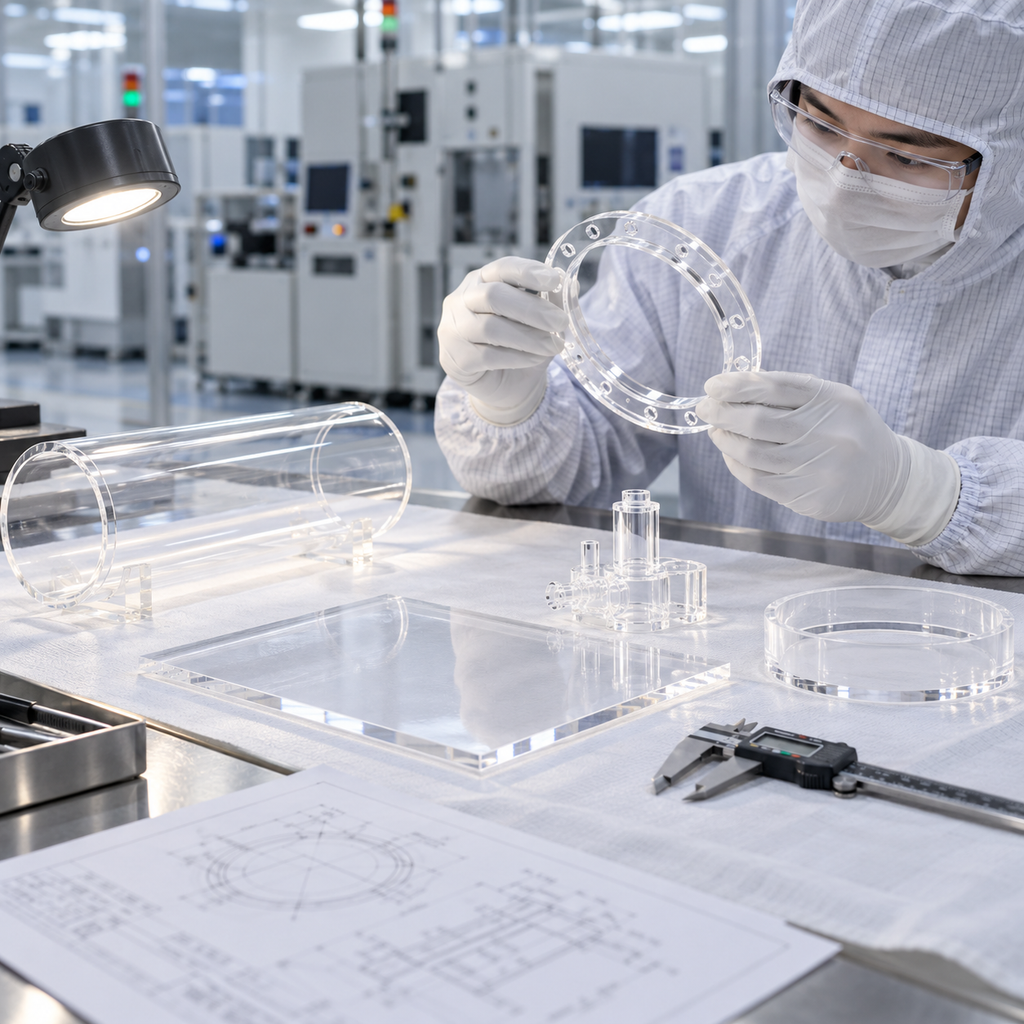
Semiconductor quartz components often require substantially more processing than simple cutting.
A qualified quartz glass supplier should have experience with multiple fabrication processes, such as:
- CNC machining
- Precision grinding
- Cutting
- Drilling
- Slot machining
- Groove machining
- Thread machining
- Polishing
- Flame polishing
- Quartz welding
- Tube forming
- Edge finishing
- Surface treatment
Modern semiconductor quartzware increasingly involves complex combinations of machining, polishing and welding. Suppliers exhibiting at SEMICON Taiwan 2026 specifically highlight integrated grinding, polishing, hole drilling, groove machining, threading and quartz welding capabilities for front-end semiconductor equipment.
For complicated custom quartz parts, buyers should ask whether all critical operations are performed internally or outsourced.
A supplier with better process integration can usually provide better consistency between prototype and mass production.
3. Evaluate Dimensional Tolerance and Inspection Capability
Quartz parts installed inside semiconductor equipment may interact directly with wafers, plasma, process gases or mechanical assemblies.
Dimensional accuracy therefore matters.
Depending on the component, important specifications may include:
| Parameter | Typical Buyer Concern |
|---|---|
| Outer diameter | Fit with equipment assembly |
| Inner diameter | Gas flow or wafer clearance |
| Thickness | Mechanical strength and process compatibility |
| Flatness | Sealing or wafer support |
| Parallelism | Assembly alignment |
| Hole diameter | Gas distribution or mounting |
| Hole position | Equipment compatibility |
| Groove dimensions | Sealing or positioning |
| Surface roughness | Particle generation and sealing |
| Edge quality | Crack and particle prevention |
The supplier should be able to provide suitable measurement reports using equipment such as:
- CMM
- Optical measuring systems
- Surface roughness testers
- Thickness gauges
- Flatness inspection systems
- Microscopes
- Profile projectors
For semiconductor quartz components, dimensional inspection should be based on the customer’s engineering drawing rather than only a standard catalog tolerance.
4. Surface Finish Matters More Than Many Buyers Expect
Poor surface condition can create several problems:
- Particle generation
- Microcracks
- Local stress concentration
- Chemical attack
- Reduced service life
- Poor sealing
- Difficulty during cleaning
For quartz plates, windows and sealing surfaces, buyers may need to specify:
- Surface roughness
- Scratch-dig quality
- Flatness
- Parallelism
- Polished area
- Ground area
- Clear aperture
For quartz tubes and welded components, surface uniformity and weld quality can be equally important.
A supplier should clearly distinguish between:
as-machined, ground, mechanically polished and flame-polished surfaces.
5. Cleaning Is a Critical Part of Semiconductor Quartz Manufacturing
A quartz component can meet the drawing perfectly and still fail semiconductor qualification if the final cleaning process is inadequate.
Particles, machining residue, metal contamination and handling contamination can all affect semiconductor processing.
For this reason, buyers should ask the supplier about:
- Pre-cleaning procedures
- Chemical cleaning
- Ultrasonic cleaning
- DI water rinsing
- Final drying
- Clean-room packaging
- Particle control
- Handling procedures
Cleaning capability is increasingly treated as part of quartz-component manufacturing rather than a separate optional service. Suppliers serving front-end semiconductor equipment highlight cleaning technology alongside fine machining and welding as essential for reducing particles and contamination.
For especially sensitive applications, buyers should define the required cleanliness standard before production.
6. Pay Special Attention to Quartz Welding
Many semiconductor quartz parts cannot be manufactured from a single solid piece.
Examples include:
- Quartz furnace tubes
- Flanged tubes
- Process chambers
- Gas distribution assemblies
- Quartz boats
- Complex carriers
- Bell jars
- Tanks
- Multi-tube assemblies
These components often require quartz welding.
Poor welding can cause:
- Distortion
- Residual stress
- Bubble formation
- Uneven wall thickness
- Leakage
- Cracking during thermal cycling
When sourcing welded quartz components, buyers should therefore evaluate both dimensional tolerance and weld quality.
The supplier should understand how heating and cooling influence quartz stress and geometry.
7. Ask About Custom Quartz Manufacturing
Most semiconductor customers do not need standard quartz products.
They need components made according to:
- Engineering drawings
- Existing samples
- Equipment models
- Modified OEM designs
- Process-specific requirements
A capable custom quartz supplier should be able to manufacture parts such as:
- Quartz tubes
- Quartz furnace tubes
- Quartz plates
- Quartz rings
- Quartz windows
- Quartz flanges
- Quartz boats
- Quartz wafer carriers
- Quartz pedestals
- Quartz chambers
- Quartz tanks
- Quartz nozzles
- Quartz gas distribution parts
- Quartz liners
- Custom welded assemblies
High-purity quartzware including tubes, boats, pedestals, carriers, bell jars, crucibles and tanks continues to be used in semiconductor processes including epitaxy, diffusion, etching and cleaning.
This makes drawing-based customization an important supplier capability.
8. Prototype Capability Is Important
For new semiconductor equipment or replacement parts, ordering thousands of units immediately is uncommon.
Most projects begin with:
drawing review → prototype → inspection → equipment testing → revision → qualification → batch production
A useful quartz glass supplier should therefore accept low-volume prototype orders.
Prototype production allows buyers to verify:
- Assembly dimensions
- Equipment compatibility
- Surface quality
- Welding structure
- Thermal performance
- Cleaning performance
- Service life
Before moving into larger-volume production.
9. Ask for Traceability and Quality Documentation
For semiconductor equipment customers, documentation can be almost as important as the physical component.
Depending on the project, suppliers may be asked to provide:
- Material certificates
- Inspection reports
- Dimensional reports
- Material batch numbers
- Production lot traceability
- Cleaning records
- Packing records
- Certificates of Conformance
- RoHS or REACH documentation where applicable
For repeat orders, lot traceability also helps investigate any process variation.
10. Packaging Should Protect Both Cleanliness and Geometry
Quartz is chemically stable but mechanically brittle.
Improper packaging can cause:
- Edge chipping
- Surface scratches
- Tube cracking
- Weld damage
- Particle contamination
Semiconductor quartz parts should normally be packed with sufficient cushioning and protection from direct contact.
For clean components, inner clean packaging may also be necessary before external shock-resistant packaging.
Large quartz tubes, plates and welded assemblies may require custom foam or dedicated transport fixtures.
11. Do Not Select a Supplier Based on Price Alone
A lower unit price can become expensive if a quartz component causes:
- Premature failure
- Excess particles
- Equipment downtime
- Poor sealing
- Process contamination
- Frequent replacement
For semiconductor equipment, total cost should include:
component price + service life + contamination risk + equipment downtime + replacement frequency.
For this reason, buyers should compare suppliers based on technical capability rather than only unit price.
12. Questions to Ask Before Sending an RFQ
Before choosing a quartz glass supplier, consider asking:
- What quartz material grades are available?
- Can you provide impurity data?
- Can you provide material certificates?
- Can you manufacture according to drawings?
- What machining tolerances can you achieve?
- What surface roughness can you provide?
- Can you perform quartz welding?
- Can you clean parts for semiconductor applications?
- Can you provide inspection reports?
- Can you manufacture prototypes?
- Can you support repeat production?
- How are finished quartz components packaged?
These questions can quickly distinguish a general glass fabricator from a supplier experienced with semiconductor quartzware.
What Information Should Buyers Provide for a Faster Quotation?
For a custom quartz project, provide as much information as possible:
Product type: Tube / Plate / Window / Flange / Ring / Boat / Custom Component
Material: Fused Quartz / Fused Silica / Specific Grade
Drawing: PDF / STEP / CAD
Dimensions: Diameter, length, thickness
Tolerance: Critical dimensional tolerances
Surface: Ground / Polished / Flame Polished
Surface Roughness: If required
Purity: Semiconductor grade or specific impurity limits
Cleaning: Standard or semiconductor cleaning
Quantity: Prototype and production quantity
Application: Etching / CVD / Diffusion / Cleaning / Furnace / Optical / Other
Providing these details at the RFQ stage makes quotation and manufacturability review much faster.
Conclusion
Choosing a quartz glass supplier for semiconductor equipment should involve more than finding a company capable of cutting quartz.
A reliable supplier should understand the complete manufacturing chain:
material selection → precision fabrication → quartz welding → polishing → cleaning → inspection → packaging.
As semiconductor processes place increasing emphasis on particle control, purity and equipment reliability, high-purity quartz components are becoming more demanding in both material quality and manufacturing precision. Current semiconductor suppliers continue to emphasize ultra-high-purity, particle-controlled quartzware and precision custom fabrication for front-end equipment.
For semiconductor OEMs, fabs, maintenance companies and equipment integrators sourcing custom quartz components, clearly defining purity, dimensions, surface condition, cleaning requirements and application environment before requesting a quotation can significantly reduce development time and qualification risk.