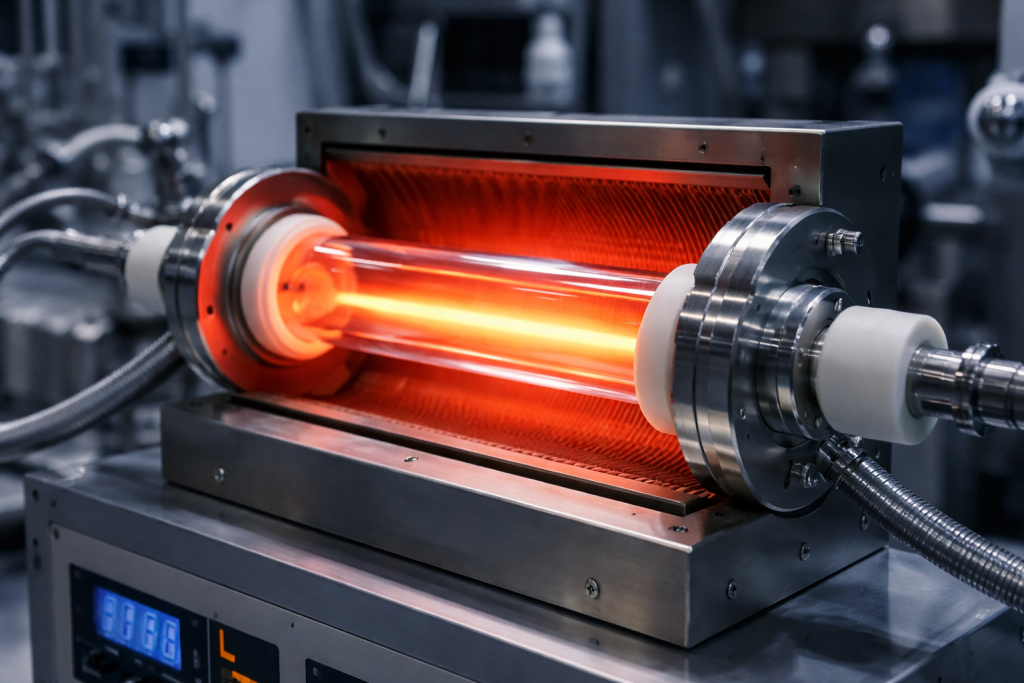
Quartz glass is widely used in semiconductor furnaces, wafer-processing equipment, optical systems and wet-process components because it combines high temperature resistance, low thermal expansion, chemical stability and relatively low contamination.
However, the terms “fused quartz” and “fused silica” are frequently used interchangeably, even though they may describe materials produced from very different raw materials and manufacturing processes.
For semiconductor equipment, this difference matters. A quartz component may contain more than 99.99% SiO₂ and still be unsuitable for a contamination-sensitive process. Conversely, selecting the most expensive synthetic fused silica for every component may add unnecessary cost without improving equipment performance.
The correct choice depends on trace-metal limits, hydroxyl content, bubble and inclusion requirements, operating temperature, optical wavelength and the component’s position inside the process chamber.
What Is Natural Fused Quartz?
Natural fused quartz is produced by melting high-purity crystalline quartz raw material. Depending on the product and manufacturer, the fusion process may use an electric furnace, resistance heating, plasma or another high-temperature method.
Because the raw material originates from natural quartz crystals, small concentrations of metallic elements may remain after purification and fusion. Common impurities can include:
- Aluminum
- Sodium
- Potassium
- Lithium
- Iron
- Calcium
- Titanium
- Boron
High-quality natural fused quartz can still achieve very high purity and is widely used for semiconductor furnace tubes, quartz boats, process chambers, flanges, rings, cleaning tanks and other thermal-processing components.
Its important advantages include relatively low OH content in many electrically fused grades, good high-temperature behavior, large-size availability and lower cost than highly purified synthetic material.

What Is Synthetic Fused Silica?
Synthetic fused silica is produced from a silicon-containing chemical precursor rather than directly melting natural quartz crystal.
One common manufacturing route uses flame hydrolysis of silicon tetrachloride or a related precursor. The precursor reacts in a controlled flame to form extremely pure silica particles, which are consolidated into transparent glass.
Because the process starts from a purified chemical precursor, synthetic fused silica can achieve extremely low concentrations of metallic contamination. Some high-purity synthetic grades may have trace elements near or below analytical detection limits.
Synthetic fused silica is commonly selected for:
- DUV optical components
- Semiconductor inspection optics
- Laser windows
- Photolithography-related components
- High-purity chamber parts
- Specialty CVD applications
- Optical fiber preforms
- Contamination-sensitive process components
Heraeus describes synthetic quartz products with trace elements below ppb-level detection limits for certain grades, illustrating the purity that chemical synthesis can achieve. Actual values, however, remain grade- and manufacturer-specific.
Are “Fused Quartz” and “Fused Silica” Standardized Terms?
In general technical usage:
- Fused quartz usually refers to material made by melting natural crystalline quartz.
- Fused silica usually refers to silica glass produced from synthetic chemical precursors.
In commercial documents, however, the terminology is not always consistent. Some suppliers use “quartz glass,” “fused quartz,” and “fused silica” as broader product-family terms.
A buyer should therefore never rely on the product name alone. The material certificate should identify:
- Raw-material origin
- Manufacturing method
- SiO₂ purity
- Individual trace-metal concentrations
- OH content
- Bubble and inclusion quality
- Optical transmission
- Thermal history
- Recommended application
Two materials sold under similar names can have significantly different performance inside semiconductor equipment.
General Comparison
| Property | Natural fused quartz | Synthetic fused silica |
|---|---|---|
| Primary raw material | Purified natural quartz crystal | Chemical silicon precursor |
| Metallic impurities | Generally higher, depending on raw-material quality | Usually extremely low |
| OH content | Often low in electrically fused grades | Can be high or low depending on the synthesis process |
| UV transmission | Grade-dependent | Often superior in UV-grade materials |
| Infrared transmission | Low-OH grades can perform well in the IR | High-OH grades may show strong OH-related absorption |
| Bubble and inclusion control | Dependent on raw material and fusion process | Can provide excellent homogeneity and low inclusion levels |
| High-temperature use | Widely used for furnace and thermal-processing components | Suitable when the selected grade is designed for high-temperature use |
| Large fabricated components | Common and relatively economical | Available but generally more expensive |
| Typical cost | Lower | Higher |
| Typical semiconductor use | Furnace tubes, boats, flanges, tanks and general process components | Critical optical and ultra-low-contamination components |
These are general tendencies rather than universal specifications. A low-OH synthetic material, for example, may behave differently from conventional flame-hydrolyzed synthetic fused silica.
Why Trace Metals Matter in Semiconductor Processing
A total SiO₂ purity value does not reveal which impurities are present.
For semiconductor manufacturing, the identity and concentration of individual elements can be more important than the total impurity percentage. Sodium and potassium, for example, are mobile alkali ions that can create device reliability problems. Iron and other transition metals may influence minority-carrier lifetime or introduce unwanted contamination.
Trace metals can enter the wafer-processing environment through:
- Raw quartz material
- Grinding and polishing tools
- Welding operations
- Contaminated cleaning chemicals
- Handling equipment
- Packaging materials
- Repeated high-temperature exposure
- Contact with process deposits
At elevated temperatures, impurities may migrate toward the quartz surface or enter the process atmosphere. Trace elements can also act as nucleation sites for crystallization, contributing to devitrification and particle generation.
For sensitive applications, buyers should request individual-element data instead of accepting a general statement such as “high-purity quartz.”
Relevant elements may include Al, Na, K, Li, Fe, Ca, Mg, Ti, Cu, Cr, Ni and B. The required list should be determined by the semiconductor process rather than copied from a generic certificate.
Understanding OH Content
OH content refers to hydroxyl groups incorporated into the silica glass structure. It is normally reported in parts per million by weight, although the measurement method and reporting basis should be confirmed.
OH content can affect:
- Infrared absorption
- Optical transmission
- High-temperature viscosity
- Structural relaxation
- Resistance to certain types of radiation
- Behavior during prolonged thermal exposure
Hydroxyl groups create a strong absorption region near approximately 2.7µm. Low-OH quartz is therefore often preferred for infrared applications where transmission around this wavelength is important.
High-OH synthetic fused silica can provide excellent ultraviolet performance for selected optical applications. However, high OH content may be undesirable in some high-temperature semiconductor components because it can affect viscosity and long-term dimensional stability.
It is incorrect to assume that every synthetic fused silica grade has high OH content. Synthetic materials can be manufactured through different routes, including processes designed to reduce hydroxyl content.
Similarly, natural fused quartz is not automatically low-OH. The final value depends on the raw material, fusion atmosphere, furnace technology and subsequent processing.
Heraeus identifies high purity, low thermal expansion, thermal-shock resistance and grade-dependent optical behavior as defining characteristics of fused silica materials.
Bubble Class, Inclusions and Striae
Bubbles are small gas-filled regions trapped inside quartz glass. Inclusions may consist of unmelted material, foreign particles or localized compositional defects. Striae are refractive-index variations caused by differences in composition or thermal history.
These defects may affect semiconductor equipment in several ways.
Optical distortion
Bubbles and striae can distort a transmitted laser or inspection beam. Their importance is especially high in windows, lenses, viewports and laser-debonding carrier wafers.
Mechanical strength
A large bubble near a machined surface may act as a stress concentrator. It can increase the risk of cracking during welding, thermal cycling or vacuum operation.
Machining yield
Internal inclusions may become exposed when the material is drilled, ground or polished. This can produce pits, chipping or unexpected surface defects.
Process contamination
A defect that intersects the surface can trap cleaning residues or process deposits. During repeated thermal cycling, it may become a particle-generation site.
“Bubble-free” should not be used as an undefined purchasing requirement. Bubble specifications should identify:
- Maximum bubble diameter
- Total bubble cross-sectional area
- Number of bubbles per unit volume
- Inspection thickness
- Exclusion zones
- Permitted location
- Inspection method
Bubble classes are not always directly comparable between suppliers. A class designation must be interpreted according to the manufacturer’s inspection standard.
Optical Homogeneity and Semiconductor Equipment
Optical homogeneity describes variations in refractive index throughout a quartz blank.
For furnace tubes, boats and cleaning tanks, optical homogeneity may have little practical value. Metallic purity, high-temperature stability, surface condition and dimensional accuracy are more important.
For lithography, laser processing and semiconductor inspection, refractive-index variation can change wavefront quality and beam focus. Synthetic fused silica is normally preferred when stringent optical homogeneity and low birefringence are required.
Paying for optical-grade homogeneity in a non-optical furnace component usually provides no process benefit. Material specifications should reflect the actual function of the component.
Selecting Quartz for Semiconductor Furnaces
Natural fused quartz remains widely used for semiconductor furnace components because it provides:
- High thermal resistance
- Low thermal expansion
- Good thermal-shock resistance
- Large tube and component availability
- Relatively low OH in selected grades
- Practical fabrication and welding
- Competitive cost
Typical applications include:
- Diffusion tubes
- Oxidation tubes
- Wafer boats
- Pedestals
- Thermocouple protection tubes
- Gas injectors
- Flanges and rings
For these components, buyers should focus on trace-metal contamination, thermal stability, weld quality, surface cleanliness and devitrification resistance.
Synthetic fused silica may be justified for especially sensitive furnace locations, but it is not automatically required for the entire furnace assembly.
Selecting Quartz for Plasma and Deposition Equipment
Quartz components used in CVD, plasma treatment or deposition systems may be exposed to reactive gases, energetic species, deposited films and repeated cleaning.
Important selection criteria include:
- Plasma chemistry
- Maximum surface temperature
- Contamination budget
- Particle-generation limits
- Wall thickness
- Surface finish
- Welded-joint design
- Maintenance frequency
- Cleaning method
Synthetic fused silica can reduce the initial metallic contamination contribution. However, component lifetime may still be controlled by plasma erosion, deposited-film stress or cleaning damage.
Using an ultra-pure raw material does not compensate for poor machining, contaminated welding or inadequate final cleaning.
Selecting Quartz for Optical and Laser Components
Synthetic fused silica is usually the stronger candidate for DUV and precision laser applications because of its low metallic contamination, controlled optical homogeneity and availability in wavelength-specific grades.
Relevant specifications may include:
- Internal transmission at the operating wavelength
- Refractive-index homogeneity
- Stress birefringence
- Laser damage threshold
- Fluorescence
- Bubble and inclusion class
- Surface figure
- Surface roughness
- Scratch-dig quality
- Coating compatibility
The material grade should match the actual wavelength. A fused silica grade designed for visible or near-infrared use may not be appropriate for 193nm DUV exposure.
Surface Contamination Can Override Raw-Material Purity
Raw-material purity receives significant attention, but the finished component can be contaminated during fabrication.
Potential contamination sources include:
- Diamond grinding tools
- Metal fixtures
- Polishing slurry
- CNC machining coolant
- Operator handling
- Welding torches
- Cleaning tanks
- Rinse water
- Drying equipment
- Packaging
A synthetic fused silica component processed in an uncontrolled workshop may have a less suitable surface than a carefully manufactured natural fused quartz component.
Semiconductor buyers should evaluate both bulk purity and surface cleanliness. Final cleaning, cleanroom handling and packaging requirements should be included in the purchase specification.
Cost Comparison
Synthetic fused silica generally costs more because its chemical precursors, deposition processes, consolidation and quality-control requirements are more complex.
The final component cost is also affected by:
- Blank size
- Material utilization
- Bubble-class requirements
- Machining complexity
- Dimensional tolerances
- Polishing area
- Surface quality
- Welding requirements
- Cleaning and packaging
- Inspection documentation
- Production quantity
The lowest-cost raw material does not always provide the lowest operating cost. Premature devitrification, particle generation or metal contamination can cause equipment downtime and wafer yield loss.
At the same time, specifying synthetic fused silica for every non-critical quartz component can unnecessarily increase purchasing costs.
A practical strategy is to divide components into three categories:
- Process-critical components: Directly exposed to wafers or sensitive process gases
- Optically critical components: Used for laser transmission, inspection or imaging
- General structural components: Used outside the most contamination-sensitive or optically demanding zones
Material purity and inspection requirements can then be assigned according to risk.
What Should Be Included in a Quartz Material Certificate?
A semiconductor-grade material certificate should provide more than a generic purity percentage.
Depending on the application, request:
- Material designation and manufacturing route
- Natural or synthetic raw-material origin
- Nominal SiO₂ content
- Individual trace-metal results
- OH concentration
- Bubble and inclusion class
- Optical transmission data
- Refractive-index homogeneity
- Stress birefringence
- Thermal expansion data
- Annealing condition
- Inspection method
- Batch or lot traceability
For critical applications, the buyer should also specify whether the test data are typical values, batch-specific measurements or guaranteed maximum limits.
Material Selection Checklist
Before choosing natural fused quartz or synthetic fused silica, answer the following questions:
- Will the component directly contact the wafer?
- What is the process contamination budget?
- Which trace metals are most critical?
- What is the maximum operating temperature?
- How long will the component remain at temperature?
- Is low OH required for infrared transmission?
- Is high UV transmission required?
- Does the component transmit a laser or inspection beam?
- Are bubbles or striae acceptable outside the optical aperture?
- Will the part be welded?
- Which chemicals or plasma gases will contact the surface?
- How frequently will the component be cleaned?
- What failure would cause the greatest cost: contamination, breakage, distortion or optical loss?
These questions are more useful than simply requesting “the highest-purity quartz available.”
Conclusion
Natural fused quartz and synthetic fused silica both have important roles in semiconductor equipment.
Natural fused quartz is often the most practical choice for furnace tubes, quartz boats, flanges, tanks and large fabricated components. It provides good thermal performance, broad availability and competitive cost.
Synthetic fused silica becomes more valuable when ultra-low metallic contamination, controlled optical homogeneity, DUV transmission or stringent bubble quality is required.
Neither material should be selected by name alone. OH content, individual trace metals, bubble and inclusion limits, surface cleanliness, optical wavelength and operating conditions must all be considered.
The best material is not always the material with the highest nominal purity. It is the material grade that controls the relevant contamination and performance risks without adding unnecessary cost.