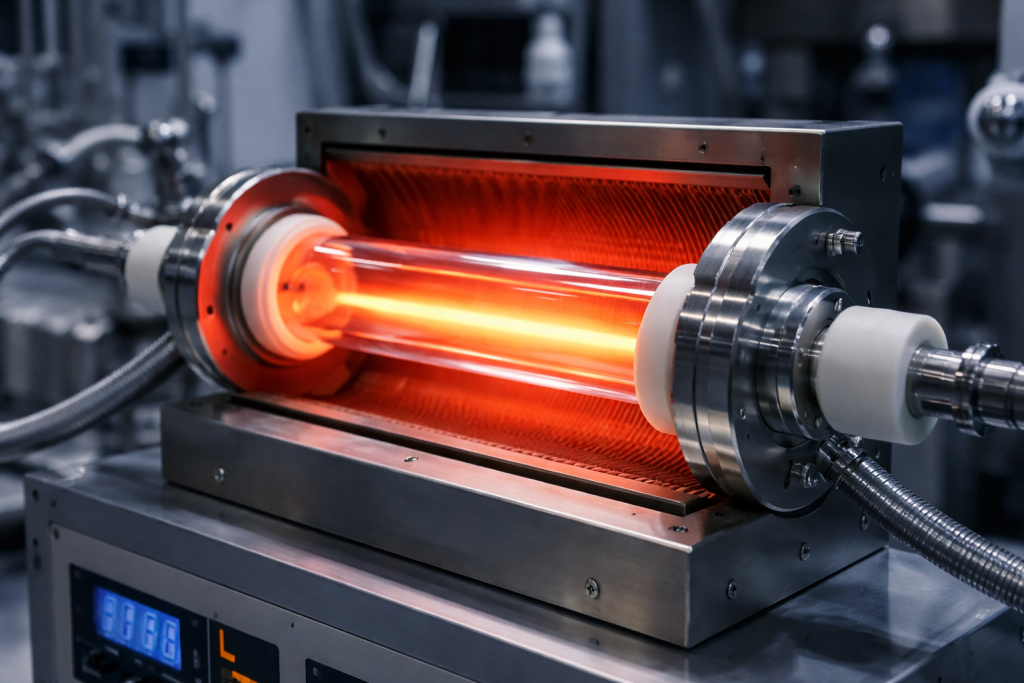
Quartz tubes used in semiconductor processing, laboratory furnaces, chemical systems, vacuum equipment and high-temperature applications are often more complex than a simple straight tube. Many custom quartz assemblies require ground joints, flanges, side ports, gas inlets, exhaust connections or permanently welded branches.
For equipment manufacturers and process engineers, the joint design is often one of the most important parts of a custom quartz tube. A poorly designed connection can create leakage, stress concentration, contamination risks, installation difficulties or premature cracking.
This guide explains the main types of quartz tube joints, their advantages, design considerations and the information buyers should provide when requesting a custom quartz tube.
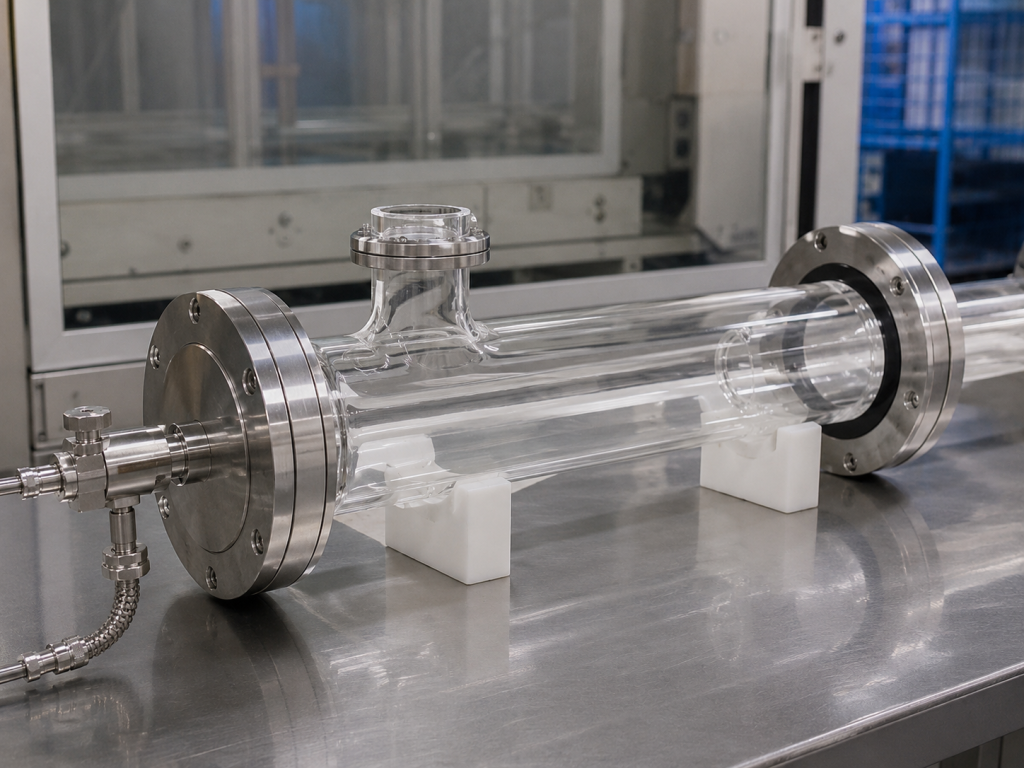
Why Quartz Tube Joint Design Matters
Quartz glass offers excellent thermal resistance, chemical stability and optical properties, but it behaves differently from metals and engineering plastics.
Fused quartz is hard but brittle. It does not tolerate concentrated mechanical stress, sharp geometry transitions or excessive installation force well.
For this reason, the connection area of a quartz tube must be designed carefully.
Important factors include:
- Tube outside diameter and inside diameter
- Wall thickness
- Joint diameter
- Joint length
- Flange dimensions
- Side-port diameter
- Port orientation
- Weld geometry
- Sealing method
- Operating temperature
- Vacuum or pressure conditions
- Thermal cycling
- Installation method
A good joint design should provide reliable sealing while minimizing mechanical and thermal stress.
1. Ground Glass Joints for Quartz Tubes
Ground joints are commonly used in laboratory quartzware, vacuum systems and removable process assemblies.
A ground joint normally consists of two precision-matched tapered surfaces. The inner and outer joint surfaces are ground to create a controlled mating geometry.
Typical configurations include:
- Male ground joints
- Female ground joints
- Standard taper joints
- Custom taper joints
- Ground socket connections
- Ground ball joints
Advantages of Ground Joints
Ground joints are useful when the quartz tube needs to be removed frequently.
Common benefits include:
- Easy assembly and disassembly
- No permanent welding required
- Suitable for laboratory systems
- Convenient component replacement
- Compatible with certain vacuum applications
- Flexible equipment configuration
Ground joints are especially useful for quartz reaction tubes connected to laboratory furnaces, gas delivery systems and chemical processing equipment.
Important Design Parameters
When specifying a quartz ground joint, buyers should provide:
- Joint type
- Large-end diameter
- Small-end diameter
- Taper angle or standard designation
- Ground length
- Surface finish requirement
- Tube diameter
- Wall thickness
- Connection orientation
Ground-joint dimensions should be controlled carefully because poor matching can result in leakage or excessive assembly force.
2. Quartz Flange Connections
Quartz flanges are widely used when a quartz tube must connect to furnace chambers, vacuum systems, gas manifolds or other equipment components.
Compared with a simple tube end, a flange provides a larger sealing and mounting surface.
Typical quartz flange designs include:
- Flat circular flanges
- Raised sealing flanges
- Ground sealing surfaces
- Drilled flanges
- Quartz-to-quartz flange connections
- Quartz-to-metal interface flanges
- Custom equipment-specific flanges
Key Flange Dimensions
A quartz flange drawing should normally define:
Outer Diameter (OD)
The overall diameter of the flange.
Inner Diameter (ID)
Normally related to the quartz tube bore or process opening.
Flange Thickness
Must provide sufficient mechanical strength without creating unnecessary thermal mass.
Flatness
Important when the flange is used as a sealing surface.
Parallelism
Important when the front and back surfaces must align accurately with equipment.
Concentricity
Controls alignment between the flange and quartz tube.
Hole Diameter and Position
If mounting holes are required, hole diameter, pitch circle diameter and positional tolerance should be clearly defined.
Avoiding Stress Around Quartz Flanges
The transition between the quartz tube and flange is a critical area.
A sharp transition may concentrate stress during heating and cooling.
Depending on the structure, manufacturers may use a smoother transition radius or optimized welded geometry to reduce stress.
Buyers should also avoid over-tightening quartz flanges during equipment installation.
Unlike metal flanges, quartz components generally should not be subjected to excessive clamping force.
3. Side Ports and Branch Tubes
Side ports are common on quartz furnace tubes and quartz reaction tubes.
They may be used for:
- Gas inlet
- Gas outlet
- Vacuum connection
- Thermocouple insertion
- Pressure measurement
- Exhaust connection
- Process monitoring
- Chemical introduction
A side port may be a simple straight branch or a more complex connection incorporating a flange, ground joint or additional quartz tube.
Side-Port Position
The drawing should specify the port position relative to a fixed reference point.
Important dimensions may include:
- Distance from tube end
- Distance from flange
- Centerline position
- Port angle
- Port projection length
Simply specifying “one side tube” is usually not enough for custom manufacturing.
Port Orientation
Port orientation can be particularly important when multiple branches are installed on the same quartz tube.
For example:
- 0°
- 90°
- 180°
- 270°
or another defined angular position.
For complex quartz assemblies, a 3D CAD model can significantly reduce misunderstanding.
4. Side-Port Diameter and Wall Thickness
The diameter of a quartz side port should be selected according to its function.
A gas inlet may require a relatively small diameter, while a vacuum exhaust connection may need a larger flow area.
Typical specifications include:
- Port OD
- Port ID
- Wall thickness
- Straight length
- Connection geometry
The relationship between the main tube and branch tube also affects mechanical strength.
A very large side port installed on a relatively thin-wall main tube may require additional structural consideration.
For demanding applications, it is advisable to discuss the complete assembly with the quartz manufacturer before finalizing the design.
5. Welded Quartz Tube Connections
Quartz welding is commonly used to permanently join quartz tubes, branches, flanges and other fused silica components.
Unlike adhesive bonding, a properly fused quartz connection becomes part of the quartz assembly.
Typical welded structures include:
- Tube-to-tube welding
- Tube-to-flange welding
- Side-port welding
- Branch-tube welding
- End-cap welding
- Quartz chamber assembly
- Multi-port quartz manifolds
Advantages of Welded Connections
Welded quartz assemblies can provide:
- Permanent construction
- Clean connection geometry
- Reduced use of additional sealing materials
- Good high-temperature compatibility
- Custom geometry
- Integration of multiple quartz components
They are widely used in semiconductor furnaces, chemical systems and high-purity processing equipment.
6. Weld Geometry and Stress Control
A welded quartz joint should not be evaluated only by appearance.
The geometry of the weld transition can influence the durability of the component.
Important considerations include:
- Smooth transition
- Adequate fused area
- Uniform wall geometry
- Minimal local distortion
- Controlled heat input
- Reduced residual stress
After flame working or welding, quartz components may require appropriate thermal treatment depending on the manufacturing process and application.
Residual stress can increase the risk of cracking during subsequent heating cycles.
For critical components, stress inspection may be performed using polarized light or other suitable inspection methods.
7. Ground Joint vs Flange vs Welded Connection
Different joint structures serve different applications.
Ground Joint
Best suited for:
- Frequently removable components
- Laboratory equipment
- Flexible experimental systems
- Certain vacuum assemblies
Main advantage:
Easy disassembly.
Quartz Flange
Best suited for:
- Equipment interface connections
- Furnace tube mounting
- Vacuum chamber connections
- Process equipment
Main advantage:
Large controlled sealing and mounting surface.
Welded Connection
Best suited for:
- Permanent assemblies
- Side branches
- Gas ports
- Integrated quartz components
- High-purity process systems
Main advantage:
Creates an integrated quartz structure.
In many custom products, several connection types are used together.
For example, a semiconductor quartz tube may include:
- One large quartz flange
- Two welded gas ports
- One ground joint
- One closed welded end
Therefore, the complete assembly should always be reviewed as a system rather than treating every joint independently.
8. Quartz-to-Metal Connections
Many semiconductor and industrial systems require quartz components to interface with stainless steel, aluminum or other metal equipment.
Direct rigid connection between quartz and metal requires careful consideration because the materials have different thermal expansion behavior.
Possible interface methods include:
- O-ring sealing
- Flexible mechanical clamps
- Gasket sealing
- Metal flange adapters
- Vacuum seals
- Custom transition assemblies
The exact solution depends on:
- Temperature
- Vacuum level
- Gas chemistry
- Pressure
- Cleaning requirements
- Equipment design
Mechanical loading should be distributed carefully to avoid applying concentrated force directly to the quartz.
9. Tolerances for Custom Quartz Tube Assemblies
Tolerance requirements depend heavily on component size and geometry.
Typical controlled dimensions may include:
- Tube OD
- Tube ID
- Wall thickness
- Overall length
- Flange diameter
- Flange thickness
- Port position
- Port angle
- Joint diameter
- Hole position
- Straightness
- Concentricity
Buyers should avoid specifying unnecessarily tight tolerances on every dimension.
Very tight tolerances can increase manufacturing difficulty and cost without improving equipment performance.
A better approach is to identify critical-to-function dimensions separately from non-critical dimensions.
For example:
Critical dimensions
Flange sealing surface
Equipment mounting dimension
Gas port position
Joint fit
Tube diameter in furnace support area
Non-critical dimensions
Non-functional external lengths
Decorative geometry
Areas without sealing or mechanical interface requirements
This approach can improve manufacturability and reduce cost.
10. Inspection Requirements
Custom quartz tube assemblies should be inspected according to their intended application.
Possible inspection items include:
- Dimensional inspection
- Visual inspection
- Surface defect inspection
- Flange flatness
- Port position
- Joint fit
- Weld appearance
- Stress inspection
- Leak testing
For semiconductor or vacuum applications, buyers may also request additional cleanliness or packaging requirements.
Inspection criteria should ideally be confirmed before production rather than after the parts have been manufactured.
11. Information to Include in a Quartz Tube RFQ
For an accurate quotation, buyers should provide as much information as possible.
A useful RFQ package should include:
Main Tube
- Material grade
- OD
- ID
- Wall thickness
- Length
Ground Joints
- Joint type
- Size
- Taper
- Ground length
- Male or female configuration
Flanges
- OD
- ID
- Thickness
- Hole pattern
- Surface requirements
Side Ports
- Quantity
- OD
- ID
- Wall thickness
- Length
- Position
- Orientation
Welded Areas
- Required joint configuration
- Critical dimensions
- Special stress requirements
Application Information
- Operating temperature
- Vacuum or pressure
- Process gas
- Chemical environment
- Thermal cycling conditions
Quality Requirements
- Dimensional tolerance
- Surface quality
- Cleanliness
- Inspection report requirements
- Packaging requirements
Providing a 2D drawing, STEP file or detailed sketch is strongly recommended for complex quartz assemblies.
12. Design for Manufacturability of Custom Quartz Tubes
Early communication between the equipment designer and quartz manufacturer can prevent many manufacturing problems.
Before finalizing a drawing, consider:
- Whether the port is too close to the flange
- Whether sufficient welding space is available
- Whether the tube wall is thick enough
- Whether the assembly can be rotated during processing
- Whether inspection tools can access critical dimensions
- Whether packaging and transportation are practical
- Whether future cleaning and maintenance are possible
For prototype equipment, it may be useful to manufacture a small initial batch before releasing a larger production order.
Conclusion
Quartz tube joint design directly affects sealing performance, installation, process reliability and service life.
Ground joints provide removable connections, quartz flanges create controlled equipment interfaces, side ports enable gas and vacuum functions, while welded connections allow complex quartz assemblies to be manufactured as integrated structures.
For custom quartz tubes, the most important step is to define not only the overall dimensions but also the functional requirements of every connection.
Clear drawings, realistic tolerances, defined port positions and information about operating temperature, vacuum conditions and process chemistry can significantly improve quotation accuracy and manufacturing results.
For semiconductor furnaces, laboratory equipment, vacuum systems and chemical processing applications, custom quartz tubes can be manufactured with flanges, ground joints, side branches and welded structures according to customer drawings and equipment requirements.
FAQ
1. Can quartz tubes be manufactured with both flanges and side ports?
Yes. A custom quartz tube can incorporate multiple features including quartz flanges, welded side ports, ground joints and closed ends in one assembly. A detailed drawing is recommended for complex configurations.
2. Are welded quartz joints suitable for high-temperature applications?
Welded fused quartz connections are commonly used in high-temperature equipment. However, joint geometry, wall thickness, residual stress and operating conditions should all be considered when designing the component.
3. What drawing format should I provide for a custom quartz tube?
A dimensioned PDF or CAD drawing is normally sufficient for relatively simple components. For multi-port or three-dimensional assemblies, STEP or other 3D CAD files can help clarify port orientation and geometry.
4. Can a quartz tube connect directly to a stainless-steel flange?
Quartz-to-metal equipment interfaces are possible, but the connection must account for differences in thermal expansion and mechanical behavior. O-rings, gaskets, clamps or adapter structures are commonly used depending on the application.
5. What dimensions are most important for a quartz tube with side ports?
The most important dimensions normally include main tube OD and ID, wall thickness, side-port OD and ID, distance from the reference end, port projection length and angular orientation.