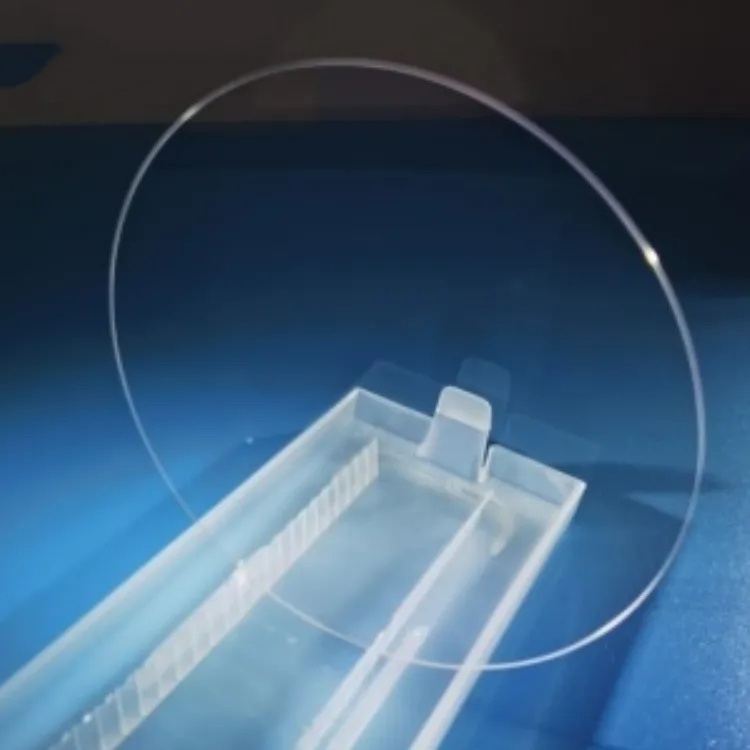
Quartz glass wafers are high-purity silicon dioxide (SiO₂) substrates widely used in semiconductor fabrication, optical systems, and precision electronic devices. Owing to their excellent thermal stability, extremely low thermal expansion coefficient, strong chemical resistance, and high optical transmission, quartz glass wafers play an important role in advanced manufacturing fields such as micro-electromechanical systems (MEMS), CMOS and CCD sensors, microwave circuits, Internet of Things (IoT) devices, and laser or optical components.
With the rapid development of semiconductor and photonic technologies, the performance requirements for substrate materials continue to increase. Compared with conventional optical quartz components, quartz glass wafers require much stricter standards in terms of thickness tolerance, surface roughness, flatness, and internal material uniformity. As a result, the production of quartz wafers involves a series of sophisticated material preparation and precision processing steps.
1. Raw Material Preparation
The starting material for quartz glass wafers is typically a quartz glass ingot. Two main types of quartz glass are used in industrial production: flame-fused quartz glass and synthetic quartz glass.
Flame-fused quartz glass is produced by melting high-purity quartz sand using a hydrogen-oxygen flame. This method is relatively economical and widely used in industrial applications. Synthetic quartz glass, on the other hand, is manufactured using chemical vapor deposition (CVD) processes. In this method, silicon tetrachloride (SiCl₄) is used as the precursor, while hydrogen acts as the reducing agent. The chemical reaction forms extremely high-purity silicon dioxide, resulting in quartz glass with superior optical and structural uniformity.
For high-end semiconductor or optical applications, the internal uniformity of the material is critical. To improve density uniformity and remove internal bubbles formed during melting, the quartz ingot often undergoes homogenization treatment in a vacuum environment. This step significantly enhances the structural stability and optical quality of the material.
2. Wafer Blank Fabrication
The wafer blank is generally prepared from cylindrical quartz ingots with uniform diameter. Two main methods are commonly used to produce these blanks: core drilling and thermal drawing.
Core drilling is typically applied to produce larger diameter wafers. A radial drilling machine is used to extract cylindrical cores from the quartz ingot. This method allows efficient production while maintaining accurate dimensional control.
For smaller wafer sizes, a thermal drawing method is often used. In this process, the quartz ingot is heated in a medium-frequency furnace until it reaches a softened state. The softened quartz is then drawn into rod-shaped blanks. This method offers several advantages. The second high-temperature melting process improves internal material quality by reducing bubbles, micro-defects, and structural irregularities. Additionally, the diameter of the rod can be precisely controlled by adjusting the drawing speed and mold dimensions, which helps reduce material waste and avoid mechanical stress caused by drilling.
3. Precision Annealing
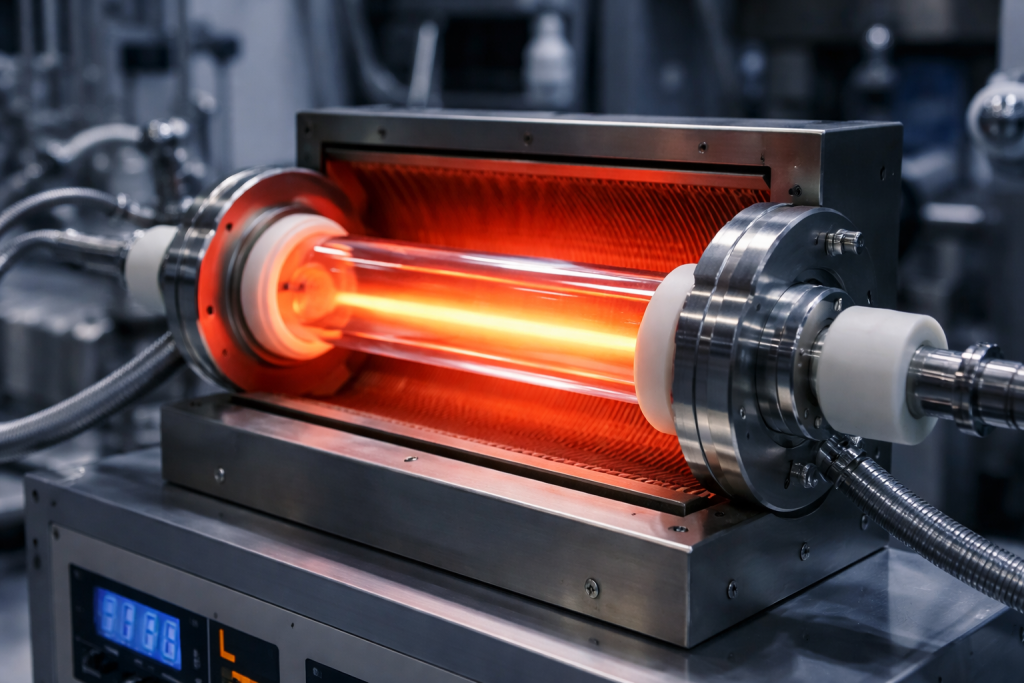
During the melting, forming, and drawing stages, quartz glass experiences non-uniform cooling, which leads to the formation of internal thermal stresses. These stresses can affect subsequent machining processes and may also reduce the optical uniformity and structural stability of the wafer.
To eliminate these internal stresses, the quartz blanks must undergo a controlled annealing process. The annealing procedure generally consists of four stages: gradual heating, temperature holding, slow cooling, and final cooling. Careful control of temperature and time parameters ensures the effective release of residual stress within the material, thereby improving mechanical stability and processing reliability.
4. Multi-Wire Slicing
As demand for quartz wafers increases, traditional cutting methods have become insufficient for large-scale production. They also result in significant material waste.
Modern quartz wafer manufacturing commonly employs multi-wire slicing technology. In this process, a single quartz rod or ingot can be sliced into multiple wafers simultaneously using a high-precision wire saw. This technique significantly improves production efficiency while minimizing material loss and ensuring consistent wafer thickness.
5. Wafer Shaping and Edge Processing
After slicing, the wafer undergoes several shaping processes to achieve the required geometry and dimensional accuracy. These processes typically include surface grinding, edge rounding, orientation flat or notch machining, and chamfering.
Surface grinding is performed to remove the majority of the slicing marks and to control wafer thickness. During this step, sufficient machining allowance is maintained for later precision processing.
Because quartz wafers are usually thin and fragile, multiple wafers are often bonded together temporarily during edge rounding to ensure stable and uniform grinding. Orientation flats or notches are added using specialized machining equipment or CNC machining centers to provide alignment references during device fabrication.
Chamfering is also an important step. It reduces edge stress concentration and prevents chipping or cracking during subsequent processing and handling.
6. Precision Grinding and Polishing
The final surface quality of quartz wafers is achieved through precision grinding and polishing processes. These steps are typically performed using double-side lapping and polishing machines.
Fine grinding removes the remaining surface damage layer and improves flatness. Polishing then produces an ultra-smooth surface with extremely low roughness.
Common abrasive materials used during grinding include silicon carbide and diamond particles. For polishing, cerium oxide polishing powders are typically employed. Because quartz wafers require extremely high surface quality, the median particle size (D50) of the polishing powder is usually less than 2 micrometers.
Another critical factor in polishing is the pH value of the polishing slurry. Maintaining an appropriate pH range helps optimize the chemical-mechanical interaction between the polishing particles and the quartz surface, ultimately achieving superior surface finish and minimal defects.
7. Cleaning and Packaging
The final stage in quartz wafer production is cleaning and packaging, which must be carried out in a cleanroom environment.
During machining, various contaminants such as polishing residues, particles, and chemical residues may remain on the wafer surface. To remove these impurities, ultrasonic cleaning processes are commonly used. Depending on customer requirements and manufacturing processes, different cleaning agents may be introduced during ultrasonic cleaning, including alkaline solutions, acidic solutions, and organic solvents.
Regardless of the cleaning method, ultrapure water is always used for the final rinsing stage. To prevent particle contamination, the final rinsing, drying, and packaging steps are typically performed in cleanroom environments with cleanliness levels of Class 100 or better.
Conclusion
The manufacturing of quartz glass wafers involves a complex combination of material science and precision engineering technologies. From raw material synthesis and ingot preparation to slicing, shaping, polishing, and cleaning, each step plays a crucial role in determining the final wafer quality.
As semiconductor devices, optical systems, and advanced sensing technologies continue to evolve, the demand for high-quality quartz substrates will continue to grow. Continuous improvements in processing technology, precision machining, and contamination control will remain key factors in enabling the next generation of high-performance quartz wafer products.