In engineering, optics, and high-temperature industrial systems, the selection between quartz glass and regular (soda-lime) glass directly influences system stability, performance, and lifetime. Although both are transparent materials based on silica, their structure, composition, and behavior under stress are fundamentally different.
This guide provides a practical engineering comparison for designers, procurement engineers, and industrial users.
1. Material Definition
Quartz Glass (Fused Silica)
Quartz glass is composed of ultra-high purity silicon dioxide (SiO₂). It is produced by melting natural quartz or synthetic silica at extremely high temperatures, forming an amorphous (non-crystalline) structure.
Common industrial names:
- Fused silica
- Fused quartz
Typical applications:
- Semiconductor manufacturing systems
- UV and IR optical systems
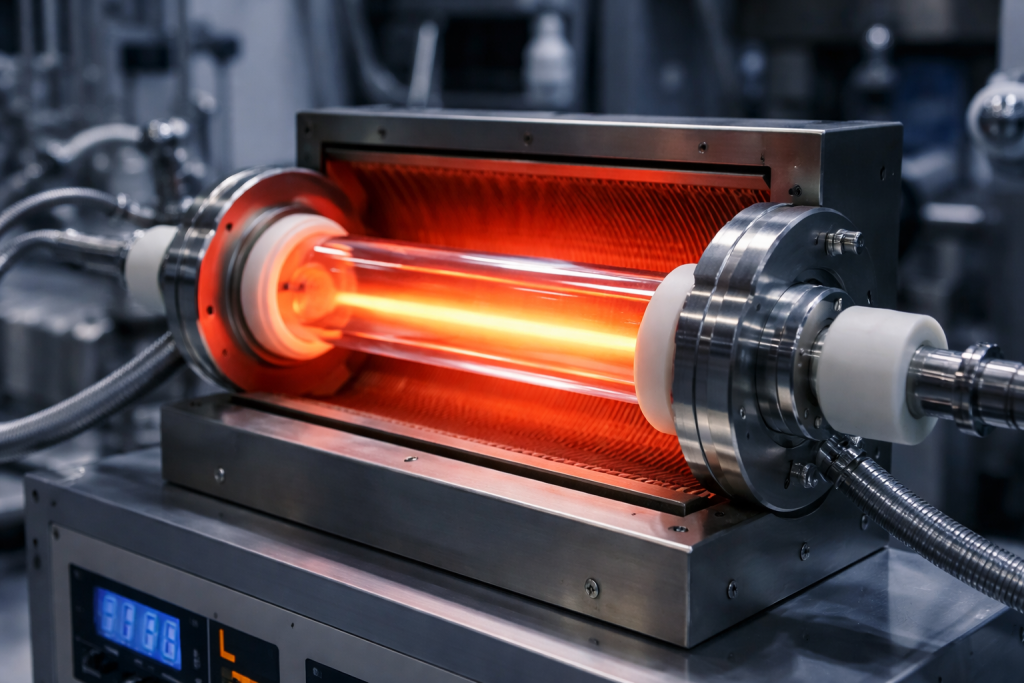
- High-temperature furnace components
- Precision laser and photonics systems
Regular Glass (Soda-Lime Glass)
Regular glass is mainly composed of:
- Silicon dioxide (SiO₂)
- Sodium oxide (Na₂O)
- Calcium oxide (CaO)
It is designed for cost-efficient, large-scale applications.
Typical applications:
- Building windows
- Bottles and containers
- General-purpose laboratory glassware
2. Key Engineering Property Comparison
| Property | Quartz Glass (Fused Silica) | Regular Glass (Soda-Lime) |
|---|---|---|
| Softening Point | ~1660°C | ~720°C |
| Thermal Expansion | Extremely low | Relatively high |
| UV Transmission | Excellent (deep UV) | Poor |
| Chemical Resistance | Excellent | Moderate |
| Thermal Shock Resistance | Very high | Low |
| Cost | High | Low |
| Application Level | High-end engineering systems | General applications |
3. Thermal Performance (Critical Factor)
Quartz glass has an extremely low thermal expansion coefficient:
αquartz≈5.5×10⁻⁷/K
This results in:
- Excellent resistance to rapid temperature changes
- Minimal internal stress during heating/cooling cycles
- Stable performance in plasma and furnace environments
In contrast, soda-lime glass expands significantly more under heat, making it prone to cracking under thermal shock conditions.
4. Optical Performance Comparison
Quartz Glass
- Transmits deep ultraviolet light (down to ~180 nm)
- Very low optical absorption
- High stability under laser irradiation
- Widely used in photonics and UV systems
Regular Glass
- Blocks most UV below ~350 nm
- Limited infrared transmission
- Higher optical distortion compared to quartz
Engineering conclusion:
For UV transmission, laser systems, or precision optics, quartz glass is required.
5. Chemical Resistance
Quartz Glass
- Highly resistant to most acids
- Only significantly attacked by hydrofluoric acid (HF)
- Stable in plasma and oxidizing environments
- Suitable for semiconductor wet and dry processes
Regular Glass
- Degraded by strong acids and alkalis over time
- Surface corrosion in aggressive chemical environments
- Limited use in chemical processing systems
6. Mechanical Behavior and Failure Modes
Quartz Glass
- High intrinsic strength but brittle behavior
- Fails suddenly under excessive mechanical load
- Excellent long-term dimensional stability
Regular Glass
- Lower mechanical strength
- More sensitive to thermal and mechanical stress
- Progressive degradation in harsh environments
7. Industrial Applications
Quartz Glass Applications
- Plasma chamber observation windows
- Furnace tubes and diffusion systems
- UV sterilization equipment
- Semiconductor wafer processing components
- High-end optical systems
Regular Glass Applications
- Architectural glazing
- Packaging and containers
- Household and basic laboratory use
8. Cost vs Performance Consideration
Quartz glass is significantly more expensive due to:
- High-purity raw materials
- High-temperature manufacturing processes
- Precision machining and finishing requirements
However, in industrial systems, it often provides better long-term value due to:
- Longer service life
- Reduced replacement frequency
- Lower downtime risk
- Improved process stability (especially in semiconductor and optical systems)
9. Engineering Selection Guide
Choose Quartz Glass when:
- Operating temperature exceeds 300°C
- UV or laser transmission is required
- Strong chemical exposure exists
- High-precision optical performance is needed
- Vacuum or semiconductor processes are involved
Choose Regular Glass when:
- Cost is the primary constraint
- Operating conditions are mild
- No thermal shock or optical requirements exist
10. Conclusion
Quartz glass and regular glass are fundamentally different engineering materials.
- Regular glass is optimized for cost and general-purpose use
- Quartz glass is designed for extreme thermal, optical, and chemical environments
From an engineering standpoint, quartz glass is not an improved version of regular glass—it is a completely different material class built for high-performance industrial applications.