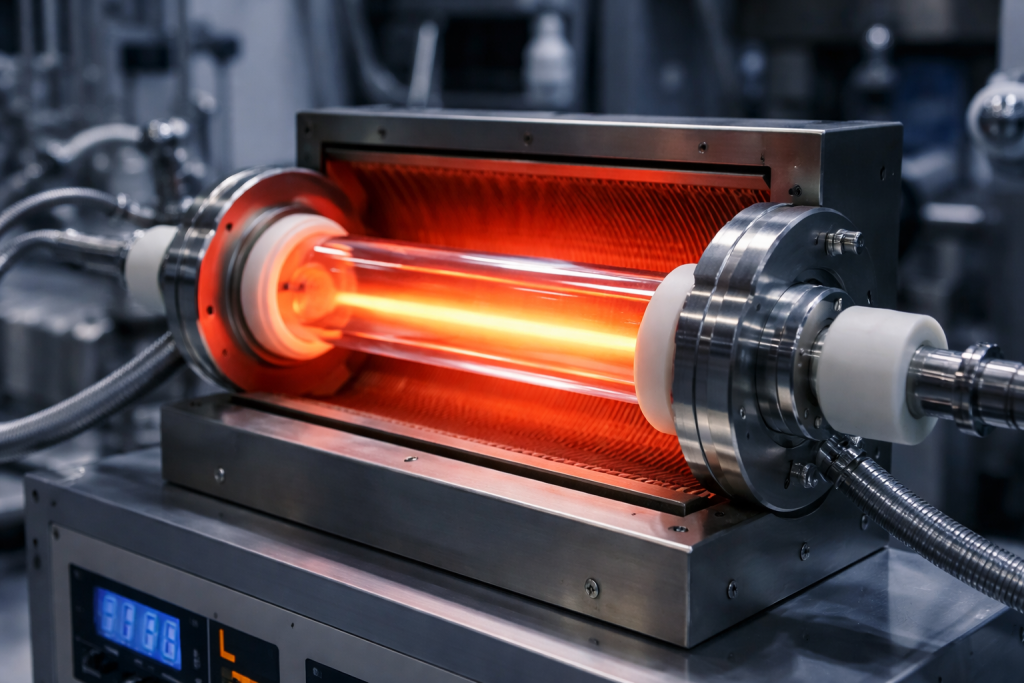
Quartz glass, commonly referred to as fused silica, is an amorphous material composed almost entirely of silicon dioxide (SiO₂). Unlike crystalline quartz, quartz glass does not possess a long-range ordered lattice structure. Instead, its atomic arrangement is typically described by the Continuous Random Network (CRN) model. In this structural model, silicon atoms are coordinated with oxygen atoms to form Si–O tetrahedra that are randomly interconnected in three-dimensional space. The strong Si–O bonds and compact network structure contribute to the exceptional stability of quartz glass.
Due to its unique atomic configuration, quartz glass exhibits a range of outstanding physical and chemical properties. These include high optical transmittance over ultraviolet, visible, and infrared wavelengths, excellent thermal stability, low thermal expansion coefficient, strong resistance to chemical corrosion, and good radiation resistance. Because of these properties, quartz glass has become an indispensable material in semiconductor processing, optical devices, laser systems, high-temperature equipment, and precision scientific instruments.
The preparation technology of quartz glass has undergone continuous development since the nineteenth century. Early production methods primarily relied on melting natural quartz using flame heating. With the advancement of materials science and chemical engineering, several mature industrial preparation processes have been established. These technologies can generally be divided into two main categories: melting methods using natural quartz raw materials and synthetic methods based on chemical reactions.
Electric Fusion Method
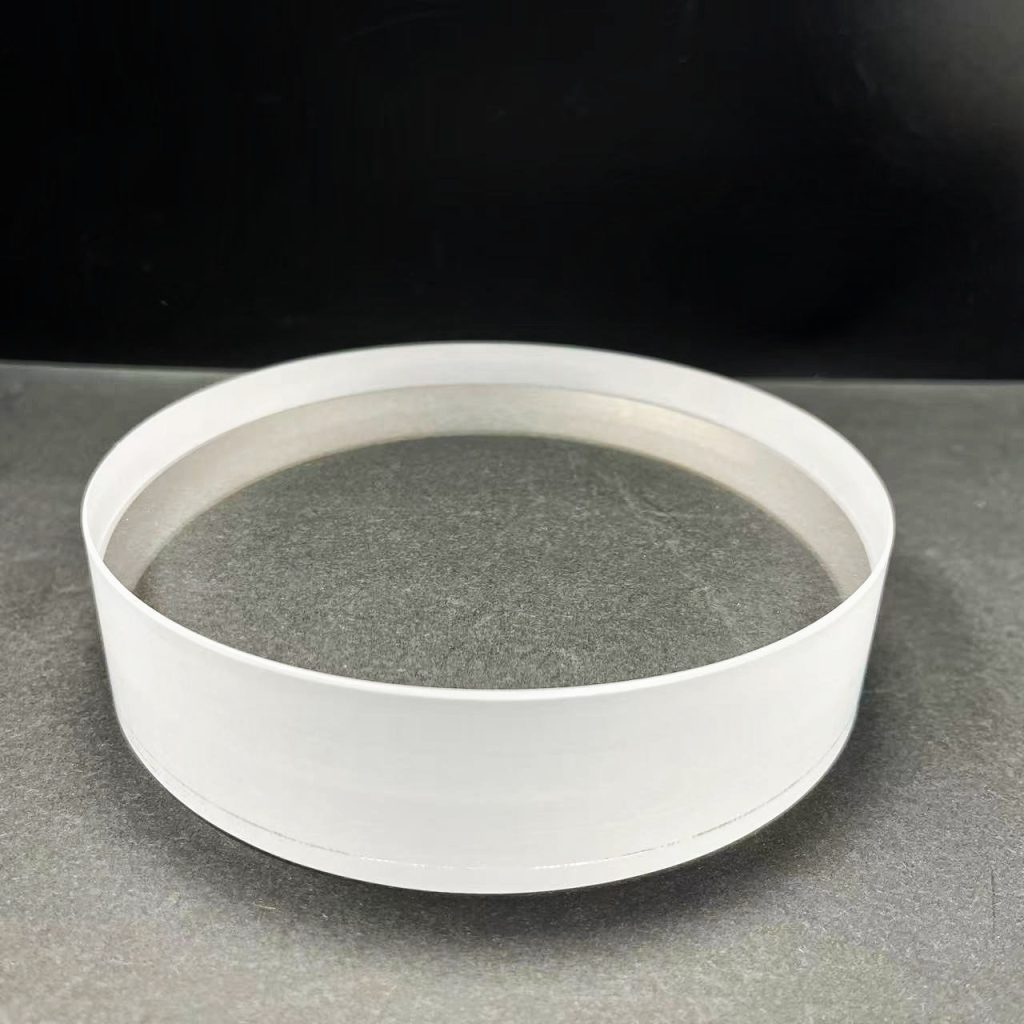
The electric fusion method is a traditional technique used to produce fused quartz from high-purity quartz sand. In this process, quartz powder or granular quartz is placed in an electric furnace and heated to temperatures exceeding 1700°C. The electrical heating system provides the energy required to melt the silica completely. Once the quartz is fully molten, the melt is rapidly cooled to prevent crystallization, forming an amorphous glass structure.
The electric fusion method is capable of producing relatively large quartz glass ingots and is widely used in industrial manufacturing. However, the purity and optical quality of the final product depend heavily on the quality of the raw quartz sand. Impurities such as iron, aluminum, or alkali metals may affect optical transparency and chemical stability.
Flame Fusion Method
Another widely used preparation technique is the flame fusion method, also known as the oxyhydrogen flame process. In this process, high-purity quartz sand is fed into a hydrogen–oxygen flame where it melts instantly due to the extremely high temperature of the flame. The molten droplets then accumulate and solidify on a rotating target surface, gradually forming a quartz glass ingot.
This process allows better control over the melting environment and can reduce contamination compared with some electric melting techniques. Flame fusion is commonly used to produce quartz glass materials with relatively good optical performance. However, the use of hydrogen and oxygen flames may introduce hydroxyl groups (OH) into the material, which can influence infrared optical transmission.
Chemical Vapor Deposition (CVD)
Chemical vapor deposition is one of the most important synthetic methods used to produce ultra-high purity quartz glass. In this process, volatile silicon compounds such as silicon tetrachloride (SiCl₄) are used as precursor materials. These compounds react with oxygen or hydrogen at high temperature to form silicon dioxide particles through chemical reactions in the gas phase.
The generated silica particles are deposited layer by layer onto a substrate, eventually forming dense quartz glass. Because the precursor materials can be purified to extremely high levels, the resulting quartz glass exhibits very low impurity content. This process is widely used in applications requiring high optical purity, such as optical fibers and advanced photonic devices.
Plasma Chemical Vapor Deposition (PCVD)
Plasma chemical vapor deposition is a modified form of the CVD process in which plasma energy is used to activate chemical reactions. The plasma environment significantly enhances the reaction efficiency and allows precise control over the deposition process.
PCVD technology is often used in the production of high-quality optical materials, particularly in optical fiber manufacturing and specialized optical components. The process enables better control of the chemical composition and microstructure of the deposited quartz glass.
Indirect Chemical Vapor Deposition
Indirect chemical vapor deposition is another important method used to produce high-purity synthetic quartz glass. In this technique, silicon-containing precursor gases are first converted into fine silica particles through gas-phase reactions. These particles are then collected and subsequently consolidated through high-temperature sintering to form dense quartz glass.
One of the advantages of this method is that it allows the use of extremely pure precursor chemicals, which helps minimize metallic impurities in the final product. During the sintering process, dehydration treatments are often applied to reduce hydroxyl content, improving ultraviolet and deep ultraviolet optical transmission performance.
Sol–Gel Method
The sol–gel process is a chemical synthesis route used to prepare silica materials at relatively low temperatures. In this method, silicon alkoxide or similar compounds are hydrolyzed and condensed to form a colloidal silica solution known as a sol. As the chemical reactions proceed, the sol gradually transforms into a gel network.
After drying and heat treatment, the gel is converted into dense quartz glass. Although the sol–gel process offers excellent control over chemical composition and microstructure, it is more commonly used in research or specialized optical applications rather than large-scale industrial production.
Types of Quartz Glass Based on Transparency
Quartz glass can generally be classified into two categories according to its optical characteristics: opaque quartz glass and transparent quartz glass.
Opaque quartz glass contains a large number of microscopic bubbles or scattering centers within the material, giving it a milky or translucent appearance. This type of quartz glass is often used in high-temperature reactors, semiconductor processing equipment, and crucibles for silicon crystal growth.
Transparent quartz glass contains very few scattering particles and extremely low levels of impurities. The concentration of bubbles or defects is typically measured in parts per million. Because of its excellent optical clarity, transparent quartz glass is widely used in precision optical components, laser systems, and photonic devices.
Defects in Quartz Glass
The performance of quartz glass is closely related to its chemical purity and structural quality. Defects introduced during raw material preparation or manufacturing processes can significantly affect its optical and mechanical properties.
Defects in quartz glass can generally be classified into two categories: structural defects and macroscopic defects.
Structural defects occur at the atomic or molecular scale and are usually caused by impurities incorporated into the silica network. These impurities often originate from raw quartz materials and may include metallic elements such as iron or chromium. Such contaminants can introduce absorption centers that reduce optical transmission.
Hydroxyl groups are another important structural impurity. They are commonly introduced during flame melting processes due to the presence of hydrogen and water vapor. Hydroxyl groups can weaken the stability of Si–O bonds and create absorption bands in the near-infrared region, particularly around wavelengths such as 2.7 μm, 1.39 μm, and 0.9 μm. These absorption bands may limit the performance of quartz glass in optical fiber communication and laser applications.
Macroscopic defects include bubbles, inclusions, striations, and cracks. These defects are typically caused by insufficient melting, impurities in raw materials, or improper cooling conditions. Because molten silica has extremely high viscosity, trapped gas bubbles may not easily escape during the melting process. Additionally, quartz glass has relatively low thermal conductivity, which can lead to significant temperature gradients during cooling. These gradients may generate internal thermal stress and even cause cracking.
Influence of Residual Stress on Optical Performance
Residual stress within quartz glass is another critical factor affecting material performance. During cooling from high temperatures, uneven temperature distribution between the surface and interior of the material can produce internal stress fields.
Non-uniform stress can lead to variations in refractive index across the material. This phenomenon alters the propagation path of light and may result in optical distortion, scattering, or reduced transmission uniformity. Stress-induced birefringence is particularly problematic in high-power laser systems and precision optical components.
In optical waveguide devices such as arrayed waveguide gratings, tunable filters, and laser cavities, stress birefringence can change polarization characteristics and introduce polarization-dependent loss. Severe stress concentration may also alter optical mode distribution, which directly affects device performance and long-term reliability.
Therefore, controlling internal stress through optimized processing conditions and appropriate annealing treatments is essential for producing high-quality quartz glass materials suitable for demanding optical applications.
Conclusion
Quartz glass is a technologically important material whose properties are strongly influenced by both its microscopic structure and manufacturing processes. Modern preparation technologies, including electric fusion, flame fusion, chemical vapor deposition, plasma-assisted deposition, and sol–gel synthesis, provide multiple routes for producing quartz glass with different purity levels and structural characteristics.
As advanced optical systems, semiconductor devices, and photonic technologies continue to develop, the demand for high-performance quartz glass will continue to grow. Ongoing improvements in material purification, defect control, and stress management remain essential for enhancing the performance and reliability of quartz glass in modern industrial and scientific applications.