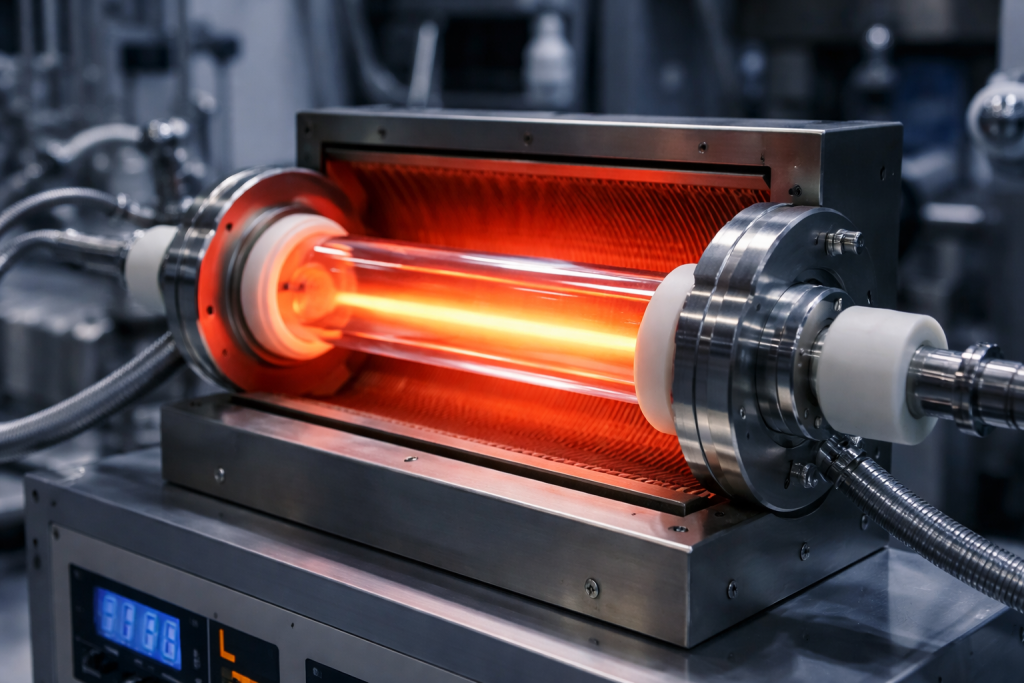
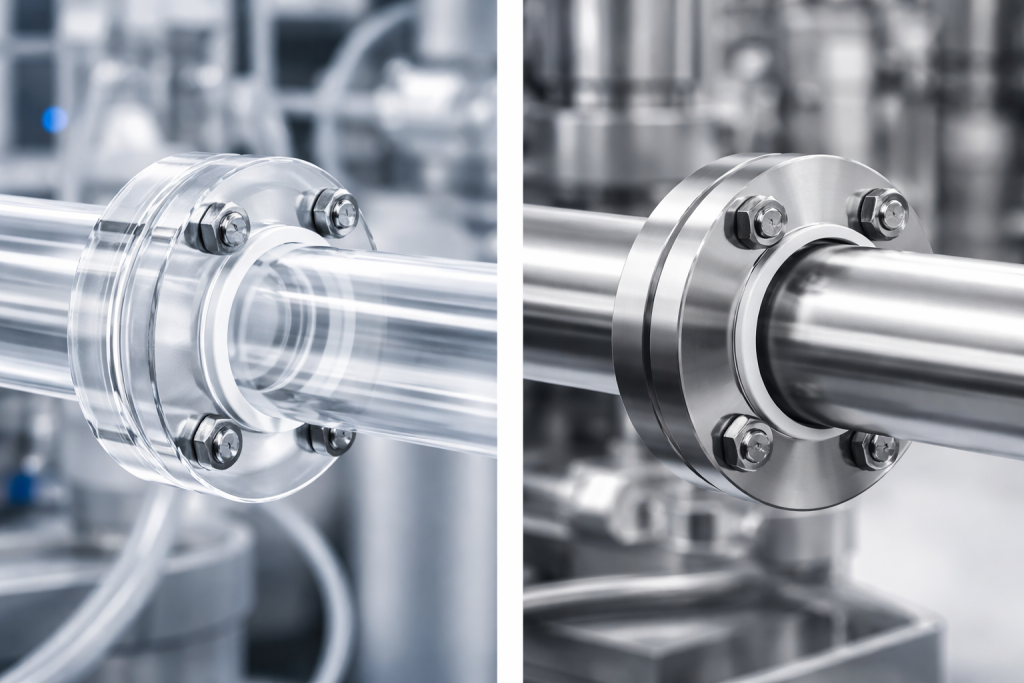
Flanges are essential components in industrial piping, vacuum systems, and high-precision instrumentation. Traditionally, metal flanges, such as stainless steel or aluminum, have been widely used due to their mechanical strength and availability. However, in high-purity, high-temperature, or chemically aggressive environments, quartz flanges are increasingly preferred. Quartz (SiO₂) offers unique properties that make it suitable for specialized scientific and industrial applications. This article provides a detailed comparison between quartz flanges and conventional metal flanges in terms of material properties, performance, and application scenarios.
1. Material Properties
1.1 Quartz Flanges
Quartz is a crystalline form of silicon dioxide with exceptional thermal, chemical, and optical characteristics:
- High thermal resistance: Quartz can withstand temperatures exceeding 1000°C without deformation, making it ideal for high-temperature processes.
- Chemical inertness: Quartz is highly resistant to acids, bases, and organic solvents, ensuring stability in corrosive environments.
- Low thermal expansion: With a coefficient of thermal expansion around 0.55 × 10⁻⁶ /°C, quartz maintains dimensional stability under rapid temperature changes.
- Electrical insulation: Quartz is an excellent dielectric, making it suitable for applications involving high-voltage or sensitive electronic systems.
1.2 Metal Flanges
Metal flanges, such as stainless steel or aluminum, have strong mechanical properties:
- High tensile and yield strength: Suitable for high-pressure systems.
- Moderate thermal resistance: Typically stable up to 500–800°C, depending on alloy composition.
- Susceptibility to corrosion: Metals can oxidize or corrode in aggressive chemical environments, requiring coatings or protective measures.
- Good thermal conductivity: Helps dissipate heat, beneficial in certain applications.
2. Thermal Performance
Quartz flanges excel in high-temperature applications. They maintain structural integrity in furnace systems, semiconductor processing chambers, and laser optics setups. Their low thermal expansion minimizes stress on connected components, reducing the risk of cracking or leaks.
Metal flanges, while mechanically robust, expand significantly under heat. This expansion can compromise seals in high-precision or vacuum systems, especially where tight tolerances are required. Stainless steel flanges may require bellows or expansion joints to accommodate thermal deformation.
3. Chemical Resistance
Chemical stability is a critical factor for industrial and laboratory flanges:
- Quartz flanges remain chemically inert in highly corrosive environments, such as hydrofluoric acid etching or strong alkaline processes.
- Metal flanges can corrode unless specifically treated or alloyed (e.g., 316L stainless steel). Prolonged exposure may lead to contamination or failure in sensitive systems.
This property makes quartz flanges particularly suitable for semiconductor fabrication, chemical vapor deposition (CVD) systems, and pharmaceutical reactors.
4. Mechanical Strength and Durability
Metal flanges naturally exhibit superior mechanical strength, handling high pressure and mechanical stress efficiently. Quartz, while brittle compared to metals, can be engineered with reinforced designs, thicker sections, or protective coatings to achieve sufficient durability in specialized applications.
Quartz flanges are particularly advantageous when weight reduction, dimensional stability, and chemical purity outweigh the need for extreme mechanical load-bearing capability. For example, in vacuum chambers or optical systems, quartz flanges provide long-term stability without introducing metal contamination.
5. Optical and Electrical Considerations
Quartz flanges are transparent to UV, visible, and IR light, allowing their integration into optical systems where in-situ observation or laser access is required. Additionally, their dielectric properties prevent electrical interference in sensitive experimental setups. Metal flanges, being opaque and conductive, cannot serve this purpose without additional optical windows or insulating layers.
6. Application Scenarios
| Feature | Quartz Flanges | Metal Flanges |
|---|---|---|
| Temperature Resistance | >1000°C | 500–800°C |
| Chemical Resistance | Excellent | Moderate (requires coatings) |
| Thermal Expansion | Very Low | Moderate to High |
| Mechanical Strength | Moderate (brittle) | High |
| Optical Transparency | Yes | No |
| Electrical Conductivity | Insulator | Conductor |
Quartz flanges are ideal for:
- Semiconductor processing equipment
- High-purity chemical reactors
- Optical and laser systems
- High-temperature vacuum chambers
Metal flanges are preferred for:
- High-pressure piping
- Mechanical assemblies requiring robust load-bearing
- General industrial applications where chemical exposure is limited
7. Conclusion
Quartz flanges and conventional metal flanges each have distinct advantages. Quartz flanges excel in high-temperature, chemically aggressive, and optical or vacuum-sensitive environments, offering superior chemical stability, low thermal expansion, and transparency. Metal flanges provide mechanical strength and pressure tolerance, making them suitable for standard industrial pipelines and structural assemblies.
Selecting the appropriate flange material requires careful consideration of operating conditions, chemical exposure, thermal load, and optical or electrical requirements. In specialized industrial or scientific applications, quartz flanges offer a unique combination of properties that cannot be matched by conventional metals, ensuring reliability, purity, and long-term performance.