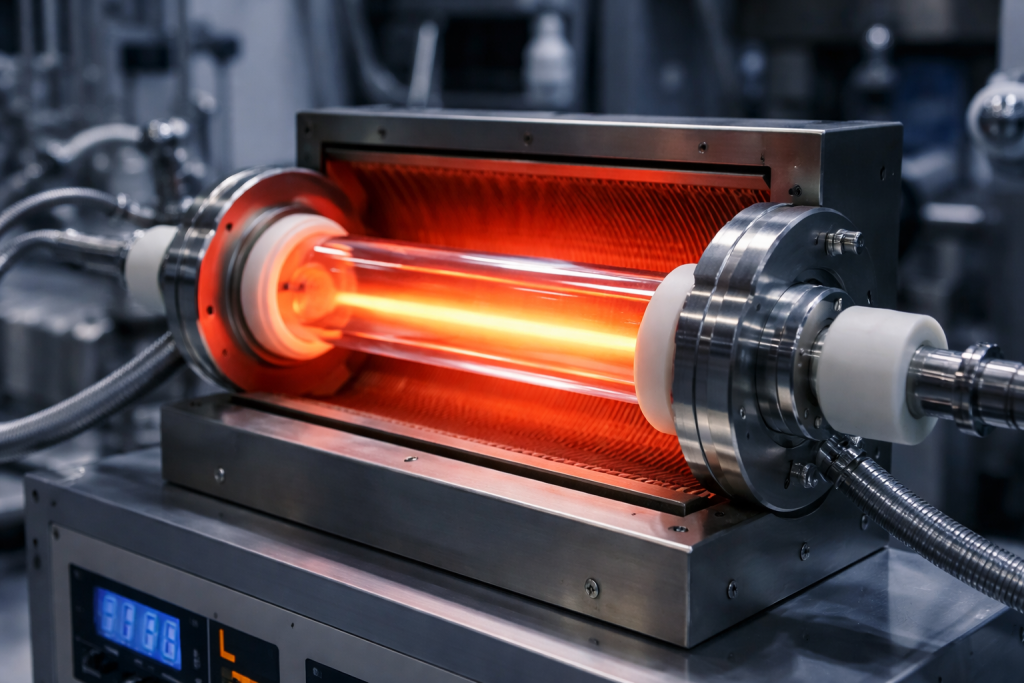
Fused quartz tubes are among the most important high-performance tubular materials used in thermal processing, optical systems, chemical handling, semiconductor equipment, laboratory instruments, and precision industrial assemblies. Unlike ordinary glass tubes, fused quartz tubes are manufactured from high-purity silicon dioxide and possess a unique combination of thermal stability, optical transparency, chemical resistance, and dimensional precision.
From a materials science perspective, fused quartz is an amorphous form of silica. It does not have a crystalline lattice like natural quartz crystal, but it retains many of the beneficial characteristics associated with silicon dioxide, including strong Si–O bonds, low thermal expansion, and excellent resistance to many chemical environments. These properties make fused quartz tubes suitable for demanding applications where common borosilicate or soda-lime glass would fail.
1. What Is a Fused Quartz Tube?
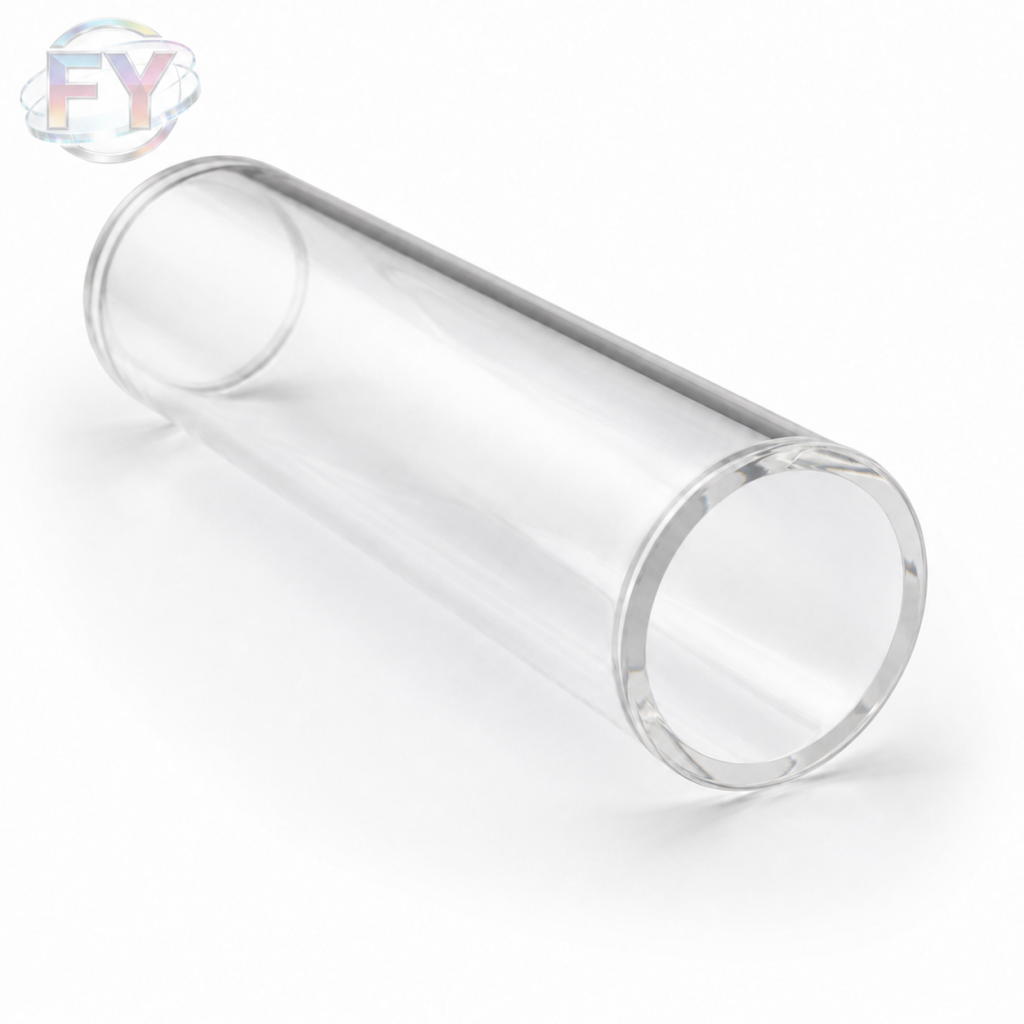
A fused quartz tube is a tubular component made from fused silica or fused quartz glass. The material is typically produced by melting high-purity silica raw material at extremely high temperatures, followed by forming, drawing, machining, or flame processing into tubular shapes.
Depending on the production route and raw material source, quartz tubes may be classified into several categories, such as:
- Transparent fused quartz tubes
- Opaque fused quartz tubes
- Synthetic fused silica tubes
- Natural fused quartz tubes
- Semiconductor-grade quartz tubes
- UV-grade or optical-grade quartz tubes
Although these categories are often used interchangeably in commercial discussions, they may differ significantly in impurity level, hydroxyl content, optical transmission, bubble content, and thermal performance. Therefore, selecting the correct fused quartz tube requires more than simply specifying diameter and length.
2. Key Material Properties of Fused Quartz Tubes
Fused quartz tubes are valued because they combine several properties that are rarely found together in one material.
2.1 High Thermal Resistance
One of the most important characteristics of fused quartz is its ability to withstand high temperatures. Its low coefficient of thermal expansion allows it to resist thermal shock better than many conventional glasses. This means a fused quartz tube can often tolerate rapid heating and cooling cycles without cracking, provided the design, wall thickness, and thermal gradient are properly controlled.
Typical thermal characteristics include:
| Property | Typical Feature |
|---|---|
| Main composition | SiO₂ |
| Thermal expansion | Very low |
| Thermal shock resistance | Excellent compared with common glass |
| Softening point | High-temperature stability |
| Continuous use temperature | Depends on grade, geometry, and atmosphere |
| Short-term heat resistance | Suitable for many high-temperature processes |
This makes fused quartz tubes widely used in furnaces, heating chambers, infrared lamps, thermal reactors, and semiconductor process equipment.
2.2 Excellent Optical Transmission
Transparent fused quartz tubes can transmit light across a wide spectral range, including ultraviolet, visible, and near-infrared regions. This property is especially important in optical instruments, UV disinfection systems, photochemical reactors, lamp envelopes, and analytical devices.
However, optical performance depends strongly on the specific material grade. For example, UV-grade fused silica generally offers better ultraviolet transmission than standard fused quartz. If the tube is used in optical or UV-related applications, parameters such as transmittance range, hydroxyl content, bubble grade, and surface quality should be carefully evaluated.
2.3 Chemical Stability
Fused quartz exhibits excellent resistance to many acids, water, salts, and organic solvents. It is widely used in laboratory and industrial environments where chemical purity and contamination control are important.
However, fused quartz is not resistant to all chemicals. Hydrofluoric acid and strong alkaline solutions at elevated temperatures can attack silica-based materials. Therefore, chemical compatibility should always be checked before using fused quartz tubes in corrosive environments.
2.4 High Purity and Low Contamination
For semiconductor, photovoltaic, and advanced material processing, high purity is one of the most critical advantages of fused quartz tubes. Quartz components can be manufactured with very low metallic impurity levels, making them suitable for processes where contamination may affect wafer yield, film quality, or material performance.
In semiconductor furnace systems, quartz tubes are often used as process tubes, diffusion tubes, liners, or reaction chambers. Their purity, cleanliness, surface finish, and dimensional stability directly influence process consistency.
2.5 Electrical Insulation
Fused quartz has excellent electrical insulation properties. It can be used in high-temperature electrical systems, lamp structures, insulating sleeves, and other applications where dielectric stability is required.
3. Common Applications of Fused Quartz Tubes
Because of their thermal, optical, and chemical performance, fused quartz tubes are used across many industries.
3.1 Semiconductor Processing
In semiconductor manufacturing, fused quartz tubes are used in oxidation, diffusion, annealing, chemical vapor deposition, and thermal treatment systems. Quartz process tubes provide a clean and thermally stable chamber for wafer processing.
Typical semiconductor-related applications include:
- Furnace tubes
- Diffusion tubes
- Oxidation tubes
- Quartz liners
- Wafer process chambers
- Gas delivery and exhaust components
- Custom quartz reaction tubes
For these applications, purity, particle control, surface roughness, and cleaning standards are especially important.
3.2 Laboratory and Chemical Processing
Fused quartz tubes are commonly used in laboratories because they can withstand high temperature and many chemical environments. They are used in thermal analysis, combustion testing, chemical reaction systems, and tube furnaces.
Compared with ordinary glass, fused quartz is more suitable for experiments involving high heat, rapid temperature changes, or optical observation.
3.3 Optical and UV Systems
Transparent fused quartz tubes are widely used in optical and ultraviolet systems. They can serve as protective sleeves, lamp envelopes, flow tubes, or optical channels.
Common applications include:
- UV sterilization lamps
- Mercury lamps
- Excimer lamp systems
- Photochemical reactors
- Spectroscopic instruments
- Infrared heating systems
For these applications, the selected tube must meet optical transmission requirements. Surface finish, wall thickness uniformity, and internal defects such as bubbles or inclusions may affect optical performance.
3.4 Industrial Heating and Furnace Equipment
Fused quartz tubes are often used as heating tubes, furnace observation tubes, infrared heater envelopes, and thermal insulation-related components. Their low thermal expansion and high-temperature stability make them suitable for environments where thermal cycling is frequent.
3.5 Photovoltaic and Advanced Material Processing
In photovoltaic and advanced material manufacturing, fused quartz tubes are used in crystal growth, thermal treatment, coating, and purification processes. Their low contamination characteristics are important for maintaining material quality.
4. Fused Quartz Tubes vs Ordinary Glass Tubes
Although fused quartz and ordinary glass may appear similar visually, their performance differences are significant.
| Item | Fused Quartz Tube | Ordinary Glass Tube |
| Main material | High-purity SiO₂ | Mixed glass composition |
| Thermal expansion | Very low | Higher |
| Thermal shock resistance | Excellent | Limited |
| High-temperature use | Strong advantage | Limited |
| Optical transmission | Excellent depending on grade | Limited, especially in UV |
| Chemical purity | High | Lower |
| Cost | Higher | Lower |
| Typical use | Semiconductor, optical, lab, furnace | General laboratory or packaging use |
For low-temperature and non-critical applications, ordinary glass may be sufficient. However, when high temperature, optical transmission, purity, or thermal shock resistance is required, fused quartz is usually the better choice.
5. Selection Guide for Fused Quartz Tubes
Selecting a fused quartz tube requires a clear understanding of the operating environment and technical requirements. The following factors are especially important.
5.1 Material Grade
The first step is to determine whether the application requires standard fused quartz, synthetic fused silica, UV-grade quartz, infrared-grade quartz, or semiconductor-grade quartz. Different grades have different impurity levels, optical transmission, hydroxyl content, and cost.
For optical systems, transmission range is critical. For semiconductor processes, purity and cleanliness are more important. For industrial heating, thermal stability and mechanical strength may be the main concerns.
5.2 Outer Diameter, Inner Diameter and Wall Thickness
The tube dimensions must be selected according to installation space, mechanical strength, gas flow, pressure conditions, and processing requirements.
Key dimensional parameters include:
- Outer diameter
- Inner diameter
- Wall thickness
- Length
- Straightness
- Roundness
- End finish
- Tolerance range
A thicker wall may improve mechanical strength but can also increase thermal stress during rapid heating or cooling. Therefore, wall thickness should be selected carefully rather than simply maximized.
5.3 Temperature and Thermal Cycling
The working temperature, heating rate, cooling rate, and temperature distribution should be considered. Even though fused quartz has excellent thermal shock resistance, improper use can still cause cracking. Large temperature gradients, mechanical constraints, or uneven heating may increase failure risk.
5.4 Surface Finish and Cleanliness
Surface finish is important for optical, semiconductor, and high-purity applications. Scratches, particles, rough surfaces, or residues can affect performance. For semiconductor use, cleaning, packaging, and handling conditions are often as important as the tube material itself.
5.5 Chemical Environment
Before selecting a fused quartz tube for chemical use, it is necessary to confirm the type of chemicals, concentration, temperature, and exposure time. Fused quartz is resistant to many acids and solvents, but it can be attacked by hydrofluoric acid and certain alkaline environments.
5.6 Custom Processing Requirements
Many fused quartz tubes require additional processing, such as:
- Cutting
- Fire polishing
- Grinding
- Drilling
- Slotting
- Bending
- Sealing
- Flanging
- Joint welding
- Surface polishing
- Precision cleaning
For custom quartz tube projects, drawings or detailed specifications are usually required to ensure dimensional accuracy and repeatability.
6. Typical Specification Parameters
When requesting a fused quartz tube, the following information is useful:
| Parameter | Description |
| Material grade | Standard, optical grade, UV grade, semiconductor grade |
| Outer diameter | Required OD and tolerance |
| Inner diameter | Required ID and tolerance |
| Wall thickness | Standard or customized |
| Length | Total length and cutting tolerance |
| End finish | Cut, ground, polished, fire-polished |
| Surface quality | Transparent, polished, low-bubble, low-inclusion |
| Working temperature | Continuous and peak temperature |
| Application environment | Furnace, UV, chemical, semiconductor, optical |
| Additional processing | Holes, slots, bends, flanges, joints |
| Cleaning requirement | Standard cleaning or high-purity cleaning |
Clear specifications help reduce production uncertainty and ensure that the final quartz tube matches the application.
7. Design Considerations and Limitations
Although fused quartz tubes offer excellent performance, they are not suitable for every condition. Engineers should consider several limitations.
First, fused quartz is brittle and can fracture under impact or excessive mechanical stress. Second, although it has excellent thermal shock resistance, very rapid or uneven heating can still lead to failure. Third, its chemical resistance is not universal, especially in hydrofluoric acid or strong alkaline environments. Finally, high-purity and optical-grade fused quartz tubes are more expensive than ordinary glass tubes, so over-specification may increase unnecessary cost.
A suitable design should balance performance, cost, manufacturing tolerance, and operating conditions.
8. Conclusion
Fused quartz tubes are advanced tubular components with outstanding thermal stability, optical transparency, chemical resistance, electrical insulation, and high purity. These properties make them essential in semiconductor processing, optical systems, UV equipment, laboratory instruments, chemical reactors, industrial furnaces, and advanced material manufacturing.
The correct selection of a fused quartz tube depends on more than size alone. Material grade, optical requirements, temperature range, chemical exposure, dimensional tolerance, surface quality, and cleaning standards should all be considered. For demanding applications, a detailed technical specification or engineering drawing is recommended.
As industries continue to require cleaner, more stable, and more precise materials, fused quartz tubes will remain an important solution for high-temperature, high-purity, and high-performance environments.