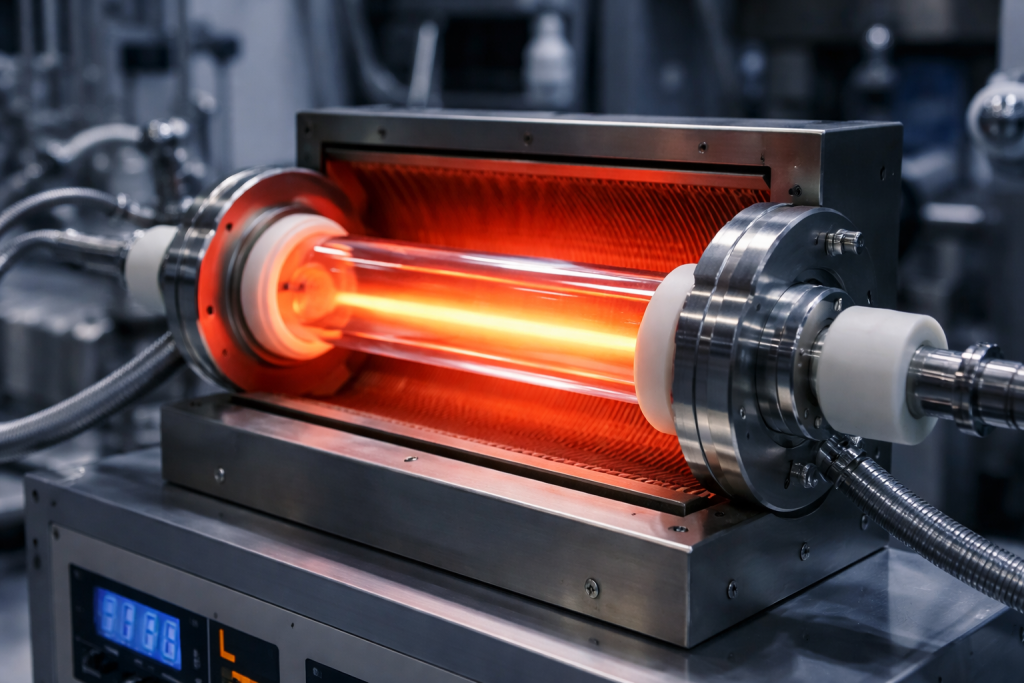
Fused quartz tubes are widely used in semiconductor equipment, laboratory instruments, chemical processing systems, optical devices, heating systems, and high-temperature industrial applications. Compared with ordinary glass tubes, fused quartz tubes offer excellent thermal stability, high purity, good chemical resistance, and strong optical transmission performance. These properties make them suitable for applications where ordinary borosilicate glass or soda-lime glass cannot meet the operating requirements.
For many engineering projects, fused quartz tubes are not purchased as simple standard tubes. Buyers often need customized diameter, wall thickness, length, end finish, shape, hole position, flange design, polishing level, or cleaning grade. Understanding the main customization options can help engineers and purchasing teams communicate requirements more clearly and reduce production risk.

What Is a Fused Quartz Tube?
A fused quartz tube is a tubular component made from high-purity silica glass. It is produced by melting high-purity quartz or synthetic silica material and forming it into a tube shape. Because fused quartz has a very low coefficient of thermal expansion and strong resistance to thermal shock, it can be used in high-temperature and rapid temperature-change environments.
Fused quartz tubes are commonly used in:
- Semiconductor diffusion and oxidation processes
- Laboratory reaction systems
- UV and infrared optical systems
- Heating lamps and infrared heaters
- Chemical processing equipment
- Furnace tubes and process chambers
- Gas delivery and exhaust systems
- Analytical instruments
- Custom quartz assemblies
In these applications, tube geometry and processing quality directly affect performance, service life, sealing reliability, and installation compatibility.
1. Diameter Customization
Diameter is one of the most important specifications for fused quartz tubes. Engineers usually need to define both outer diameter and inner diameter.
The outer diameter affects how the tube fits into holders, seals, clamps, furnaces, or machine structures. The inner diameter affects gas flow, sample capacity, chemical reaction space, optical path, or heating uniformity.
When specifying diameter, buyers should provide:
| Parameter | Description |
|---|---|
| Outer diameter | The outside size of the tube |
| Inner diameter | The inside opening of the tube |
| Diameter tolerance | Allowable dimensional variation |
| Roundness | Important for sealing and precision assembly |
| Straightness | Important for long tubes and furnace systems |
For general industrial use, standard diameter tolerance may be acceptable. For semiconductor equipment, optical instruments, and precision assemblies, tighter tolerance may be required.
Large-diameter fused quartz tubes are often used as furnace tubes, reaction chambers, or process tubes. Small-diameter quartz tubes are used in lamps, capillary systems, analytical instruments, and compact heating devices.
2. Wall Thickness Selection
Wall thickness affects the tube’s mechanical strength, thermal behavior, weight, cost, and processing difficulty. A thicker wall usually improves rigidity and handling strength, while a thinner wall may provide faster thermal response and lower weight.
Common wall thickness considerations include:
- Operating temperature
- Internal or external pressure
- Tube diameter and length
- Installation method
- Thermal shock conditions
- Handling and transportation risk
- Machining or welding requirements
- Final application environment
For long or large-diameter tubes, wall thickness is especially important because the tube must remain stable during installation and operation. If the wall is too thin, the tube may deform, crack, or break during handling. If the wall is too thick, the tube may become more expensive and slower to heat or cool.
In semiconductor and laboratory equipment, wall thickness should also be matched with sealing components, furnace supports, and process requirements.
3. Length and End Finish
Fused quartz tubes can be customized in different lengths according to equipment design. Short tubes may be used as sleeves, lamp covers, sample holders, or optical protection tubes. Long tubes may be used in furnaces, gas systems, and chemical reaction equipment.
End finish is another important detail. The tube ends may be:
- Cut only
- Fire polished
- Ground flat
- Beveled
- Flanged
- Closed at one end
- Open at both ends
- Connected with quartz joints or adapters
A simple cut end may be enough for some low-risk applications. For sealing, assembly, and safety, fire-polished or ground ends are often preferred. Fire polishing helps reduce sharp edges and micro-cracks, while precision grinding improves flatness and dimensional control.
For vacuum, gas flow, or chemical reaction systems, the end structure should be carefully designed to match sealing rings, clamps, flanges, or connectors.
4. Shape Customization
Not all fused quartz tubes are straight cylindrical tubes. Many applications require special shapes to match equipment layout or process function.
Common customized quartz tube shapes include:
| Shape Type | Typical Application |
| Straight tube | Furnace, lamp, gas flow, reaction systems |
| U-shaped tube | Heating, cooling, laboratory systems |
| Spiral tube | Condensing, cooling, thermal exchange |
| Bent tube | Gas delivery, connection, instrument layout |
| T-shaped tube | Branching flow systems |
| Closed-end tube | Thermocouple protection, sample protection |
| Flanged tube | Sealing and installation in equipment |
| Slotted tube | Custom process chambers or holders |
| Multi-hole tube | Gas distribution and special process flow |
Special-shaped quartz tubes require careful control of forming temperature, bend radius, wall uniformity, and stress release. For complex shapes, drawings or 3D models are strongly recommended.
5. Hole Drilling and Slot Processing
Some fused quartz tubes require holes, slots, notches, or openings for gas flow, sensor access, installation, or connection with other components. Quartz is hard and brittle, so hole drilling must be handled carefully to reduce chipping and cracking.
Important hole-processing details include:
- Hole diameter
- Hole position
- Hole spacing
- Edge chamfer
- Hole wall quality
- Distance from tube end
- Distance from other holes
- Whether fire polishing is required
For small holes or thin-wall tubes, processing risk is higher. Engineers should avoid placing holes too close to the tube edge or too close to each other unless the design has been reviewed for manufacturability.
6. Quartz Welding and Assembly
Fused quartz tubes can be welded to other quartz components, such as flanges, joints, rings, nozzles, adapters, and end caps. Quartz welding allows manufacturers to create more complex assemblies for semiconductor, laboratory, and industrial equipment.
Typical welded quartz tube assemblies include:
- Quartz tube with flange
- Quartz tube with side branch
- Quartz reaction chamber
- Quartz gas distributor
- Quartz condenser tube
- Quartz tube with closed end
- Quartz sleeve with quartz ring
- Quartz process tube assembly
Welding quality is important because poor welding may create stress concentration, weak joints, bubbles, deformation, or leakage risk. For high-temperature or vacuum-related use, welding quality and stress relief should be carefully controlled.
7. Surface Finish and Polishing Options
Surface quality affects cleaning, optical performance, contamination control, and service life. Fused quartz tubes may be supplied with different surface finishes depending on the application.
Common surface options include:
- As-drawn surface
- Fire-polished surface
- Mechanically polished surface
- Ground surface
- Chemically cleaned surface
- High-cleanliness surface for semiconductor use
For optical applications, surface quality may affect transmission, scattering, and appearance. For semiconductor equipment, surface cleanliness and particle control are more important. For chemical processing, smooth surfaces may reduce residue buildup and make cleaning easier.
8. Cleaning and Packaging
Cleaning is often overlooked, but it is very important for fused quartz tubes used in semiconductor, optical, and laboratory applications. Particles, metal ions, fingerprints, oil, and polishing residue can affect performance.
Depending on the application, cleaning requirements may include:
- Deionized water cleaning
- Ultrasonic cleaning
- Acid cleaning
- High-purity cleaning
- Drying in clean environment
- Cleanroom packaging
- Individual protective packaging
For semiconductor applications, buyers should clearly state whether the tube will be used in a high-cleanliness process. This helps the supplier choose the correct cleaning and packaging method.
9. Thermal and Chemical Requirements
Fused quartz tubes are selected because of their excellent thermal and chemical performance. However, the actual working condition still needs to be confirmed before production.
Engineers should provide:
- Maximum operating temperature
- Continuous working temperature
- Heating and cooling rate
- Chemical environment
- Gas type
- Pressure condition
- Vacuum requirement
- Contact material
- Expected service life
For example, a tube used in a high-temperature furnace may require different wall thickness and stress control compared with a tube used as a transparent protective sleeve. A tube exposed to corrosive gas may require special cleaning and surface quality control.
10. Drawing Requirements for Custom Fused Quartz Tubes
For simple straight tubes, basic dimensions may be enough. For custom quartz tube projects, drawings are very helpful. A good drawing should include:
| Item | What to Specify |
| Outer diameter | OD and tolerance |
| Inner diameter | ID and tolerance |
| Wall thickness | Nominal value and tolerance |
| Length | Total length and tolerance |
| End finish | Cut, polished, beveled, closed, or flanged |
| Holes or slots | Size, quantity, position, tolerance |
| Shape | Straight, bent, spiral, U-shaped, or special |
| Surface finish | As-drawn, polished, fire-polished, cleaned |
| Application | Furnace, optics, lab, semiconductor, chemical |
| Quantity | Prototype or mass production |
The more complete the information, the easier it is to evaluate manufacturability, cost, and lead time.
11. Common Mistakes When Ordering Fused Quartz Tubes
Many problems in custom quartz tube projects come from unclear specifications. Common mistakes include:
- Only providing outer diameter without inner diameter
- Ignoring wall thickness tolerance
- Not specifying end finish
- Requesting holes too close to the tube edge
- Choosing a wall thickness that is too thin for the tube size
- Not considering thermal shock conditions
- Not providing the working temperature
- Confusing fused quartz with borosilicate glass
- Not confirming cleaning and packaging requirements
- Providing no drawing for special-shaped parts
To avoid these issues, buyers should communicate both dimensions and application conditions before ordering.
Conclusion
Fused quartz tube customization is not limited to choosing a diameter and length. Engineers should also consider wall thickness, tube shape, end finish, hole processing, welding, polishing, cleaning, packaging, and operating environment. These details directly affect installation, sealing, thermal stability, mechanical strength, and long-term reliability.
For standard applications, a simple straight fused quartz tube may be enough. For semiconductor equipment, optical systems, laboratory reactors, or high-temperature industrial processes, custom processing and strict quality control are often required.
When requesting a quotation, buyers should provide drawings, dimensions, tolerances, application details, temperature conditions, surface requirements, and quantity. Clear specifications help ensure that the final fused quartz tube is suitable for both the equipment design and the real working environment.
What information is needed to customize a fused quartz tube?
Buyers should provide outer diameter, inner diameter, wall thickness, length, tolerance, end finish, shape, hole details, surface finish, cleaning requirement, quantity, and application. A drawing is recommended for special-shaped tubes.
Can fused quartz tubes be bent or made into special shapes?
Yes. Fused quartz tubes can be made into straight, bent, U-shaped, spiral, T-shaped, closed-end, flanged, or other customized structures. Complex designs should be reviewed for manufacturability before production.
How should wall thickness be selected for a fused quartz tube?
Wall thickness should be selected according to diameter, length, operating temperature, pressure condition, handling risk, installation method, and processing requirements. Thin-wall tubes offer faster thermal response, while thick-wall tubes provide better strength and rigidity.