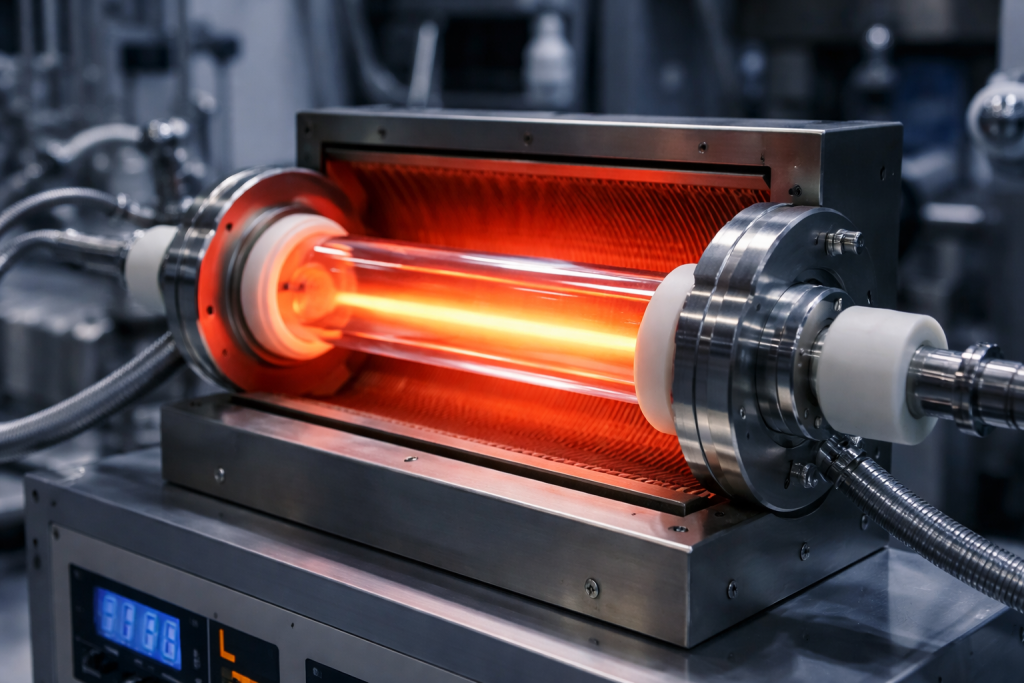
Quartz plates are flat components made from high-purity fused silica, widely used in optical systems, semiconductor equipment, and high-temperature industrial environments.
Unlike standard glass, quartz plates combine excellent thermal stability, chemical resistance, and optical transmission, making them a key material in precision engineering applications.

1. What Are Quartz Plates?
Quartz plates are flat sheets of fused silica (SiO₂) produced through high-temperature melting and precision machining processes.
They are characterized by:
- Expansión térmica extremadamente baja
- High UV and IR transmission
- Strong resistance to chemical corrosion
- High dimensional stability under heat
These properties make quartz plates suitable for demanding optical and industrial environments.
2. Quartz Plate Manufacturing Process
The manufacturing of quartz plates involves several controlled steps to ensure purity and precision:
2.1 Raw Material Selection
High-purity natural quartz or synthetic silica is selected to ensure minimal impurities and stable optical performance.
2.2 Melting Process
Silica is melted at temperatures above 1700°C using flame fusion or electric fusion techniques, forming a homogeneous quartz structure.
2.3 Forming
The molten material is cast into slabs or ingots under controlled cooling conditions to avoid internal stress.
2.4 Annealing
Slow cooling is applied to release internal stress and improve structural stability.
2.5 Cutting and Machining
Quartz ingots are cut into plates using diamond tools or precision wire cutting systems.
2.6 Surface Finishing
Depending on application requirements, surfaces may be:
- Ground finish
- Polished
- Double-side polished (DSP) for optical use
3. Quartz Plate Technical Parameters
The following table summarizes typical material and processing characteristics of quartz plates:
3.1 Material Properties
| Propiedad | Valor típico |
|---|---|
| Material | Fused Silica (SiO₂ ≥ 99.99%) |
| Densidad | ~2.20 g/cm³ |
| Coeficiente de dilatación térmica | 5.5 × 10-⁷ /°C |
| Punto de ablandamiento | ~1730°C |
| Continuous Working Temperature | Up to 1100°C |
| Alcance de transmisión óptica | 180 nm – 2500 nm |
3.2 Dimensional Range
| Parámetro | Typical Range |
|---|---|
| Espesor | 0.5 mm – 50 mm |
| Max Size | Up to 500 mm or customized |
| Forma | Round / Square / Rectangular / Custom |
| Tipo de borde | Cut / Ground / Chamfered |
3.3 Precision Tolerance Levels
| Parámetro | Standard Grade | Precision Grade | Optical Grade |
|---|---|---|---|
| Tolerancia de grosor | ±0.05 mm | ±0.02 mm | ±0.01 mm |
| Planitud | ≤ 5 µm / 100 mm | ≤ 2 µm / 100 mm | ≤ 1 µm / 100 mm |
| Paralelismo | ≤ 0.05 mm | ≤ 0.02 mm | ≤ 0.01 mm |
| Rugosidad superficial (Ra) | ≤ 0.2 µm | ≤ 0.05 µm | ≤ 0.01 µm |
3.4 Optical Performance
| Wavelength Range | Transmission Rate |
|---|---|
| UV (200–400 nm) | >85% |
| Visible (400–700 nm) | >90% |
| IR (700–2500 nm) | >85% |
4. Applications of Quartz Plates
Quartz plates are used in multiple high-tech industries due to their stability and optical performance.
4.1 Optical Industry
Used in:
- Laser systems
- UV optical devices
- Imaging and detection systems
4.2 Semiconductor Industry
Used in:
- Wafer processing equipment
- Thermal chambers
- Etching and deposition systems
4.3 Industrial High-Temperature Systems
Used in:
- Furnace observation windows
- Heat-resistant shielding components
4.4 Laboratory and Scientific Equipment
Used in:
- Spectroscopy instruments
- Chemical analysis systems
- Precision measurement devices
5. Key Advantages of Quartz Plates
- Excelente resistencia al choque térmico
- Very low thermal expansion
- High optical transparency (UV–IR range)
- Strong resistance to acids and chemicals
- Stable performance under extreme conditions
6. Summary
Quartz plates are essential engineering materials used in optics, semiconductor manufacturing, and industrial thermal systems. Their performance depends heavily on purity, machining accuracy, and surface quality.
Understanding their manufacturing process and technical parameters helps engineers and buyers select the right grade for different applications.
PREGUNTAS FRECUENTES
What is the main difference between quartz plates and standard glass?
Quartz plates offer higher thermal resistance, better UV transmission, and superior chemical stability.
Can quartz plates be used in high-temperature environments?
Yes, they can operate continuously at temperatures up to approximately 1100°C.
Are quartz plates suitable for optical applications?
Yes, especially high-purity fused silica plates used in UV and laser systems.