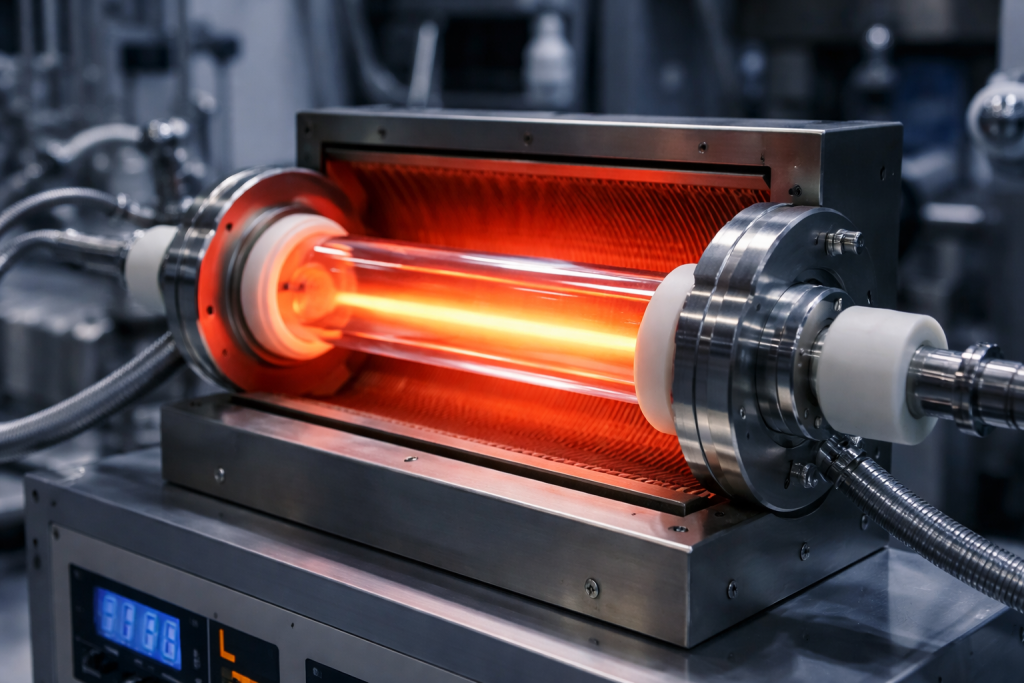
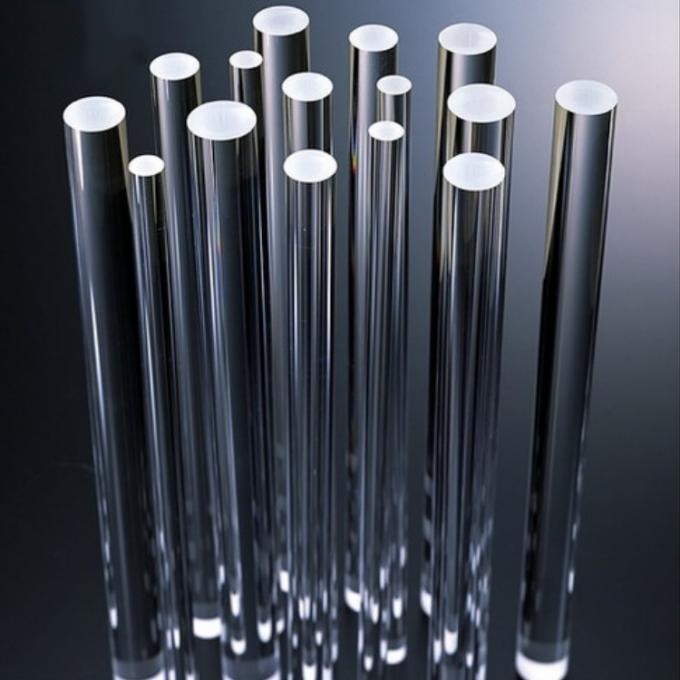
Quartz glass, composed primarily of silicon dioxide (SiO₂), is an inorganic non-metallic material widely used in optics, semiconductors, chemical processing, and scientific research due to its excellent optical, thermal, and chemical properties. Depending on its purity and manufacturing process, quartz glass can be classified into pure quartz glass and standard quartz glass (fused quartz). These two types differ significantly in terms of performance and applications. This article provides a comprehensive analysis of their distinctions and explores their respective applications.
1. Composition and Purity
Standard quartz glass is typically produced by melting natural quartz sand, with SiO₂ content ranging from 99.5% to 99.9%. Impurities such as Al₂O₃, Fe₂O₃, and Na₂O are present at higher levels, which can affect optical transmittance, thermal expansion, and chemical stability at elevated temperatures.
Pure quartz glass, in contrast, is manufactured from high-purity SiO₂ powder or via chemical vapor deposition (CVD), achieving SiO₂ content of 99.99% or higher. Impurities are minimized to parts-per-million levels, resulting in superior optical clarity, thermal stability, and chemical resistance compared to standard quartz glass.
2. Manufacturing Processes
Standard Quartz Glass
- Produced mainly through electric arc melting or gas-fusion melting methods, forming quartz blocks that are then drawn or cast into shapes.
- The process is relatively simple and cost-effective but may result in internal bubbles and minor impurities, limiting optical uniformity.
Pure Quartz Glass
- Commonly fabricated via chemical vapor deposition (CVD) or high-purity fused quartz techniques.
- In CVD, silicon tetrachloride (SiCl₄) reacts at high temperature to deposit SiO₂ layer by layer, forming a homogeneous, virtually impurity-free quartz glass blank.
- This process is complex and costly but enables precise control of optical, thermal, and chemical properties, making it ideal for high-end optical and semiconductor applications.
3. Physical and Optical Properties
| Property | Standard Quartz Glass | Pure Quartz Glass |
|---|---|---|
| SiO₂ Content | 99.5%–99.9% | ≥99.99% |
| Optical Transmittance (UV range) | ~90% | 95–99% |
| Thermal Expansion Coefficient | 5.5 × 10⁻⁷ /K | 0.5 × 10⁻⁶ /K (lower) |
| Softening Point | ~1650°C | >1700°C |
| Chemical Stability | Good | Excellent (resistant to strong acids and bases) |
| Internal Defects | Minor bubbles and inclusions | Virtually defect-free |
The low thermal expansion and high chemical stability of pure quartz glass allow it to maintain dimensional and optical stability under extreme conditions.
4. Applications
- Optics and Photonics
Pure quartz glass is widely used in high-precision lenses, prisms, optical fibers, and UV-grade windows due to its exceptional transparency and low impurity content. Standard quartz glass is suitable for less demanding optical components. - Semiconductor Industry
Pure quartz glass is essential in semiconductor processing equipment such as CVD reactors, wafer carriers, and quartz tubes, where chemical purity and thermal stability are critical. Standard quartz glass can be used for protective covers or lower-purity process components. - Chemical and High-Temperature Applications
Pure quartz glass excels in handling aggressive chemicals and high temperatures, making it ideal for laboratory crucibles, reaction vessels, and furnace windows. Standard quartz glass serves in moderate-temperature applications where cost efficiency is prioritized. - Scientific Research and Space Applications
In research requiring precise optical measurements or exposure to extreme conditions, pure quartz glass ensures minimal distortion and contamination. Standard quartz glass is often sufficient for educational or low-precision instruments.
Conclusion
The primary distinctions between pure quartz glass and standard quartz glass lie in purity, manufacturing method, optical clarity, thermal and chemical stability, and internal defect levels. While standard quartz glass meets general-purpose requirements, pure quartz glass is indispensable in high-precision, high-temperature, and chemically aggressive environments. Understanding these differences helps engineers and researchers select the appropriate material for optical, semiconductor, chemical, and scientific applications. Moreover, as modern technologies demand increasingly stringent performance, the adoption of high-purity quartz glass ensures enhanced reliability, longer service life, and minimized contamination in critical processes, reinforcing its role as a key material in advanced industries.