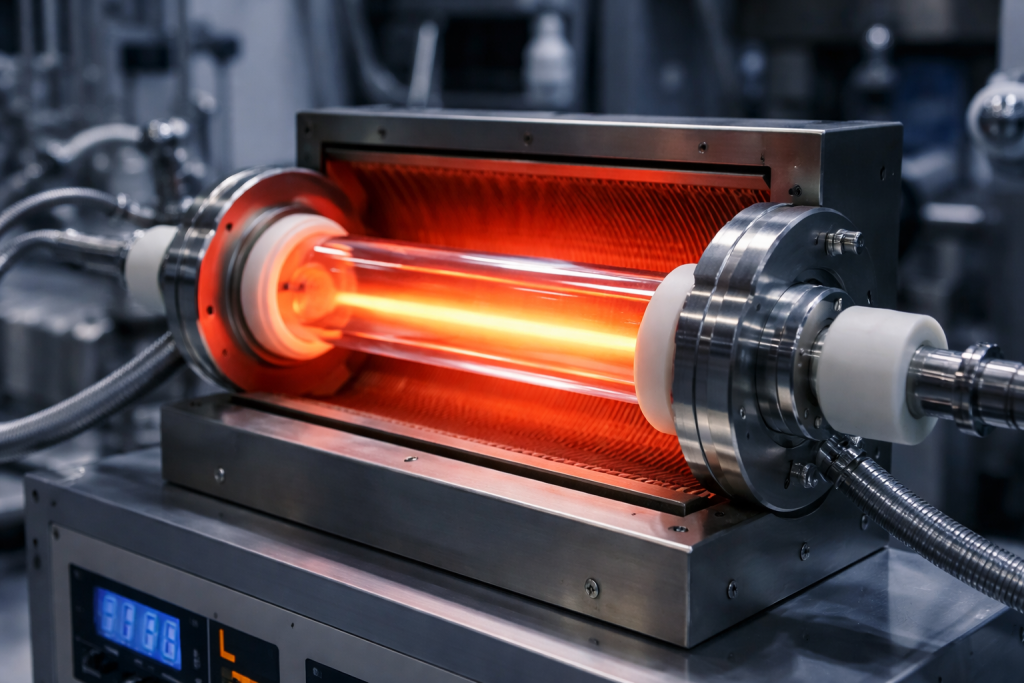
Quarz ist eines der wichtigsten Materialien, die in der Halbleiterfertigung zum Einsatz kommen. Es wird in großem Umfang in Diffusionsöfen, Oxidationsanlagen, CVD-Anlagen, Waferträgern, Prozesskammern, optischen Inspektionssystemen und Komponenten für den Umgang mit Chemikalien verwendet.
Allerdings sind nicht alle Quarzwerkstoffe für Halbleiteranwendungen geeignet. Je nach Prozessumgebung können an Quarzbauteile unterschiedliche Anforderungen hinsichtlich Reinheit, thermischer Stabilität, Hydroxylgehalt, optischer Eigenschaften und Maßgenauigkeit gestellt werden.
Die Auswahl des geeigneten Quarzmaterials ist entscheidend für die Minimierung von Verunreinigungen, die Aufrechterhaltung der Prozessstabilität und die Maximierung der Waferausbeute.
Warum in der Halbleiterfertigung hochreines Quarz zum Einsatz kommt
Die Halbleiterfertigung umfasst zahlreiche Prozesse, die unter extremen Bedingungen ablaufen:
- Hohe Temperaturen von über 1000 °C
- Korrosive Prozessgase
- Reaktive Chemikalien
- Hochreine Fertigungsumgebungen
- Bauelementstrukturen im Nanometerbereich
Unter diesen Bedingungen können selbst geringste Verunreinigungen, die von den Werkstoffen der Geräte stammen, die Leistung der Geräte beeinträchtigen.
Daher verwenden Halbleiterhersteller in der Regel hochreines Quarzglas oder synthetisches Quarzglas anstelle von handelsüblichem Industriekvarts.
1. Extrem geringe Metallverunreinigung
Die Reinheit des Materials ist eine der wichtigsten Anforderungen an Halbleiterquarz.
Bei der Hochtemperaturverarbeitung können metallische Verunreinigungen in die Wafer diffundieren und deren elektrische Eigenschaften beeinträchtigen.
Besonderes Augenmerk wird auf Folgendes gelegt:
- Aluminium (Al)
- Eisen (Fe)
- Kalzium (Ca)
- Magnesium (Mg)
- Titan (Ti)
- Natrium (Na)
- Kalium (K)
- Lithium (Li)
Anstatt einer einzigen, allgemein gültigen Spezifikation zu folgen, werden die Grenzwerte für Verunreinigungen in der Regel vom Hersteller des Halbleiterprozesses und der Anlagen festgelegt.
Bei anspruchsvollen Halbleiteranwendungen werden die Verunreinigungskonzentrationen häufig im ppm- oder Sub-ppm-Bereich geregelt.
2. Hervorragende Hochtemperaturbeständigkeit
Viele Halbleiterprozesse finden bei Temperaturen zwischen 800 °C und 1200 °C statt.
Quarz wird häufig verwendet, da er folgende Vorteile bietet:
| Eigentum | Typischer Wert |
|---|---|
| Erweichungspunkt | Etwa 1730 °C |
| Dauerbetriebstemperatur | Bis zu 1200 °C |
| Wärmeausdehnungskoeffizient | Etwa 0,5 × 10⁻⁶ /°C |
Der extrem niedrige Wärmeausdehnungskoeffizient trägt dazu bei, thermische Spannungen bei schnellen Aufheiz- und Abkühlzyklen zu minimieren.
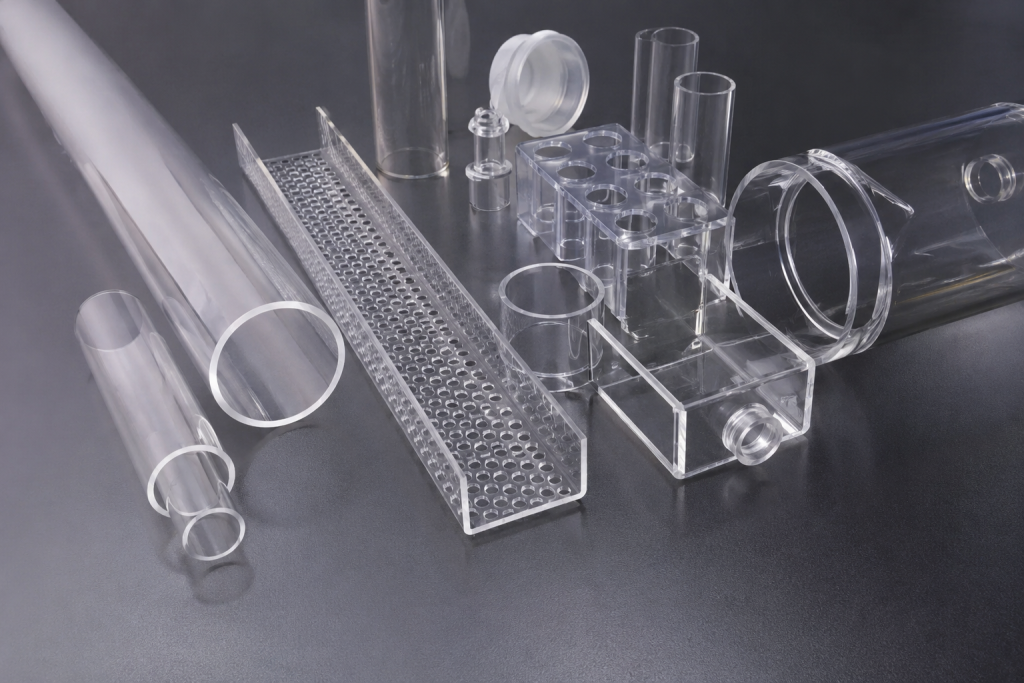
Zu den gängigen Hochtemperatur-Quarzbauteilen gehören:
- Quarzglas-Ofenrohre
- Quarzboote
- Waferträger
- Prozessauskleidungen
- Sockel
3. Der Hydroxyl (OH)-Gehalt ist entscheidend
Ein Faktor, der häufig übersehen wird, ist der Hydroxylgehalt.
Die Konzentration der OH-Gruppen kann die thermische Stabilität und die optischen Transmissionseigenschaften erheblich beeinflussen.
Quarz mit geringem OH-Gehalt
Typischerweise verwendet für:
- Diffusionsöfen
- Oxidationsöfen
- LPCVD-Verfahren
Vorteile:
- Verbesserte thermische Stabilität
- Geringere Verformung bei hohen Temperaturen
- Bessere Infrarotübertragung
Quarz mit hohem OH-Gehalt
Typischerweise verwendet für:
- UV-Optiksysteme
- Optische Fenster
- Laseranwendungen
Vorteile:
- Verbesserte UV-Durchlässigkeit
- Hervorragende optische Leistung
Unterschiedliche Halbleiteranwendungen erfordern unterschiedliche OH-Spezifikationen.
4. Kontrolle von Blasen und Einschlüssen
Interne Blasen und Einschlüsse sind entscheidende Qualitätsindikatoren für Halbleiterquarz.
Eine zu hohe Blasenkonzentration kann zu folgenden Problemen führen:
- Partikelbildung
- Reduzierte mechanische Festigkeit
- Lokale thermische Beanspruchung
- Vorzeitiger Ausfall von Bauteilen
Für kritische Halbleiteranwendungen werden Quarzwerkstoffe häufig nach ihrer Blasen- und Einschlussdichte klassifiziert.
Bei High-End-Halbleiteranlagen sind in der Regel extrem niedrige Blasen- und Einschlusswerte erforderlich.
5. Chemische Beständigkeit
Quarz weist eine hervorragende Beständigkeit gegenüber den meisten Säuren und Prozesschemikalien auf, die in der Halbleiterfertigung zum Einsatz kommen.
Es erweist sich als besonders geeignet in Umgebungen, in denen:
- Schwefelsäure
- Salpetersäure
- Salzsäure
- Oxidierende Chemikalien
Quarz kann jedoch durch folgende Faktoren angegriffen werden:
- Fluorwasserstoffsäure (HF)
- Bestimmte stark alkalische Lösungen bei erhöhten Temperaturen
Daher muss die Materialverträglichkeit stets unter Berücksichtigung der vorgesehenen Prozesschemie bewertet werden.
6. Maßgenauigkeit und Oberflächenqualität
Halbleiteranlagen erfordern hochpräzise Quarzbauteile.
Zu den typischen Anforderungen können gehören:
- Ebenheit
- Parallelität
- Rundlaufgenauigkeit
- Oberflächenbeschaffenheit
- Kantenqualität
Außerdem sollten Oberflächen frei von folgenden Stoffen sein:
- Kratzer
- Chips
- Risse
- Fremde Einschlüsse
Oberflächenfehler können zu Verunreinigungsquellen werden und die Prozesssicherheit beeinträchtigen.
7. Sauberkeit und Partikelkontrolle
In der modernen Halbleiterfertigung wird der Kontaminationskontrolle immer mehr Bedeutung beigemessen.
Quarzbauteile werden häufig folgenden Verfahren unterzogen:
- Präzisionsbearbeitung
- Säurereinigung
- Ultraschallreinigung
- Spülen mit hochreinem Wasser
- Reinraum-Verpackungen
Ein hochreines Material allein reicht nicht aus, wenn das Endprodukt nicht gemäß den Reinheitsanforderungen für Halbleiter verarbeitet und verpackt wird.
Gängige Quarzwerkstoffe in der Halbleiterfertigung
| Materialart | Typische Anwendungen |
|---|---|
| Geschmolzener Quarz | Allgemeine Komponenten für Halbleiterausrüstung |
| Hochreines Quarzglas | Diffusions- und Oxidationssysteme |
| Synthetisches Quarzglas | Anwendungen in der Optik und Photolithografie |
| Quarz mit geringem OH-Gehalt | Komponenten von Hochtemperaturöfen |
| Quarz mit hohem OH-Gehalt | UV-durchlässige Bauteile |
Schlussfolgerung
Nicht alle Quarzwerkstoffe eignen sich für die Halbleiterfertigung.
Die Auswahl von Quarz in Halbleiterqualität sollte auf der Grundlage verschiedener Faktoren erfolgen, darunter Reinheit, Hydroxylgehalt, thermische Stabilität, Blasen Dichte, chemische Beständigkeit, Maßgenauigkeit und Reinheitsanforderungen.
Da jeder Halbleiterprozess unterschiedliche Anforderungen an das Material stellt, ist die Auswahl der geeigneten Quarzsorte oft genauso wichtig wie die Wahl des richtigen Bauteil-Designs.
Für Hersteller von Halbleiterausrüstung und Waferfertigungsanlagen kann das richtige Quarzmaterial die Prozessstabilität erheblich verbessern, Kontaminationsrisiken verringern und die Lebensdauer der Komponenten verlängern.