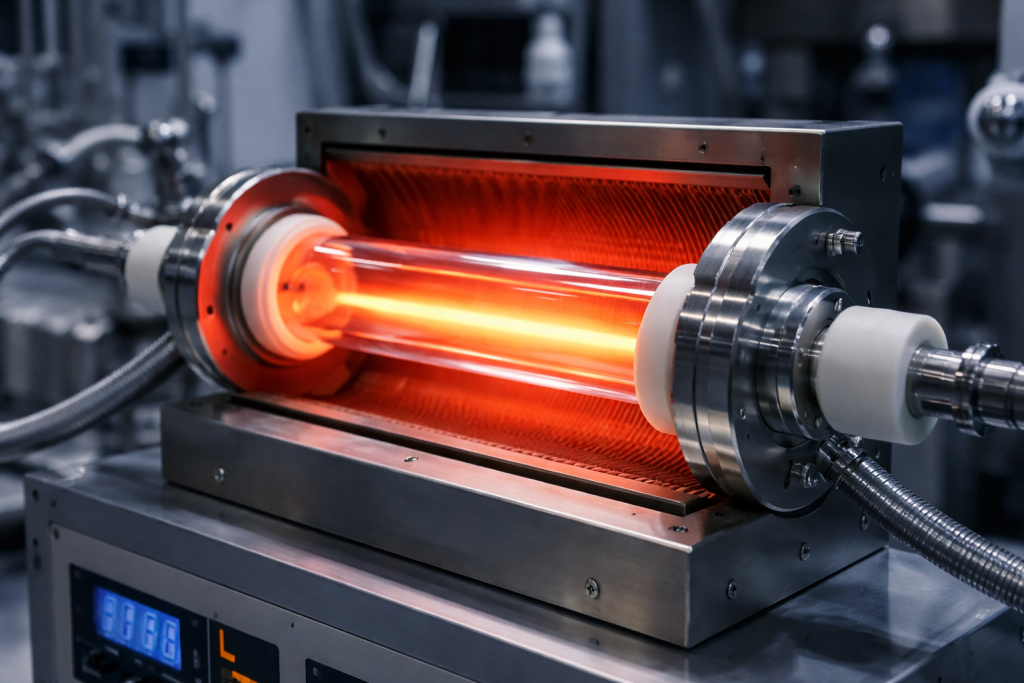
As semiconductor manufacturing continues to move toward larger wafers, tighter contamination control and more advanced process equipment, high-purity fused quartz remains an important material for 300mm wafer processing.
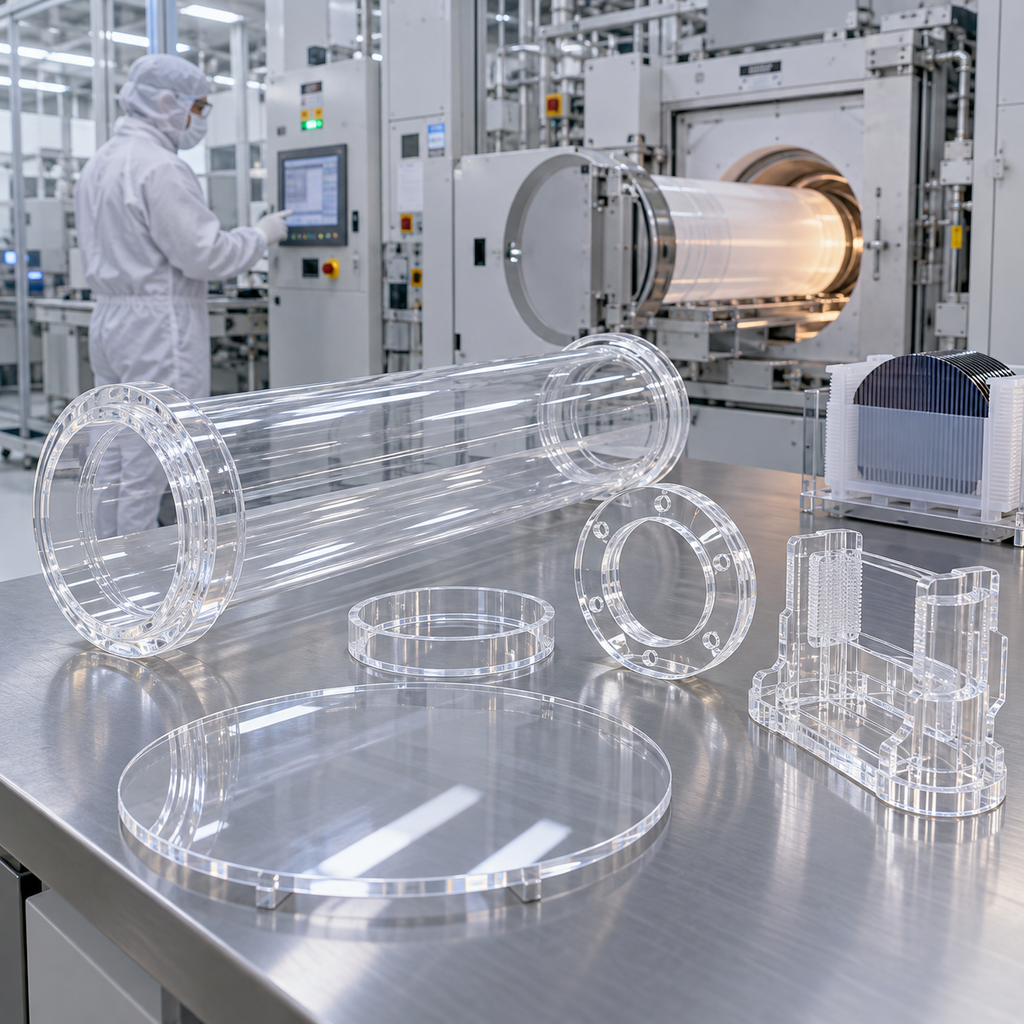
Typical quartz components used in semiconductor equipment include:
- Quartz furnace tubes
- Quartz process tubes
- Quartz plates
- Quartz flanges
- Quartz rings
- Quartz windows
- Quartz wafer boats
- Quartz carriers
- Quartz chambers
- Quartz liners
- Custom-machined quartz components
Recent industry activity also shows continued demand for high-purity quartzware used in diffusion, epitaxy, etching, deposition and cleaning systems. In September 2026, industry reporting highlighted qualification progress for high-purity quartz used in 300mm DRAM production, including furnace-tube materials, wafer boats, quartz plates and other consumables.
For buyers, however, selecting semiconductor quartz components involves much more than simply requesting “high-purity quartz.”
Material purity, geometry, surface condition, welding quality, cleaning and inspection all affect component performance.
1. Why Is High-Purity Fused Quartz Used in 300mm Semiconductor Equipment?
Fused quartz combines several properties required inside semiconductor processing systems:
- High thermal resistance
- Very low thermal expansion
- High chemical stability
- Low metallic contamination
- Good electrical insulation
- Excellent resistance to thermal shock
- Good optical transmission
- High dimensional stability
These properties allow fused quartz to operate in environments involving:
- High-temperature diffusion
- Oxidation
- LPCVD
- CVD
- Etching
- Plasma processing
- Wet cleaning
- Epitaxy
- RTP
- Wafer handling
High-purity quartzware remains widely used in semiconductor applications such as epitaxy, diffusion, etching and cleaning, including tubes, boats, carriers, bell jars, crucibles and tanks.
2. Why 300mm Processing Places Greater Demands on Quartz Components
A 300mm wafer has a much larger surface area than a 200mm wafer.
As component dimensions increase, manufacturers must control:
- Dimensional tolerance
- Flatness
- Roundness
- Wall-thickness uniformity
- Thermal deformation
- Residual stress
- Particle generation
- Surface contamination
Large quartz components are also more difficult to manufacture without introducing distortion.
For example, a large quartz furnace tube may require tight control of:
- Inner diameter
- Outer diameter
- Length
- Wall thickness
- Straightness
- Roundness
- Flange alignment
- Weld geometry
The challenge is not simply making a larger quartz part.
It is maintaining stable geometry and cleanliness across a larger component.
3. Purity Is One of the Most Important Specifications
In semiconductor processing, trace contaminants can affect wafer yield and process stability.
Typical elements that may need to be controlled include:
- Al
- Fe
- Na
- K
- Li
- Ca
- Mg
- Cu
- Cr
- Ti
Industry reporting in September 2026 noted that quartz used in semiconductor process equipment typically reaches approximately 4N5 to 5N purity, around 99.995% to 99.999% SiO₂, while furnace-tube materials may use approximately 5N-class high-purity fused quartz.
However, purity should not be evaluated only by the total SiO₂ percentage.
The concentration of individual metallic contaminants can be more important than the overall purity number.
Buyers should therefore request:
- Material grade
- Trace element data
- OH content
- Material certificate
- Batch traceability
- Manufacturing method
4. High-Purity Quartz Tubes for 300mm Semiconductor Furnaces
Quartz tubes are among the most important fused quartz components used in semiconductor manufacturing.
Typical applications include:
- Diffusion furnaces
- Oxidation furnaces
- LPCVD systems
- Annealing systems
- Epitaxy equipment
- Thermal processing systems
For 300mm wafer processing, furnace tubes can become significantly larger and heavier than components for smaller wafer sizes.
Important specifications include:
| Parameter | Why It Matters |
|---|---|
| Inner diameter | Wafer boat clearance |
| Outer diameter | Equipment compatibility |
| Wall thickness | Mechanical strength |
| Wall uniformity | Thermal stability |
| Straightness | Wafer boat alignment |
| Roundness | Equipment fit |
| Length | Process zone design |
| Flange geometry | Sealing and installation |
Current semiconductor suppliers continue to offer high-purity quartz tubes alongside rings, windows and gas-distribution components for wafer-processing equipment.
5. Quartz Tube Wall Thickness Must Be Controlled Carefully
Wall-thickness variation can cause uneven thermal response.
In high-temperature processing, this may contribute to:
- Local stress
- Distortion
- Uneven heating
- Reduced service life
Large-diameter quartz tubes therefore require stable forming and machining processes.
For critical projects, buyers should specify:
- Nominal wall thickness
- Thickness tolerance
- Maximum wall variation
- Tube diameter
- Tube length
- Operating temperature
Rather than simply requesting a “300mm quartz furnace tube.”
6. Quartz Plates for Semiconductor Equipment
High-purity quartz plates are used in many semiconductor tools.
Applications include:
- Chamber components
- Process liners
- Gas distribution assemblies
- Support plates
- Insulating plates
- Windows
- Equipment fixtures
Quartz plates may require:
- Precision cutting
- CNC machining
- Hole drilling
- Slot machining
- Grinding
- Lapping
- Polishing
Important specifications include:
- Length and width
- Thickness
- Flatness
- Parallelism
- Surface roughness
- Hole diameter
- Hole position
- Edge finish
Quartz plates are also among the semiconductor consumables currently associated with high-purity quartz supply for advanced wafer processing.
7. Flatness Becomes More Difficult on Large Quartz Plates
As plate diameter or width increases, maintaining flatness becomes more difficult.
This is particularly important for:
- 300mm process equipment
- Sealing surfaces
- Chamber interfaces
- Precision wafer-handling systems
Large thin plates can deform during:
- Grinding
- Polishing
- Heat treatment
- Welding
- Cleaning
Therefore, buyers should define realistic requirements for:
- Flatness
- Thickness
- Parallelism
These specifications should be reviewed together rather than independently.
8. Quartz Flanges for Semiconductor Process Equipment
Quartz flanges are frequently used to connect:
- Furnace tubes
- Chambers
- Gas lines
- Process assemblies
- Vacuum components
A flange may be manufactured as:
- A machined solid component
- A welded component
- An integrated tube-flange assembly
Important specifications include:
- Outside diameter
- Inside diameter
- Thickness
- Bolt-hole dimensions
- Hole position
- Sealing surface
- Flatness
- Welding geometry
Quartz suppliers serving semiconductor equipment currently list flanges together with process chamber windows, rings, tubes and other custom-machined components.
9. Flange Flatness and Sealing Surfaces Matter
Poor flange geometry can create:
- Vacuum leakage
- Uneven gasket compression
- Mechanical stress
- Assembly misalignment
For sealing surfaces, buyers should define:
- Flatness
- Surface finish
- Parallelism
- Edge condition
A flange should not simply be inspected by outside diameter and thickness.
10. Quartz Welding Is Critical for Large Assemblies
Many semiconductor quartz components require welding.
Examples include:
- Furnace tube and flange assemblies
- Multi-tube structures
- Gas distribution systems
- Quartz chambers
- Wafer boats
- Bell jars
- Process tanks
Poor welding can create:
- Residual stress
- Bubbles
- Distortion
- Wall-thickness variation
- Cracks
- Leakage
For 300mm systems, the challenge increases because components are larger.
The supplier should therefore control:
heating → welding → forming → cooling → stress management
as one complete process.
11. Custom Quartz Components Are Increasingly Important
Semiconductor equipment rarely uses only standard catalog parts.
Custom quartz components can include:
- Quartz rings
- Quartz liners
- Quartz windows
- Gas distribution plates
- Quartz nozzles
- Quartz showerhead components
- Quartz pedestals
- Quartz carriers
- Quartz chambers
- Quartz tanks
- Quartz wafer boats
- Quartz process fixtures
SEMICON Taiwan 2026 suppliers specifically highlight high-purity quartz rings, tubes, windows, gas-distribution plates and custom-machined components for semiconductor equipment.
This makes drawing-based manufacturing capability increasingly important.
12. Complex Quartz Machining Capability
A qualified custom quartz manufacturer may need to perform:
- CNC machining
- Grinding
- Lapping
- Drilling
- Slotting
- Grooving
- Thread machining
- Polishing
- Flame polishing
- Quartz welding
Some current semiconductor quartz suppliers advertise precision grinding, micro-machining, complex channels and custom fabrication from prototype through mass production.
This is particularly useful when buyers need replacement parts for existing semiconductor tools.
13. Surface Roughness Can Affect Particle Generation
Machining marks and micro-damage can create particle sources.
Depending on the application, quartz components may therefore require:
- Ground surfaces
- Mechanically polished surfaces
- Flame-polished surfaces
- Optical-polished surfaces
The required finish depends on:
- Plasma exposure
- Chemical exposure
- Sealing
- Wafer proximity
- Optical requirements
For critical areas, surface roughness should be specified numerically instead of simply writing:
“polished.”
14. Edge Quality Is Important for Large Components
Quartz is brittle.
Small chips or microcracks at the edge can grow during thermal cycling.
Potential results include:
- Cracking
- Premature failure
- Particle generation
Common edge treatments include:
- Chamfer
- Bevel
- Radius
- Ground edge
- Polished edge
Large 300mm-related quartz components need particular attention because mechanical and thermal stresses can be higher.
15. Cleaning Is Part of Manufacturing, Not an Optional Step
After machining, quartz components may contain:
- Grinding residue
- Polishing compounds
- Metal particles
- Dust
- Organic contamination
For semiconductor use, suppliers may need to perform:
- Chemical cleaning
- Ultrasonic cleaning
- DI water rinsing
- Controlled drying
- Clean handling
- Clean packaging
High-purity quartz suppliers serving semiconductor manufacturing increasingly position cleanliness standards alongside material purity and dimensional precision.
16. Particle Control Is Especially Important Near the Wafer
A component used far from the wafer may tolerate a different cleanliness level than a component installed inside the process zone.
Buyers should identify:
- Component location
- Distance from wafer
- Plasma exposure
- Process gases
- Cleaning chemistry
This allows the supplier to recommend appropriate surface and cleaning requirements.
17. Inspection Requirements for 300mm Quartz Components
Depending on the component, inspection may include:
- Dimensional inspection
- Flatness
- Parallelism
- Surface roughness
- Wall thickness
- Roundness
- Straightness
- Hole position
- Weld inspection
- Visual defect inspection
Typical equipment can include:
- CMM
- Optical measurement systems
- Surface roughness testers
- Thickness gauges
- Microscopes
- Flatness measurement systems
For repeat orders, buyers may also request lot-based inspection reports.
18. Traceability Helps Control Long-Term Process Stability
For semiconductor customers, component consistency is important.
A supplier should ideally be able to trace:
- Raw material lot
- Production batch
- Machining records
- Cleaning records
- Inspection records
If equipment performance changes later, traceability can help identify possible causes.
19. Prototype Manufacturing Before Mass Production
For custom 300mm quartz components, buyers should normally start with prototypes.
A typical qualification process may be:
drawing review → manufacturability review → prototype → inspection → equipment installation → process testing → revision → qualification → production
Prototype production helps verify:
- Fit
- Alignment
- Thermal behavior
- Sealing
- Surface condition
- Cleaning compatibility
- Service life
A supplier that supports one-piece or low-volume prototyping can make development easier. Current semiconductor quartz fabricators also emphasize single-piece prototypes and made-to-order production from customer drawings.
20. Typical Quartz Components for 300mm Processing
Quartz Tubes
Used for:
- Diffusion
- Oxidation
- LPCVD
- Annealing
Quartz Plates
Used for:
- Chamber structures
- Gas distribution
- Supports
- Insulators
Quartz Flanges
Used for:
- Tube connections
- Vacuum interfaces
- Chamber connections
Quartz Rings
Used for:
- Process chambers
- Plasma systems
- Wafer processing
Quartz Windows
Used for:
- Optical monitoring
- UV transmission
- RF transmission
- Chamber observation
Quartz Boats and Carriers
Used for:
- Wafer loading
- Furnace processing
- Batch thermal processes
21. What Should Be Included in an RFQ?
To receive an accurate quotation, buyers should provide:
Product: Tube / Plate / Flange / Ring / Window / Boat / Custom Part
Wafer Size: 300mm or other
Material: High-Purity Fused Quartz / Synthetic Fused Silica
Dimensions: Full dimensions
Tolerance: Critical dimensions
Purity: Required grade or impurity limits
Surface: Ground / Polished / Flame Polished
Surface Roughness: If required
Flatness: If required
Cleaning: Semiconductor cleaning requirement
Drawing: PDF / STEP / CAD
Quantity: Prototype and batch quantity
Application: Diffusion / Etch / CVD / Cleaning / Other
22. Example RFQ
A quartz furnace tube RFQ might include:
Product: High-Purity Quartz Furnace Tube
Application: 300mm Semiconductor Diffusion Furnace
Material: Semiconductor-Grade High-Purity Fused Quartz
Outer Diameter: 350 mm
Wall Thickness: 5 mm
Length: 1500 mm
Flange: Custom welded flange
Surface: Flame polished
Cleaning: Semiconductor grade
Quantity: 2 prototypes + production forecast
Drawing: Available
This is much easier for a supplier to evaluate than simply asking:
“What is the price of a 300mm quartz tube?”
23. Why Price Alone Is Not Enough
High-purity quartz components are consumables, but choosing the cheapest component may increase total operating cost.
Possible consequences include:
- Shorter lifetime
- Higher particle generation
- Process contamination
- Equipment downtime
- Frequent replacement
Therefore, buyers should evaluate:
purchase price + lifetime + cleanliness + dimensional stability + qualification risk
rather than price alone.
Conclusion
High-purity fused quartz remains a critical material for 300mm semiconductor manufacturing equipment.
Tubes, plates, flanges, rings, windows, wafer boats and custom-machined components are used throughout thermal processing, etching, deposition, epitaxy and cleaning systems. Industry reporting and current SEMICON supplier activity continue to show strong emphasis on high-purity quartz consumables and precision quartz fabrication for semiconductor processing.
For buyers, the most important specifications are not limited to purity.
A reliable sourcing process should consider:
material purity → dimensions → surface quality → welding → cleaning → inspection → traceability → packaging
For custom 300mm semiconductor quartz components, providing complete drawings and process requirements at the RFQ stage can significantly reduce quotation time and qualification risk.