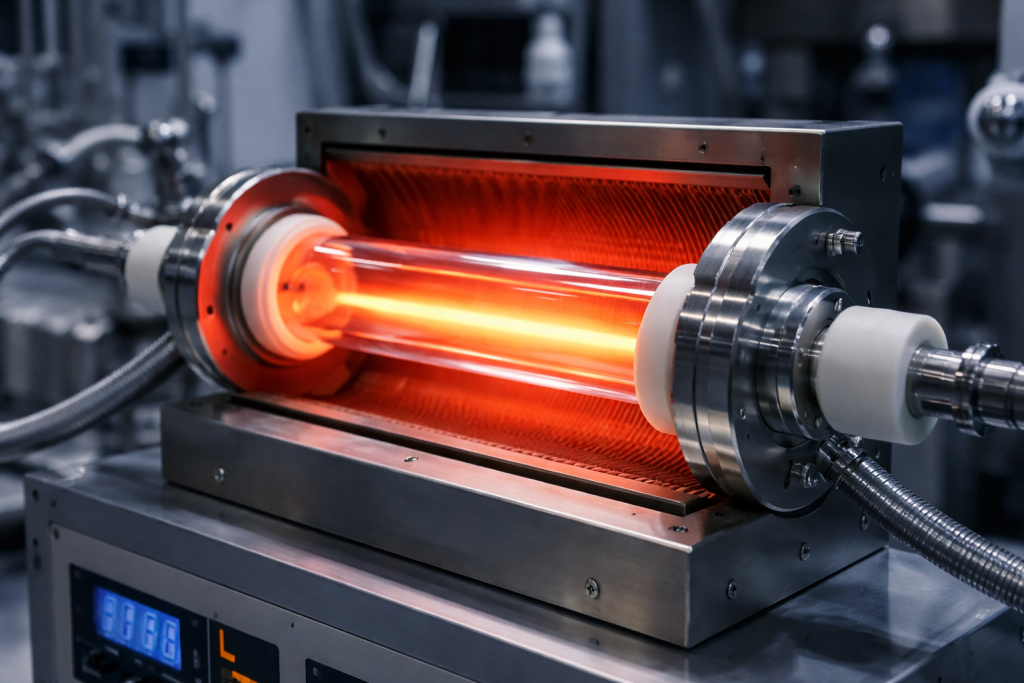
Quartz furnace tubes are widely used in semiconductor diffusion, oxidation, annealing, CVD, thermal processing, laboratory furnaces, and other high-temperature systems. Their high purity, thermal stability, chemical resistance, and low thermal expansion make fused quartz an excellent material for controlled furnace environments.
However, quartz furnace tubes are consumable components rather than permanent furnace parts.
After repeated high-temperature cycles, chemical exposure, mechanical loading, and contamination, a tube may gradually lose transparency, deform, develop surface damage, or eventually crack.
For equipment engineers and purchasing teams, understanding quartz furnace tube failure mechanisms is important because replacing a tube too early increases operating cost, while replacing it too late may lead to contamination, furnace downtime, damaged wafers, or unexpected process interruptions.
This guide explains the most common failure modes of quartz furnace tubes, including devitrification, sagging, cracking, contamination, and dimensional changes, and discusses how users can evaluate service life and determine when replacement is necessary.
1. Why Do Quartz Furnace Tubes Fail?
A quartz furnace tube normally operates under a combination of several stresses:
- High processing temperatures
- Repeated heating and cooling cycles
- Long-duration thermal exposure
- Mechanical loading
- Furnace support pressure
- Process gas exposure
- Alkali or metallic contamination
- Cleaning chemicals
- Localized thermal gradients
Quartz glass has excellent thermal properties, but its performance depends strongly on purity, manufacturing quality, furnace design, operating temperature, contamination control, and thermal history.
One particularly important issue is contamination. Heraeus notes that quartz glass is sensitive to alkali and alkaline-earth compounds because even small traces can accelerate devitrification at elevated temperatures.
For this reason, furnace tube failure should rarely be analyzed only by operating hours. The actual thermal and chemical environment usually matters more than a simple calendar-based replacement interval.
2. Devitrification: One of the Most Common Quartz Furnace Tube Failures
What Is Devitrification?
Fused quartz is normally amorphous rather than crystalline.
During prolonged exposure to elevated temperatures, especially when contamination is present, portions of the quartz surface may begin transforming toward crystalline silica structures.
This process is called devitrification.
Instead of remaining clear and glass-like, affected areas can become:
- White
- Cloudy
- Milky
- Rough
- Opaque
- Crystalline in appearance
Devitrification often begins locally and gradually spreads across the furnace tube surface.
Why Is Devitrification Dangerous?
Devitrification is not simply a cosmetic problem.
The crystalline region has different thermal and mechanical behavior from the surrounding fused quartz. This can create localized stress during heating and cooling.
As devitrification becomes more severe, the affected region may become more vulnerable to:
- Surface flaking
- Microcracking
- Particle generation
- Thermal stress
- Structural failure
In semiconductor furnaces, particle generation is particularly undesirable because particles may contaminate wafers or furnace components.
What Causes Devitrification?
Common causes include:
Metal contamination
Sodium, potassium, calcium, iron and other contaminants can significantly influence high-temperature quartz behavior.
Dirty handling
Touching quartz surfaces with bare hands can introduce oils, salts, and particles.
Poor cleaning procedures
Contaminated cleaning tanks, inappropriate chemicals, or residues left after cleaning may contribute to surface degradation.
Extended high-temperature operation
Long exposure at elevated temperature increases the opportunity for structural changes.
Deposited process materials
Process deposits may create localized contamination or thermal differences across the tube.
What Should You Check?
During furnace maintenance, inspect the tube under strong illumination.
Look for:
- Cloudy white areas
- Localized crystalline spots
- Roughened surfaces
- Increasing opacity
- Rings of discoloration near hot zones
- Deposits that cannot be removed by normal cleaning
Minor surface appearance changes do not always require immediate replacement, but rapidly expanding devitrification should be investigated.
3. Quartz Furnace Tube Sagging and Deformation
Another common long-term failure mode is sagging.
Quartz glass does not suddenly melt when furnace temperature increases. Instead, its viscosity gradually decreases as temperature rises.
During prolonged high-temperature operation, gravity and mechanical loading can therefore cause the tube to deform slowly.
Typical symptoms include:
- Centerline sagging
- Ovality
- Local diameter change
- Tube bending
- Distorted flange alignment
- Uneven spacing between the tube and heater
- Changes in wafer boat position
Published fused-quartz material data also distinguish temperature-dependent characteristics such as annealing behavior, reinforcing why furnace-tube geometry must be considered together with operating temperature and thermal exposure rather than temperature alone.
4. Why Does Sagging Occur?
Excessive Process Temperature
Operating close to the practical thermal limit of a tube for long periods accelerates deformation.
Two tubes may survive the same peak temperature very differently if one experiences the temperature for several minutes and another remains there continuously.
Unsupported Tube Length
Long horizontal furnace tubes are particularly sensitive to gravity.
As the unsupported span increases, the center of the tube experiences greater bending stress.
Heavy Internal Components
Wafer boats, liners, paddles, fixtures, or deposited materials may increase mechanical load.
Incorrect Wall Thickness
A tube with insufficient wall thickness may deform faster under the same furnace conditions.
However, simply specifying the thickest possible tube is not always the correct solution. Wall thickness should be matched to:
- Tube diameter
- Furnace dimensions
- Support structure
- Thermal profile
- Process requirements
Uneven Heating
If one section of the furnace tube operates substantially hotter than another, localized softening and deformation may occur.
5. How to Evaluate Furnace Tube Sagging
Sagging should be monitored before it becomes visually severe.
Useful inspection methods include:
Straightness Measurement
Measure tube centerline deviation along its length.
Outer Diameter Measurement
Compare OD at several positions:
- Loading end
- Hot zone
- Center section
- Exhaust end
Significant diameter differences can indicate thermal deformation.
Roundness Inspection
High-temperature exposure may gradually change a circular tube into a slightly oval geometry.
Flange Alignment
If the furnace tube includes welded or formed quartz flanges, check whether the flange remains perpendicular to the tube axis.
Misalignment can affect sealing and installation.
Clearance Inspection
Verify that sufficient clearance remains between:
- Furnace tube and heating elements
- Tube and insulation
- Tube and wafer boat
- Tube and furnace support
A sagging tube may eventually contact surrounding furnace components.
6. Cracks: The Most Critical Failure Mode
Cracking usually requires much faster action than gradual discoloration or minor deformation.
Quartz furnace tube cracks can originate from:
- Thermal shock
- Mechanical impact
- Surface scratches
- Edge damage
- Improper installation
- Excessive clamping
- Devitrified regions
- Welded joint stress
- Localized overheating
- Cleaning damage
Some cracks are immediately visible, while others begin as very small surface defects.
7. Thermal Shock Cracks
Fused quartz has very low thermal expansion, which gives it excellent resistance to thermal shock compared with many conventional glasses.
However, severe temperature gradients can still generate damaging stress.
Typical causes include:
- Cooling a hot tube too quickly
- Introducing cold gas into a very hot furnace
- Contact with cold tools
- Uneven furnace heating
- Sudden furnace shutdown
- Local cooling near a flange or seal
Thermal cracks often appear around regions where temperature changes abruptly.
8. Mechanical Damage and Surface Scratches
Quartz is hard but can still be damaged by improper handling.
A small scratch may act as a stress concentration point.
At room temperature, the defect may appear harmless. After repeated heating cycles, however, thermal stress may propagate the defect into a crack.
For this reason, quartz furnace tubes should never be dragged across hard surfaces during installation or maintenance.
Special attention should be paid to:
- Tube ends
- Flange edges
- Ground surfaces
- Weld joints
- Boat-loading areas
- Support contact positions
Protective packaging should also prevent tube-to-tube or tube-to-metal contact during shipment.
9. Flange and Weld Joint Cracking
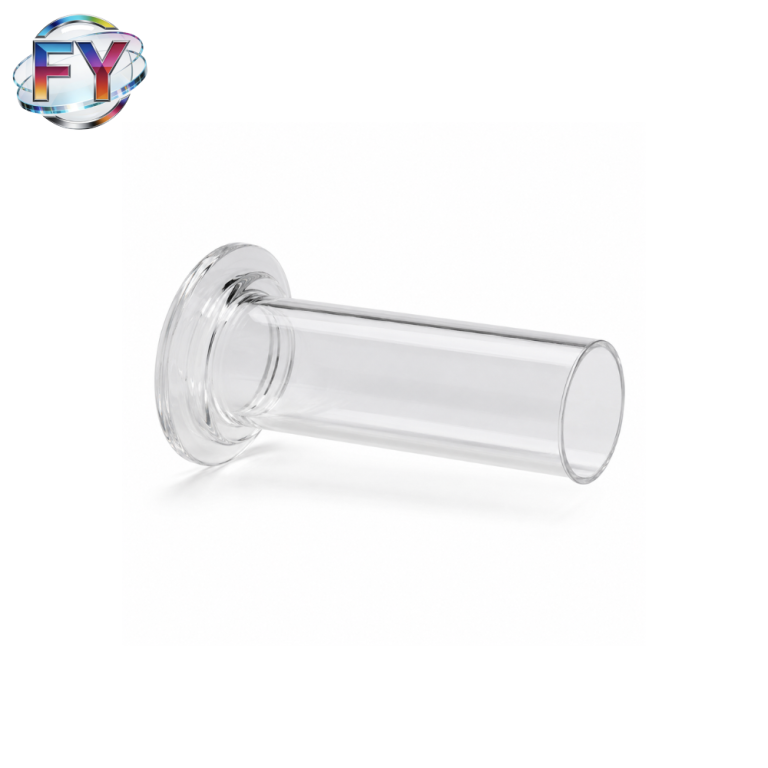
Custom quartz furnace tubes frequently contain:
- Flanges
- Side ports
- Gas inlet tubes
- Exhaust connections
- Thermocouple ports
- Observation ports
- Welded quartz components
These regions may experience different thermal gradients and mechanical stresses than the main tube body.
Poor geometry or excessive residual stress around welded areas may reduce service reliability.
When specifying a custom furnace tube, buyers should provide complete drawings showing:
- Main tube OD
- Main tube ID
- Wall thickness
- Overall length
- Flange diameter
- Flange thickness
- Port position
- Port angle
- Port OD
- Joint geometry
- Required tolerances
Accurate dimensional control is particularly important when replacement tubes must fit existing furnace equipment.
10. Contamination Can Shorten Quartz Furnace Tube Life
Contamination is frequently underestimated during furnace maintenance.
Quartz tubes used in semiconductor and high-purity processes may be exposed to:
- Sodium
- Potassium
- Calcium
- Iron
- Aluminum
- Process residues
- Cleaning residues
- Fingerprints
- Furnace deposits
Alkali contamination is especially problematic because it can promote devitrification at high temperature.
Recommended Handling Practices
Operators should normally:
- Wear clean gloves
- Avoid direct hand contact
- Use clean tools
- Keep quartz away from dirty metal surfaces
- Follow controlled cleaning procedures
- Thoroughly rinse after chemical cleaning
- Store cleaned tubes in clean packaging
The furnace tube should also be inspected after cleaning because aggressive handling can introduce scratches even when contamination has been successfully removed.
11. How Long Does a Quartz Furnace Tube Last?
There is no universal number of hours or furnace cycles that defines quartz furnace tube service life.
Two identical tubes can have very different lifetimes depending on their operating conditions.
Important variables include:
| Factor | Effect on Service Life |
|---|---|
| Maximum operating temperature | Higher temperature generally increases thermal degradation |
| Time at temperature | Long continuous cycles increase deformation risk |
| Thermal cycling frequency | Repeated heating and cooling increases stress |
| Contamination level | Can accelerate devitrification |
| Tube diameter | Influences mechanical loading |
| Wall thickness | Affects stiffness and thermal behavior |
| Unsupported length | Longer spans may increase sagging |
| Process atmosphere | May influence deposits and surface condition |
| Cleaning frequency | Can affect both contamination and mechanical damage |
| Installation quality | Misalignment can generate stress |
| Quartz purity | Important for high-temperature and semiconductor applications |
Therefore, service life should be evaluated using condition-based inspection together with operating history.
12. When Should a Quartz Furnace Tube Be Replaced?
A replacement should be considered when inspection reveals significant deterioration.
Typical warning signs include:
Severe Devitrification
Large areas becoming opaque, rough, crystalline, or unstable.
Growing Cracks
Any crack showing measurable growth between inspection intervals should be treated seriously.
Significant Sagging
Tube deformation that changes furnace clearances, wafer boat position, or heater spacing may affect process stability.
Flange Distortion
Poor flange alignment may cause sealing problems or mechanical stress.
Heavy Surface Damage
Deep scratches, chips, or localized impact marks may reduce structural reliability.
Repeated Particle Problems
If furnace particle counts increase and the tube surface shows deterioration, the quartz tube should be investigated as a possible source.
Difficult-to-Remove Deposits
Persistent deposits may affect process cleanliness and accelerate localized degradation.
13. A Practical Quartz Furnace Tube Inspection Checklist
Before reinstalling a furnace tube, check the following items.
Visual condition
- No visible cracks
- No deep scratches
- No serious chips
- No excessive cloudy areas
- No severe devitrification
Geometry
- Tube remains straight
- OD remains within acceptable limits
- Roundness is acceptable
- Flanges remain aligned
Surface
- No loose deposits
- No visible contamination
- No fingerprints
- No abnormal rough areas
Connections
- Side ports are intact
- Welded joints show no cracking
- Gas connections are undamaged
- Flange sealing surfaces are acceptable
Installation
- Tube is properly supported
- No excessive clamping force is applied
- Thermal expansion is not mechanically restricted
- Heater clearance is sufficient
Keeping inspection records makes it easier to identify gradual changes before a major failure occurs.
14. How to Extend Quartz Furnace Tube Service Life
Several operating practices can significantly improve reliability.
Control Contamination
Maintain clean handling procedures and prevent contact with alkali-containing contaminants.
Avoid Rapid Temperature Changes
Follow controlled furnace ramp-up and cool-down procedures whenever the process allows.
Optimize Tube Support
Long horizontal tubes should have appropriate furnace support to minimize deformation.
Avoid Mechanical Contact
Quartz components should not rub against metal furnace structures.
Inspect Regularly
Monitor:
- Devitrification
- Sagging
- Cracks
- Surface deposits
- Port condition
- Flange alignment
Record Operating History
Track furnace:
- Maximum temperature
- Processing hours
- Number of thermal cycles
- Cleaning cycles
- Maintenance events
This makes it possible to establish a realistic replacement schedule for a specific furnace rather than relying on a generic service-life estimate.
15. What Information Should Be Provided When Ordering a Replacement Quartz Furnace Tube?
For replacement or custom furnace tubes, buyers should provide as much dimensional and process information as possible.
Important specifications include:
- Quartz material grade
- Tube outer diameter
- Tube inner diameter
- Wall thickness
- Overall length
- Flange dimensions
- Side-port dimensions
- Port positions
- Weld structure
- Dimensional tolerances
- Operating temperature
- Furnace orientation
- Process environment
- Cleaning requirements
- Required purity level
- Quantity
For existing equipment, supplying an engineering drawing or original furnace tube sample can significantly reduce dimensional uncertainty.
Custom fabrication may also be required when replacement tubes include complex welded structures, large diameters, special flanges, multiple ports, or non-standard lengths.
Conclusion
Quartz furnace tube failure is usually a gradual process rather than a single unexpected event.
The most important failure mechanisms include devitrification, thermal deformation, sagging, cracking, surface contamination, and mechanical damage.
Devitrification often indicates high-temperature exposure combined with surface contamination. Sagging is commonly related to temperature, unsupported length, tube geometry, and time under load. Cracking may result from thermal shock, scratches, mechanical stress, poor installation, or damage around welded structures.
Instead of defining quartz furnace tube life only by operating hours, furnace operators should establish a condition-based inspection program that monitors surface condition, straightness, roundness, flange alignment, cracks, deposits, and process history.
For semiconductor and high-temperature applications, selecting the correct quartz material, wall thickness, geometry, manufacturing quality, and inspection requirements can significantly improve furnace reliability and reduce unplanned equipment downtime.
When sourcing a custom replacement quartz furnace tube, providing detailed dimensions, operating temperature, furnace configuration, ports, flanges, and process conditions allows the quartz manufacturer to recommend a more suitable design for the application.