
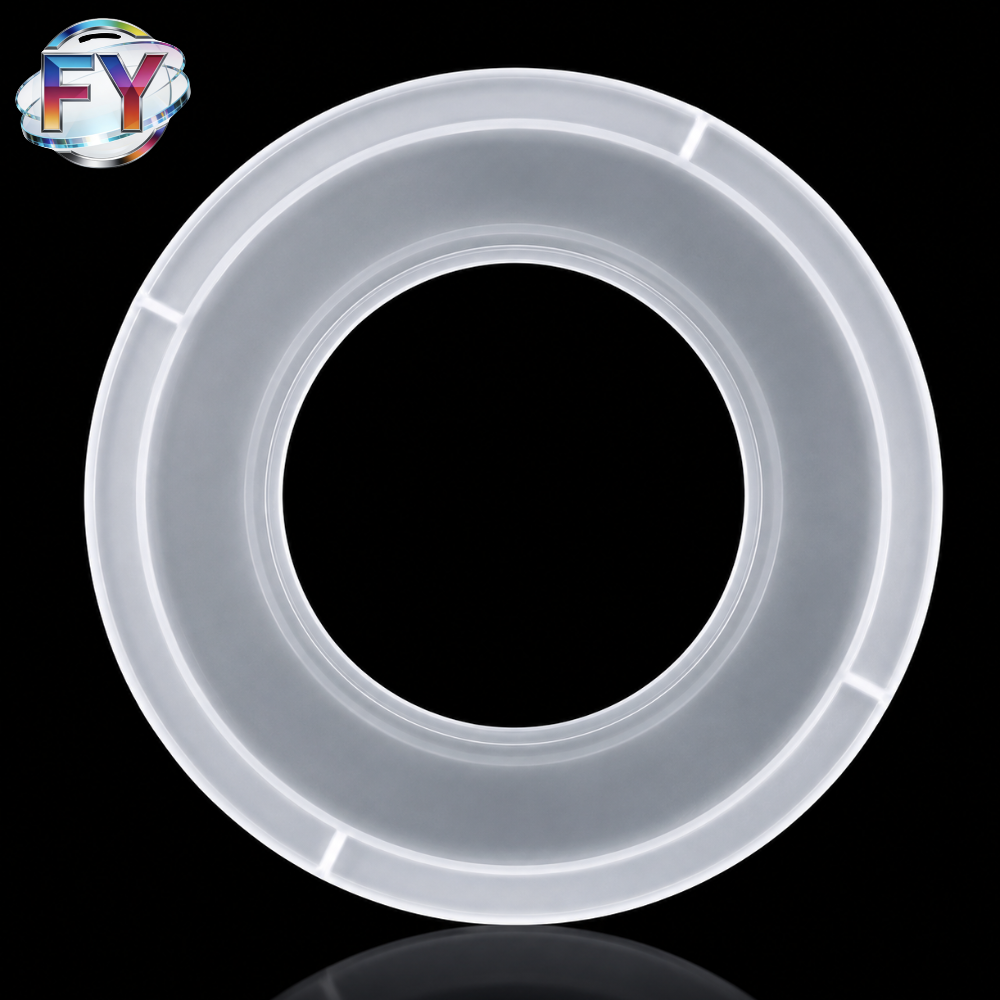
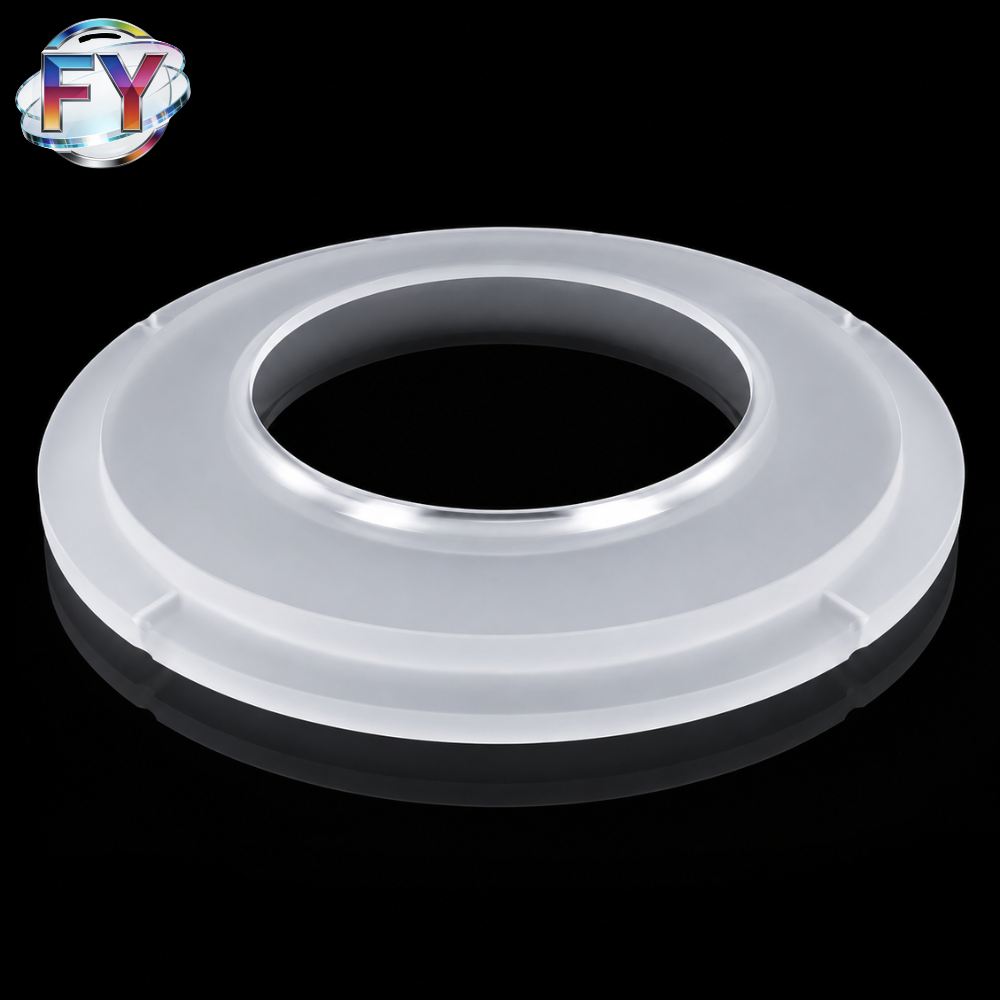
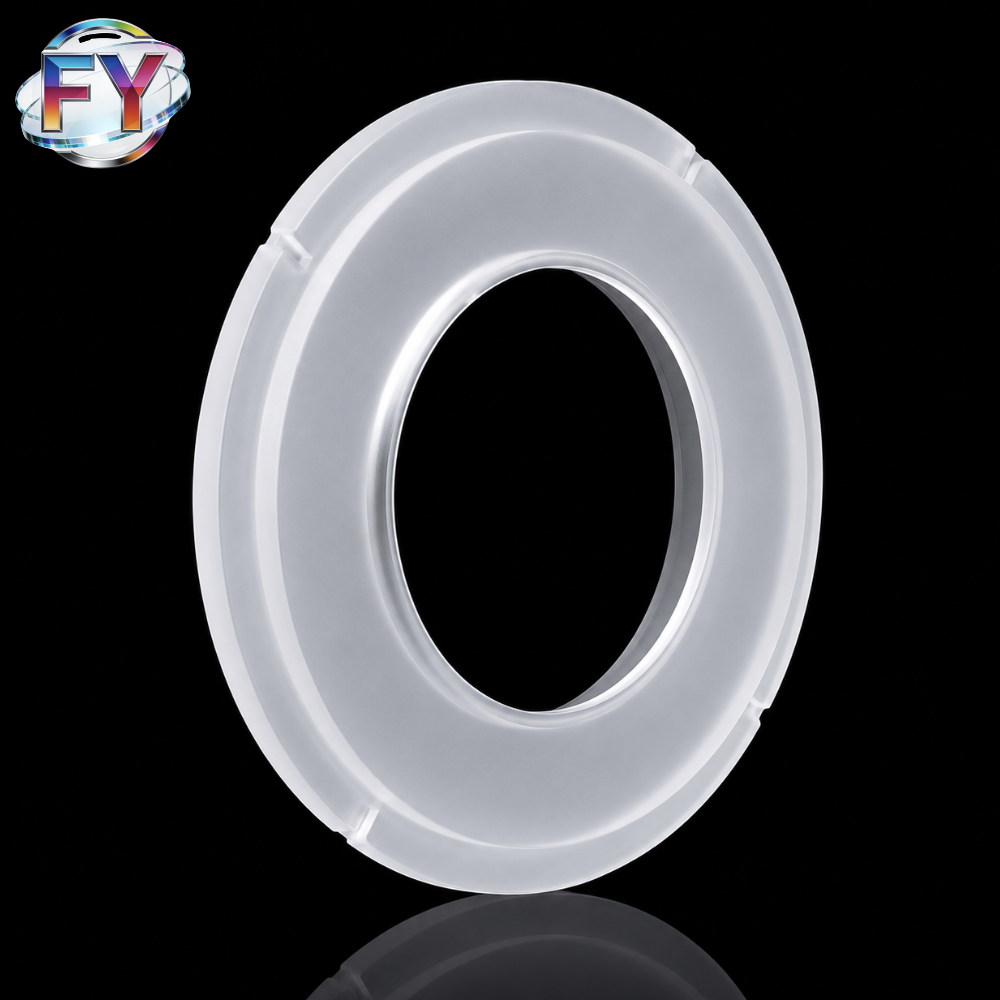
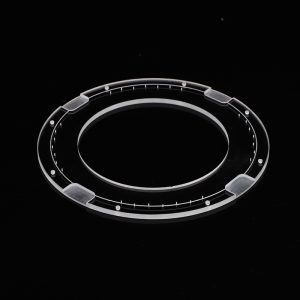
 This custom large-diameter fused quartz flange ring is a precision-machined annular quartz component designed for semiconductor equipment, high-temperature processing systems, vacuum assemblies, laboratory instruments, and customized industrial machinery. The product features a broad circular ring body, a large central opening, a stepped cross-sectional profile, a raised inner positioning lip, and several evenly distributed locating notches around the outer circumference.
Unlike a standard flat quartz plate, this component has multiple functional levels and positioning surfaces. The stepped geometry allows the quartz ring to fit into a corresponding equipment chamber, support structure, furnace assembly, protective cover, or positioning fixture. Its large central opening provides clearance for wafers, process tubes, gas flow, heating zones, optical paths, or other internal equipment components.
The product can be manufactured from fused quartz or high-purity fused silica according to the customer’s operating environment and contamination-control requirements. Outer diameter, inner diameter, thickness, step height, locating groove position, surface condition, dimensional tolerance, and cleaning method can all be customized according to technical drawings or physical samples.
 Distinctive Annular and Stepped Structure
The most recognizable feature of this quartz component is its large annular shape. The center of the part contains a wide circular through opening, while the surrounding quartz body forms a thick and stable support ring.
The upper surface is not completely flat. It includes a raised or stepped inner section around the central opening. This structure may be used for positioning, supporting, separating, protecting, or aligning another component inside the equipment.
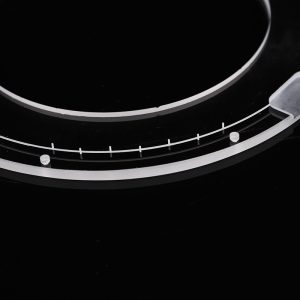
The outer circumference also contains several evenly distributed notch-like or segmented positioning structures. Depending on the final design, these features may serve as:
- Locating points during equipment assembly;
- Anti-rotation structures;
- Clearance sections for surrounding components;
- Alignment references;
- Installation orientation markers;
- Mechanical positioning grooves.
The exact function of the notches should be determined by the customer’s equipment drawing and assembly method.
 Precision-Machined Fused Quartz Material
Fused quartz is widely used in semiconductor, thermal-processing, optical, laboratory, and chemical equipment because it combines low thermal expansion with good chemical stability and electrical insulation.
Compared with ordinary glass, fused quartz is better suited for applications involving controlled heating, repeated thermal cycles, process gases, vacuum environments, and high-purity equipment assemblies.
Depending on the project, available material options may include:
- Standard industrial fused quartz;
- High-purity fused quartz;
- Semiconductor-grade quartz;
- Synthetic fused silica;
- Optical-grade fused silica.
The correct material grade should be selected according to the required purity, operating temperature, optical transmission, chemical environment, and contamination limit.
For semiconductor-related projects, customers should specify whether trace-metal control, special cleaning, cleanroom packaging, or material certification is required.
Surface Finish Options
The pictured quartz ring has a combination of frosted and transparent surfaces. The broad annular area appears to have a fine-ground or matte finish, while selected edges and inner-ring surfaces are more transparent and polished.
Different surface finishes may be applied to different areas of the component according to the required function.
Available finishing options include:
- Fine-ground surface;
- Lapped surface;
- Transparent polished surface;
- Fire-polished edge;
- Frosted surface;
- Precision-machined surface;
- Rounded edge;
- Chamfered edge;
- Localized optical polishing;
- Custom roughness control.
A fine-ground surface is often suitable for general positioning and support applications. Transparent polishing may be applied where visual inspection, optical transmission, smoother contact surfaces, or reduced particle retention is required.
Edge chamfering and rounding can help reduce the risk of chipping during cleaning, transportation, installation, and equipment maintenance.
Custom Dimensions and Geometry
This fused quartz flange ring is supplied as a custom-manufactured component. Its shape, size, and tolerance can be modified according to the customer’s equipment requirements.
Customizable parameters include:
- Outer diameter;
- Central opening diameter;
- Overall thickness;
- Ring width;
- Inner raised-lip diameter;
- Inner step height;
- Outer step height;
- Groove or notch quantity;
- Groove width and depth;
- Groove angular position;
- Surface flatness;
- Parallelism;
- Concentricity;
- Circularity;
- Edge chamfer;
- Surface finish;
- Quartz purity grade;
- Cleaning standard;
- Packaging method.
For large-diameter quartz components, flatness, concentricity, thickness uniformity, and internal stress control are particularly important. These requirements should be clearly marked on the technical drawing before production.
Manufacturing Capabilities
Producing a large stepped quartz ring requires more than simple cutting. Depending on the material blank and final structure, manufacturing may include several precision-processing steps.
Available processing services include:
- Quartz blank cutting;
- CNC contour machining;
- Large central-hole machining;
- Inner- and outer-diameter grinding;
- Annular surface grinding;
- Step and shoulder machining;
- Positioning-notch machining;
- Edge chamfering;
- Precision lapping;
- Surface polishing;
- Fire polishing;
- Ultrasonic cleaning;
- High-purity chemical cleaning;
- Clean packaging.
The manufacturing route depends on the component diameter, thickness, step geometry, tolerance level, surface finish, and purchase quantity.
Prototype production can be used to verify fit, assembly position, dimensional compatibility, and equipment performance before batch manufacturing.
Typical Applications
Because of its large central opening and stepped support structure, this custom quartz flange ring may be used in a variety of industrial and scientific systems.
Potential applications include:
- Semiconductor process chambers;
- Plasma etching equipment;
- Chemical vapor deposition systems;
- Physical vapor deposition equipment;
- Diffusion and oxidation furnaces;
- Quartz furnace assemblies;
- Wafer-processing equipment;
- High-temperature reaction systems;
- Vacuum chambers;
- Optical processing equipment;
- Laboratory thermal systems;
- Gas-distribution assemblies;
- Quartz protective structures;
- Equipment positioning fixtures;
- High-purity support and spacing components.
In semiconductor equipment, similar quartz rings may be used as support rings, protective rings, insulation rings, spacing components, chamber liners, locating parts, or replaceable process accessories.
However, the exact application cannot be determined solely from the product appearance. Customers should provide the equipment model, installation location, operating conditions, and technical drawing when requesting a quotation.
Product Advantages
Large-Diameter Integrated Construction
The ring is manufactured as an integrated quartz component, reducing the need to assemble multiple smaller pieces.
Stepped Positioning Profile
The raised inner section and outer stepped structure can provide controlled positioning and interface surfaces within an equipment assembly.
High-Temperature Compatibility
Fused quartz is suitable for many thermal-processing environments when the operating temperature, heating rate, thermal cycle, and mechanical loading are properly evaluated.
Low Thermal Expansion
The low thermal-expansion characteristics of fused quartz help reduce dimensional changes during heating and cooling.
Good Chemical Stability
Quartz is resistant to many acids and process chemicals, making it suitable for laboratory and semiconductor applications. Compatibility must still be confirmed for the specific chemical, concentration, and temperature.
Electrical Insulation
Fused quartz provides good electrical-insulation performance and may be used near electrodes, heaters, plasma systems, and electrically active equipment parts.
Customized Manufacturing
Outer diameter, inner opening, step profile, notch position, finish, tolerance, material grade, and cleaning method can all be customized.
Quality Inspection
Each custom quartz flange ring can be inspected according to the approved drawing and agreed quality standard.
Typical inspection items include:
- Outer diameter;
- Inner diameter;
- Overall thickness;
- Step height;
- Ring width;
- Groove quantity;
- Groove position;
- Groove width and depth;
- Flatness;
- Parallelism;
- Concentricity;
- Circularity;
- Surface roughness;
- Edge chipping;
- Surface scratches;
- Visible bubbles and inclusions;
- Internal cleanliness;
- Packaging condition.
For precision applications, dimensional inspection records, material information, product photographs, and customized inspection reports may be provided according to the order requirements.
Cleaning and Packaging
Cleaning and packaging can be selected according to the final application.
Available options may include:
- Standard industrial cleaning;
- Ultrasonic cleaning;
- High-purity cleaning;
- Deionized-water rinsing;
- Individual protective wrapping;
- Double-layer clean packaging;
- Cleanroom-compatible packaging;
- Shock-resistant export packaging.
Large-diameter quartz rings should be protected from direct contact, impact, and concentrated edge loading during transportation. Customized foam supports or rigid protective packaging can be used to reduce the risk of cracking and edge chipping.
Ordering Information
For an accurate quotation and manufacturability review, please provide:
- Outer diameter;
- Central opening diameter;
- Overall thickness;
- Complete step dimensions;
- Groove or notch quantity;
- Groove width, depth, and position;
- Required dimensional tolerances;
- Flatness and parallelism requirements;
- Surface-finish requirements;
- Quartz material or purity grade;
- Operating temperature;
- Process gas or chemical environment;
- Intended application;
- Required quantity;
- Technical drawing or physical sample.
A detailed 2D drawing is strongly recommended for controlling the stepped profile, notch positions, concentricity, and critical installation dimensions.
FAQ
1. Is this product a quartz flange or a quartz support ring?
It can be described as both a custom quartz flange ring and a quartz support ring. The most appropriate name depends on its actual function inside the equipment. For website classification, it is suitable for the Quartz Flange category.
2. Can the outer notches be customized?
Yes. The number, width, depth, shape, and angular position of the outer positioning notches can be manufactured according to the customer’s drawing.
3. Can the frosted surface be transparently polished?
Yes. The entire ring or selected functional areas can be polished. Customers may specify which surfaces require grinding, lapping, transparent polishing, fire polishing, or a controlled roughness.
4. Can you manufacture large-diameter quartz rings?
Yes. Large-diameter components can be evaluated according to the outer diameter, thickness, step structure, tolerance, material availability, and required quantity. A drawing is required for dimensional review.
5. Is this product suitable for semiconductor equipment?
It can be manufactured from high-purity quartz for semiconductor-related equipment. The customer should provide the contamination limit, cleaning standard, packaging requirement, equipment position, and operating conditions before production.
6. Can you produce the product from a physical sample?
Yes. A physical sample can be used for preliminary evaluation. However, a complete technical drawing is recommended for accurate control of the diameter, thickness, step height, grooves, flatness, and tolerances.




Reviews
There are no reviews yet.