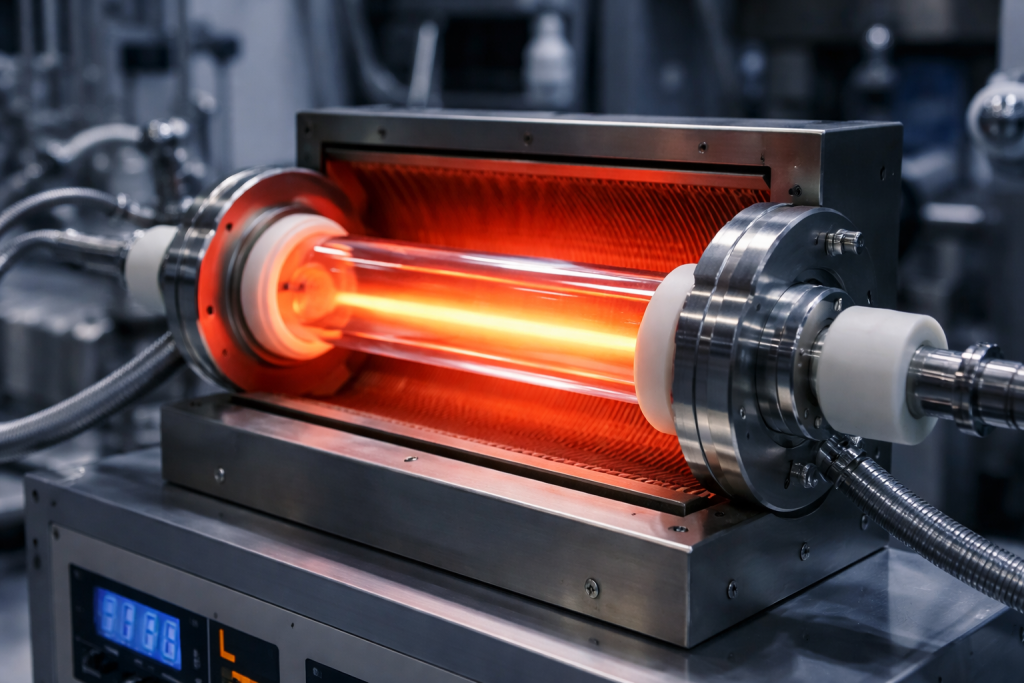
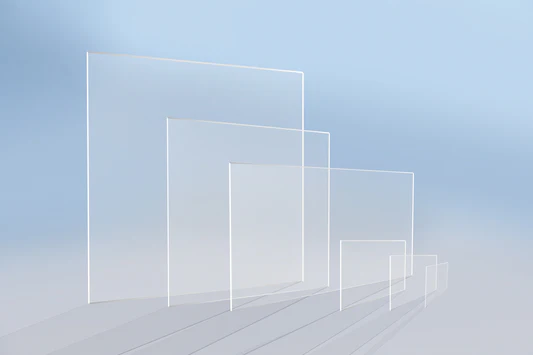
熔融石英 is one of the most widely used optical materials for ultraviolet, visible, and near-infrared applications. It is valued for high optical transmission, low thermal expansion, good chemical stability, high purity, and strong resistance to demanding environments. In optical windows, lenses, plates, prisms, tubes, and custom quartz components, fused silica often serves as the transparent substrate that allows light to pass through with minimal absorption. UV-grade fused silica is especially suitable for applications requiring transmission deeper into the ultraviolet range compared with many conventional optical glasses.
However, the substrate itself is only one part of optical performance. In many systems, the surface of the fused silica component must also be engineered. This is where optical coatings become important. Anti-reflection coatings, protective coatings, high-reflection coatings, conductive coatings, hydrophobic coatings, and contamination-resistant coatings can all change how a quartz optical part interacts with light, heat, chemicals, moisture, plasma, or cleaning processes.
The key question is not simply whether a fused silica component can be coated. The more important question is: when does a quartz optical part actually need a coating, and what type of coating is appropriate for its working environment?

1. Why Fused Silica Optical Parts May Need Coatings
Uncoated fused silica already has excellent optical performance, but every air-glass interface produces reflection. For a simple optical window, light enters through the first surface and exits through the second surface. Even if absorption inside the fused silica is low, surface reflections can reduce total transmission and create stray light.
In precision optical systems, reflection is not just an energy loss problem. It can also cause ghost images, interference fringes, reduced contrast, detector noise, heating at unwanted locations, and unstable measurement signals. For laser systems, reflected light may return toward the source and interfere with beam stability. For UV instruments, even a small transmission loss may reduce system efficiency.
This is why anti-reflection coatings are commonly applied to fused silica windows, lenses, and plates. Commercial UV fused silica windows are often available either uncoated or with broadband AR coatings, including UV coating ranges such as 245–400 nm.
2. What Is an Anti-Reflection Coating?
An anti-reflection coating is a thin film structure designed to reduce reflected light from an optical surface. In the simplest explanation, the coating uses optical interference: reflected light from the upper and lower boundaries of the coating layer can partially cancel each other at a selected wavelength or wavelength range.
A single-layer AR coating can reduce reflection at a narrow or moderate wavelength range, while multilayer coatings can be designed for broader spectral performance. For fused silica optics, AR coatings may be optimized for ultraviolet, visible, near-infrared, laser-line, or broadband applications.
For example, a coating designed for 254 nm UV sterilization equipment is not necessarily suitable for 1064 nm laser optics. Similarly, a visible-band AR coating may not survive or perform well in deep-ultraviolet systems. Coating design must match wavelength, angle of incidence, polarization, optical power, temperature, cleaning method, and environmental exposure.
3. When Fused Silica Parts Need AR Coatings
Fused silica parts usually need AR coatings when the optical system is sensitive to transmission loss, stray reflection, or imaging contrast. Common examples include UV inspection systems, fluorescence instruments, spectrometers, laser windows, photolithography-related optics, high-resolution imaging systems, optical sensors, and analytical instruments.
In deep-UV systems, reflection losses can be more serious than many users expect. One optical coating supplier reports that uncoated fused silica has reflectance of about 4.8% per surface at 193 nm and about 4.1% per surface at 248 nm. For a window with two surfaces, the total reflection loss may therefore become significant before absorption is even considered.
AR coatings are especially useful when the optical path includes multiple fused silica elements. A single uncoated window may be acceptable in a simple setup, but several windows, lenses, and plates in sequence can create cumulative reflection loss. In such systems, AR coatings can improve throughput and reduce unwanted internal reflections.
4. Protective Coatings: More Than Optical Transmission
Not all coatings are designed only to improve light transmission. Some coatings are applied to protect the surface of fused silica from mechanical, chemical, environmental, or process-related damage.
Protective coatings may help reduce scratching, moisture effects, contamination adhesion, plasma exposure, chemical attack, or cleaning-related degradation. In semiconductor, UV, biomedical, and analytical equipment, fused silica surfaces may be exposed to aggressive cleaning chemicals, reactive gases, ozone, high-energy UV radiation, or repeated thermal cycles. In these cases, surface durability can be just as important as optical transmission.
A protective coating must be selected carefully. If the coating absorbs the working wavelength, outgasses under vacuum, reacts with chemicals, cracks during thermal cycling, or produces particles, it may create more problems than it solves. For high-purity semiconductor and vacuum environments, coating material compatibility should always be evaluated before use.
5. UV and Deep-UV Coating Considerations
UV and deep-UV applications are among the most demanding cases for fused silica coatings. UV-grade fused silica is chosen because it offers strong ultraviolet transmission, but the coating must also transmit the target wavelength efficiently. A coating that performs well at visible wavelengths may absorb strongly in the UV.
Deep-UV wavelengths such as 193 nm, 248 nm, and 254 nm require special attention. Coating materials must have low absorption, good adhesion, and resistance to UV-induced degradation. In high-energy UV systems, coating damage may occur through heating, photochemical reactions, contamination buildup, or radiation-induced changes.
Fused silica grade also matters. UV-grade and IR-grade fused silica are not the same. UV-grade fused silica is generally better for UV and visible applications, while IR-grade fused silica has lower OH content and better infrared transmission but reduced UV performance.
Therefore, coating selection should not be separated from substrate selection. A high-quality UV coating on the wrong fused silica grade may still fail to deliver the required performance.
6. Coatings and Solarization
Solarization is a phenomenon in which optical materials develop increased absorption after exposure to high-energy radiation. It is especially relevant in ultraviolet systems and high-energy optical environments. Solarization can reduce transmission, shift optical performance, and shorten component lifetime.
Research has shown that solarization can occur in glass substrates during thin-film deposition and can induce absorption near the surface. This is important because coating processes themselves may expose the substrate to radiation, heat, plasma, ion bombardment, or energetic particles.
For fused silica optics used in demanding UV systems, coating suppliers and component manufacturers must consider not only the final coating design, but also the deposition process. Low-damage coating methods, proper material selection, and post-process inspection can help reduce optical degradation.
7. Coating Methods for Fused Silica
Common coating technologies include physical vapor deposition, electron-beam evaporation, ion-assisted deposition, ion beam sputtering, magnetron sputtering, sol-gel coating, and chemical coating methods. Each method has advantages and limitations.
Electron-beam evaporation is widely used for optical coatings and can produce multilayer structures with controlled thickness. Ion-assisted deposition can improve film density and adhesion. Ion beam sputtering is often used for high-performance precision coatings, especially when low scatter, high durability, and accurate spectral control are required. Sol-gel coatings may be used in some broadband or large-area applications.
The best method depends on the required wavelength range, optical loss, coating durability, substrate size, production cost, and working environment. For high-power laser optics, coating defects and absorption must be minimized. For large fused silica windows, uniformity across the full aperture becomes important. For semiconductor quartz components, cleanliness and particle control may be critical.
8. When Protective Coatings Are Not Recommended
Although coatings can improve performance, they are not always necessary. In some cases, uncoated fused silica is the better choice.
Uncoated fused silica may be preferred when the component is used in very high-temperature environments, strong chemical exposure, harsh plasma processes, or semiconductor processes where coating contamination is unacceptable. Coatings can also introduce additional failure modes, such as delamination, cracking, absorption, outgassing, or surface particles.
For simple protective windows, lamp sleeves, furnace viewports, or quartz process parts, the natural chemical and thermal stability of fused silica may be sufficient. In these cases, it may be better to improve surface polishing, cleaning, geometry, or packaging rather than adding a coating.
The decision should be based on system requirements, not on the assumption that coated parts are always better.
9. How to Specify Coated Fused Silica Parts
When ordering coated fused silica optics or custom quartz optical parts, the specification should include both substrate requirements and coating requirements.
Important substrate parameters include material grade, wavelength range, diameter or custom shape, thickness, surface quality, flatness, parallelism, wedge, roughness, edge treatment, and cleaning grade. Important coating parameters include coating type, design wavelength or wavelength range, reflectance target, transmission target, angle of incidence, polarization, laser damage threshold if applicable, environmental durability, adhesion, cleaning method, and whether one or both surfaces should be coated.
For UV applications, it is also important to specify whether the component is used at 185 nm, 193 nm, 248 nm, 254 nm, 365 nm, or another wavelength. A coating designed for one UV wavelength may not perform well at another.
For vacuum, semiconductor, or high-cleanliness applications, users should also ask whether the coating may outgas, shed particles, react with process gases, or introduce metallic contamination.
10. Typical Applications
Coated fused silica parts are used in UV inspection systems, excimer laser optics, spectrometers, fluorescence instruments, semiconductor optical modules, analytical devices, optical sensors, UV curing equipment, laser protection windows, biomedical instruments, and precision imaging systems.
AR-coated fused silica windows are often used when high transmission and low reflection are required. Protective-coated fused silica parts may be used when the optical surface must resist contamination, humidity, cleaning, or process exposure. Custom coated quartz parts may combine special geometry with optical performance, such as drilled windows, stepped plates, bonded assemblies, or precision-machined optical components.
總結
Fused silica coatings are not just an optional surface treatment. In many optical systems, they directly influence transmission, reflection, contrast, durability, lifetime, and measurement stability. Anti-reflection coatings are useful when optical loss and stray reflection must be reduced. Protective coatings are useful when the surface must withstand contamination, cleaning, chemical exposure, or environmental stress.
However, coating selection must be done carefully. The correct coating depends on wavelength, angle, power, temperature, substrate grade, process environment, and cleanliness requirements. In UV and deep-UV applications, coating materials and deposition processes become especially important because absorption, solarization, and contamination can significantly affect performance.
For fused silica windows, lenses, plates, tubes, and custom quartz optical components, the best solution is not always “coated” or “uncoated.” The best solution is the one that matches the real optical and environmental conditions of the application.