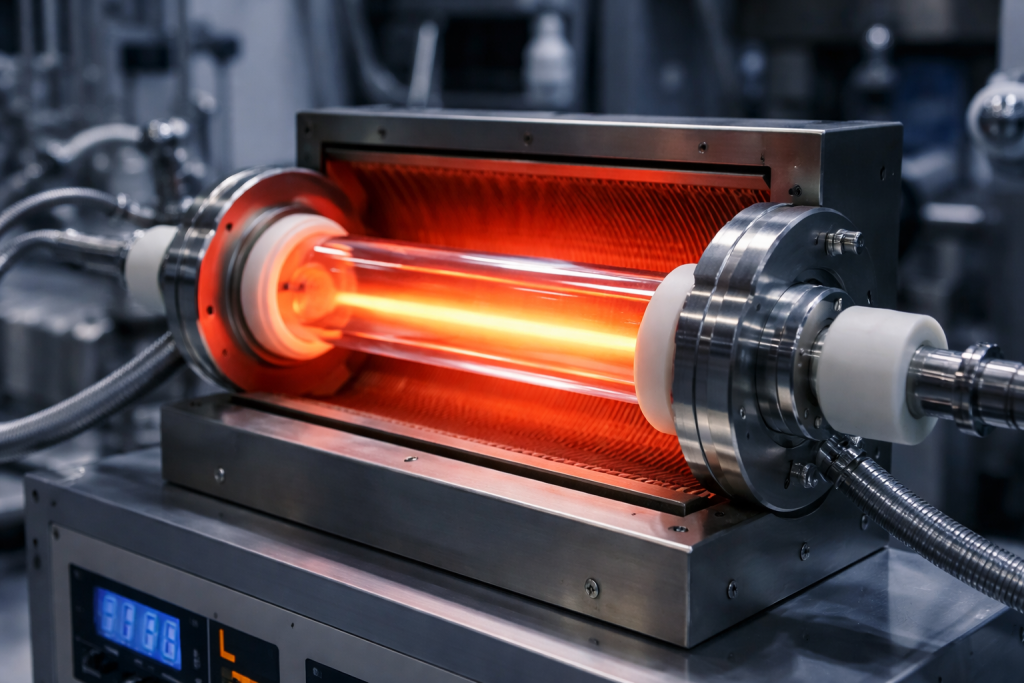
Quartz plates, made from high-purity silicon dioxide (SiO₂), have long been recognized as critical components in semiconductor fabrication and optical applications. Their unique combination of thermal stability, chemical resistance, optical clarity, and mechanical strength makes them an indispensable material for industries that demand precision, reliability, and performance under extreme conditions. This article explores the material properties, manufacturing advantages, and key applications of quartz plates, emphasizing why they are particularly well-suited for semiconductor and optical industries.

Material Properties of Quartz Plates
- High Thermal Stability
Quartz plates exhibit exceptional resistance to high temperatures, withstanding continuous exposure up to 1,100°C without deformation. The low thermal expansion coefficient minimizes the risk of warping, cracking, or thermal shock when subjected to rapid heating and cooling cycles. This property is critical in semiconductor processing, where precise temperature control during oxidation, diffusion, and annealing is essential for producing high-quality wafers. - Chemical Inertness
Quartz is highly resistant to most acids, alkalis, and organic solvents. This chemical stability ensures that quartz plates do not react with chemicals used in photolithography, wet etching, or cleaning processes in semiconductor manufacturing. As a result, quartz plates maintain high purity and prevent contamination, which is vital for achieving consistent device performance. - Optical Transparency and UV Transmission
Quartz plates are transparent to a wide range of wavelengths, including ultraviolet (UV) light. This property is especially important in optical and photolithographic applications, where precise light transmission is required to accurately pattern semiconductor wafers or to conduct UV-based optical experiments. Standard glass materials often absorb or scatter UV light, making quartz a superior choice for applications requiring high optical fidelity. - Mechanical Strength and Flatness
Quartz plates are manufactured to achieve high surface flatness and uniform thickness, which is critical in semiconductor lithography and optical experiments. Their mechanical strength ensures durability during handling, processing, and integration into precision equipment, while the flat and smooth surfaces allow for uniform deposition of thin films or optical coatings.
Advantages in Semiconductor Industry
Quartz plates are extensively used in semiconductor fabrication due to their ability to withstand harsh processing conditions while maintaining high purity and dimensional stability. Key applications include:
- Oxidation and Diffusion Furnaces: Quartz plates provide a stable platform for wafers in high-temperature furnaces, ensuring uniform thermal exposure and minimizing contamination.
- Quang khắc: Their high optical transparency and flatness allow precise transmission of UV light, critical for accurate patterning of micro- and nano-scale features.
- Chemical Cleaning: Quartz plates are used as substrates or supports in cleaning baths, where resistance to aggressive chemicals ensures long-term durability and minimal contamination risk.
Advantages in Optical Industry
In optical applications, quartz plates offer unique properties that make them indispensable:
- UV and Visible Light Transmission: Quartz plates allow high transmittance of both UV and visible light, which is essential in optical experiments, lasers, and imaging systems.
- Low Thermal Expansion: Optical setups often involve heating or exposure to light sources. Quartz plates maintain dimensional stability, reducing optical distortion or misalignment.
- High Surface Quality: Polished quartz plates provide smooth, defect-free surfaces necessary for high-precision optical measurements and lens fabrication.
Comparative Advantages
| Bất động sản | Tấm thạch anh | Thủy tinh borosilicat | Sapphire Plate |
|---|---|---|---|
| Maximum Temperature | >1100°C | ~500°C | ~2000°C |
| Khả năng chịu hóa chất | Tuyệt vời | Trung bình | Tuyệt vời |
| Độ trong suốt quang học | Excellent (UV & Visible) | Trung bình | Tuyệt vời |
| Khả năng chịu sốc nhiệt | Cao | Trung bình | Trung bình |
| Độ phẳng bề mặt | Cao | Trung bình | Cao |
Compared to other materials, quartz plates provide a balanced combination of thermal resistance, chemical inertness, optical clarity, and mechanical precision, making them the material of choice for most semiconductor and optical processes.
Kết luận
Quartz plates are an essential material in both semiconductor and optical industries. Their ability to withstand high temperatures, resist chemical attack, transmit ultraviolet and visible light, and maintain flat, smooth surfaces makes them ideal for critical applications ranging from photolithography and thin-film deposition to optical experiments and precision instrumentation.