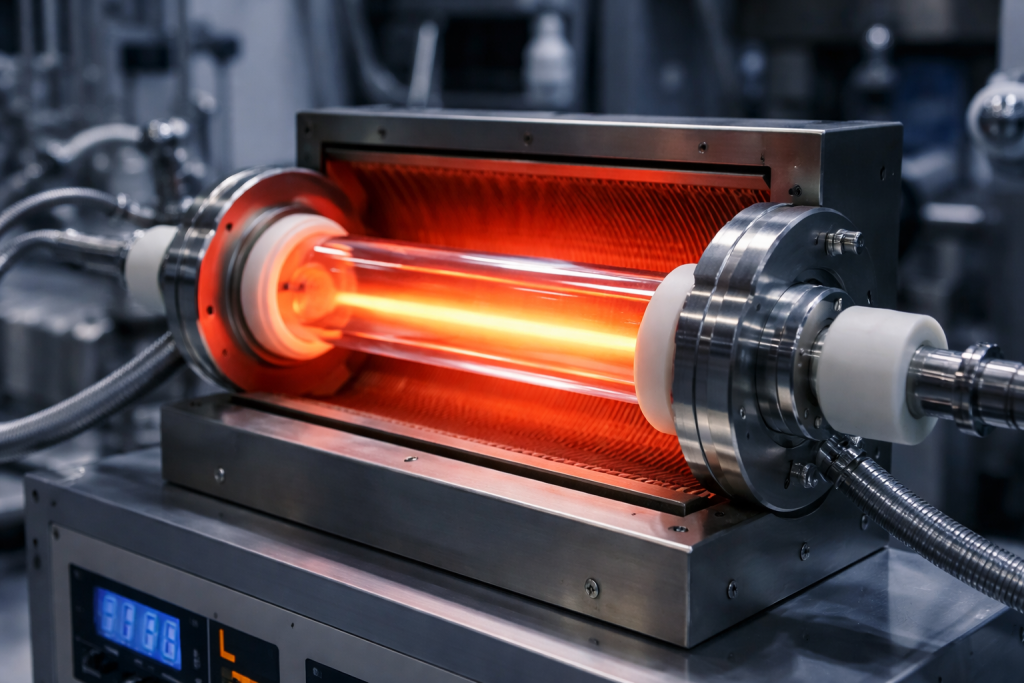
In semiconductor manufacturing, quartz components are often described in terms of purity, thermal stability, dimensional tolerance, and chemical resistance. However, for many advanced processes, material cleanliness is just as important as bulk material properties. A quartz tube, wafer boat, ring, flange, chamber, tray, or custom quartz fixture may appear visually clean, but its surface condition can still influence particle generation, metal contamination, process drift, and wafer yield.
Semiconductor quartz cleanliness is not only about removing visible dust. It involves the control of particles, trace metal ions, organic residues, surface roughness, micro-defects, cleaning chemistry, handling, packaging, and long-term stability in the process environment. As device dimensions continue to shrink, contamination control becomes increasingly critical for process reliability. Semiconductor cleaning technologies are widely recognized as essential because wafer surfaces must be protected from particles, organic residues, inorganic impurities, and other contaminants before and during device fabrication.

1. Why Quartz Cleanliness Matters in Semiconductor Equipment
Quartz glass is widely used in semiconductor equipment because it combines high purity, high temperature resistance, low thermal expansion, and good chemical stability. It is commonly found in diffusion furnaces, oxidation systems, LPCVD tools, wet benches, plasma process chambers, UV process equipment, wafer handling systems, and laboratory-scale semiconductor devices.
In these systems, quartz parts may be exposed to high temperature, reactive gases, corrosive chemicals, plasma, vacuum, and repeated thermal cycling. Under such conditions, even small surface defects or residues can become contamination sources. A rough surface may release particles. A poorly cleaned part may introduce metal ions. A chipped edge may become a particle source during installation or process cycling. A contaminated surface may affect film deposition, etching uniformity, or wafer surface quality.
For this reason, quartz cleanliness should be treated as a system-level requirement rather than a simple visual inspection step.
2. Particles: The Most Visible Cleanliness Risk
Particle contamination is one of the most direct risks associated with quartz components. Particles may come from machining debris, grinding residues, polishing slurry, packaging dust, handling, chipped edges, microcracks, or surface corrosion during use.
In semiconductor equipment, particles are especially problematic because they can fall onto wafer surfaces, block patterns, disturb thin-film uniformity, or create defects in later process steps. Process equipment suppliers and users increasingly consider particle contamination on components an essential quality requirement, and standardized measurement methods are important for supplier-user communication.
Quartz components can generate particles for several reasons. Mechanical machining may leave loose debris if post-cleaning is insufficient. Sharp edges may chip during handling. Improperly supported quartz rings, flanges, or bases may rub against other parts and release particles. Thermal cycling may enlarge microcracks or stress-damaged regions. Chemical exposure may slowly attack the surface and change its texture.
Therefore, particle control begins before cleaning. It starts with proper design, suitable wall thickness, good edge finishing, controlled machining, and appropriate packaging.
3. Metal Ions: Invisible but Critical Contaminants
Unlike particles, metal ion contamination is usually invisible. A quartz surface may look perfectly clean while still carrying trace levels of sodium, potassium, iron, aluminum, titanium, calcium, copper, nickel, or other metallic species. These contaminants may originate from raw material, machining tools, polishing media, cleaning chemicals, water quality, handling fixtures, or packaging materials.
Metal contamination is a major concern because metal ions can migrate, diffuse, or interact with wafer surfaces during high-temperature processes. In semiconductor manufacturing, cleaning processes often specifically target different contaminant classes. For example, the RCA cleaning sequence is commonly described as including an SC-1 step for particles and organic matter, followed by an SC-2 step aimed at reducing metal contamination.
For quartz components, metal ion control is especially important when the part is used near wafers, inside high-temperature furnace systems, or in plasma and wet process environments. Quartz boats, process tubes, liners, rings, and chambers should be manufactured and cleaned with attention to trace metal control, not only dimensional accuracy.
High-purity quartz itself can also contain natural structural impurities such as aluminum, iron, titanium, and alkali metals, depending on the source and purification process. This is one reason semiconductor-grade quartz requires carefully controlled material selection and processing.
4. Surface Roughness and Micro-Defects
Surface roughness is another important cleanliness factor. A smoother surface is generally easier to clean and less likely to trap particles, residues, and chemical contaminants. A rough or damaged surface may hold polishing compound, metal traces, organics, or process residues, even after washing.
For optical quartz parts, surface roughness also affects transmission, scattering, and imaging quality. For semiconductor quartz parts, the concern is often contamination retention and particle release. Microcracks, scratches, pits, chipped corners, and subsurface damage may become hidden contamination sources.
Different quartz components require different surface conditions. A fused quartz window may require optical polishing. A quartz ring may require edge chamfering and particle-controlled cleaning. A quartz tube for thermal processing may require smooth inner surfaces to reduce residue retention. A quartz flange used for sealing may require flatness and surface uniformity.
Surface control therefore includes cutting, grinding, lapping, polishing, fire polishing, chamfering, cleaning, inspection, and packaging. It is not a single final step.
5. Organic Residues and Molecular Contamination
Organic residues can come from gloves, oils, fingerprints, tapes, lubricants, adhesives, packaging films, cleaning agents, or airborne molecular contamination. Although organic residues may be less obvious than particles, they can carbonize, volatilize, outgas, or react under UV, plasma, vacuum, or high-temperature conditions.
In semiconductor environments, organic contamination can interfere with surface preparation, film growth, bonding, lithography-related processes, and high-temperature treatment. For quartz components used in UV systems or ozone-generating environments, organic residues may decompose and form haze or deposits on the surface.
This is why clean handling and suitable packaging are essential. Quartz components should not only be washed; they should also be protected from recontamination after cleaning.
6. Cleaning Methods for Semiconductor Quartz Parts
Cleaning semiconductor quartz parts usually requires a combination of mechanical, chemical, and ultrapure water-based processes. The exact cleaning route depends on the part geometry, contamination type, material grade, and final application.
Common cleaning goals include removing particles, metal ions, organic residues, polishing residues, and loosely bonded surface contaminants without damaging the quartz surface. Wet cleaning methods for quartz components used in plasma processing equipment have been developed specifically to reduce metallic contaminants on quartz surfaces.
Cleaning may include ultrasonic or megasonic assistance, acid cleaning, ultrapure water rinsing, drying in controlled environments, and clean packaging. However, aggressive cleaning must be used carefully. Hydrofluoric acid-based chemistries, strong alkalis, or improper mechanical agitation can etch, roughen, or damage quartz surfaces if not properly controlled.
The objective is not maximum chemical strength, but controlled removal of contaminants while preserving surface integrity.
7. Inspection and Cleanliness Evaluation
Cleanliness cannot be judged only by appearance. A visually transparent quartz part may still carry ionic contamination, submicron particles, or surface residues. Therefore, semiconductor quartz cleanliness may require analytical testing depending on the application.
Particle inspection can be performed through visual inspection, optical microscopy, particle counting after extraction, or surface scanning methods. Metal contamination may be evaluated by techniques such as ICP-MS, TXRF, ion chromatography, or surface extraction analysis. Surface morphology may be checked using profilometry, microscopy, SEM, or AFM when required.
For most commercial quartz parts, the testing method should be selected based on risk level. A general laboratory quartz tube may not need the same inspection as a quartz boat used in a semiconductor diffusion furnace. A custom quartz flange used outside the process zone may not require the same metal ion limits as an inner chamber liner.
The key is to define cleanliness requirements according to the actual process environment.
8. Design Factors That Improve Cleanliness
Cleanliness is strongly affected by component design. A quartz part that is difficult to clean will remain a contamination risk even if high-purity material is used. Deep narrow grooves, sharp internal corners, blind holes, rough surfaces, and complex welded structures may trap particles or residues.
Good design for clean quartz components should avoid unnecessary sharp corners, reduce particle-trapping geometry, allow proper rinsing and drying, and provide adequate mechanical strength to prevent chipping. Edge chamfering and polishing are especially important for rings, flanges, bases, plates, and custom fixtures.
For quartz tubes and chambers, inner surface quality, end finish, weld quality, and cleaning accessibility should be considered. For quartz wafer boats and carriers, contact points should be designed to minimize particle generation and wafer contact contamination.
9. Handling, Packaging and Storage
Even if a quartz part is manufactured and cleaned correctly, contamination can occur during handling, packaging, shipping, storage, or installation. Clean gloves, particle-controlled bags, cleanroom-compatible packaging, and protected transport conditions are important for semiconductor-grade parts.
Packaging materials should not shed particles, transfer organics, or introduce ionic contamination. Parts should be separated to avoid rubbing, scratching, or edge damage. Large quartz tubes and fragile quartz rings require mechanical protection to prevent microcracking during transportation.
Storage conditions also matter. Quartz parts should be kept in clean, dry, and controlled environments. Recleaning may be necessary if parts are stored for a long time or exposed to uncontrolled conditions before installation.
10. How to Specify Cleanliness Requirements When Ordering Quartz Parts
When purchasing semiconductor quartz components, buyers should provide more than size and drawing information. Cleanliness-related specifications may include material grade, process application, whether the part contacts wafers, maximum operating temperature, chemical exposure, plasma exposure, surface finish, particle control requirement, metal contamination requirement, cleaning grade, packaging method, and inspection method.
For critical applications, it is useful to define whether the part is for furnace processing, wet cleaning, plasma chamber use, optical inspection, UV exposure, or general laboratory support. Each application has different contamination risks.
A clear specification helps the manufacturer choose suitable raw material, machining tools, cleaning process, inspection method, and packaging procedure. Without this information, a part may meet dimensional requirements but fail to meet process cleanliness expectations.
Sonuç
Semiconductor quartz cleanliness is a multi-dimensional technical requirement involving particles, metal ions, organic residues, surface roughness, micro-defects, cleaning methods, handling, and packaging. High-purity quartz material is important, but it is not sufficient by itself. The surface condition of the final component often determines whether the part can perform reliably in contamination-sensitive semiconductor environments.
For quartz tubes, wafer boats, chambers, rings, flanges, bases, windows, and custom quartz fixtures, cleanliness should be considered from design through manufacturing, cleaning, inspection, packaging, and installation. A well-designed and properly cleaned quartz part can help reduce contamination risk, improve equipment stability, and support reliable semiconductor process performance.
In advanced semiconductor equipment, quartz cleanliness is not simply a finishing detail. It is an essential part of process control.