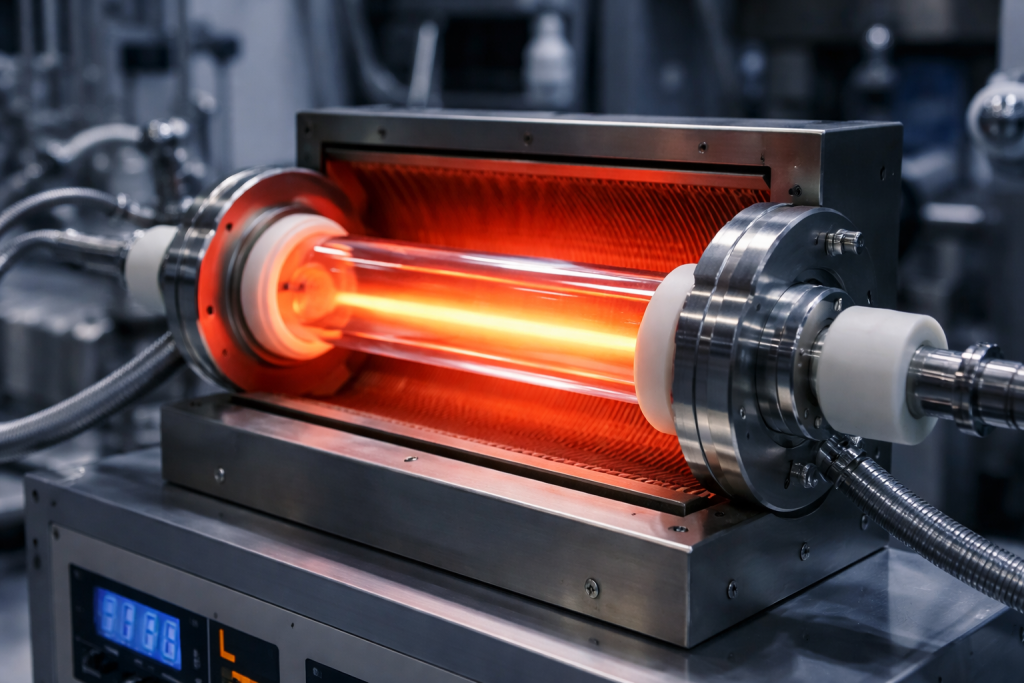
Quartz glass is widely used in semiconductor equipment, optics, laboratory systems, and high-temperature industrial environments due to its excellent thermal stability, high purity, and optical performance. As semiconductor and photonics applications continue moving toward miniaturization and precision integration, demand for custom quartz components with ultra-small holes and complex geometries continues to grow.
However, machining holes in quartz glass is not straightforward.
Quartz is a hard and brittle material with low fracture toughness. During drilling processes, improper machining can easily create edge chipping, micro-cracks, or internal stress, reducing component reliability.
For engineers and purchasing teams, one common question is:
What is the minimum hole size achievable in quartz glass, and should CNC or laser drilling be used?
The answer depends on hole diameter, thickness, tolerance requirements, and application objectives.
Why Quartz Glass Drilling Is Challenging
Unlike metals or plastics, quartz behaves differently under machining forces.
Key material characteristics include:
- High hardness
- Brittle fracture behavior
- Düşük termal genleşme
- Yüksek sıcaklık dayanımı
- Sensitivity to localized stress
When hole diameters become extremely small, several issues become more pronounced:
- Edge chipping
- Micro-cracks
- Surface defects
- Thermal damage
- Poor dimensional consistency
These defects can affect optical performance, contamination control, and component lifetime.
This is why selecting the appropriate drilling process becomes critical.
Two Main Technologies Used for Quartz Hole Drilling
For custom quartz fabrication, two common methods dominate:
- CNC mechanical drilling
- Lazer delme
Each technology offers unique advantages and limitations.
CNC Drilling for Quartz Glass
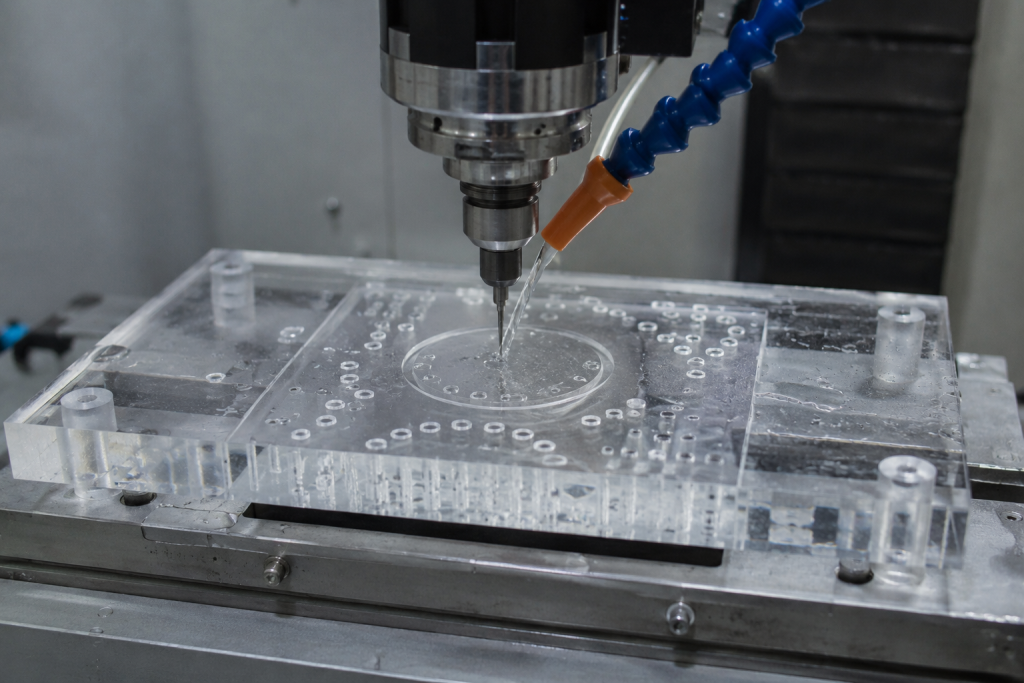
CNC drilling uses precision machine tools equipped with diamond-coated tools or specialized abrasive processes.
Material removal occurs through controlled mechanical contact.
Typical capabilities:
| Parametre | CNC Drilling |
|---|---|
| Typical Hole Diameter | ≥0.5 mm |
| Hole Accuracy | Yüksek |
| Yüzey İşlemi | Mükemmel |
| Hole Depth Capability | İyi |
| Through Holes | Mükemmel |
| Large Batch Consistency | Yüksek |
Advantages:
- Better dimensional tolerance
- Superior wall quality
- Lower thermal effects
- Suitable for thicker materials
- Good for high precision applications
Sınırlamalar:
- Smaller holes increase fracture risk
- Tool wear affects consistency
- Slower for micro-scale features
- Mechanical stress can create chipping
For many industrial applications, hole diameters below approximately 0.5 mm become increasingly difficult.
Actual capability depends on thickness and geometry.
Laser Drilling for Quartz Glass
Laser drilling removes material using concentrated thermal energy.
Instead of direct mechanical contact, the laser vaporizes localized material regions.
Typical capabilities:
| Parametre | Laser Drilling |
|---|---|
| Minimum Hole Diameter | ~0.05–0.2 mm |
| Mechanical Force | None |
| Complex Geometry | Mükemmel |
| Processing Speed | Yüksek |
| Thin Material Capability | Mükemmel |
Advantages:
- Extremely small hole sizes
- No tool wear
- Fast processing
- Suitable for micro-holes
- Capable of complex patterns
Sınırlamalar:
- Heat affected zones
- Possible micro-cracks
- Surface recast layers
- Lower sidewall quality
- Tapered hole geometry possible
Laser systems are often preferred when feature size becomes the primary concern.
What Is the Actual Minimum Hole Size?
The theoretical minimum hole size and practical production capability are not always the same.
Real-world limits depend on several factors:
Material Thickness
As thickness increases, maintaining straightness becomes more difficult.
Example:
| Quartz Thickness | Typical Minimum Hole |
|---|---|
| 0,3 mm | 0.1–0.2 mm |
| 1 mm | 0.2–0.5 mm |
| 3 mm | 0.5–1 mm |
| 5 mm | >1 mm |
The hole diameter-to-thickness ratio strongly influences manufacturability.
Hole Depth Ratio
Deep and narrow holes create challenges:
- Debris removal
- Heat accumulation
- Tool wear
- Sidewall defects
Extremely high aspect ratio holes may require specialized processing.
Tolerance Requirements
A micro-hole with ±0.1 mm tolerance differs significantly from one requiring:
±0.01 mm
Tighter tolerances generally require additional processing steps.
Surface Quality Requirements
Optical and semiconductor applications often demand:
- Minimal chipping
- Smooth sidewalls
- Reduced particles
- Stress-free surfaces
Secondary polishing may be required.
CNC vs Laser: Which Process Should You Choose?
The answer depends on application priorities.
Choose CNC when:
- Hole size exceeds 0.5 mm
- Tight tolerance is required
- Thick quartz material is used
- Surface quality is critical
- Deep through holes are needed
Tipik uygulamalar:
- Semiconductor fixtures
- Quartz carriers
- Precision optical components
- Furnace components
Choose Laser when:
- Hole diameter is extremely small
- Complex patterns are needed
- Thin substrates are used
- High processing speed is required
- Mechanical stress must be minimized
Tipik uygulamalar:
- Optical filters
- Sensor substrates
- Mikroakışkan cihazlar
- Semiconductor processing plates
Common Defects During Quartz Hole Machining
Several quality issues can occur if process parameters are not optimized:
Edge Chipping
Small fragments break away from hole edges.
Causes:
- Excessive drilling force
- Tool wear
- Poor support conditions
Micro-Cracks
Tiny subsurface fractures may remain invisible but reduce reliability.
Causes:
- Excessive heat
- Mechanical stress
- Improper processing conditions
Thermal Stress
Laser energy concentration may introduce localized stress.
Consequences:
- Çatlak yayılması
- Structural weakness
- Reduced lifetime
Advanced manufacturers often use optimized drilling parameters and post-processing to reduce these risks.
What to Ask Your Quartz Supplier
When requesting custom quartz drilling services, consider asking:
- Minimum hole capability
- Thickness limitations
- Hole tolerance
- Edge quality specification
- Surface roughness
- Secondary polishing options
- Inspection methods
- Experience with semiconductor applications
Early technical discussion can significantly reduce production risk.
Son Düşünceler
Ultra-small holes in quartz glass are increasingly important in semiconductor, optical, and scientific applications. However, hole size alone should never be the only decision factor.
CNC drilling provides superior precision and structural quality, while laser drilling excels in ultra-small and complex geometries.
The best manufacturing approach balances hole size, thickness, tolerance, and long-term reliability.
Working with an experienced quartz fabrication supplier ensures that custom designs remain both manufacturable and application-ready.
SSS
What is the smallest hole achievable in quartz glass?
Laser drilling can typically produce holes around 0.05–0.2 mm depending on material thickness and process conditions.
Is CNC drilling more accurate than laser drilling?
Generally yes. CNC drilling usually provides better dimensional control and surface quality for larger holes.
Can quartz holes be polished after drilling?
Yes. Secondary polishing and edge treatment are commonly used to improve surface quality and reduce micro-cracks.