Glass is one of the most widely used materials in scientific, industrial, and consumer applications. However, not all glass is created equal. กระจกควอตซ์ (also known as fused silica) and regular glass (typically soda-lime or borosilicate glass) differ significantly in their chemical composition, optical properties, thermal behavior, and mechanical performance. Understanding these differences is essential for engineers, researchers, and designers who rely on glass in precision applications.
1. Composition Differences
กระจกธรรมดา
Regular glass, such as soda-lime glass, is primarily composed of:
- Silicon dioxide (SiO2): ~70–75%
- Sodium oxide (Na2O) and calcium oxide (CaO): act as flux and stabilizers
- Minor additives: magnesium, aluminum, or other oxides to improve durability
Borosilicate glass, a high-end variant of regular glass, contains boron oxide (B2O3), which enhances thermal and chemical resistance.
แก้วควอตซ์
Quartz glass is made almost entirely of high-purity silicon dioxide (SiO2), usually above 99.9%. It is produced by:
- Melting natural quartz crystals at high temperatures (~2000 °C) or
- Chemical vapor deposition to produce extremely pure fused silica
Unlike regular glass, quartz glass contains no metal oxides or flux agents, which gives it unique properties.
2. Optical Properties
ช่วงการส่งกำลัง
- กระจกธรรมดา: Transparent in visible light (400–700 nm), but absorbs UV light below ~350 nm and has limited infrared (IR) transmission.
- แก้วควอตซ์: Extremely transparent across a much wider spectrum, from ultraviolet (UV, ~160 nm) to mid-infrared (~3.5 µm).
ดัชนีหักเห
- Regular glass: ~1.5 (depends on composition)
- Quartz glass: ~1.46, with very low dispersion and minimal optical distortion
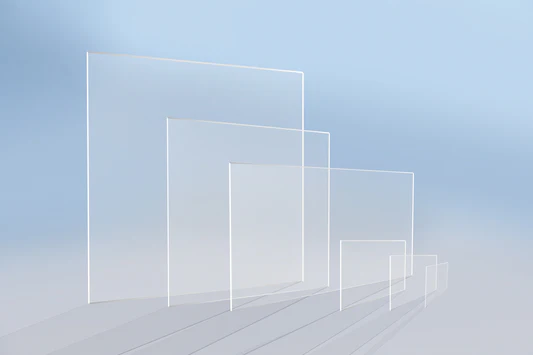
These differences make quartz glass ideal for UV lasers, spectroscopy, optical fibers, and precision lenses, whereas regular glass is sufficient for windows, containers, and low-cost optics.
3. Thermal Properties
Coefficient of Thermal Expansion (CTE)
- Regular soda-lime glass: ~9 × 10^-6 /°C
- Borosilicate glass: ~3.3 × 10^-6 /°C
- Quartz glass: ~0.5 × 10^-6 /°C
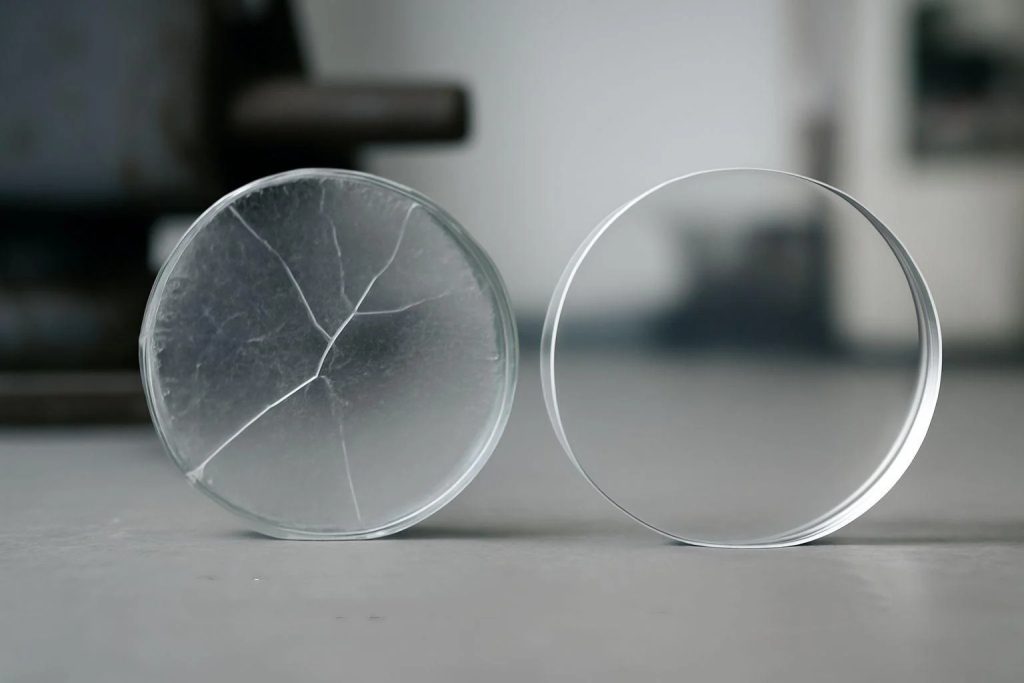
Interpretation: Quartz glass expands far less when heated, making it highly resistant to thermal shock. For example:
- Pouring boiling water into soda-lime glass may crack it
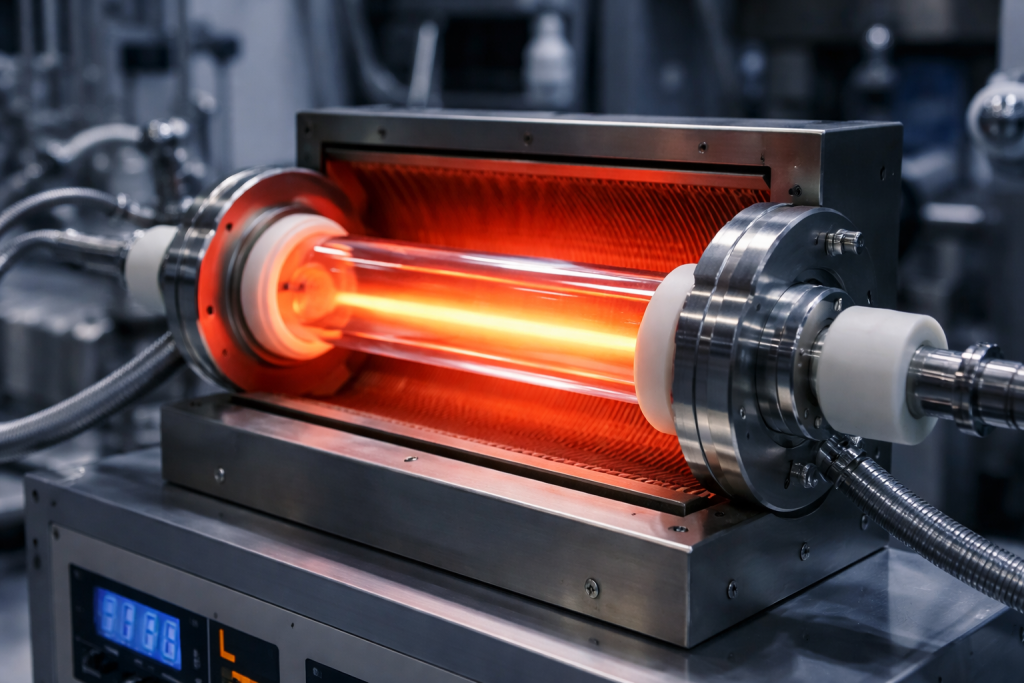
- Quartz glass can withstand rapid temperature changes of several hundred degrees Celsius
Softening Temperature
- Regular glass: ~700–800 °C (soda-lime)
- Borosilicate: ~820–850 °C
- Quartz glass: >1600 °C
Quartz glass can be used in high-temperature furnaces, semiconductor processing, and industrial optics, where regular glass would deform or melt.
4. Chemical Resistance
Quartz glass has excellent chemical stability:
- Resistant to acids (except hydrofluoric acid)
- Resistant to alkalis
- Does not leach ions
Regular glass is more chemically reactive:
- Soda-lime glass can be attacked by strong acids and alkalis
- Borosilicate glass is more resistant but still reacts under extreme conditions
For applications in chemical reactors, laboratory glassware, or photonics, quartz glass is often preferred.
5. Mechanical Properties
- ความแข็ง: Quartz glass (Mohs 6–7) is harder than regular glass (Mohs 5–6)
- Strength: Both are brittle, but quartz glass can withstand higher temperatures without deformation
- Durability: Quartz glass is more resistant to scratching and abrasion
6. Applications Comparison
| Property / Application | กระจกธรรมดา | แก้วควอตซ์ |
|---|---|---|
| หน้าต่างออปติคอล | ✓ visible light | ✓ UV, visible, IR |
| Laboratory beakers | ✓ | ✓ high-temperature chemical applications |
| Thermal shock resistance | ต่ำ | สูงมาก |
| High-temperature processing | จำกัด | ยอดเยี่ยม |
| Fiber optics | ✗ | ✓ |
| UV laser optics | ✗ | ✓ |
| ค่าใช้จ่าย | ต่ำ | สูง |
สรุป: Regular glass is sufficient for general purposes and low-cost applications. Quartz glass is chosen when high purity, extreme temperature tolerance, wide optical range, and chemical inertness are required.
7. บทสรุป
Quartz glass and regular glass serve different needs:
- Regular glass: Cost-effective, good for everyday optical, container, and window applications
- กระจกควอตซ์: Premium material for high-precision, high-temperature, or high-purity applications in science and industry
Choosing the right glass type depends on:
- Optical wavelength requirements
- Thermal and chemical environment
- Mechanical and surface durability
- Budget constraints
For laboratories, semiconductors, UV optics, or high-temperature reactors, quartz glass is often indispensable. For everyday applications, regular soda-lime or borosilicate glass remains the standard.