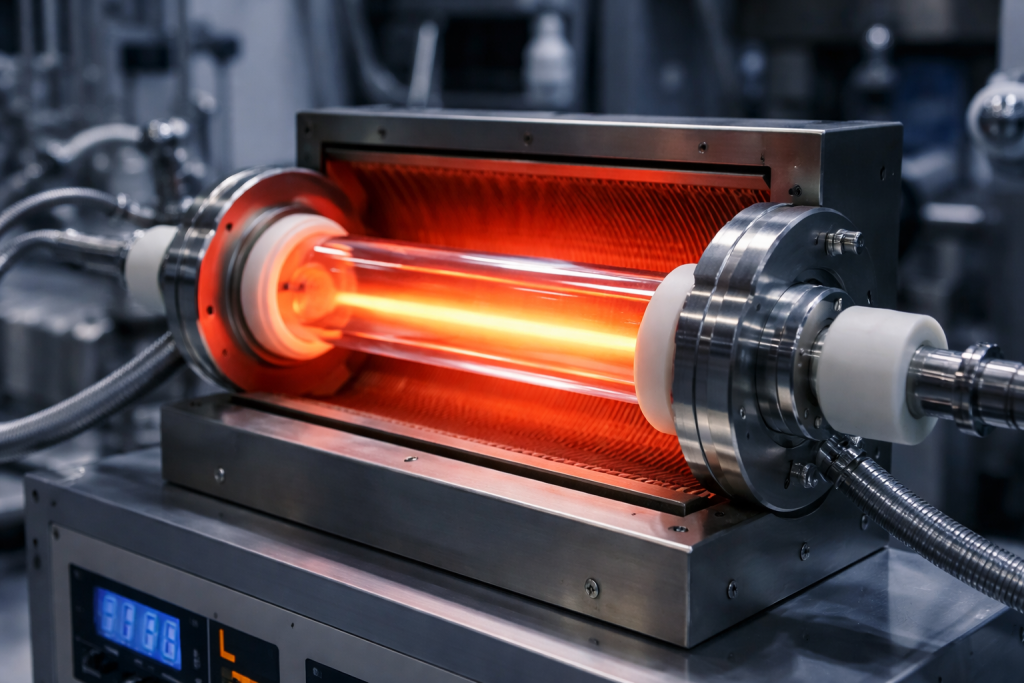
Flänsar av kvarts are commonly used to connect quartz tubes, reaction chambers, furnace components, gas lines and vacuum equipment. In semiconductor processing, laboratory systems and chemical applications, the sealing method directly affects vacuum performance, process purity, installation reliability and the service life of the quartz assembly.
Unlike metal flanges, quartz flanges cannot tolerate high localized clamping forces or significant installation misalignment. The sealing structure must therefore create the required vacuum or gas-tight connection while distributing pressure evenly across the quartz surface.
This article compares the main sealing methods used with quartz flanges, including O-rings, flat gaskets, ground quartz joints and vacuum connections.
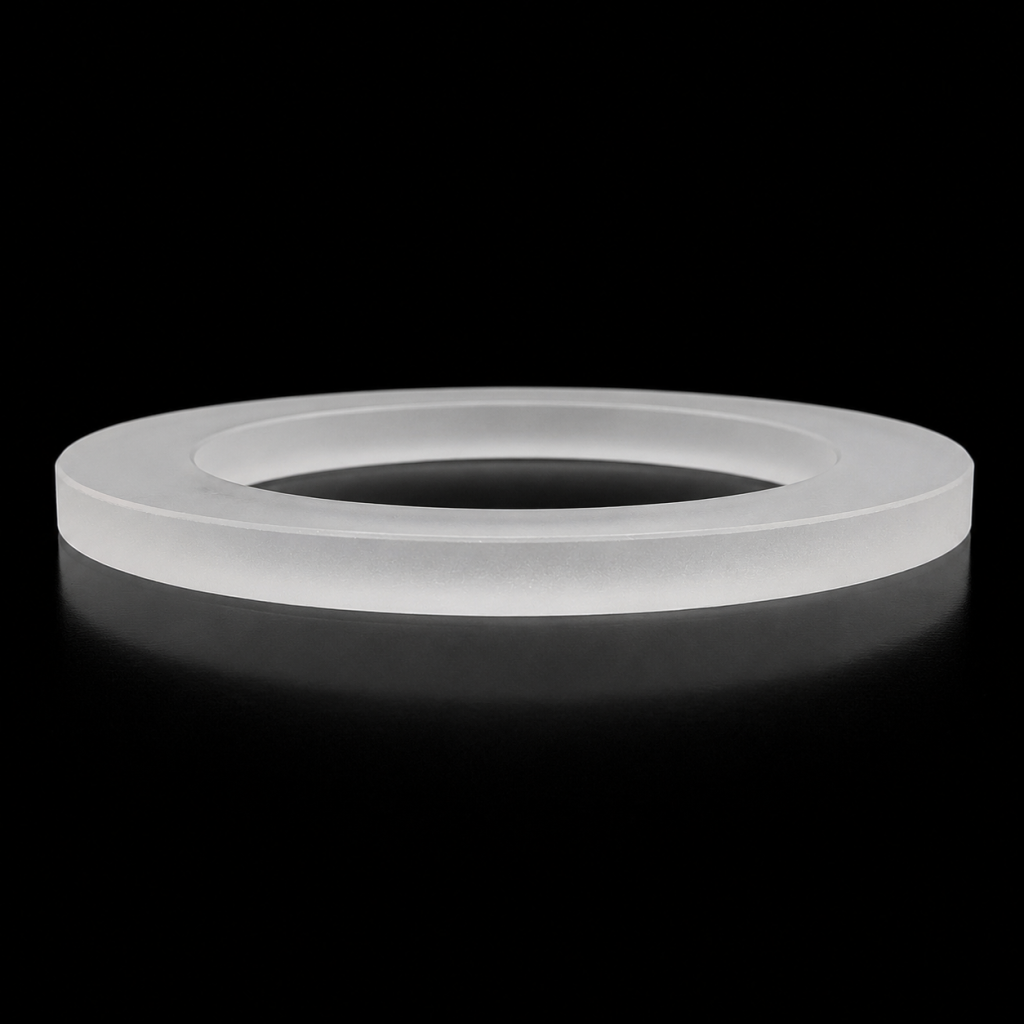
Why the Sealing Method Matters
A sealing system must prevent gases, vapors or liquids from passing through the connection between two components. For quartz flanges, the seal must also protect the brittle quartz from excessive mechanical stress.
An unsuitable sealing method may cause:
- Vacuum leakage
- Process-gas contamination
- Uneven flange loading
- O-ring extrusion or degradation
- Gasket deformation
- Chipping around the flange edge
- Cracking during installation
- Failure during thermal cycling
- Difficulty during maintenance
The correct design depends on the operating temperature, pressure, vacuum level, chemical environment, flange size and frequency of disassembly.
Main Factors in Selecting a Quartz Flange Seal
Before choosing a sealing structure, engineers should define the following operating conditions:
| Selection factor | Information to confirm |
|---|---|
| Operating environment | Vacuum, atmospheric pressure or controlled gas |
| Vacuum requirement | Rough, medium, high or process-specific vacuum |
| Temperature | Normal and maximum sealing-interface temperature |
| Process media | Gas, vapor, liquid or corrosive chemical |
| Cleanliness | Industrial, laboratory or semiconductor grade |
| Flange dimensions | Outside diameter, inside diameter and thickness |
| Surface condition | Flatness, roughness and surface treatment |
| Assembly method | Bolted, clamped, fused or removable |
| Maintenance | Permanent installation or frequent disassembly |
| Connected material | Quartz, metal, ceramic or polymer |
No single sealing method is suitable for every quartz system. In some assemblies, a combination of several methods is required.
1. O-Ring Sealing
O-ring sealing is one of the most widely used methods for removable quartz flange connections. An elastomer ring is compressed between the quartz flange and the mating component to form a vacuum-tight or gas-tight seal.
The O-ring may be installed in:
- A groove machined into the quartz flange
- A groove in the mating metal component
- A separate centering or sealing ring
- A controlled recess between two flat surfaces
Placing the groove in the metal component can sometimes simplify the quartz design and reduce the amount of machining required on the quartz flange.
Advantages of O-Ring Seals
O-rings provide several benefits:
- Good sealing with relatively low clamping force
- Ability to compensate for small surface variations
- Easy installation and replacement
- Suitable for removable assemblies
- Available in many materials and sizes
- Compatible with many vacuum applications
- Less likely to damage quartz when properly designed
Because the O-ring is elastic, it can distribute pressure more evenly than a rigid sealing element.
Common O-Ring Materials
The O-ring material must be compatible with temperature, chemicals, vacuum requirements and contamination limits.
| O-ring material | General characteristics |
|---|---|
| FKM | Good heat and chemical resistance for many industrial applications |
| FFKM | Excellent chemical resistance and high-purity process capability |
| Silicone | Flexible over a wide temperature range, but application compatibility must be checked |
| EPDM | Suitable for certain water, steam and chemical environments |
| NBR | Common for oils and general industrial use at moderate temperatures |
| PTFE-encapsulated elastomer | Provides improved chemical resistance with an elastic inner core |
These are general characteristics only. The actual material should be selected according to the specific process gas, chemical exposure, temperature and vacuum level.
O-Ring Groove Design
The groove must control O-ring positioning and compression. Important parameters include:
- Groove width
- Groove depth
- Inside and outside diameter
- O-ring cross-sectional diameter
- Target compression
- Ytfinish
- Groove edge radius
- Allowance for thermal expansion
- Vacuum-side orientation
Excessive compression increases the force applied to the quartz and can shorten O-ring life. Insufficient compression may result in leakage.
Sharp groove corners should be avoided because they can damage the O-ring and create stress concentration in the quartz.
Limitations of O-Ring Seals
O-ring sealing may not be suitable when:
- The sealing interface reaches very high temperatures
- The process chemical attacks the elastomer
- Extremely low outgassing is required
- Organic contamination cannot be tolerated
- The joint is directly exposed to plasma
- The system requires an all-quartz flow path
If the flange is installed near a high-temperature process zone, cooling or thermal isolation may be required to protect the O-ring.
2. Flat Gasket Sealing
A flat gasket is positioned between two flange faces and compressed to create a seal. This method is commonly used for larger quartz flanges, laboratory chambers and systems where a broad sealing surface is available.
Possible gasket materials include:
- Elastomer sheets
- PTFE
- Expanded PTFE
- Graphite-based materials
- High-temperature fiber materials
- Process-specific composite gaskets
Material compatibility must be evaluated carefully, especially for semiconductor, corrosive chemical and high-temperature applications.
Advantages of Flat Gaskets
Flat gaskets can offer:
- Broad distribution of clamping pressure
- Simple flange geometry
- Compensation for minor surface irregularities
- Availability in custom diameters and shapes
- Suitability for large openings
- Easy replacement during maintenance
A correctly selected soft gasket can reduce point loading on the quartz flange.
Gasket Design Considerations
A flat gasket specification should define:
- Inside diameter
- Outside diameter
- Tjocklek
- Material
- Hardness or compressibility
- Maximum operating temperature
- Kemisk beständighet
- Target compression
- Surface cleanliness
- Reuse limitations
The gasket should be wide enough to distribute load but should not interfere with bolt holes, process flow or assembly clearances.
Risks of Incorrect Gasket Selection
A gasket that is too hard may require excessive bolt force. A gasket that is too soft may extrude into the opening or lose compression over time.
Additional problems can include:
- Uneven gasket thickness
- Permanent compression set
- Partikelbildning
- Chemical degradation
- Outgassing under vacuum
- Absorption of process chemicals
- Contamination from fillers or binders
For high-purity processes, gasket composition and cleaning history may be as important as its mechanical performance.
3. Ground Quartz Joints
Ground joints use precisely matched tapered or flat quartz surfaces to create a removable connection. They are commonly found in laboratory glassware, vacuum lines, chemical-processing systems and specialized quartz apparatus.
Common joint forms include:
- Tapered male and female joints
- Spherical joints
- Flat ground joints
- Socket-and-cone connections
- Custom precision-ground interfaces
Tapered Ground Joints
A tapered joint consists of a male cone and a matching female socket. The large contact area helps create a seal while maintaining alignment.
Tapered joints are often used for:
- Laboratory reactors
- Condensation systems
- Gas-handling assemblies
- Chemical vessels
- Removable quartz tubing
Some applications use a compatible sealing compound, sleeve or gasket, while others rely on closely matched ground surfaces.
Spherical Ground Joints
Spherical joints allow a small degree of angular adjustment. This can be useful when connected components are difficult to align precisely.
They are often selected for:
- Vacuum apparatus
- Complex laboratory assemblies
- Connections exposed to minor movement
- Systems requiring adjustable orientation
Although spherical joints tolerate more angular variation than tapered joints, they still require proper support and controlled clamping.
Advantages of Ground Quartz Joints
Ground joints provide:
- An all-quartz connection option
- Good chemical and thermal compatibility
- Removable assembly
- Precise component alignment
- Reduced use of organic sealing materials
- Suitability for custom laboratory systems
Limitations of Ground Joints
Ground joints may be affected by:
- Surface scratches
- Particles between the mating surfaces
- Incorrect joint matching
- Excessive clamping
- Seizure after high-temperature operation
- Chemical residue
- Chipping around thin joint edges
Matched joints should be kept together when possible. Replacing one half with a nominally similar component may not provide the same fit or sealing performance.
4. Vacuum Flange Connections
Quartz components are frequently connected to metal vacuum systems. Since quartz cannot normally be welded directly to standard stainless-steel vacuum hardware, the connection requires a mechanical seal or a specialized transition.
Common approaches include:
- Quartz flange with an elastomer O-ring
- Quartz-to-metal adapter
- Clamp-style vacuum connection
- Custom metal retaining flange
- Centering ring and sealing assembly
- Graded glass or engineered transition component
Quartz-to-Metal Flange Connections
A quartz flange may be positioned between a metal support flange and a soft sealing element. The metal hardware provides structural clamping while the gasket or O-ring protects the quartz surface.
A suitable design should:
- Distribute load over a broad area
- Prevent direct metal-to-quartz point contact
- Allow for differential thermal expansion
- Maintain flange alignment
- Limit bolt torque
- Avoid rigidly trapping the quartz
Metal and quartz expand at different rates. A connection that performs correctly at room temperature may become highly stressed during heating if no movement is allowed.
Clamp-Style Vacuum Connections
Clamps can provide faster installation and more uniform force than individual bolts. However, the clamp geometry must match the quartz flange design.
The clamping system should not:
- Apply force only to the flange edge
- Create metal point contact
- Pull misaligned components together
- Require excessive compression
- Prevent necessary thermal movement
A separate retaining ring or cushioning layer may be used to distribute the clamping load.
High-Vacuum Considerations
For higher-vacuum applications, sealing performance depends on more than the visible condition of the flange.
Important considerations include:
- O-ring permeability
- Outgassing
- Surface cleanliness
- Trapped volumes
- Groove design
- Surface roughness
- Leak-test sensitivity
- Temperature exposure
- Chemical compatibility
An elastomer seal may be suitable for many vacuum systems, but applications requiring very low outgassing or high-temperature bakeout may need a different interface or a purpose-designed quartz-to-metal transition.
Comparison of Quartz Flange Sealing Methods
| Sealing method | Main advantages | Main limitations | Typical applications |
|---|---|---|---|
| O-ring | Low clamping force, replaceable and easy to install | Temperature and chemical limitations | Vacuum systems, removable quartz chambers |
| Flat gasket | Broad load distribution and simple flange design | Possible creep, particles and outgassing | Large flanges, laboratory and industrial systems |
| Tapered ground joint | All-quartz connection and precise alignment | Sensitive to scratches and mismatching | Laboratory reactors and gas lines |
| Spherical joint | Allows limited angular adjustment | Requires careful support and clamping | Complex laboratory and vacuum assemblies |
| Quartz-to-metal adapter | Connects quartz to standard equipment | Thermal expansion must be managed | Semiconductor and industrial vacuum systems |
| Clamp-style connection | Fast installation and distributed force | Clamp design must match quartz geometry | Frequently opened process assemblies |
Surface Requirements for Reliable Sealing
The sealing surface should be designed according to the selected seal.
Important surface characteristics include:
- Planhet
- Surface roughness
- Parallellism
- Absence of chips
- Absence of deep scratches
- Controlled edge geometry
- Cleanliness
- Concentricity with the opening
A flame-polished surface may have a smooth appearance but may not provide the dimensional precision required for every sealing application. Precision sealing surfaces may require controlled grinding and mechanical polishing.
For an O-ring seal, deep scratches running across the sealing path can create leakage channels. For flat gaskets, poor flatness may produce uneven compression.
How to Prevent Quartz Damage During Sealing
Quartz flange seals should be assembled with enough force to achieve the required seal, but not so much that the flange is bent or overloaded.
Recommended practices include:
- Inspect the flange for chips, scratches and cracks.
- Clean all sealing surfaces and grooves.
- Use a new or verified sealing element.
- Confirm that the components align naturally.
- Prevent direct metal contact with quartz.
- Insert fasteners without forcing them against the hole walls.
- Tighten bolts gradually in a crosswise pattern.
- Use controlled and evenly distributed clamping force.
- Support connected tubes and chambers independently.
- Perform leak testing before applying full process conditions.
If leakage is detected, the first response should not always be to increase the bolt torque. Check gasket position, surface cleanliness, flange alignment and seal compatibility first.
Cleaning and Maintenance
Contamination can affect both sealing performance and process purity. Before installation, remove:
- Dust and particles
- Old gasket residue
- Grease or sealing compound
- Metal fragments
- Packaging fibers
- Chemical deposits
- Broken quartz particles
Cleaning procedures should be selected according to the quartz grade, seal material and application. Abrasive cleaning methods can scratch a sealing surface and should be avoided unless specifically approved.
During maintenance, record:
- Seal replacement frequency
- Evidence of chemical attack
- Permanent compression
- Flange surface damage
- Leak-test results
- Changes in required clamping force
A sudden need for greater clamping force may indicate gasket degradation, flange distortion or surface contamination.
Vanliga frågor och svar
Which sealing method is best for a removable quartz flange?
O-rings and flat gaskets are generally suitable for removable flange connections. The best choice depends on temperature, vacuum level, chemical compatibility and required cleanliness.
Can a quartz flange use a standard vacuum O-ring?
Possibly, but the O-ring size, material and compression must match the custom flange design. Standard size alone does not guarantee process compatibility.
Can quartz flanges be connected directly to stainless-steel flanges?
Yes, using a properly designed gasket, O-ring, retaining flange or quartz-to-metal adapter. The design must prevent point loading and accommodate thermal expansion differences.
Are ground quartz joints suitable for vacuum use?
Ground quartz joints can be used in certain vacuum systems, particularly laboratory equipment. Their performance depends on joint quality, cleanliness, matching and the use of any compatible sealing accessory.
Can a metal gasket be used on a quartz flange?
Metal gaskets usually require high sealing force and may damage quartz if used in a conventional metal-flange configuration. Any metal-seal design involving quartz requires specialized engineering and careful load distribution.
Why does an O-ring-sealed quartz flange still leak?
Possible causes include insufficient or excessive compression, surface scratches, particles, an incorrectly sized groove, flange misalignment, O-ring damage or unsuitable material selection.
Slutsats
The most suitable quartz flange sealing method depends on the balance between vacuum performance, temperature resistance, chemical compatibility, cleanliness and installation safety.
O-rings offer reliable sealing with relatively low clamping force. Flat gaskets distribute pressure over a larger area. Ground quartz joints provide removable all-quartz connections, while engineered vacuum adapters allow quartz components to connect to metal equipment.
Regardless of the method selected, the seal should distribute load evenly and avoid forcing the quartz into alignment. Proper flange design, clean surfaces and controlled assembly are essential for preventing leakage and protecting the quartz component from damage.
For custom quartz flanges, O-ring grooves, ground joints, quartz-to-metal connection components and complete quartz tube assemblies, provide your drawings, sealing requirements and operating conditions. The sealing structure can then be evaluated according to your application.