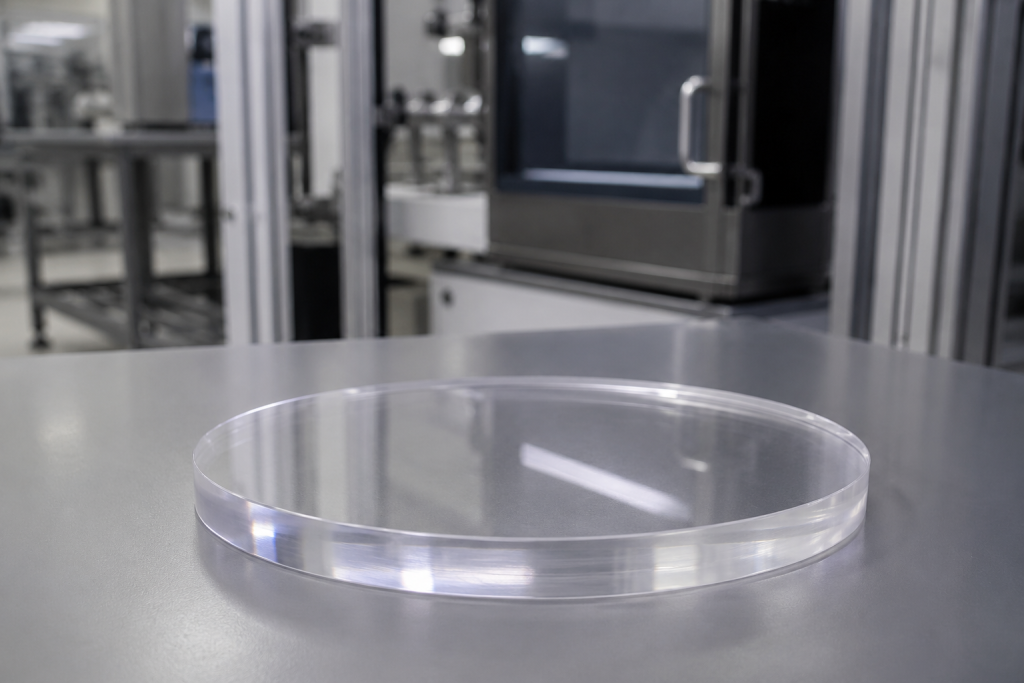
Ultra-low expansion (ULE) quartz glass is a specialized glass material engineered to exhibit an extremely small coefficient of thermal expansion (CTE) across a specific temperature range. Compared with conventional aluminosilicate glass and ceramic materials, its thermal expansion coefficient can be reduced by one to two orders of magnitude. In some temperature intervals, the CTE approaches zero, enabling exceptional dimensional stability under severe thermal fluctuations.
Because of this unique property, ultra-low expansion quartz glass has become a critical material in advanced optical systems, semiconductor lithography, aerospace instrumentation, astronomical telescopes, and precision metrology. This article reviews the fundamental characteristics, manufacturing technologies, and emerging applications of ULE quartz glass while discussing recent developments in material engineering.
Introduction
Conventional optical materials inevitably undergo dimensional changes when exposed to temperature variation. In high-precision systems, even nanometer-scale deformation may induce optical aberration, frequency drift, or mechanical instability.
For example:
- Semiconductor lithography optics require sub-nanometer dimensional stability.
- Space telescopes operate under extreme temperature cycling.
- Optical atomic clocks rely on cavity lengths with near-zero thermal sensitivity.
Traditional fused silica already exhibits relatively low thermal expansion:
Approximately:
0.5 ×10⁻⁶/K
However, for extreme applications, even this value remains insufficient.
Ultra-low expansion quartz glass addresses this challenge by modifying the silica network through controlled dopant incorporation and advanced manufacturing processes, achieving thermal expansion coefficients close to zero.
Thermal Expansion Characteristics of Ultra-Low Expansion Quartz Glass
Thermal expansion behavior is commonly described by:
Where:
- α = coefficient of thermal expansion
- L = original dimension
- dL/dT = dimensional change with temperature
Compared with conventional materials:
| Материал | Typical CTE |
|---|---|
| Aluminum | ~23×10⁻⁶/K |
| Боросиликатное стекло | ~3.3×10⁻⁶/K |
| Плавленый кварц | ~0.5×10⁻⁶/K |
| Ultra-Low Expansion Quartz | <0.05×10⁻⁶/K |
In optimized systems, thermal expansion may approach zero within a designated operating range.
This property dramatically reduces thermal deformation and improves optical stability.
Manufacturing Technologies of Ultra-Low Expansion Quartz Glass
The fundamental strategy behind ULE material preparation involves modifying the silica network through carefully controlled doping processes.
Titanium dioxide (TiO₂) is among the most widely used additives because of its negative thermal expansion contribution.
Several manufacturing methods have been developed.
1. Flame Hydrolysis Deposition (FHD)
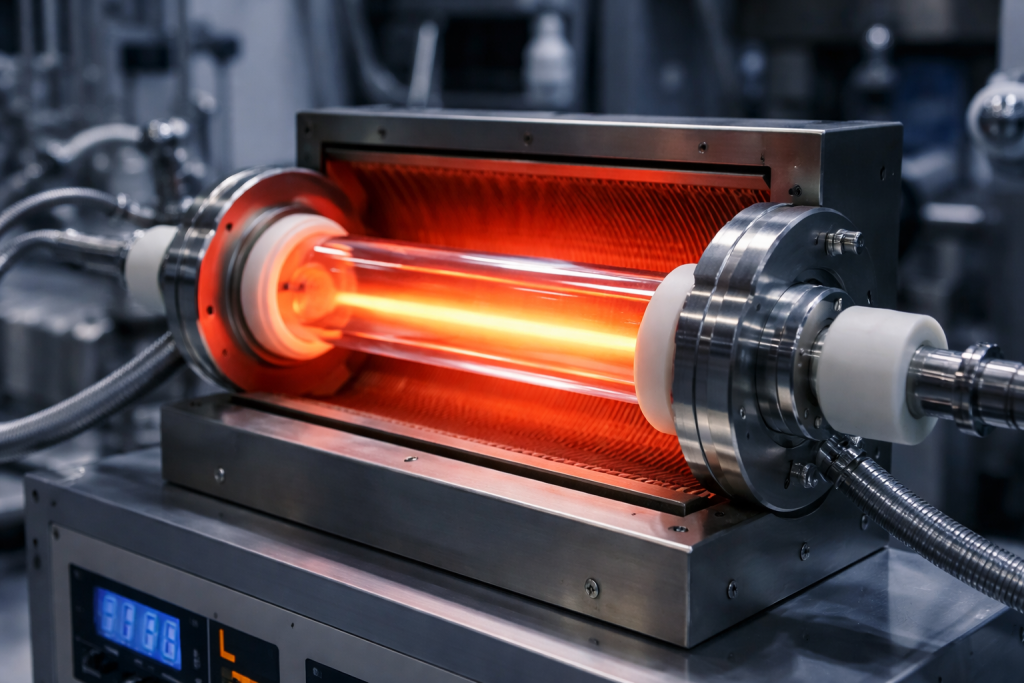
Flame Hydrolysis Deposition remains the most mature industrial process for producing TiO₂-doped ultra-low expansion quartz glass.
The process typically utilizes silicon and titanium precursors such as:
- SiCl₄
- TiCl₄
Within a hydrogen-oxygen flame, these precursors undergo hydrolysis and oxidation reactions, generating nanoscale SiO₂–TiO₂ particles.
These particles are deposited layer by layer onto rotating substrates and subsequently consolidated into dense glass.
Two primary approaches are used:
Direct Synthesis
Chemical Vapor Deposition (CVD) directly forms doped glass during deposition.
Advantages include:
- Simplified processing
- Высокая чистота
- Industrial scalability
Indirect Synthesis
Processes such as:
- VAD (Vapor Axial Deposition)
- OVD (Outside Vapor Deposition)
first generate porous preforms, followed by:
- dehydration
- doping
- consolidation
- thermal treatment
This approach offers improved composition control and uniformity.
2. Sol–Gel Method
The sol–gel process employs metal alkoxide precursors that undergo hydrolysis and condensation reactions.
The resulting gel structure is subsequently processed through:
- solvent exchange
- drying
- pre-sintering
- densification
Advantages include:
- molecular-level mixing
- low-temperature processing
- flexible composition adjustment
However, challenges remain in:
- crack control
- shrinkage management
- large-scale production
3. Hybrid VAD–ALD Processing
Emerging fabrication routes combine Vapor Axial Deposition with Atomic Layer Deposition.
The process involves:
- Preparing porous SiO₂ preforms through VAD
- Utilizing surface hydroxyl groups as reaction sites
- Introducing TiCl₄ for atomic-scale deposition
- Removing chlorine residues through water vapor reaction cycles
- Repeating deposition cycles to ensure concentration uniformity
After high-temperature consolidation around 1400°C, highly homogeneous SiO₂–TiO₂ glass structures can be obtained.
Compared with conventional methods, this technique provides:
- nanoscale dopant precision
- superior uniformity
- lower concentration fluctuation
4. Fluorine Doping Technology
Fluorine-modified silica represents another important approach for reducing thermal expansion.
Fluorine alters network bonding structures and decreases thermal sensitivity.
Some fluorinated silica materials exhibit:
CTE <5×10⁻⁸/K
Such materials have attracted significant attention for advanced lithographic systems.
Major Applications of Ultra-Low Expansion Quartz Glass
Extreme Ultraviolet Lithography (EUV)
EUV lithography operates at:
13.5 nm
Unlike previous lithographic generations that relied on refractive optics, EUV systems use multilayer reflective optical architectures.
During exposure, optical elements may experience temperature increases from room temperature to more than 100°C.
Even extremely small thermal distortions can affect:
- wavefront quality
- imaging accuracy
- overlay precision
Ultra-low expansion quartz minimizes these effects because of:
- near-zero CTE
- extremely low CTE variation
- low residual stress
- excellent polishing capability
Therefore, it is widely employed in:
- reflective mirrors
- mask substrates
- optical support structures
Large Lightweight Astronomical Mirrors
Modern astronomical and aerospace optical systems increasingly demand larger apertures with lower structural weight.
Mirror substrates must simultaneously provide:
- dimensional stability
- lightweight design
- mechanical rigidity
Ultra-low expansion quartz enables fabrication of:
- honeycomb mirror structures
- fused assemblies
- lightweight closed-cell designs
Surface densities below:
10 kg/m²
have been reported while maintaining excellent optical precision.
Приложения включают:
- space telescopes
- adaptive optics
- satellite imaging systems
Optical Atomic Clocks
Optical atomic clocks require ultra-stable optical frequencies as references.
The optical cavity acts as the frequency stabilization core.
Any thermal expansion can alter cavity length and induce frequency drift.
At the material’s zero-expansion temperature point, cavity dimensions become highly insensitive to environmental fluctuations.
When combined with:
- ultra-high vacuum systems
- precision thermal control
- vibration isolation
ULE quartz enables substantial improvements in:
- frequency stability
- drift suppression
- long-term timing accuracy
This technology plays a central role in next-generation precision timing systems.
Future Trends
As semiconductor technology, quantum systems, and aerospace optics continue advancing, future ultra-low expansion materials are expected to pursue:
- lower thermal expansion
- larger dimensions
- improved homogeneity
- reduced defect density
- higher optical performance
Emerging manufacturing technologies such as:
- atomic-scale deposition
- AI-assisted process control
- advanced nanostructure engineering
may further improve thermal and optical characteristics.
Ultra-low expansion quartz glass is therefore expected to remain one of the foundational materials enabling next-generation precision engineering.
ЧАСТО ЗАДАВАЕМЫЕ ВОПРОСЫ
What makes ultra-low expansion quartz different from conventional fused silica?
Ultra-low expansion quartz incorporates carefully controlled dopants such as titanium dioxide to significantly reduce thermal expansion, achieving coefficients close to zero over specific temperature ranges.
Why is thermal expansion critical in precision optical systems?
Even nanometer-scale dimensional changes can affect optical alignment, imaging accuracy, and frequency stability in advanced systems such as EUV lithography and optical clocks.
What are the main challenges in manufacturing ULE quartz glass?
Key challenges include maintaining dopant uniformity, controlling residual stress, minimizing defects, and achieving large-scale production while preserving ultra-low thermal expansion performance.