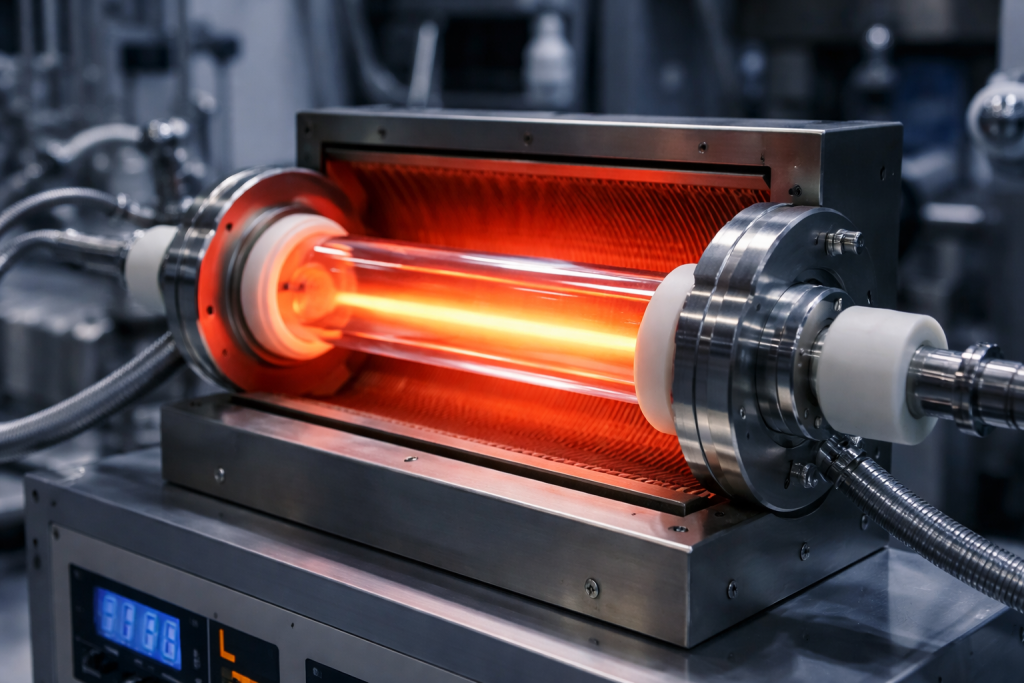
Quartz products are essential consumables in semiconductor manufacturing and play a critical role throughout the entire integrated circuit (IC) production process. From silicon crystal growth to wafer fabrication and advanced semiconductor processing, high-purity quartz components are indispensable due to their exceptional thermal stability, chemical purity, and resistance to corrosive environments.
A typical semiconductor production line utilizes a wide variety of quartz products, including:
- Кварцевые тигли
- Quartz boats
- Quartz bell jars
- Quartz diffusion tubes
- Quartz process chambers
- Quartz glass substrates
- Quartz rings and carriers
- Optical quartz components
As semiconductor technology advances toward larger wafer sizes and more sophisticated process equipment, the demand for high-performance quartz components continues to increase.
Why Quartz Is Essential in Semiconductor Manufacturing
High-purity fused quartz offers several unique advantages:
- Отличная устойчивость к тепловым ударам
- Extremely low impurity content
- High temperature stability
- Superior resistance to chemical corrosion
- Excellent optical transparency
- Low contamination risk
These characteristics make quartz an ideal material for high-temperature semiconductor processes such as:
- Crystal growth
- Oxidation
- Diffusion
- LPCVD
- Etching
- Wafer handling
Many quartz components operate directly inside process chambers and come into contact with wafers, making manufacturing quality and cleanliness critical factors.
From Quartz Sand to Semiconductor Components
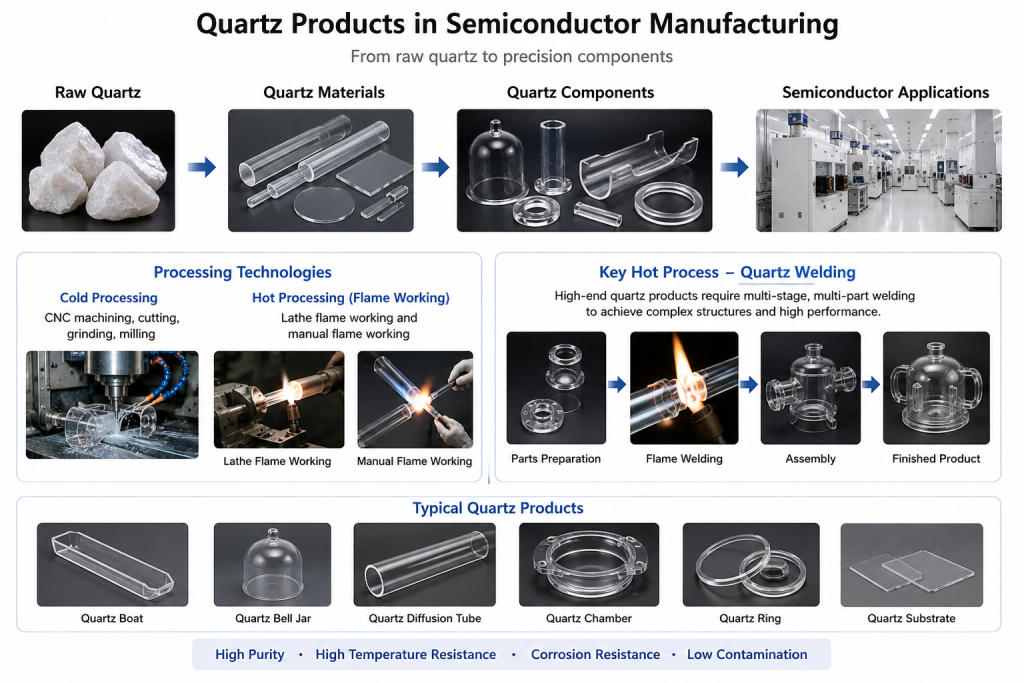
The journey from raw quartz sand to precision semiconductor components involves multiple manufacturing stages.
High-purity quartz materials are first refined and processed into:
- Quartz rods
- Quartz tubes
- Quartz ingots
- Quartz plates
- Quartz rings
- Quartz wafers
- Optical quartz glass
These materials are then fabricated into complex semiconductor components through a combination of cold-working and hot-working processes.
Two Core Manufacturing Technologies
Quartz processing can generally be divided into two major categories:
1. Cold Processing
Cold processing refers to the mechanical shaping of quartz materials without melting the material.
Typical Processes
- CNC cutting
- Precision grinding
- Milling
- Drilling
- Surface polishing
- Edge finishing
Modern quartz manufacturers rely heavily on advanced CNC equipment to achieve tight dimensional tolerances and consistent quality.
Приложения
Cold processing is commonly used for:
- Quartz rings
- Quartz plates
- Оптические окна
- Precision machined components
- Certain etching chamber parts
Some relatively simple semiconductor components can be completed entirely through precision machining.
Ключевые преимущества
- Высокая точность размеров
- Excellent repeatability
- Automated production
- Suitable for large-scale manufacturing
However, cold processing alone cannot produce many of the complex geometries required in advanced semiconductor equipment.
2. Hot Processing (Flame Working)
Hot processing is the most critical and technically demanding stage of quartz manufacturing.
Unlike CNC machining, flame working relies heavily on experienced technicians and specialized craftsmanship developed through years of practice.
Even in today’s highly automated semiconductor industry, many high-end quartz components still depend on manual flame-working techniques that are difficult to replace with automation.
Lathe Flame Working
One of the most common hot-processing methods is glass lathe flame working.
Process Overview
The quartz tube is mounted on a precision glass lathe and rotated continuously.
Using an oxyhydrogen flame as the heat source, skilled technicians perform operations such as:
- Reshaping
- Forming
- Necking
- Expansion
- Surface finishing
- Polishing
The combination of controlled rotation and precise flame heating allows manufacturers to produce highly symmetrical and dimensionally accurate quartz components.
Typical Products
- Quartz diffusion tubes
- Quartz process chambers
- Quartz bell jars
- Large-diameter quartz vessels
Manual Flame Working
Manual flame working represents the highest level of quartz fabrication expertise.
Rather than relying on machine rotation, the process is performed almost entirely by skilled craftsmen using hand-controlled techniques.
Typical Operations
- Quartz blowing
- Quartz welding
- Complex assembly
- Precision reshaping
- Surface polishing
Oxyhydrogen flames are used to soften and fuse quartz materials together while maintaining structural integrity and purity.
Why It Matters
Many advanced semiconductor quartz products contain:
- Multiple assemblies
- Complex branch structures
- Special angles
- Precision interfaces
- Customized geometries
These features often cannot be produced solely by automated equipment.
As a result, manual flame-working remains one of the most valuable and difficult-to-master skills in the quartz industry.
Quartz Welding: A Core Technology for High-End Components
Among all hot-processing techniques, quartz welding is often considered the most critical capability.
High-performance semiconductor quartz components require:
- Multi-stage assembly
- Layered fabrication
- Precision alignment
- Low-stress welding
- Контроль загрязнения
Complex products are frequently manufactured by welding multiple precision-machined components into a single finished assembly.
The quality of these welds directly affects:
- Mechanical strength
- Thermal stability
- Process lifetime
- Cleanliness performance
- Yield reliability
In many cases, a manufacturer’s welding expertise determines the complexity and performance level of the quartz products it can supply.
Cleaning: The Final Step Toward Semiconductor Quality
Manufacturing precision alone is not sufficient for semiconductor applications.
After machining and flame processing, quartz components must undergo rigorous cleaning procedures to remove:
- Particulates
- Metallic contaminants
- Organic residues
- Surface impurities
Even microscopic contamination can affect semiconductor yield and process stability.
Therefore, advanced cleaning and inspection technologies are essential for producing semiconductor-grade quartz products.
Small vs. Large Quartz Components
As wafer sizes increase from 4–6 inches to 8–12 inches and beyond, quartz components become significantly more complex.
Large semiconductor quartz products generally feature:
- Более длительный срок службы
- More sophisticated structures
- Более жесткие допуски на размеры
- Higher cleanliness requirements
- Greater integration with process equipment
Examples include:
- Large quartz boats
- Multi-zone diffusion tubes
- Complex chamber assemblies
- Large quartz insulation structures
These products often require both advanced CNC machining and highly skilled flame-working expertise.
Заключение
Quartz products are indispensable throughout the semiconductor manufacturing supply chain. From crystal growth furnaces and diffusion systems to wafer handling and process chambers, high-purity quartz components provide the thermal, chemical, and contamination-control performance required by modern semiconductor fabrication.
Although semiconductor manufacturing is one of the most automated industries in the world, the production of high-end quartz components still depends heavily on experienced craftsmen and specialized flame-working techniques. The combination of precision cold processing, advanced quartz welding, and ultra-clean manufacturing ultimately determines the quality and performance of semiconductor-grade quartz products.
As semiconductor technologies continue to evolve toward larger wafers, more advanced process nodes, and stricter contamination requirements, high-performance quartz components will remain a critical foundation of the industry.