


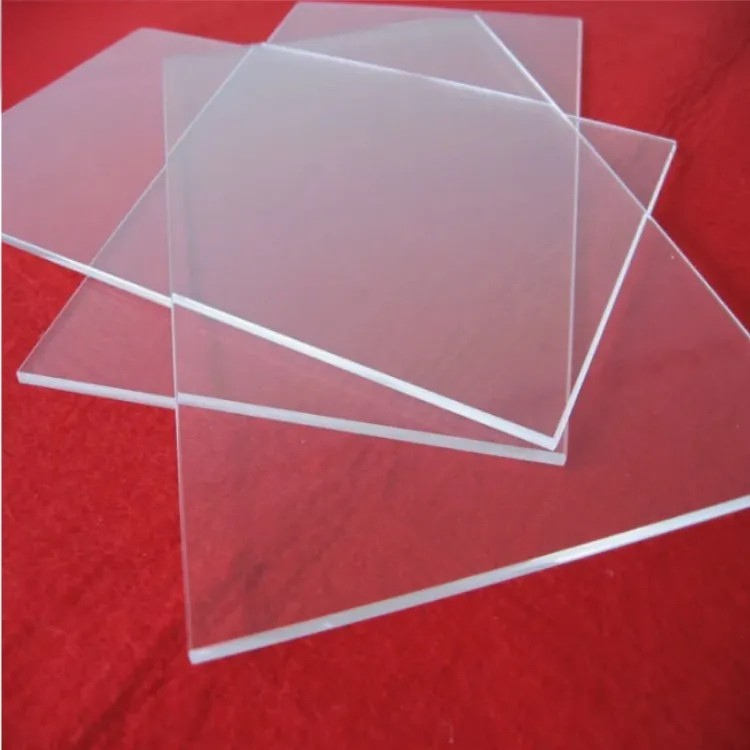
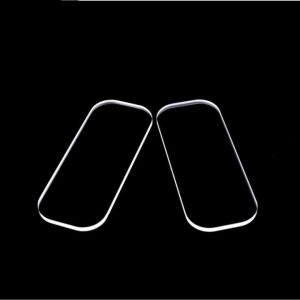
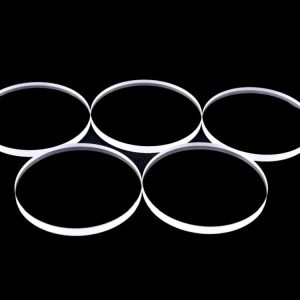
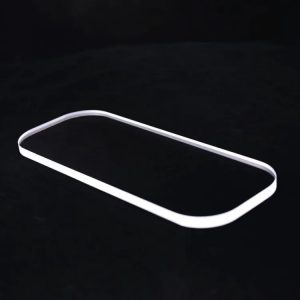
These high-purity quartz glass plates are precision-engineered from ultra-pure silicon dioxide (SiO₂ ≥ 99.99%) using advanced melting and rapid cooling techniques. The resulting fused silica exhibits exceptional optical clarity, thermal stability, and chemical resistance. Based on purity and optical performance, these plates are classified into three grades: JGS1, JGS2, and JGS3.
Optical Grades
JGS1 – Far-Ultraviolet Optical Fused Silica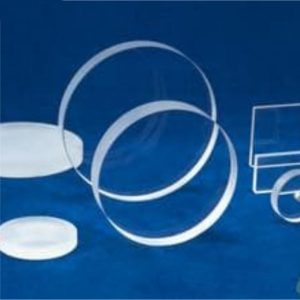
-
High hydroxyl content (~2000 ppm)
-
Exceptional UV transmittance, exceeding 90% at 185 nm
-
Suitable for 185–2500 nm wavelength range
-
Applications: DUV lithography lenses, space telescope mirrors, UV laser collimators
JGS2 – Ultraviolet Optical Fused Silica
-
Manufactured from crystalline raw materials via gas refining
-
Metal impurities at tens of ppm, hydroxyl content 100–200 ppm
-
Transmission range 220–2500 nm
-
Applications: Consumer optics such as camera lenses, projector prisms, microscope objectives
JGS3 – Infrared Optical Fused Silica
-
Produced from high-purity quartz sand or crystalline materials via vacuum electrical melting
-
Minimal hydroxyl content and negligible bubbles
-
Infrared transmittance >85%, suitable for 260–3500 nm wavelength range
-
Applications: IR thermal imaging windows, CO₂ laser focusing mirrors, missile infrared seeker domes
Основные характеристики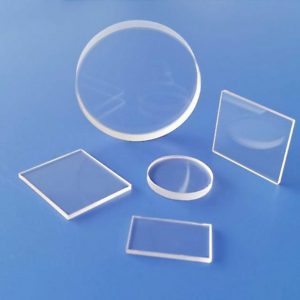
-
Термическая стабильность: Softening point 1683°C, annealing point 1215°C, strain point 1120°C
-
Precision Processing: Multi-stage gradient annealing reduces internal stress; magnetorheological polishing achieves Ra <0.5 nm
-
Coating Options: Anti-reflective (AR), high-reflection (HR), and corrosion-resistant coatings
-
Химическая стойкость: Highly resistant to water and most acids (except HF)
-
Mechanical Properties: Mohs hardness 5.5–6.5, Young’s modulus 7.2×10¹⁰ Pa
 Приложения
-
High-End Optical Systems: DUV lithography lenses, UV collimators, space telescope mirrors
-
Semiconductor Manufacturing: Photomask substrates, wafer processing carriers, high-temperature diffusion furnace components
-
Laser Technology: Nd:YAG laser mirrors, CO₂ laser transmission components
-
Аэрокосмическая промышленность: Spacecraft optical windows, hypersonic missile IR seeker domes
-
Special Lighting: High-purity UV lamps, mercury lamp housings
-
Scientific Research: Synchrotron beamline windows, Cherenkov particle detectors
Standard Specifications
| Недвижимость | Значение |
|---|---|
| Плотность | 2.20 g/cm³ |
| Abbe Number | 67.6 |
| Refractive Index (588 nm) | 1.4586 |
| Твердость | 5.5–6.5 Mohs |
| Design Tensile Strength | 4.8×10⁷ Pa |
| Design Compressive Strength | >1.1×10⁹ Pa |
| Модуль Юнга | 7.2×10¹⁰ Pa |
| Poisson’s Ratio | 0.17 |
| Коэффициент теплового расширения | 5.5×10⁻⁷ cm/cm·℃ |
| Теплопроводность | 1.4 W/m·℃ |
| Точка размягчения | 1683℃ |
| Точка отжига | 1215℃ |
| Точка деформации | 1120℃ |
| Electrical Resistivity | 7×10⁷ ohm·cm (350℃) |
| Химическая стабильность | Highly resistant to water and acids except HF |
ЧАСТО ЗАДАВАЕМЫЕ ВОПРОСЫ
-
What are the differences between JGS1, JGS2, and JGS3?
JGS1 offers >90% UV transmission at 185 nm with 2000 ppm OH, JGS2 provides 220–2500 nm transmission with 100–200 ppm OH, and JGS3 delivers >85% IR transmission with near-zero OH content. -
Which grade is suitable for UV laser applications?
JGS1 is ideal for UV lasers due to its >90% transmittance at 185 nm and high laser damage threshold of 15 J/cm².


Отзывы
Отзывов пока нет.