In industrial, laboratory, and scientific applications, selecting the appropriate glass material is crucial for ensuring process efficiency, product quality, and safety. Quartz and borosilicate glass are two widely used materials, each with distinct properties that make them suitable for specific high-temperature, chemical, and optical applications. Understanding the differences between these materials is essential for engineers, researchers, and technicians who aim to optimize their processes.
Material Properties
Quartz (High-Purity SiO₂)
Quartz, composed primarily of silicon dioxide, is renowned for its exceptional thermal, chemical, and optical properties:
- 열 저항
Quartz can withstand temperatures exceeding 1,100°C without deformation, softening, or loss of mechanical integrity. Its low thermal expansion coefficient minimizes thermal stress, making it highly resistant to thermal shock. - Chemical Inertness
Quartz exhibits excellent resistance to acids, alkalis, and organic solvents, ensuring that it does not react with the chemicals it contains. This property is particularly valuable in high-purity chemical synthesis, semiconductor processing, and photochemical experiments. - 광학 투명도
Quartz is highly transparent to both ultraviolet (UV) and visible light, which allows for precise optical and photochemical processes. Standard glass or borosilicate often absorbs UV light, limiting their use in such applications. - 기계적 강도
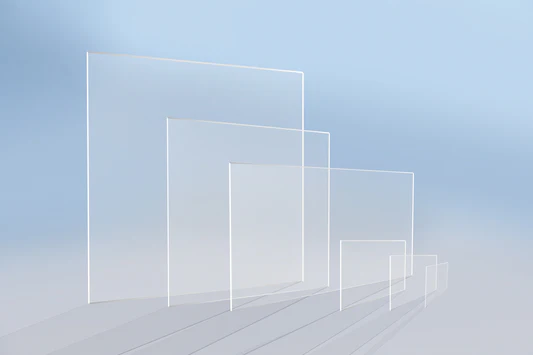
Quartz maintains structural integrity under high temperatures and is manufactured with high flatness and smooth surfaces, ideal for precision laboratory and industrial applications.
붕규산 유리
Borosilicate glass, commonly known under trade names such as Pyrex®, is a silicate-based glass with boron trioxide added to improve thermal resistance and chemical stability:
- Moderate Thermal Resistance
Borosilicate can typically withstand temperatures up to 500°C continuously, with a higher thermal expansion than quartz. It is suitable for moderate-temperature applications but is less tolerant to rapid thermal cycling. - Good Chemical Resistance
Borosilicate glass resists most acids and aqueous solutions but is less resistant than quartz to strong alkalis and some reactive gases. For processes requiring extreme chemical inertness, quartz is generally preferred. - 광학 속성
Borosilicate glass is transparent in the visible spectrum but absorbs UV light below approximately 300 nm. This limits its use in UV-dependent photochemical processes. - Mechanical Durability
Borosilicate is mechanically strong at moderate temperatures and more resistant to breakage than standard soda-lime glass, making it suitable for general laboratory glassware and moderate industrial applications.
Key Differences and Applications
| 속성 | 쿼츠 | 붕규산 유리 |
|---|---|---|
| Maximum Temperature | >1100°C | ~500°C |
| 열팽창 | 매우 낮음 | 보통 |
| 열 충격 저항 | 높음 | 보통 |
| 내화학성 | 우수 | Good |
| UV Transparency | Excellent (200–400 nm) | Limited (<300 nm) |
| 표면 평탄도 | 높음 | 보통 |
| 일반적인 애플리케이션 | Semiconductor processing, high-temperature reactors, photochemistry, optical instruments | General laboratory glassware, chemical storage, moderate-temperature reactions |
Process Considerations
- High-Temperature Applications
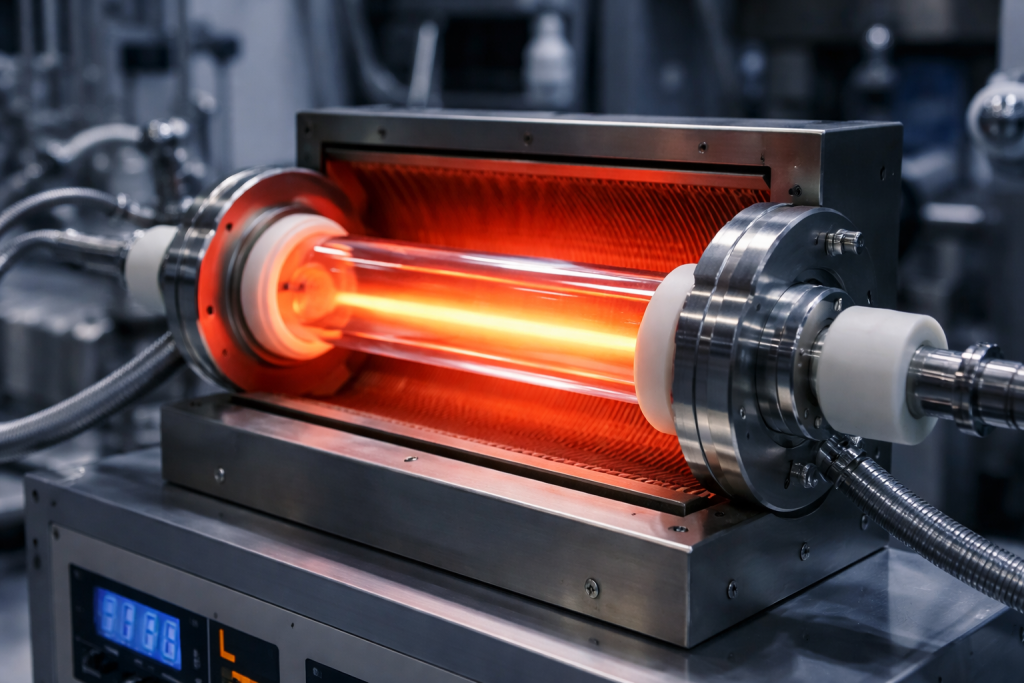
For processes that require sustained high temperatures or rapid temperature cycling, such as tube furnaces, semiconductor annealing, or crystal growth, quartz is the preferred material due to its superior thermal stability and resistance to thermal shock. - 화학 처리
When working with strong acids, corrosive gases, or ultra-pure chemical environments, quartz provides the highest level of chemical inertness. Borosilicate glass is suitable for general chemical applications, especially at lower temperatures, but may degrade under extreme conditions. - Optical and Photochemical Requirements
Quartz allows for UV transmission, making it ideal for photochemical reactions, UV sterilization, and optical instrumentation. Borosilicate glass is limited in the UV range and is less suitable for processes requiring high UV transparency. - Cost and Availability
Borosilicate glass is generally less expensive and more widely available than high-purity quartz. For applications that do not require extreme thermal or chemical resistance, borosilicate offers a cost-effective solution. Quartz, while more costly, provides unmatched performance in demanding processes.
결론
Both quartz and borosilicate glass have their advantages and limitations. Quartz excels in high-temperature, chemically aggressive, and UV-sensitive applications, offering unparalleled purity, stability, and optical performance. Borosilicate glass is a robust and economical choice for moderate-temperature chemical processes, general laboratory use, and less demanding industrial operations. Selecting the right material depends on evaluating temperature requirements, chemical environment, optical needs, and process precision.