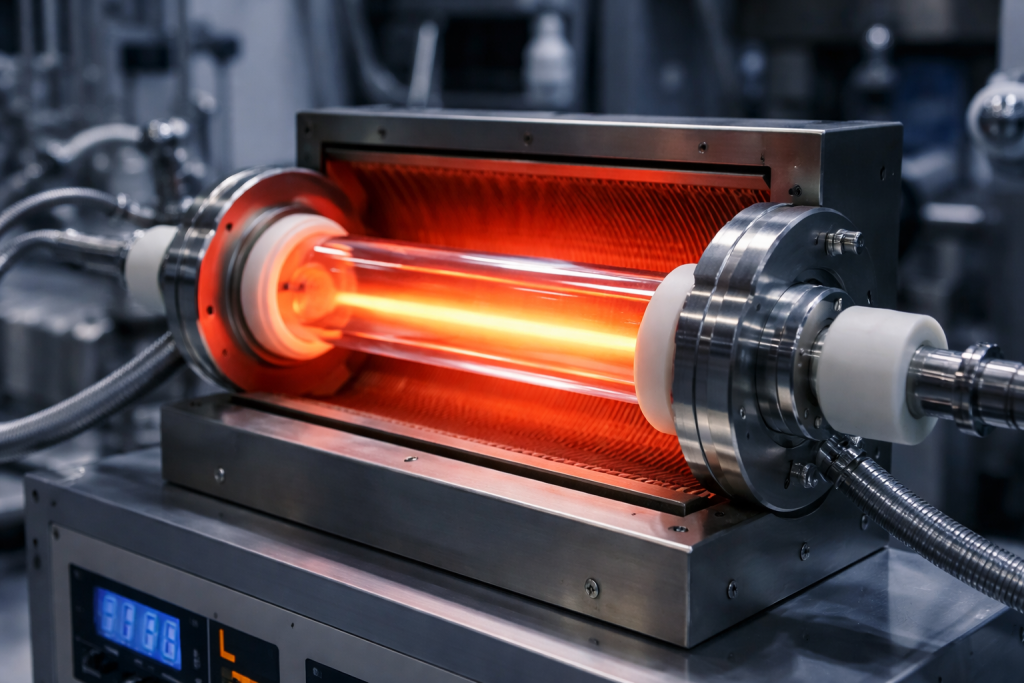
In semiconductor manufacturing, there is a class of materials that does not directly form the chip structure, yet runs through nearly every critical process step. This material is high-purity quartz glass and its fabricated components, widely regarded as the “invisible backbone” of semiconductor production.
From wafer oxidation and diffusion to etching, deposition, and lithography support systems, quartz-based materials provide indispensable performance under extreme conditions such as high temperature, corrosive gases, and ultra-clean environments.
This article provides a systematic overview of the quartz glass industry chain from a semiconductor application perspective.

1. Overall Industry Chain Structure: A Three-Tier System
The quartz glass industry chain can be divided into three major segments:
High-purity quartz sand → Quartz glass materials → Quartz glass components → Semiconductor and advanced applications
Each stage plays a critical role in determining final performance, especially in terms of purity, defect control, and thermal stability.
2. Upstream: High-Purity Quartz Sand (The Foundation of the Industry)
2.1 Core Function
High-purity quartz sand is the starting raw material of the entire industry chain. Its purity level directly determines whether downstream products can meet semiconductor-grade requirements.
Typical specifications include:
- SiO₂ ≥ 99.9%
- Fe₂O₃ ≤ 0.0001%
- Al₂O₃ ≤ 0.01%
- Extremely low inclusion content
- Minimal radioactive impurities
2.2 Purity Classification
Industrial high-purity quartz sand is commonly classified as:
- 3N (99.9%) – basic industrial use
- 4N (99.99%) – optical and photovoltaic applications
- 4N8 (99.998%) – high-end optical and advanced electronics
- 5N+ (99.999% and above) – semiconductor-grade applications
Each additional “nine” represents a significant exponential increase in purification difficulty.
2.3 Resource Constraints and Supply Characteristics
High-purity quartz sand production is strongly dependent on natural mineral deposits, resulting in a resource-constrained supply structure:
- Limited availability of ultra-high-quality ore
- Complex beneficiation and purification processes
- Extremely sensitive impurity control requirements
- High cost sensitivity to raw material quality
As a result, the upstream segment is characterized by a resource-driven and technology-intensive barrier structure.
3. Midstream: Quartz Glass Materials (The Technical Core)
3.1 Product Forms
Quartz sand is processed into semi-finished materials such as:
- Quartz ingots
- Quartz tubes
- Quartz rods
- Quartz plates
These serve as the foundation for downstream precision fabrication.
3.2 Main Manufacturing Routes
Quartz glass is primarily produced through three industrial routes:
(1) Natural Melting Method
Natural quartz crystals or silica sand are melted at high temperatures to form amorphous silica.
特徴
- Mature and widely used process
- Relatively lower cost
- Limited impurity removal capability
- Suitable for industrial-grade applications
During processing, quartz undergoes phase transitions:
β-quartz → α-quartz → cristobalite → molten amorphous silica
(2) Chemical Synthesis Method
Silicon-containing precursors are converted into SiO₂ through chemical reactions at high temperature or plasma conditions.
Main routes include:
- Chemical vapor deposition (CVD)
- Flame hydrolysis deposition (FHD)
- Sol-gel process
特徴
- Extremely high purity output
- Excellent impurity control
- Higher production cost
- Widely used in semiconductor-grade materials
(3) Thermal Reprocessing (Reforming) Method
Existing quartz materials are reheated and reshaped into required geometries.
Typical products include:
- Tubes
- Crucibles
- Boats and carriers
- Customized optical structures
特徴
- High flexibility
- Suitable for complex geometries
- Requires advanced thermal processing control
3.3 Key Material Quality Indicators
Critical parameters for midstream quartz glass include:
- Hydroxyl (OH) content
- Total metallic impurity level
- バブルとインクルージョンの密度
- Internal stress distribution
- Optical uniformity
Among them, OH content significantly affects infrared transmission and high-temperature stability.
4. Downstream: Quartz Components (High Value-Added Segment)
4.1 Product Categories
Quartz glass is further fabricated into functional semiconductor components, including:
- Wafer carrier boats
- 拡散炉管
- CVD reactor chamber parts
- High-purity crucibles
- 光学窓
- Plasma etching chamber components
4.2 Role in Semiconductor Processes
Quartz components are widely used across key semiconductor manufacturing steps:
(1) High-Temperature Processes
- Oxidation
- Diffusion
- Annealing
Key requirements:
- Thermal resistance above 1000°C
- Excellent thermal shock stability
- Ultra-low contamination release
(2) Thin-Film Deposition
- CVD / PECVD
- ALD
Key requirements:
- Ultra-low particle generation
- High chemical inertness
- Plasma resistance
(3) Plasma Etching Environments
- CF₄, Cl₂, and other corrosive gases
- High-energy plasma exposure
Key requirements:
- Strong plasma erosion resistance
- Structural stability under ion bombardment
- Minimal surface degradation
4.3 Technical Barriers
Quartz component manufacturing represents the highest barrier segment in the industry chain, due to:
- Ultra-precision machining requirements
- Surface/subsurface damage control
- Ultra-clean processing environments
- High-temperature structural engineering
- Strong customization demand
5. Key Industry Trends
5.1 Continuous Purity Improvement
Advanced semiconductor nodes demand increasingly lower impurity levels approaching theoretical limits.
5.2 Increasing Structural Complexity
Products are evolving from simple tubes into:
- Multi-chamber structures
- Large-scale precision components
- Optical-grade engineered parts
5.3 Accelerating Localization
High-end supply chains are gradually shifting toward regional production, although top-tier capabilities remain challenging.
5.4 Expanding Application Domains
Beyond semiconductors, quartz materials are increasingly used in:
- Photovoltaics
- 光ファイバー
- 高出力レーザーシステム
- 航空宇宙・防衛システム
6.結論
The quartz glass industry chain represents a classic progression from natural resources to ultra-precision engineering. Each stage—from high-purity quartz sand to advanced semiconductor components—directly determines process stability, yield, and performance in modern chip manufacturing.
As semiconductor technology continues to advance toward smaller nodes and more complex process architectures, quartz glass will remain a foundational material whose importance continues to grow, particularly in ultra-clean, high-temperature, and high-stability environments.