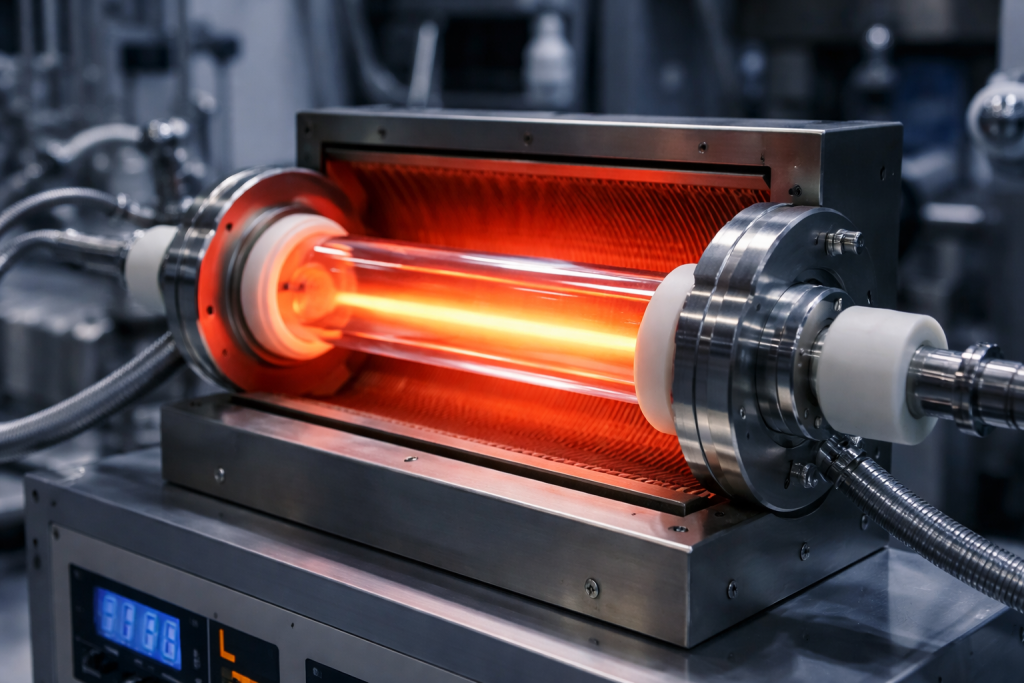
A cracked quartz tube can sometimes be repaired, but repair is not suitable for every crack, tube design or operating environment.
Small end cracks, damaged ports and localized defects may be removed and rebuilt by an experienced quartz fabricator. Longitudinal cracks, extensive devitrification, distorted walls and damage inside critical process zones usually make replacement the safer and more economical choice.
The decision should not be based only on whether the crack can be melted closed. A successful repair must restore geometry, mechanical reliability, cleanliness and—where required—vacuum or pressure integrity.
Quick Answer: Repair or Replace?
| Tube condition | Typical recommendation |
|---|---|
| Small crack near an open end | Cut off damaged section and reform the end |
| Broken sidearm, port or nozzle | Remove and weld in a replacement feature |
| Localized crack outside the process zone | Repair may be possible after complete crack removal |
| Crack through a flange or sealing face | Repair only if geometry and sealing performance can be restored |
| Long longitudinal crack | Replacement is usually recommended |
| Multiple branching cracks | Replace |
| Heavy devitrification or cloudy surface | Replace |
| Tube is sagged, oval or dimensionally unstable | Replace |
| Critical semiconductor tube with contamination history | Replacement is often preferable |
| Vacuum or positive-pressure service | Repair requires qualified leak and service testing |
This table provides general guidance. The final decision depends on material grade, wall thickness, tube diameter, crack location, operating temperature, process chemistry and safety requirements.
Why Do Quartz Tubes Crack?
Fused quartz has a very low coefficient of thermal expansion and excellent resistance to thermal shock. However, it is still a brittle glass material. Once a surface defect develops into a crack, the crack tip can concentrate stress and continue propagating.
Common causes include:
- Rapid heating or cooling
- Uneven temperature distribution
- Contact with a cold metal tool while the tube is hot
- Excessive clamping force
- Misaligned supports
- Impact during handling or installation
- Sharp machined edges
- Residual stress from welding or forming
- Incorrect wall-thickness transitions
- Chemical attack or plasma erosion
- Devitrification after prolonged high-temperature use
- Mechanical stress around ports, joints and flanges
- Contamination introduced during processing or cleaning
Before repairing the tube, it is important to identify the original failure mechanism. If the installation, heating profile or component design is not corrected, the repaired area—or another area nearby—may crack again.
Which Quartz Tube Cracks Can Be Repaired?
1. End Cracks
A crack close to an open end is one of the most repairable conditions.
The damaged section can often be cut away completely. The remaining tube may then be ground, fire-polished, flared or welded to a replacement section.
This method is generally more reliable than attempting to melt the visible crack closed because the damaged glass is removed instead of being left inside the tube wall.
The main limitation is dimensional. Cutting away the end changes the total length, port location or distance to the sealing feature. The repaired tube must still meet the installation drawing.
2. Broken Sidearms and Nozzles
A damaged gas inlet, sidearm, thermocouple port or drain nozzle may be repairable when the surrounding main tube remains structurally sound.
The damaged feature is normally removed, and the local surface is prepared before a new quartz component is flame-welded into position.
Important parameters include:
- Port diameter
- Port angle
- Distance from the tube end
- Weld fillet geometry
- Wall-thickness transition
- Internal bore smoothness
- Concentricity and alignment
- Gas-flow requirements
- Clearance from nearby components
A port that is visibly attached but poorly aligned may still cause assembly, flow or sealing problems. Dimensional inspection is therefore as important as the appearance of the weld.
3. Localized Surface Cracks
A short, isolated crack may sometimes be repaired if it has not spread through a critical sealing surface or into a large stressed area.
The complete crack must first be identified. Simply heating the visible surface is risky because part of the crack may remain below the remelted layer.
Depending on the geometry, the fabricator may remove the affected area, create a controlled opening and weld in compatible quartz material. The repaired zone must then be inspected for residual cracks, bubbles, thinning and distortion.
4. Cracks Around Welded Joints
Cracks near a welded joint often indicate residual stress, an abrupt wall-thickness transition, incomplete fusion or poor thermal control.
Repair may be possible, but the original joint normally needs to be removed and rebuilt. Reheating only the crack line can create another highly stressed heat-affected zone.
The fabricator should evaluate whether the joint design itself needs modification, such as:
- A smoother thickness transition
- A larger bend radius
- Better support
- A wider weld zone
- Improved port positioning
- More uniform heating
- A revised annealing cycle
Welding Limits in Quartz Tube Repair
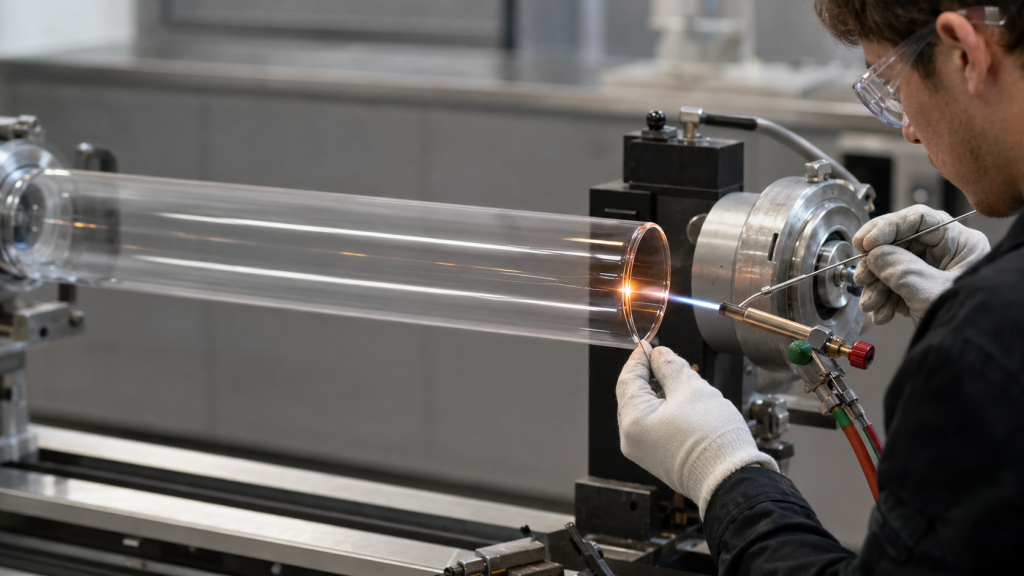
Quartz flame welding requires the glass to be heated into a highly viscous working condition. During this process, the fabricator must control temperature, rotation, gas flow and forming force.
Several limitations affect repair feasibility.
Material Compatibility
The replacement tube, rod or port should be compatible with the original quartz material. Different fused quartz grades can have different viscosity, OH content, impurity levels and high-temperature behavior.
Even when two materials are both described as fused quartz, they may not respond identically during welding and cooling. For sensitive semiconductor or optical applications, the original material grade should be identified whenever possible.
壁厚
Thin-wall tubing can collapse or become oval during local heating. Heavy-wall tubing requires more heat and a wider heated zone, which increases the risk of distortion and residual stress.
A large difference between the original wall and the replacement section can create a stress concentration. Smooth transitions are generally more reliable than abrupt changes.
Crack Location
Cracks close to complex flanges, multiple ports, ground joints or inaccessible internal surfaces can be difficult to remove completely.
If the damaged area cannot be heated uniformly or inspected properly, replacement may be safer than repair.
Contamination
Oil, dust, metal particles, process deposits and cleaning residues can become trapped in the weld. Contamination may produce bubbles, discoloration, inclusions or weak areas.
Semiconductor quartz tubes require particularly careful cleaning because a visually acceptable repair may still introduce particles or trace contamination into the process.
Dimensional Distortion
Quartz softens during flame working. Roundness, straightness, wall thickness and port position can change even when the crack disappears.
For this reason, repair feasibility should be evaluated against the drawing tolerances—not only against visual appearance.
Typical Professional Repair Process
A professional repair commonly follows these stages.
Step 1: Stop Using the Tube
A cracked tube should be removed from service. Continuing to heat, pressurize or mechanically load the tube may extend the crack without warning.
Step 2: Inspect and Map the Damage
The tube is inspected under suitable lighting and magnification. The fabricator records:
- Crack length and direction
- Distance from the tube end
- Distance from ports or flanges
- Whether the crack penetrates the wall
- Nearby scratches, chips or impact marks
- Signs of devitrification
- Wall thinning or deformation
- Previous repair areas
Polarized-light inspection can also help identify residual stress around formed or welded regions.
Step 3: Confirm the Service Conditions
Repair requirements differ significantly between a laboratory protection tube and a semiconductor process tube.
The supplier should know the operating temperature, atmosphere, vacuum or pressure condition, process chemicals, cleanliness requirement and expected service life.
Step 4: Remove the Damaged Glass
Whenever practical, the cracked section should be cut out or ground away completely. Heating over an unidentified crack is not the same as removing the damaged region.
The prepared edges must be clean, smooth and suitable for joining.
Step 5: Rebuild the Tube or Feature
A compatible quartz section is aligned and flame-welded into place. Heating should be distributed gradually to avoid a sharp temperature gradient.
The fabricator controls:
- Tube rotation
- Joint alignment
- Internal bore
- Wall-thickness transition
- Weld penetration
- 表面の滑らかさ
- Port angle
- 丸み
- Local distortion
Step 6: Anneal the Repaired Area
Flame welding produces steep temperature gradients. If the repaired tube cools too quickly, residual tensile stress may remain around the joint.
Annealing allows stress in the heated region to relax before the tube is cooled at a controlled rate.
Annealing temperature is material-specific. Published fused-quartz tube data shows that different grades can have annealing points around 1100–1220°C and strain points around 1000–1125°C. The correct cycle must therefore be selected according to the actual grade, tube dimensions and joint geometry—not copied from one universal number. Heraeus quartz-tube data, QSIL fused-quartz data
The tube must also be supported correctly during heat treatment. Large or thin-wall tubes can sag or become oval if the annealing setup is unsuitable.
Annealing reduces residual stress, but it does not remove an existing crack that was left inside the glass. Heraeus also notes that thermally induced stress after fused-silica cutting or forming needs annealing to reduce the risk of later failure. Fused-silica shaping and forming guidance
Step 7: Inspect and Test
Depending on the application, final inspection may include:
- Visual inspection
- Magnified crack inspection
- Polarized-light stress inspection
- Dimensional measurement
- Roundness and straightness inspection
- Wall-thickness measurement
- Port-position inspection
- Helium leak testing
- Vacuum hold testing
- Pressure testing under an approved procedure
- Surface cleanliness inspection
- Particle or trace-metal testing
- Material and repair documentation
A tube used with hazardous gases, vacuum, positive pressure or high temperature should not be returned to service without appropriate qualification.
Why Annealing Is Critical After Quartz Welding
Quartz has low thermal expansion, but low expansion does not mean that residual stress cannot form.
During repair, the weld zone may be heated to a very high temperature while nearby glass remains much cooler. The heated area expands, softens and changes shape. As it cools, the temperature difference can lock stress into the joint.
Poor stress control can lead to:
- Delayed cracking after repair
- Cracking during the next heating cycle
- Stress birefringence
- Distortion
- Reduced mechanical reliability
- Failure near the edge of the weld
- Crack propagation from an adjacent scratch
Research on laser-processed fused silica also shows that localized heating can introduce residual stress and that controlled annealing can reduce it. The same general principle—managing the temperature field and cooling rate—is relevant to flame-repaired quartz components.
When Should a Quartz Tube Be Replaced?
Replacement is normally recommended in the following situations.
Longitudinal Cracks
A long crack running along the tube axis can be difficult to remove without replacing a substantial section. It may also indicate installation stress, impact damage or an unsuitable support system.
Multiple or Branching Cracks
Several connected cracks suggest a larger damaged zone. Repairing one visible line may leave other crack tips in the material.
Heavy Devitrification
Devitrification changes quartz from an amorphous glass toward a crystalline structure. A heavily devitrified area may appear cloudy, rough or white and can become more susceptible to cracking and particle release.
Welding over severely devitrified quartz generally does not restore the original material condition.
Significant Sagging or Ovality
If the tube has deformed during service, repairing the crack alone will not restore the original geometry or high-temperature stability.
Damage in a Critical Process Zone
For semiconductor diffusion, oxidation, CVD and other contamination-sensitive processes, repair qualification can cost more than replacement. A repaired area may also have different surface condition, particle behavior or thermal history.
Unverified Vacuum or Pressure Integrity
If reliable leak testing or pressure qualification cannot be performed, a repaired tube should not be used in safety-critical service.
Repeated Failure
A tube that cracks again after repair may have an unresolved design, material or installation problem. Repeated local welding can introduce further distortion and additional heat-affected zones.
Is Repair Economically Worthwhile?
Repair is most attractive when the quartz tube is:
- Large or expensive
- Highly customized
- Equipped with multiple welded ports
- Difficult to replace quickly
- Made to an unavailable legacy drawing
- Damaged only in a removable local area
Replacement may be more economical when the tube is:
- A standard stocked size
- Heavily contaminated
- Extensively cracked
- Dimensionally distorted
- Close to the end of its expected service life
- Used in a process requiring costly requalification
The correct comparison should include repair cost, inspection cost, downtime, qualification requirements and the risk of another failure—not only the price of the welding work.
Information Required for a Repair Evaluation
To evaluate a cracked quartz tube, provide the supplier with:
- Overall tube length
- Outer diameter
- Inner diameter or wall thickness
- Material grade, if known
- OH content requirement, if applicable
- Clear photographs of the crack
- Close-up and full-tube photographs
- Crack length and location
- Distance to the nearest port or flange
- Original drawing
- Operating temperature
- Heating and cooling rate
- Vacuum or pressure condition
- Process gases and chemicals
- Semiconductor cleanliness requirements
- Dimensional tolerances
- Required inspection reports
- Quantity
- Whether an identical replacement is also required
Photographs should include a ruler or other dimensional reference. For complex damage, a short video showing the complete tube and crack location can help the supplier evaluate access and alignment.
よくある質問
Can annealing alone repair a quartz tube crack?
No. Annealing can reduce residual stress, but it does not reliably close or remove a physical crack. The damaged glass normally needs to be removed, rebuilt or replaced before annealing.
Can I melt the crack closed with a torch?
This is not recommended without professional quartz-fabrication equipment and experience. Local overheating can extend the crack, collapse the wall, trap contamination or create severe residual stress.
Will a repaired quartz tube be as strong as a new tube?
Not automatically. Strength depends on crack removal, weld geometry, material compatibility, annealing, surface condition and inspection. Critical applications require qualification rather than an assumption of equal strength.
Can a repaired quartz tube be used under vacuum?
Possibly, but it should pass an appropriate leak test and dimensional inspection. The test method and acceptance limit must match the actual vacuum system.
Can a semiconductor process tube be repaired?
Some localized damage can be repaired, but contamination, particles, thermal history and process qualification must be considered. For critical wafer-processing zones, replacement is often the lower-risk choice.
What is the difference between fire polishing and crack repair?
Fire polishing smooths a quartz surface by controlled heating. It may remove minor sharpness or superficial damage, but it is not a substitute for removing a structural crack.
How can future cracking be prevented?
Review the heating rate, cooling rate, supports, clamps, port geometry, wall-thickness transitions, installation alignment and handling procedure. Correcting the original failure mechanism is essential.
結論
A cracked quartz tube is not automatically scrap, but it is also not automatically repairable.
Small end cracks, broken ports and localized defects may be repaired by removing the damaged glass, rebuilding the area with compatible quartz, annealing the joint and completing the required inspection.
Long cracks, multiple fractures, heavy devitrification, serious distortion and damage in critical semiconductor process zones usually justify replacement.
For an accurate assessment, send the tube drawing, dimensions, crack photographs and operating conditions to an experienced quartz fabricator. The supplier can then determine whether repair, partial section replacement or complete reproduction offers the best balance of cost, reliability and process safety.