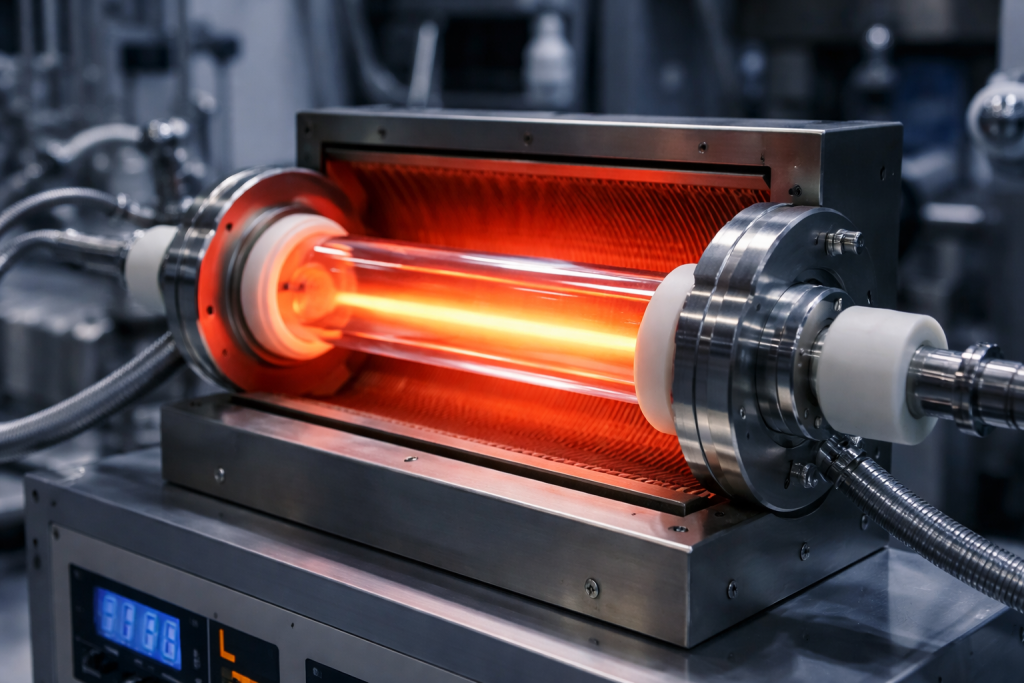
Quartz reaction tubes are one of the most critical components in high-temperature and high-purity processing environments. They are widely used in semiconductor manufacturing, chemical processing, and laboratory systems where contamination control, thermal stability, and optical transparency are essential.
Unlike conventional metal or ceramic tubes, quartz reaction tubes are made from high-purity fused silica, giving them a unique combination of thermal resistance, chemical inertness, and optical clarity. These properties make them indispensable in advanced industrial processes.
1. What Is a Quartz Reaction Tube?
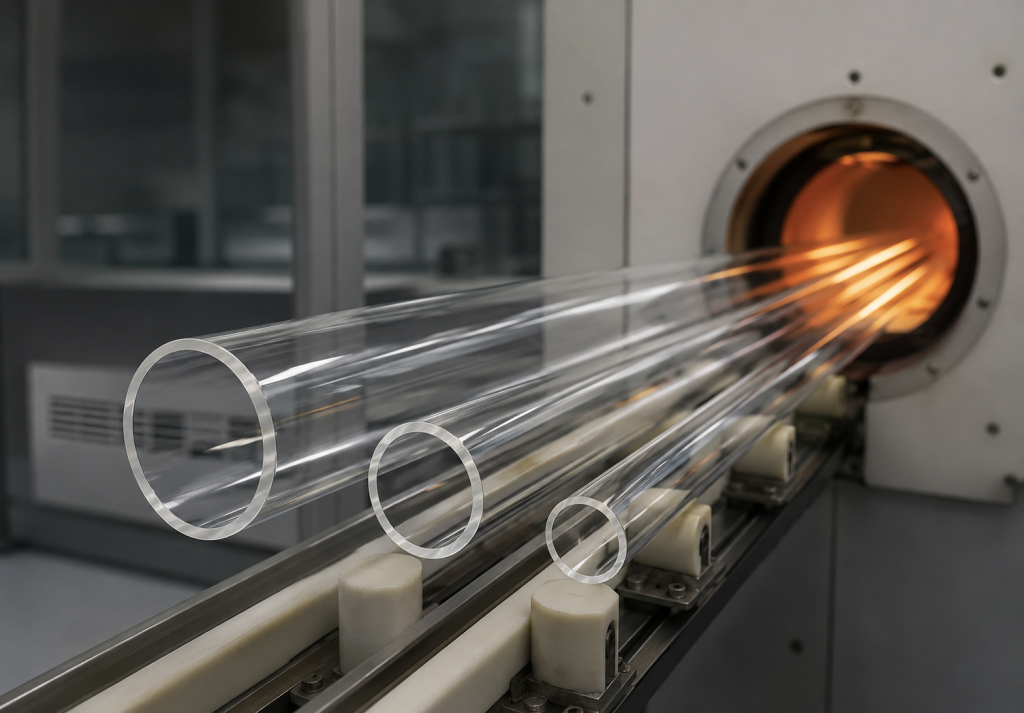
A quartz reaction tube is a cylindrical component made from fused quartz (also called fused silica). It is designed to hold or transport gases and materials under extreme conditions, often inside high-temperature furnaces or reactors.
Typical features include:
- High purity SiO₂ content (often >99.99%)
- Transparent or semi-transparent structure
- Kiváló termikus sokkállóság
- Rendkívül alacsony hőtágulás
- High chemical resistance to acids and many corrosive gases
These tubes are commonly found in horizontal or vertical furnace systems used in semiconductor wafer processing and chemical vapor deposition (CVD) systems.
2. Why Quartz Instead of Metal or Ceramic?
In industrial high-temperature environments, material selection is critical. Quartz outperforms many traditional materials in several key areas:
2.1 Thermal Stability
Quartz can withstand continuous temperatures up to around 1100°C–1200°C. More importantly, it maintains dimensional stability during rapid heating and cooling cycles, reducing the risk of cracking or deformation.
2.2 Chemical Resistance
Quartz is highly resistant to most acids and reactive gases used in semiconductor and chemical processes. This prevents contamination of sensitive materials inside the reactor.
2.3 Purity Control
In semiconductor manufacturing, even trace metal contamination can destroy wafer quality. Quartz provides ultra-low impurity levels, making it ideal for cleanroom-grade processes.
2.4 Optikai átláthatóság
Unlike opaque ceramics or metals, quartz allows visual monitoring of internal reactions, which is useful for process control and diagnostics.
3. Role in Semiconductor Manufacturing
Quartz reaction tubes are essential in multiple semiconductor fabrication steps.
3.1 Thermal Diffusion Process
In doping processes, wafers are placed inside a quartz tube furnace where dopant gases diffuse into silicon wafers at high temperatures. The quartz tube ensures:
- Stable thermal environment
- Clean gas flow
- Minimal contamination
3.2 Oxidation Process
Silicon wafers are oxidized in oxygen-rich environments inside quartz tubes. The high purity of quartz prevents unwanted chemical reactions that could affect oxide layer quality.
3.3 Chemical Vapor Deposition (CVD)
Quartz tubes are used as reaction chambers where thin films are deposited onto wafers using gas-phase chemical reactions.
4. Role in Chemical Industry
Outside semiconductor manufacturing, quartz reaction tubes are widely used in chemical engineering systems.
4.1 High-Temperature Chemical Reactions
Many industrial chemical reactions require controlled high-temperature environments. Quartz tubes provide a stable and inert chamber for these reactions.
4.2 Corrosive Gas Processing
Processes involving chlorine, fluorine, or acidic gases require materials that do not react or degrade. Quartz offers strong resistance in these environments.
4.3 Laboratory Reactors
Quartz tubes are also used in research laboratories for:
- Catalysis testing
- Material synthesis
- Gas reaction studies
5. Manufacturing Process of Quartz Reaction Tubes
The production of quartz tubes is highly specialized and involves multiple precision steps:
5.1 Raw Material Selection
High-purity silica sand or synthetic silica is used as the base material.
5.2 Melting Process
The silica is melted at extremely high temperatures (over 1700°C) using electric arc or flame fusion methods.
5.3 Forming the Tube
The molten quartz is shaped into cylindrical forms using precision drawing or rotational molding techniques.
5.4 Annealing
Slow cooling is applied to eliminate internal stress and prevent cracking.
5.5 Machining and Finishing
Final processes include cutting, polishing, and dimensional calibration according to customer specifications.
6. Key Performance Requirements
Industrial quartz reaction tubes must meet strict technical requirements:
- High thermal shock resistance (rapid heating/cooling cycles)
- Low hydroxyl (OH) content for high-temperature stability
- Tight dimensional tolerance for furnace compatibility
- Smooth inner surface to ensure laminar gas flow
- High mechanical strength despite brittleness
Even small defects such as bubbles or inclusions can lead to failure under extreme conditions.
7. Common Types of Quartz Reaction Tubes
7.1 Straight Tubes
Used in standard horizontal furnace systems for wafer processing.
7.2 U-Shaped Tubes
Used in specialized reactors requiring directional gas flow control.
7.3 Double-Walled Tubes
Provide enhanced thermal insulation and stability.
7.4 Custom-Designed Tubes
Manufactured for specific equipment dimensions or process requirements.
8. Challenges in Practical Applications
Despite their advantages, quartz reaction tubes also face limitations:
8.1 Brittleness
Quartz is mechanically brittle and can crack under mechanical stress or improper handling.
8.2 Cost
High-purity quartz and precision processing increase manufacturing costs.
8.3 Devitrification
Long-term exposure to high temperatures may cause crystallization (devitrification), reducing transparency and strength.
9. Future Trends
With the rapid development of semiconductor technology and advanced chemical processing, the demand for quartz reaction tubes continues to grow.
Key trends include:
- Larger diameter tubes for advanced wafer sizes (8-inch, 12-inch and beyond)
- Ultra-high purity fused silica for next-generation chips
- Coated quartz tubes for enhanced lifetime
- Customized reactor systems for AI chip manufacturing
Következtetés
Quartz reaction tubes play a foundational role in both semiconductor and chemical industries. Their combination of thermal resistance, chemical stability, and ultra-high purity makes them irreplaceable in modern high-tech manufacturing.
As industries continue to move toward higher precision and cleaner production environments, quartz-based components will remain a core enabling material for next-generation technologies.