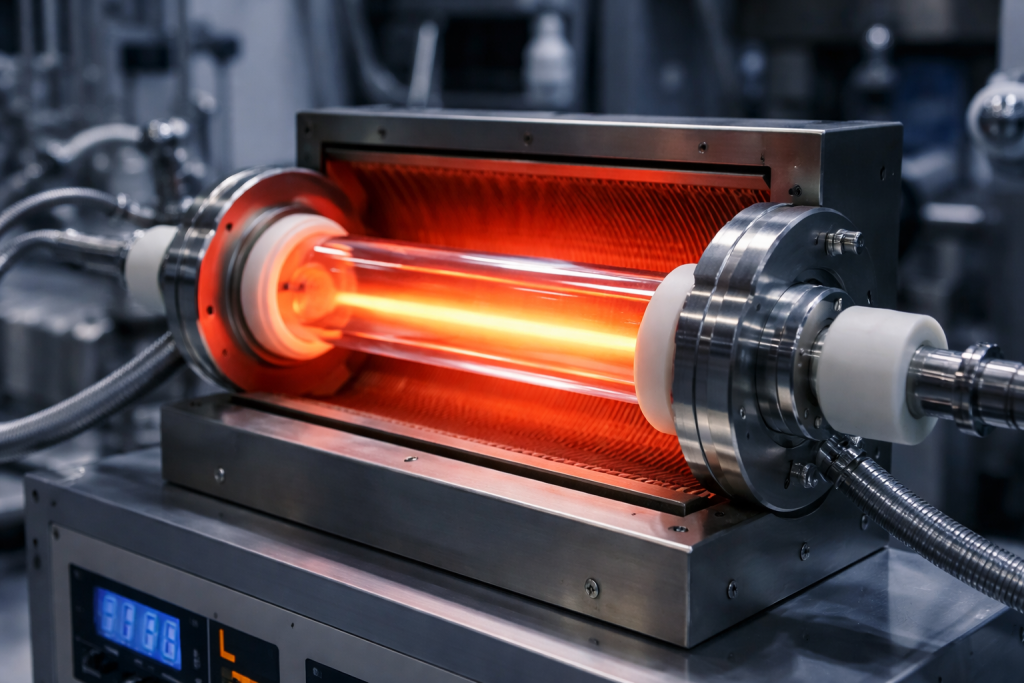
The price of a olvasztott kvarc cső cannot be determined by diameter and length alone. Material grade, wall thickness, dimensional tolerance, machining, welded features, cleaning, inspection and order quantity can all significantly affect the final quotation.
A standard clear quartz tube cut to length may be relatively straightforward to produce. A large-diameter semiconductor process tube with precision-ground ends, side ports, welded flanges and strict cleanliness requirements involves more material, processing time and manufacturing risk.
This guide explains the main factors that influence fused quartz tube prices and the information buyers should include when requesting a quotation.
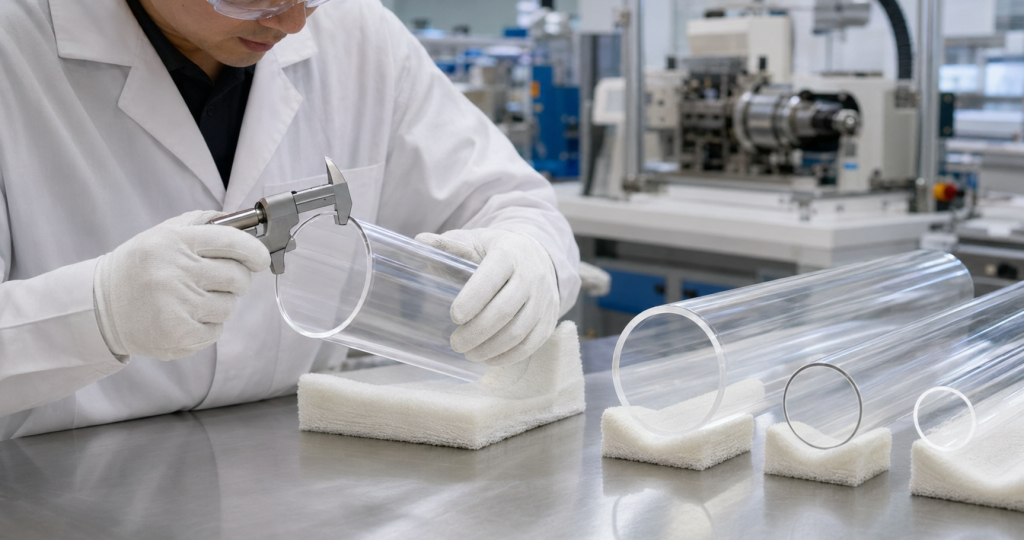
Why Fused Quartz Tube Prices Vary
Fused quartz tubes are used in semiconductor furnaces, UV equipment, chemical reactors, laboratory systems, heating equipment, optical instruments and high-temperature industrial processes.
Although the products may look similar, their technical requirements can be very different.
A quotation normally consists of several cost elements:
- Raw fused quartz tube or blank
- Cutting and dimensional preparation
- Csiszolás és polírozás
- Drilling and slot machining
- Port, flange or connector fabrication
- Flame working and joining
- Cleaning and inspection
- Packaging and shipping
- Manufacturing yield and scrap risk
The more complex the geometry and specifications, the greater the difference between the raw material price and the finished component price.
1. Tube Diameter
Outside diameter is one of the main factors affecting fused quartz tube cost.
Larger tubes require more raw material and may need specialized forming, handling, cutting and inspection equipment. Large-diameter tubes are also more difficult to protect during production and transportation.
Important diameter specifications include:
- Outside diameter
- Inside diameter
- Nominal diameter
- Diameter tolerance
- Kerekség
- Középpontosság
- Taper allowance
Standard diameter sizes are normally more economical than unusual custom dimensions. If the required diameter is not available as a standard tube, the manufacturer may need to source or produce a special blank.
For assemblies that connect with metal flanges, seals or furnace equipment, provide the actual mating dimensions instead of only giving a nominal pipe size.
2. Wall Thickness
Wall thickness affects raw material usage, mechanical handling, heating performance and manufacturing difficulty.
Thin-Wall Quartz Tubes
Thin-wall tubes can offer:
- Lower thermal mass
- Faster heating and cooling
- Lower material consumption
- Better transmission in some optical or UV applications
However, they are more susceptible to deformation, breakage and damage during cutting, drilling, flame working and transportation.
Thin walls may also make it more difficult to maintain roundness and dimensional consistency.
Thick-Wall Quartz Tubes
Thick-wall tubes can provide:
- Greater handling stability
- More material for grinding and machining
- Better support for certain ports and joints
- Improved resistance to accidental impact during assembly
However, they require more raw material and longer machining time. Very thick walls may also make thermal processing and joining more difficult.
The quotation should state both the nominal wall thickness and the acceptable wall-thickness variation.
3. Tube Length
Long tubes usually cost more because they require:
- More material
- Larger manufacturing equipment
- Additional handling support
- More protective packaging
- Higher transportation costs
Long, thin-wall tubes are especially sensitive to bending, vibration and impact during shipment.
If the final assembly can use several shorter sections instead of one continuous tube, ask the manufacturer whether this would reduce manufacturing and shipping costs. However, additional joints may introduce alignment, contamination or sealing concerns.
4. Material Grade and Purity
Not all fused quartz tubes use the same material grade.
Possible material options include:
- Natural fused quartz
- Electrically fused quartz
- High-purity fused quartz
- Szintetikus olvasztott szilícium-dioxid
- UV-grade fused silica
- Low-OH infrared-grade fused silica
- Opaque or translucent quartz
Material selection may depend on:
- Process temperature
- Trace-metal limits
- UV or infrared transmission
- OH content
- Chemical environment
- Bubble and inclusion limits
- Semiconductor cleanliness requirements
- Optical uniformity
Synthetic fused silica is generally selected for demanding optical, deep-UV or high-purity applications. Standard natural fused quartz can be more economical for many furnace, laboratory and industrial systems.
Specifying the highest available grade without a functional reason can unnecessarily increase the price. Buyers should define the required performance and allow the manufacturer to recommend a suitable material.
5. Dimensional Tolerances
Standard commercial tubes usually have broader dimensional tolerances than precision-ground quartz tubes.
Common tolerance requirements include:
- Outside diameter
- Inside diameter
- Wall thickness
- Hosszúság
- Kerekség
- Straightness
- Középpontosság
- Perpendicularity of the end face
- Flange alignment
- Port position
Tight diameter and wall-thickness tolerances may require additional grinding, measurement and inspection.
The tolerance should reflect the actual assembly requirement. For example, a tube inserted into a loose furnace support may not need the same dimensional control as a tube fitted into a vacuum seal or precision metal housing.
Avoid applying tight tolerances to every dimension. Identify the features that directly affect installation, sealing or process performance.
6. End-Face Processing
The ends of a quartz tube may require different treatments depending on the application.
Common options include:
- As-cut ends
- Ground ends
- Polished ends
- Fire-polished ends
- Beveled or chamfered ends
- Flared ends
- Reduced or tapered ends
- Precision-machined sealing faces
A basic cut-to-length tube is normally less expensive than a tube with ground, polished or formed ends.
Fire polishing can smooth sharp edges, but it may slightly change local dimensions. When dimensional control is critical, clearly indicate whether fire polishing is permitted.
7. Holes, Slots and Side Ports
Drilling or cutting fused quartz requires controlled machining to reduce chipping, cracking and subsurface damage.
Features that increase machining cost include:
- Small-diameter holes
- Multiple hole patterns
- Long slots
- Closely spaced holes
- Holes near an edge
- Angled holes
- Side ports
- Complex cutouts
- Tight position tolerances
The drawing should specify hole diameter, location, orientation and edge treatment.
If a port will be joined to another quartz tube, include its outside diameter, wall thickness, angle and required projection length.
8. Flanges and Welded Assemblies
Quartz furnace and process tubes may include:
- Flat flanges
- Ground sealing flanges
- Side branches
- Gas inlet tubes
- Exhaust ports
- Thermocouple ports
- Quartz connectors
- Support rings
- Internal liners
- Closed or domed ends
These structures are normally joined by controlled flame working. Pricing depends on the number of joints, joint size, alignment requirements and risk of distortion.
A process tube with several ports and flanges may cost considerably more than a plain tube with the same outside diameter and length.
For an accurate quotation, provide an assembly drawing that identifies:
- Joint locations
- Port angles
- Flange dimensions
- Centerline distances
- Critical alignment
- Sealing surfaces
- Leak-test requirements
9. Grinding, Polishing and Surface Finish
Different applications require different surface conditions.
Available finishes may include:
- Standard transparent surface
- Ground surface
- Mechanically polished surface
- Fire-polished surface
- Optical polish
- Frosted or diffuse surface
- Cleaned semiconductor surface
Optical or sealing surfaces can require additional grinding, lapping and inspection.
If only one area needs precision finishing, identify it on the drawing. Selective finishing is usually more economical than applying the same requirement to the entire tube.
10. UV and Optical Requirements
Quartz tubes used for UV lamps, optical systems and photochemical equipment may require specific transmission performance.
The RFQ should identify:
- Operating wavelength
- Minimum transmission
- Tube wall thickness
- Material grade
- OH requirement
- Bubble and inclusion limits
- Surface condition
- Solarization resistance
- Coating requirement, if applicable
A tube that appears transparent in visible light may not provide suitable transmission at deep-UV wavelengths. Material selection should therefore be based on the operating wavelength rather than appearance alone.
11. Cleaning Requirements
Cleaning can have a major effect on the final price of semiconductor, vacuum and analytical quartz tubes.
Possible requirements include:
- Removal of machining residue
- Savas tisztítás
- Nagy tisztaságú vízzel történő öblítés
- Particle-controlled drying
- Cleanroom handling
- Double-bag packaging
- Trace-metal analysis
- Cleaning records
- Customer-specific cleaning procedures
“Semiconductor clean” should not be used as the only specification. Buyers should define measurable contamination limits or provide an approved cleaning standard.
For general laboratory and heating applications, a simpler cleaning process may be sufficient.
12. Inspection and Documentation
Standard industrial tubes may only require visual and dimensional inspection. Precision or semiconductor components can require considerably more documentation.
Possible documents include:
- Material certificate
- Certificate of conformity
- Dimensional inspection report
- Wall-thickness measurement
- Roundness and straightness report
- Optical transmission report
- Surface-quality inspection
- Cleaning record
- Leak-test report
- First Article Inspection report
- Lot traceability
Inspection should be included in the original RFQ. Adding documentation after production may increase cost or require additional testing.
Fused Quartz Tube Price Factors
| Price factor | Typical cost impact | Reason |
|---|---|---|
| Standard diameter | Low to medium | Existing raw tube may be available |
| Custom diameter | Medium to high | Special blank or forming may be required |
| Large diameter | Magas | More material and specialized handling |
| Thin wall | Medium to high | Higher breakage and deformation risk |
| Thick wall | Medium to high | Greater material and machining time |
| Tight tolerances | Magas | Additional grinding and inspection |
| Cut-to-length only | Alacsony | Minimal processing |
| Ground or polished ends | Közepes | Additional finishing operations |
| Holes and slots | Medium to high | Precision machining and breakage risk |
| Welded side ports | Magas | Flame working and alignment |
| Kvarc karimák | Magas | Complex forming, grinding and joining |
| Semiconductor cleaning | Medium to high | Controlled cleaning and packaging |
| Optical requirements | Medium to high | Higher material and inspection requirements |
| Prototype quantity | Higher unit cost | Setup cost is distributed over fewer parts |
| Volume order | Lower unit cost | More efficient production and setup allocation |
Standard Tube Versus Custom Machined Tube
A standard fused quartz tube normally includes:
- Standard outside diameter
- Standard wall thickness
- Commercial dimensional tolerances
- Simple cutting to length
- Basic edge finishing
A custom machined tube may include:
- Precision diameter or length
- Ground sealing surfaces
- Holes and slots
- Side ports
- Flanges
- Closed ends
- Special bends
- Optical surfaces
- Semiconductor cleaning
- Detailed inspection reports
Buyers should confirm whether quotations refer to raw tubing, cut tubing or a finished custom assembly.
How Quantity Affects Price
Custom quartz tube production often includes setup, programming, tooling, flame-working preparation and inspection costs.
These costs are distributed differently for:
- One-piece prototypes
- Small engineering batches
- Repeat production orders
- Annual volume agreements
For a new project, request separate prices for:
- Prototype quantity
- Initial production batch
- Expected annual quantity
This makes it easier to evaluate both development cost and future production pricing.
How to Reduce Fused Quartz Tube Cost
Use Standard Raw-Tube Dimensions
If the design can accept an available diameter and wall thickness, the supplier may avoid special material production.
Tighten Only Critical Tolerances
Use practical general tolerances and identify only the dimensions that affect sealing, alignment or assembly.
Limit Unnecessary Polishing
Specify polished or optical surfaces only where they are functionally required.
Simplify Ports and Joints
Reducing the number of side ports, unusual angles and complex welded structures can improve yield and reduce processing time.
Separate Prototype and Production Pricing
Prototype costs should not be treated as the expected volume-production price.
Provide a Complete Drawing
A controlled drawing reduces uncertainty and allows the manufacturer to calculate machining, inspection and material requirements accurately.
Fused Quartz Tube RFQ Checklist
| RFQ item | Required information |
|---|---|
| Tube dimensions | Outside diameter, inside diameter, wall and length |
| Anyag | Fused quartz or fused silica grade |
| Tisztaság | Trace metals, OH, bubbles and inclusions |
| Tolerances | Diameter, wall, straightness and length |
| End treatment | Cut, ground, polished, flared or closed |
| Machining | Holes, slots, ports and cutouts |
| Joined components | Flanges, branches, connectors and rings |
| Felületi kivitel | Standard, ground, fire polished or optical |
| Alkalmazás | Furnace, UV, chemical, optical or semiconductor |
| Operating conditions | Temperature, pressure, vacuum and chemicals |
| Cleanliness | Standard, high-purity or semiconductor cleaning |
| Inspection | Dimensional, optical, leak or material reports |
| Quantity | Prototype and production volume |
| Packaging | Individual, cleanroom or export packaging |
| Delivery | Required date and destination |
Common Quotation Mistakes
Requesting a Price by Diameter Only
Diameter does not define wall thickness, material grade, length, tolerance or machining.
Not Identifying the Application
A UV lamp sleeve and a semiconductor diffusion tube may require different materials and cleanliness levels even when their dimensions are similar.
Omitting Port and Flange Details
Port angle, projection length, joint type and flange alignment can significantly affect manufacturing difficulty.
Selecting the Lowest Quote Without Comparing Scope
Confirm whether each quote includes machining, cleaning, inspection, packaging and shipping.
Ignoring Transportation Risk
Large and thin-wall quartz tubes need protective packaging. Inadequate packaging can create a lower initial quotation but a higher risk of damage.
Gyakran ismételt kérdések
Can fused quartz tubes be priced per meter?
Standard tubes may sometimes be quoted by length, but custom tubes are normally priced by finished part because machining, tolerances, ports, flanges and inspection affect the cost.
Are large-diameter quartz tubes more expensive?
Generally, yes. They require more raw material, specialized equipment, careful handling and stronger packaging.
Does a thicker wall always make a tube more expensive?
A thicker wall usually increases material usage, but very thin walls can also be expensive because of lower production yield and greater breakage risk.
Can holes and slots be machined into fused quartz tubes?
Yes. Hole size, position, wall thickness and distance from the edge must be evaluated to reduce chipping and cracking risks.
Can quartz tubes be supplied with welded flanges and ports?
Yes. Custom assemblies can include flanges, side ports, connectors, support rings and closed ends. A detailed drawing is required for quotation.
What information is needed for a furnace tube replacement?
Provide the outside diameter, wall thickness, total length, end design, flange dimensions, port locations, process temperature and photographs or drawings of the existing assembly.
Is synthetic fused silica required for every quartz tube?
No. The appropriate material depends on purity, optical wavelength, temperature and process requirements. Standard fused quartz may be suitable for many industrial and furnace applications.
Can a manufacturer quote from an existing sample?
A sample can help with reverse engineering, but a controlled drawing and application description are still recommended for confirming tolerances and material requirements.
Következtetés
Fused quartz tube price is determined by more than outside diameter and length. Wall thickness, material grade, dimensional tolerance, machining, welded structures, cleanliness, inspection, packaging and quantity all influence the final quotation.
To obtain an accurate price, buyers should provide a controlled drawing together with the application, operating conditions, material requirement and expected order quantity.
For custom fused quartz tubes, send the following information with your RFQ:
- Outside and inside diameter
- Wall thickness and length
- Material and purity requirements
- Holes, ports, flanges and end design
- Critical tolerances
- Cleaning and inspection requirements
- Prototype and production quantity
- Delivery destination
A complete specification allows the manufacturer to recommend a practical production method, reduce quotation time and provide more reliable pricing.