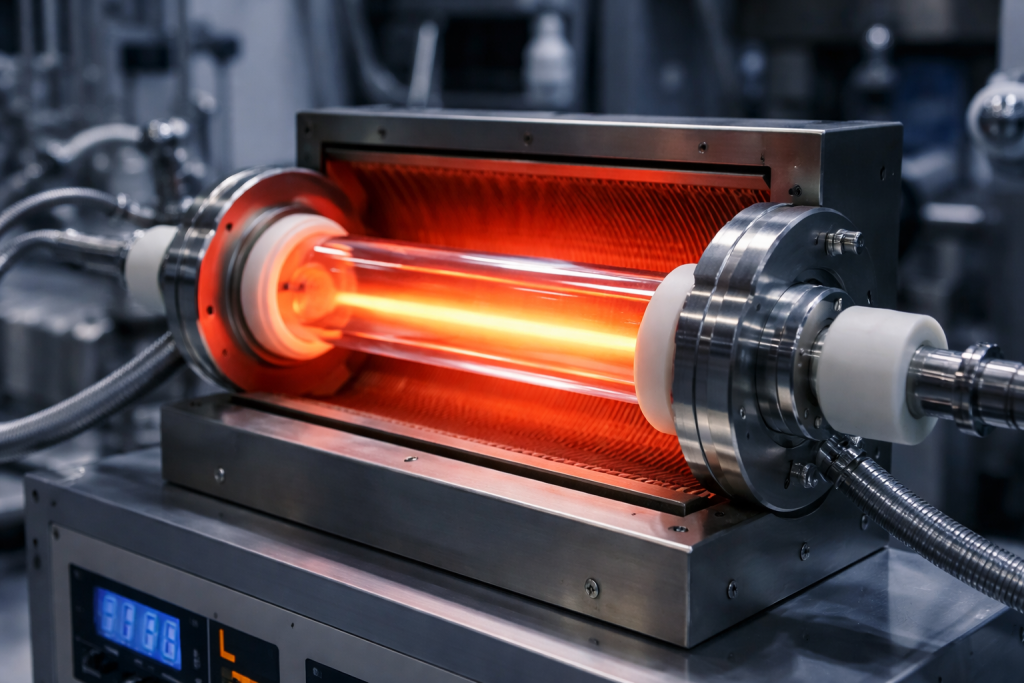
Quartz parts are widely used in semiconductor processing, optical systems, laboratory instruments, chemical equipment, photovoltaic manufacturing, high-temperature furnaces, and precision industrial assemblies. Compared with ordinary glass or many ceramic materials, quartz offers a unique combination of high purity, thermal stability, optical transparency, chemical resistance, and excellent dimensional reliability.
However, a finished quartz component is not simply a piece of glass cut into shape. It is the result of material selection, thermal forming, mechanical machining, polishing, cleaning, inspection, and careful handling. From raw silica material to a precision-fabricated quartz part, each manufacturing step can influence the final performance of the component.
This article explains the quartz parts manufacturing process from raw material preparation to precision fabrication, with a focus on engineering applications and quality control.
1. What Are Quartz Parts?
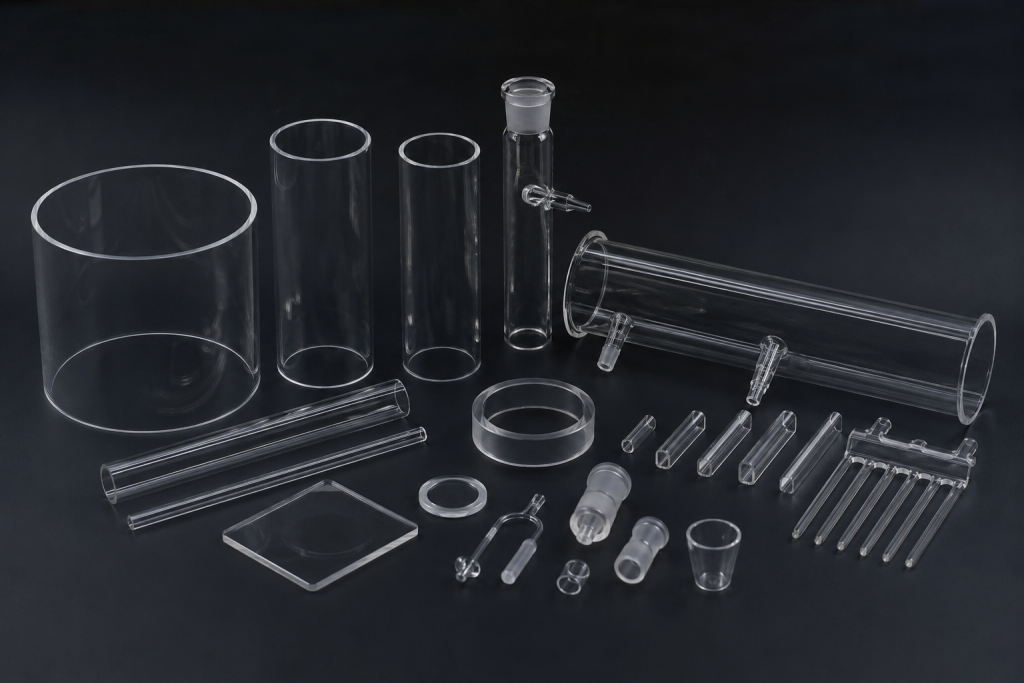
Quartz parts generally refer to components made from fused quartz, fused silica, or high-purity quartz glass. These parts may be simple shapes such as plates, rods, tubes, rings, and discs, or complex assemblies such as chambers, boats, carriers, flanges, nozzles, trays, and custom-fabricated quartz structures.
Common quartz parts include:
- Quartz tubes
- Quartz plates
- Quartz rods
- Quartz rings
- Fenêtres en quartz
- Brides en quartz
- Bateaux en quartz
- Quartz chambers
- Creusets en quartz
- Quartz holders
- Quartz nozzles
- Quartz wafer carriers
- Custom quartz components
The final design depends on the application environment. For example, semiconductor quartz parts often emphasize purity and cleanliness, while optical quartz parts require high transmission and surface quality. Furnace components focus more on thermal stability and resistance to thermal shock.
2. Material Basis: Why Quartz Is Used
The main chemical composition of quartz glass is silicon dioxide. Unlike crystalline quartz, fused quartz and fused silica are amorphous materials. This structure gives them a very low coefficient of thermal expansion, excellent thermal shock resistance, and stable performance under high-temperature conditions.
Key advantages of quartz materials include:
| Propriété | Engineering Significance |
|---|---|
| High SiO₂ content | Provides purity and thermal stability |
| Faible dilatation thermique | Reduces cracking risk during heating and cooling |
| Température de ramollissement élevée | Suitable for high-temperature processes |
| Résistance chimique | Useful in many acid and solvent environments |
| Optical transparency | Suitable for UV, visible, and infrared applications |
| Isolation électrique | Useful in high-temperature electrical systems |
| Low contamination | Important for semiconductor and photovoltaic processes |
These properties make quartz parts difficult to replace in applications where both thermal and chemical stability are required.
3. Raw Material Selection
Quartz parts manufacturing begins with the selection of the correct raw material. The material grade must match the application. Although many quartz products look similar, their impurity level, bubble content, hydroxyl content, optical transmission, and thermal behavior may be different.
Common material categories include:
3.1 Natural Fused Quartz
Natural fused quartz is produced from high-purity natural quartz crystal or quartz sand. It is widely used in industrial, thermal, chemical, and general optical applications. It offers good thermal performance and is suitable for many custom-fabricated components.
3.2 Synthetic Fused Silica
Synthetic fused silica is usually produced through chemical synthesis. It has very high purity and excellent optical transmission, especially in ultraviolet applications. It is commonly used for optical windows, lenses, UV systems, and high-end precision components.
3.3 Opaque Quartz
Opaque quartz contains microbubbles or controlled internal scattering structures. It is often used in thermal insulation, heating systems, and certain furnace-related applications where optical transparency is not required.
3.4 Semiconductor-Grade Quartz
Semiconductor-grade quartz requires stricter control of metallic impurities, particles, surface contamination, and cleaning procedures. It is used in diffusion, oxidation, annealing, CVD, etching support systems, and other wafer process environments.
Selecting the wrong material grade may lead to premature failure, contamination, poor optical performance, or unnecessary cost.
4. Forming Processes for Quartz Parts
After raw material selection, quartz must be formed into basic shapes. Quartz glass has a very high working temperature, so forming requires specialized equipment and skilled processing.
4.1 Tube Drawing
Quartz tubes are commonly produced by drawing or forming processes. The tube dimensions, wall thickness uniformity, straightness, and surface condition are controlled during production. These tubes may later be cut, ground, polished, bent, sealed, or welded into custom components.
4.2 Rod and Plate Production
Quartz rods and plates are produced by forming, cutting, or machining larger quartz bodies. Plates may be further processed into windows, wafers, discs, rings, carriers, or structural parts.
4.3 Flame Working
Flame working is used to bend, join, seal, or reshape quartz components. It is especially important for manufacturing quartz laboratoryware, reaction chambers, joints, side arms, flanges, and custom assemblies.
4.4 Thermal Forming
For certain shapes, quartz may be softened and formed at high temperature. Thermal forming must be carefully controlled because uneven heating can introduce stress or deformation.
5. Precision Machining of Quartz Parts
Quartz is hard, brittle, and sensitive to surface defects. Therefore, precision machining of quartz requires suitable tools, cooling methods, and process control.
Common machining methods include:
- Cutting
- Grinding
- Drilling
- Slotting
- Milling
- Chamfering
- Lapping
- Polissage
- Usinage CNC
- Ultrasonic machining
- Laser processing for selected applications
Machining must balance dimensional accuracy with surface integrity. Excessive mechanical force can cause chipping, cracks, or micro-damage. These defects may not always be visible immediately but can become failure points during high-temperature use.
6. Cutting and Edge Processing
Cutting is often the first mechanical fabrication step. Quartz tubes, plates, rods, and blocks must be cut to the required size before further processing.
After cutting, edge treatment is usually necessary. Sharp edges can easily chip and may act as crack initiation points. Therefore, quartz parts often require chamfering, grinding, or fire polishing.
Common edge treatments include:
| Type de bord | Purpose |
| As-cut edge | Basic size preparation |
| Ground edge | Improves dimensional control |
| Chamfered edge | Reduces chipping risk |
| Rounded edge | Improves handling safety |
| Fire-polished edge | Smooths sharp tube ends |
| Optical polished edge | Used for optical or precision parts |
For semiconductor and optical applications, edge quality is especially important because particles or chips can affect cleanliness and performance.
7. Drilling, Slotting and Custom Features
Many quartz parts require holes, slots, grooves, notches, side openings, or special profiles. These features are common in quartz carriers, holders, flanges, process chambers, and instrument components.
When specifying these features, drawings should clearly indicate:
- Hole diameter
- Hole position
- Hole tolerance
- Slot width and length
- Edge radius
- Finition de surface
- Position tolerance
- Chamfer requirement
- Whether the feature is through-hole or blind-hole
Because quartz is brittle, sharp internal corners should be avoided when possible. Rounded corners and proper edge transitions help reduce stress concentration and improve durability.
8. Grinding, Lapping and Polishing
Grinding is used to achieve dimensional accuracy and shape control. Lapping and polishing are used to improve flatness, surface roughness, and optical quality.
Different applications require different surface levels:
8.1 Industrial Surface Finish
Industrial quartz parts may only require basic grinding or fire-polished surfaces. These are suitable for furnace components, general fixtures, and chemical processing parts.
8.2 Precision Mechanical Surface
Precision quartz components may require controlled flatness, parallelism, thickness tolerance, and surface roughness. This is important for wafers, plates, carriers, and sealing components.
8.3 Optical Polishing
Optical quartz parts require high transparency and low surface defects. Polishing quality can affect transmission, scattering, reflection, and optical distortion. Quartz windows, optical tubes, lenses, and UV components often require strict surface inspection.
8.4 Semiconductor Surface Finish
Semiconductor quartz parts require not only accurate geometry but also controlled surface cleanliness. Surface roughness, particles, residues, and metallic contamination must be carefully managed.
9. Quartz Welding and Assembly
Complex quartz components are often made by joining multiple pieces together. Quartz-to-quartz welding is performed at high temperature, usually through flame working or specialized thermal processes.
Typical welded quartz assemblies include:
- Quartz chambers
- Quartz manifolds
- Brides en quartz
- Quartz reactors
- Quartz laboratory apparatus
- Quartz gas delivery parts
- Quartz process tubes with side arms
- Quartz holders and support structures
Welding quality affects strength, leak resistance, dimensional accuracy, and thermal durability. Poorly controlled welding may introduce stress, bubbles, deformation, or weak joints.
For complex assemblies, the design should consider manufacturability from the beginning. Some shapes may be possible in drawings but difficult to fabricate reliably in quartz.
10. Cleaning and Contamination Control
Cleaning is a critical step in quartz parts manufacturing, especially for semiconductor, photovoltaic, optical, and high-purity chemical applications.
Quartz parts may be cleaned to remove:
- Grinding residues
- Polishing compounds
- Particles
- Fingerprints
- Organic contamination
- Metallic impurities
- Surface dust
- Packaging contamination
Standard industrial cleaning may be sufficient for general applications. However, semiconductor-grade quartz parts may require high-purity cleaning, cleanroom handling, and special packaging.
Improper cleaning can reduce performance even when the part is dimensionally correct. In high-purity processes, contamination from machining or handling may affect wafer yield or process stability.
11. Inspection and Quality Control
Inspection ensures that quartz parts meet the required specifications. The inspection method depends on the application and complexity of the component.
Common quality checks include:
| Inspection Item | Purpose |
| Dimensional measurement | Confirms OD, ID, thickness, length and feature size |
| Visual inspection | Detects cracks, chips, bubbles and inclusions |
| Surface quality inspection | Evaluates scratches, roughness and polishing quality |
| Flatness and parallelism | Important for plates, wafers and windows |
| Straightness and roundness | Important for tubes and rods |
| Leak testing | Required for sealed or welded assemblies |
| Cleanliness inspection | Important for semiconductor and optical use |
| Material verification | Confirms grade and application suitability |
For precision quartz components, drawings should define which dimensions are critical and what inspection standards are required. This avoids both under-specification and unnecessary over-specification.
12. Typical Applications of Manufactured Quartz Parts
Quartz parts are used in many industries because of their stable performance under harsh conditions.
12.1 Semiconductor Industry
In semiconductor manufacturing, quartz parts are used in high-temperature wafer processing, diffusion, oxidation, annealing, deposition, etching support, and cleaning systems. Common components include quartz process tubes, wafer boats, carriers, liners, rings, and chambers.
Important requirements include high purity, thermal stability, dimensional accuracy, low particle generation, and controlled cleaning.
12.2 Optical and Photonics Systems
Quartz is used for optical windows, lenses, tubes, light guides, UV lamp sleeves, and precision optical components. The key requirements are transmission range, surface quality, bubble control, and polishing accuracy.
12.3 Laboratory and Chemical Equipment
Quartz parts are used in reaction vessels, combustion tubes, crucibles, connectors, and analytical instruments. Chemical resistance and thermal shock resistance are major advantages.
12.4 Industrial Furnaces
Quartz tubes, plates, rods, and fixtures are used in thermal processing equipment. The material’s low thermal expansion makes it suitable for heating and cooling cycles.
12.5 Photovoltaic and Advanced Materials
Quartz components are used in crystal growth, thermal treatment, coating, purification, and process support systems. High purity and thermal stability help maintain material quality.
13. Design Considerations for Custom Quartz Parts
When designing custom quartz parts, engineers should consider both application performance and manufacturing feasibility.
Important design considerations include:
- Avoid sharp internal corners
- Use reasonable wall thickness
- Allow thermal expansion clearance
- Avoid unnecessary tight tolerances
- Specify critical dimensions clearly
- Consider support points for long parts
- Define surface finish based on function
- Provide drawings for complex geometry
- Select material grade according to the application
- Define cleaning and packaging requirements
Quartz has excellent thermal and chemical properties, but it remains brittle. Good design should reduce mechanical stress, thermal stress, and surface damage.
14. From Prototype to Batch Production
Many quartz parts begin as prototypes. During prototyping, the main goal is to verify material suitability, geometry, installation fit, and process compatibility. Once the design is confirmed, the part can move toward batch production.
For batch production, consistency becomes more important. Manufacturing records, inspection procedures, cleaning standards, packaging methods, and tolerance control should be standardized.
A successful quartz parts project usually requires close communication between the customer and manufacturer, especially when the part is used in semiconductor, optical, high-temperature, or chemical process environments.
15. Conclusion
Quartz parts manufacturing is a specialized process that combines material science, thermal forming, precision machining, polishing, welding, cleaning, and inspection. From raw material selection to final fabrication, every step influences the performance and reliability of the finished component.
High-quality quartz parts are not defined only by material purity. Geometry, tolerance, surface finish, edge quality, cleanliness, and application-specific design are equally important. For demanding applications such as semiconductor processing, optical systems, chemical reactors, and high-temperature furnaces, a well-designed and properly manufactured quartz component can provide excellent stability and long service performance.
When selecting or designing custom quartz parts, engineers should provide detailed drawings, material requirements, dimensional tolerances, surface finish expectations, and operating conditions. This helps ensure that the final quartz part is not only manufacturable, but also suitable for its intended technical environment.