In modern photonics, optoelectronics, and high-precision instrumentation, optical components are no longer used only for “light transmission.” They often serve multiple roles at the same time: optical access, environmental isolation, electrical grounding, electromagnetic shielding, and mechanical integration.
Among these components, the metallized optical window plays a critical but often overlooked role. It may look like a simple transparent disk, but in reality it is a highly engineered interface between delicate optical systems and harsh external environments.
1. What Is a Metallized Optical Window?
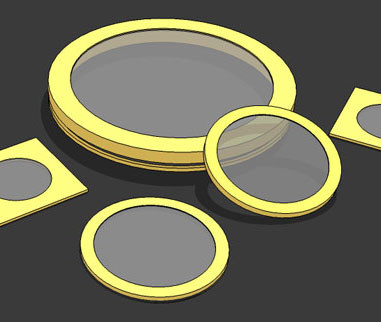
A metallized optical window is an optical element made from a transparent substrate—such as glass, fused silica, or sapphire—whose surface or edge is coated with a thin metallic layer using processes like:
- Vacuum evaporation
- Sputtering deposition
- Thin-film metallization
Common metals used include:
- Chromium (Cr)
- Gold (Au)
- Silver (Ag)
- Aluminum (Al)
- Nickel (Ni)
Optical Window is typically designed to provide high optical transmission across a wide wavelength range. However, a metallized version is a specialized subtype where a conductive metal layer is added to introduce additional electrical and mechanical functions.
Unlike optical filters, which selectively transmit or block specific wavelengths, a metallized window still maintains broad optical transparency while adding functional surface engineering.
2. Why Metallize an Optical Window?
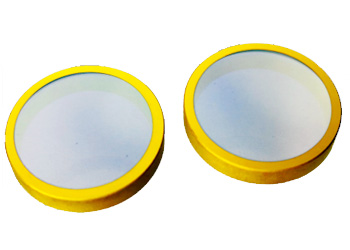
At first glance, adding an opaque metal layer to a transparent optical component may seem counterintuitive. However, metallization transforms a passive optical element into a multifunctional interface component.
The key motivations include the following:
2.1 Electromagnetic Interference (EMI) Shielding
Many optical and electronic systems—such as imaging sensors, lasers, and detectors—are highly sensitive to electromagnetic noise.
A continuous metallic layer acts as a conductive shield, forming a Faraday cage effect, which:
- Blocks external electromagnetic interference
- Prevents internal signal leakage
- Improves system stability and signal integrity
This is essential in high-precision measurement and communication systems.
2.2 Electrical Grounding and Conductive Pathways
Metal coatings are electrically conductive. This enables:
- Grounding of optical assemblies
- Static charge dissipation
- Electrical connection between components
- Integration of heaters, sensors, or electrodes mounted near the window
In many systems, the window is not just optical—it is also part of the electrical architecture.
2.3 Hermetic Sealing for Vacuum and Gas Environments
One of the most critical applications is hermetic sealing.
In devices that require:
- High vacuum
- Inert gas environments
- Long-term sealed optical cavities
the window must be permanently bonded to a metal housing.
By using metallized layers, the window can be joined using brazing techniques, creating:
- Strong metal-to-metal bonding
- Excellent vacuum tightness
- High resistance to thermal cycling and mechanical stress
This is far more reliable than adhesive bonding, especially in extreme environments.
2.4 Optical Aperture Definition and Stray Light Control
Metallization does not always cover the entire surface. It can be patterned to form:
- Apertures
- Masks
- Light-blocking regions
This helps:
- Define the effective optical opening
- Block stray light
- Improve image contrast and signal-to-noise ratio
In imaging and sensing systems, this function is essential for optical precision.
3. Common Substrate Materials
The performance of a metallized optical window depends heavily on its base material:
- K9 glass: Cost-effective, suitable for visible wavelengths
- Silice fondue: Excellent UV–visible–IR transmission, low thermal expansion
- Saphir: Extremely hard, scratch-resistant, high-temperature stable
- Silicon (Si) / Germanium (Ge): Common for infrared applications
Fused Silica and sapphire substrates are especially common in demanding environments due to their thermal and mechanical stability.
4. Key Technical Parameters
When evaluating a metallized optical window, several engineering parameters must be considered:
4.1 Clear Aperture (CA)
The region that maintains full optical performance. Metallization is usually applied outside this area.
4.2 Metallization Type and Thickness
- Chromium (Cr): adhesion layer, mask applications
- Gold (Au): high conductivity, corrosion resistance
- Typical thickness: tens to hundreds of nanometers
4.3 Optical Transmittance
High-performance windows can achieve up to 99% transmission within the designed wavelength range.
4.4 Hermeticity
Measured using helium leak detection. High-end applications require extremely low leakage rates (e.g., <10⁻⁸ cc/sec).
4.5 Brazing Compatibility
The metal layer must bond reliably with solder materials such as AuSn or AgCu alloys.
4.6 Surface Quality
Defined using scratch-dig standards (e.g., 60–40). Lower values indicate higher optical quality.
4.7 Surface Flatness
Often specified in fractions of wavelength (e.g., λ/4 or λ/10), indicating optical precision.
5. Applications of Metallized Optical Windows
Metallized optical windows are widely used in advanced engineering fields, including:
- Aerospace and defense optical systems
- Satellite and spaceborne sensors
- High-power laser systems
- Vacuum chambers and scientific instruments
- Infrared detection modules
- Optical communication devices
- Medical imaging and analytical equipment
In all these applications, the window must simultaneously provide optical access and environmental isolation.
6. Why Metallized Windows Are So Important
Modern optical systems are no longer isolated components—they are integrated electro-optical-mechanical systems.
A metallized optical window acts as:
- A transparent barrier for light transmission
- A protective shield against harsh environments
- A conductive interface for grounding and signal control
- A vacuum-sealing boundary for sealed systems
This combination of properties makes it a critical component in systems where reliability, stability, and precision are essential.
Conclusion
A metallized optical window is far more than a simple transparent component. It is a highly engineered interface that bridges optics, electronics, and mechanical systems.
By combining nanometer-scale metal coatings with high-performance optical substrates, it enables reliable operation in extreme environments while maintaining excellent optical performance.
In essence, it serves as a “functional window” between sensitive optical systems and the real world, ensuring both optical clarity and system integrity under demanding conditions.