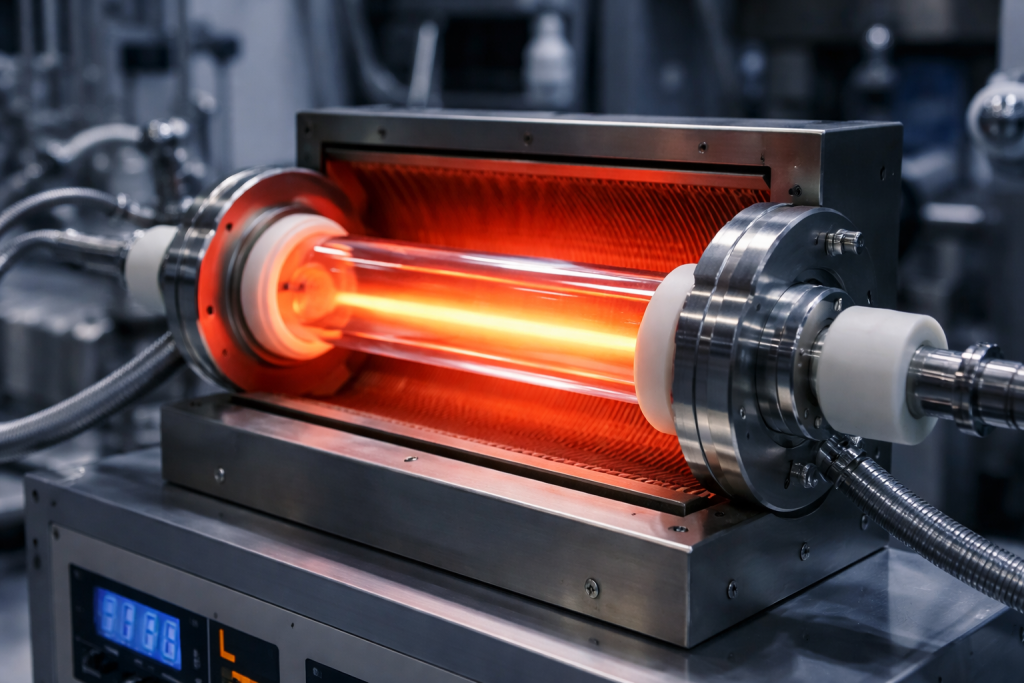
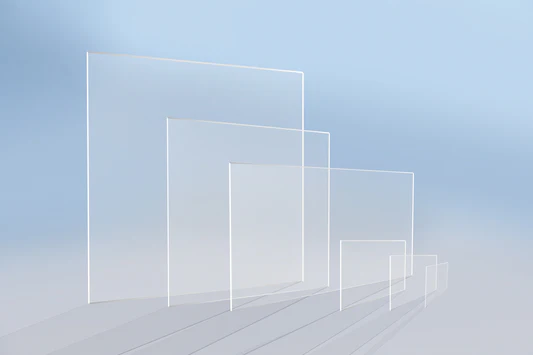
Quartz glass (high-purity fused silica) is widely regarded as one of the most critical optical materials in extreme photonic and radiation environments. Owing to its exceptional optical transparency, ultra-low thermal expansion, and outstanding chemical stability, it plays a central role in high-power laser systems, nuclear facilities, and space-borne optical platforms.
With the rapid advancement of kilowatt-to-megawatt laser technologies and long-duration space missions, the performance of quartz glass is no longer limited to conventional optical properties. Instead, its behavior must be understood as a coupled system involving energy absorption, defect generation, thermal stress evolution, and radiation-induced structural modification.
This article provides a scientific overview of quartz glass from the perspectives of structure, laser interaction mechanisms, radiation effects, and engineering optimization.

1. Amorphous Network Structure and Fundamental Properties
Quartz glass is composed of a continuous SiO₂ tetrahedral network characterized by short-range order and long-range disorder. This unique amorphous structure governs its exceptional physical properties:
- High softening temperature (~1580°C) due to strong Si–O bond energy (~443 kJ/mol)
- Extremely low thermal expansion (~0.55 × 10⁻⁶ /K) resulting in excellent thermal shock resistance
- Broad optical transmission window (160 nm – 5 μm) covering deep UV to mid-IR regions
- Ultra-high electrical resistivity (>10¹⁶ Ω·cm) due to limited charge carrier mobility
These properties establish fused silica as a benchmark material for demanding optical and electro-optical applications.
2. Energy Coupling Mechanisms under High-Power Laser Irradiation
In high-power laser environments (from kilowatt continuous wave systems to high-energy pulsed lasers), quartz glass does not fail simply by melting. Instead, its degradation is governed by a complex multi-physics coupling process involving absorption, heat accumulation, and defect activation.
2.1 Residual Absorption and Localized Heating
Even in ultra-pure fused silica, residual absorbers remain, including:
- Hydroxyl groups (OH⁻)
- Trace metallic impurities (Fe, Na, Al)
- Intrinsic point defects (E’ centers, non-bridging oxygen hole centers)
Under intense laser irradiation, these centers act as energy absorption sites, leading to:
- Local temperature rise
- Refractive index gradients (thermal lensing)
- Wavefront distortion
- Cumulative thermal stress buildup
At multi-kilowatt power levels, even absorption at ppm/cm scale can become thermally significant.
2.2 Laser-Induced Damage Threshold (LIDT)
The laser-induced damage threshold of quartz glass is highly dependent on surface and subsurface quality rather than bulk composition alone.
Key influencing factors include:
- Surface roughness (scattering and field enhancement sites)
- Subsurface damage (SSD) from polishing processes
- Coating defects and localized absorbers
Damage initiation mechanisms vary with pulse duration:
- Nanosecond regime: defect absorption → electron excitation → plasma formation → micro-explosion ablation
- Femtosecond regime: multi-photon ionization → non-thermal plasma → ultrafast lattice breakdown
Therefore, modern optical engineering focuses not only on material purity but also on defect density control at the surface level.
2.3 Thermo-Elastic Stress and Fracture
Due to its extremely low thermal expansion coefficient, quartz glass does not expand significantly under rapid heating. However, steep temperature gradients still form:
- Hot surface layer
- Relatively cold bulk interior
This gradient generates tensile stress in cooler regions, potentially leading to:
- Microcrack initiation
- Edge chipping
- Catastrophic brittle fracture
Such thermally induced failure remains one of the major limitations in continuous high-power laser optics.
3. Radiation-Induced Structural Evolution
In nuclear, space, and high-energy physics environments, quartz glass is exposed to ionizing and non-ionizing radiation, including:
- Gamma rays (γ radiation)
- Neutrons
- High-energy electrons and ions
The primary degradation mechanism is radiation-induced defect formation and accumulation.
3.1 Color Center Formation
Radiation breaks Si–O bonds and generates point defects such as:
- E’ centers (dangling silicon bonds)
- Non-bridging oxygen hole centers (NBOHC)
- Oxygen deficiency centers (ODC)
These defects result in:
- Increased UV absorption
- Visible light darkening
- Enhanced fluorescence background
3.2 Differences between Gamma and Neutron Irradiation
- Gamma radiation: primarily induces ionization effects, generating electron–hole pairs
- Neutron radiation: causes atomic displacement damage, breaking the network structure
As a result:
- Gamma-induced defects may partially recover via thermal annealing
- Neutron-induced damage tends to be deeper and more permanent
3.3 Recovery and Saturation Effects
High-purity fused silica may exhibit partial self-recovery through:
- Defect recombination
- Oxygen migration and network relaxation
- Thermal annealing of color centers
However, once radiation dose exceeds ~10⁸–10⁹ rad, defect accumulation becomes largely irreversible, leading to long-term optical degradation.
4. Defect Engineering and Performance Optimization
Modern advances in quartz glass technology increasingly rely on defect engineering rather than purely compositional improvement.
4.1 Ultra-High Purity Control
Critical parameters include:
- OH content < 1 ppm
- Total metallic impurities < 100 ppb
- Bubble- and striation-free microstructure
Advanced chemical vapor deposition (CVD) and electric fusion techniques are commonly used to achieve these levels.
4.2 Surface and Subsurface Damage Control
Since laser damage often originates at the surface, key optimization strategies include:
- Ultra-precision polishing with minimal SSD
- Ion beam figuring (IBF)
- Chemical etching and surface densification
These processes significantly enhance laser-induced damage resistance.
4.3 Radiation Resistance Enhancement
Common modification approaches include:
- Fluorine doping to reduce defect formation probability
- Hydrogen loading for defect passivation
- Network densification to improve structural stability
Such treatments can significantly delay radiation-induced degradation.
5. Representative Application Fields
5.1 High-Power Laser Systems
- Optical windows for industrial laser processing (cutting, welding)
- Fiber laser end caps for kilowatt-class systems
- Beam shaping lenses and reflective substrates
5.2 Nuclear and High-Energy Physics
- Reactor observation windows
- Optical coupling in particle detectors
- Gamma radiation monitoring systems
5.3 Space and Optical Communication
- Satellite laser communication windows
- Space telescope optical elements
- Cosmic radiation-resistant sensor protection windows
6. Future Development Trends
The evolution of quartz glass for extreme environments is driven by three major trends:
6.1 Higher Laser Power Handling Capability
Transition from kilowatt to megawatt-class continuous systems requires improved LIDT and thermal robustness.
6.2 Enhanced Radiation Hardness
Deep-space exploration and fusion energy systems demand long-term optical stability under sustained irradiation.
6.3 Functional Integration
Next-generation optical materials may integrate:
- Thermal management layers
- Self-healing coatings
- Meta-surface anti-reflection structures
Päätelmä
Kvartsilasi has evolved from a conventional transparent material into a highly engineered functional system operating at the intersection of optics, thermodynamics, and radiation physics. Its performance under extreme conditions is governed not only by composition but also by defect dynamics and energy–matter interactions at the microscopic scale.
As high-power photonic systems and extreme-environment applications continue to advance, quartz glass will remain a foundational material whose limits define the boundaries of modern optical engineering.