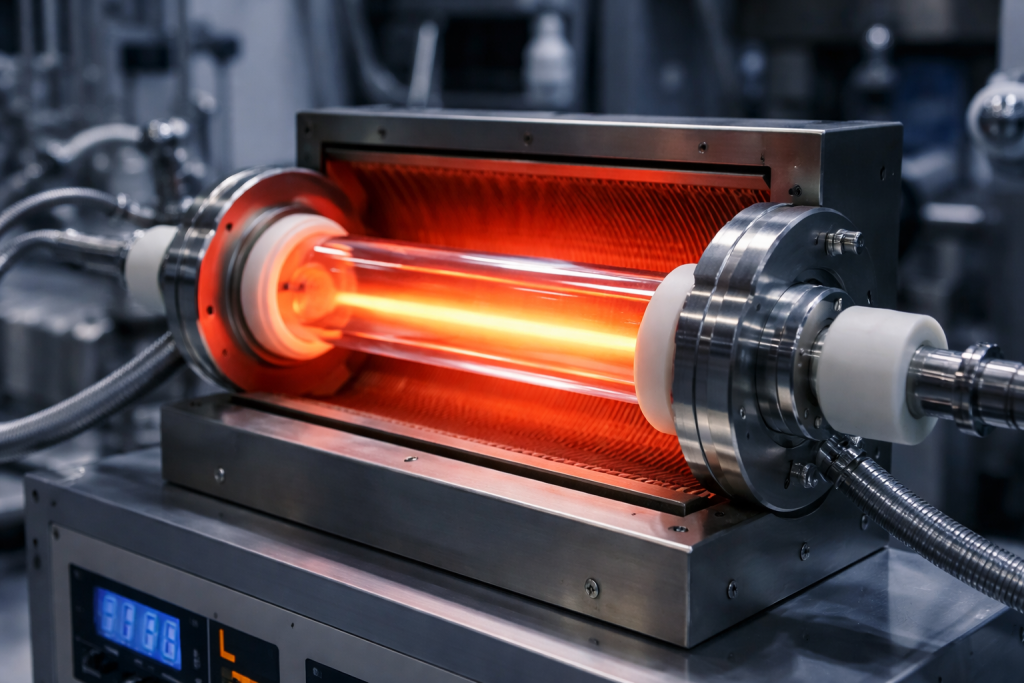
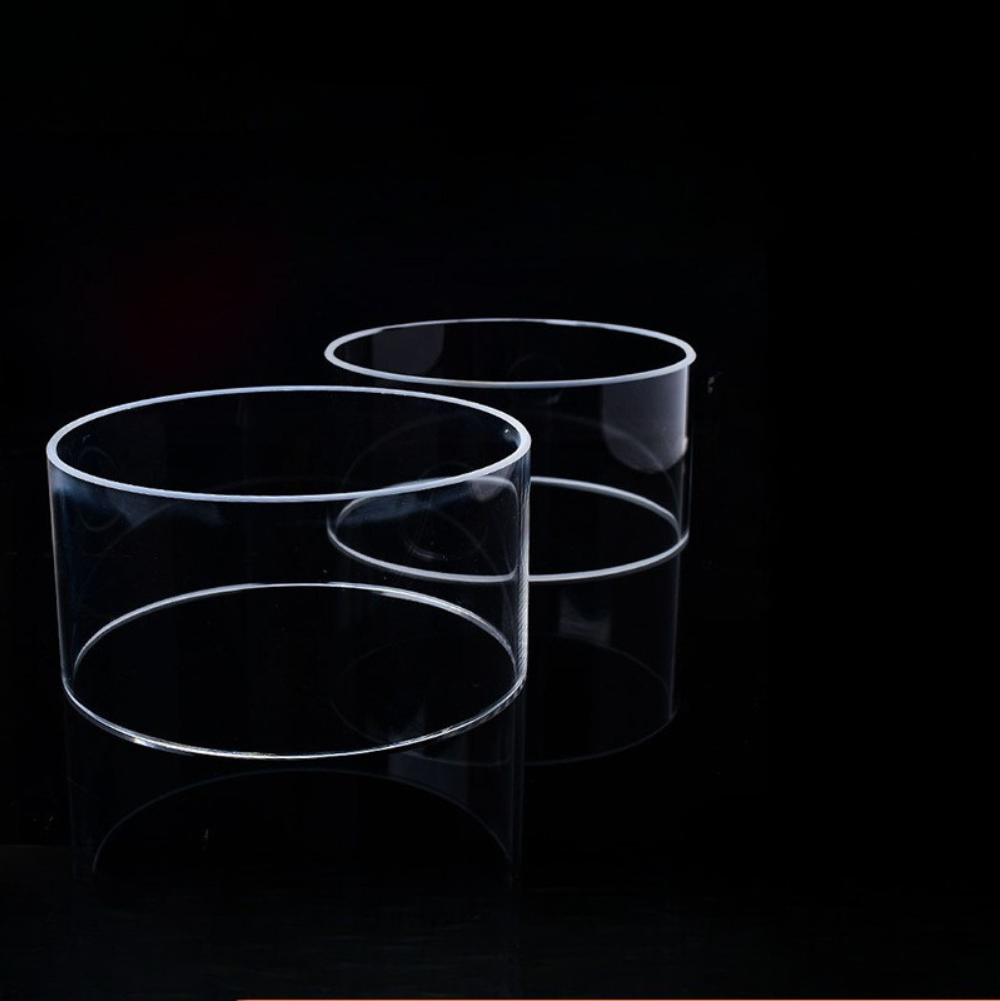
Large diameter quartz tubes, fabricated from high-purity silicon dioxide (SiO₂), are critical components in high-temperature, chemically aggressive, and optically demanding environments. This article provides a scientific overview of their material properties, structural advantages, manufacturing considerations, and application scenarios. Emphasis is placed on thermal stability, chemical inertness, optical transmission, and scalability challenges associated with large-diameter fabrication.
1. Johdanto
Quartz, in its fused (amorphous) form, is a non-crystalline material derived from silica. Unlike conventional glass, fused quartz exhibits exceptional thermal resistance, low thermal expansion, and high chemical stability. These properties become increasingly valuable when scaled into large diameter quartz tubes, which are widely used in semiconductor processing, laboratory systems, and high-temperature industrial equipment.
The transition from small-diameter to large-diameter quartz tubes introduces additional engineering challenges, including uniformity control, stress distribution, and defect minimization. Therefore, understanding both material science and manufacturing processes is essential.
2. Material Composition and Structure
Fused quartz is composed of nearly pure SiO₂, typically exceeding 99.99% purity in high-end applications. Its amorphous structure distinguishes it from crystalline silica:
- No grain boundaries → reduced defect propagation
- Isotropic properties → uniform thermal and optical behavior
- Low impurity content → minimal contamination risk
This structure directly contributes to its stability in extreme environments.
3. Thermal Properties and Stability
3.1 High Temperature Resistance
Quartz exhibits a softening point around 1730°C, enabling:
- Long-term operation at ~1100°C
- Short-term exposure up to ~1450°C
3.2 Low Thermal Expansion
The coefficient of thermal expansion (CTE) of quartz is approximately:
- ~5.5 × 10⁻⁷ /°C
This is significantly lower than most metals and ceramics, resulting in:
- Excellent thermal shock resistance
- Reduced risk of cracking during rapid heating/cooling
3.3 Thermal Shock Behavior
Due to its low CTE and high thermal conductivity (relative to glass), quartz can withstand rapid temperature gradients, making it suitable for furnace tubes and thermal processing systems.
4. Chemical Stability and Corrosion Resistance
Quartz is chemically inert in most environments:
- Resistant to strong acids (e.g., HCl, HNO₃, H₂SO₄)
- Does not react with water or most solvents
- Exception: reacts with hydrofluoric acid (HF)
Comparatively:
- ~30× more acid-resistant than typical ceramics
- ~150× more resistant than stainless steel in acidic environments
This makes large diameter quartz tubes ideal for:
- Chemical reactors
- Corrosive gas handling
- Analytical systems
5. Optical Properties
Quartz is widely recognized for its excellent optical transmission:
- Visible light transmittance: >93%
- UV transmittance: >80% (depending on OH content)
- Broad spectral range: UV → IR
Low hydroxyl (OH) content quartz is particularly important for:
- UV applications
- High-temperature optical systems
- Semiconductor photoprocessing
6. Manufacturing Challenges of Large Diameter Quartz Tubes
Scaling quartz tubes to large diameters introduces several technical challenges:
6.1 Uniform Heating and Forming
Quartz must be processed at extremely high temperatures. Achieving uniform viscosity across large diameters is difficult and requires:
- Precision-controlled furnaces
- Rotational forming techniques
6.2 Stress Control
Residual stress can lead to:
- Cracking
- Optical distortion
- Reduced mechanical strength
Annealing processes are critical to relieve internal stress.
6.3 Dimensional Accuracy
Maintaining:
- Wall thickness uniformity
- Roundness
- Surface smoothness
is significantly more complex at larger scales.
7. Tyypilliset sovellukset
7.1 Semiconductor and Electronics
- Diffusion furnace tubes
- Wafer processing chambers
- High-purity gas environments
7.2 Laboratory and Scientific Research
- Reaction vessels
- High-temperature experiment tubes
- UV/optical systems
7.3 Industrial Equipment
- Heating elements protection tubes
- Chemical processing pipelines
- Thermal insulation systems
7.4 Medical and Analytical Systems
- Sterilization equipment
- Diagnostic instruments
- Optical sensing components
8. Advantages of Large Diameter Quartz Tubes
- Exceptional thermal stability
- Erinomainen kemiallinen kestävyys
- Korkea optinen läpinäkyvyys
- Ultra-high purity
- Long service life in harsh environments
9. Limitations and Considerations
Despite its advantages, quartz also has limitations:
- Brittleness → requires careful handling
- Sensitivity to HF acid
- Higher cost compared to standard glass
- Manufacturing complexity increases with diameter
Proper design and application matching are essential to maximize performance.
10. Conclusion
Large diameter quartz tubes represent a critical class of advanced materials bridging material science and industrial engineering. Their unique combination of thermal, chemical, and optical properties makes them indispensable in high-end applications ranging from semiconductor manufacturing to scientific research.
As processing technologies continue to improve, the scalability and performance consistency of large diameter quartz tubes are expected to advance further, supporting the growing demand for high-purity and high-performance materials in modern industries.